
DVD-quality lessons (including tabs/sheet music) available for immediate viewing on any device.
Take your playing to the next level with the help of a local or online banjo teacher.
Weekly newsletter includes free lessons, favorite member content, banjo news and more.
Premier Sponsors





|
Please note this is an archived topic, so it is locked and unable to be replied to. You may, however, start a new topic and refer to this topic with a link: http://www.banjohangout.org/archive/270824/2
Page: 1 2
Polle Flaunoe - Posted - 09/26/2013: 09:00:39
Paul,
As you can tell from my reply to Carl´s posting - you´ll have to do your homework and not always take something coming from others (except from me -LOL!) for granted - so many mistakes have been done in the past - now is the time to clear up these.
Regarding features, details, pics, stamps, confirmed shipping/first sales dates etc. etc. - as many times mentioned I do keep an extended database (far far too large to be published) - all of this stuff is recorded/contained in this extended DB.
An additional advice - do never "interpret" my infos/statements yourself - in case of any doubt - do ask for my opinion and/or especially my exact knowledge.

Polle
Edited by - Polle Flaunoe on 09/26/2013 09:08:22
pgroff - Posted - 09/26/2013: 09:33:47
Hi Polle,
I recognize the many limitations of the data available. I anticipated that you would try to continue to argue your claim (which I called hypothesis A) by questioning the individual data that seemed, to Carl, to contradict it.
It would not surprise me if we can show that your claim is true, and as you (and I) mentioned, there are ways to approach that question by re-examining the data and the assumptions (such as perfect chronological order for the serial numbers in sequence). Of course, it would be important to do that in a way that is very "intellectually honest" rather than *merely* challenging the inconvenient data points. :-)
As I mentioned before, due to many sources of error an overall statistical correlation is probably the most we can hope for in answering these questions.
Again, it seems to me that very little progress with any of these questions is possible unless those describing the banjos find terms that work better, and use them more consistently to describe exactly what features are present on each banjo.
Again, I commend you all for the great progress made so far.
Best regards,
Paul Groff
Polle Flaunoe - Posted - 09/26/2013: 09:52:18
quote:
Originally posted by pgroff
Again, it seems to me that very little progress with any of these questions is possible unless those describing the banjos find terms that work better, and use them more consistently to describe exactly what features are present on each banjo.
Paul,
Just ask the guys in question to consult me at first hand. I´ll tell them how to do!
Regarding "we can show" - feel free doing so - but in fact you don´t need doing it - over here in DK everything is based on trust - that´s one of the reasons, why we Danes year after year are appointed the most happy/content population on this globe.
Don´t mind the Smiley - I´m in fact very serious regarding this
Polle
PS!
Only problem is - it seems, that many of your co-citiziens are very reluctant accepting aliens telling them about their domestic products!
Edited by - Polle Flaunoe on 09/26/2013 10:07:52
esmic - Posted - 09/26/2013: 11:43:24
Here's another thought regarding the FF stamp's demise, which seems to have coincided with the emergence of the Blue Ribbon, c. 1921:
Bacon's Blue Ribbon was designed for cutting power, so it could hold its own in the emerging dance bands of the day. It succeeded admirably.
Bacon must have known his old Professional line was no longer the loudest gun in his musical arsenal. When new "The Bacon" dowel stamps were designed around this time, the FF (Double Forte) may have been dropped from the Professional's dowel as it was no longer relevant, and might otherwise conflict with the promotion for the Blue Ribbon.
If this was the reason, one would expect to see no FF stamp on subsequent Professionals, regardless of tone ring type. If I read correctly, Polle's data seems to bear this out.
pgroff - Posted - 09/26/2013: 12:45:30
Hi esmic,
Very interesting and convincing point!
And to all,
OK, it seems that it may not be desirable to use the term "FF ring" for the wide, donut shaped Bacon ring of the early Bacon IR banjos. This had been a thought in the back of my mind as a possible step toward improving the tone ring nomenclature. But, aside from the fact that these wider rings themselves vary, if the correlation between FF stamp and that kind of tone ring is not very strong, such a designation could be confusing.
I still hold that the current terms, "Bacon ring," and "dish," are even more confusing!
What terms would you suggest to describe and identify the range of non-Silver Bell rings? (BTW, three of these types are visible in the photo below). Was the "wide donut Bacon ring" used *only* in (some of) the internal-resonator Bacon banjos? The narrower ring that was originally in my Professional - 3 is identical to the ring that is in my Peerless. Is this identical to the ring used in some of the Bacon Specials?
PG
Edited by - pgroff on 09/26/2013 12:46:29
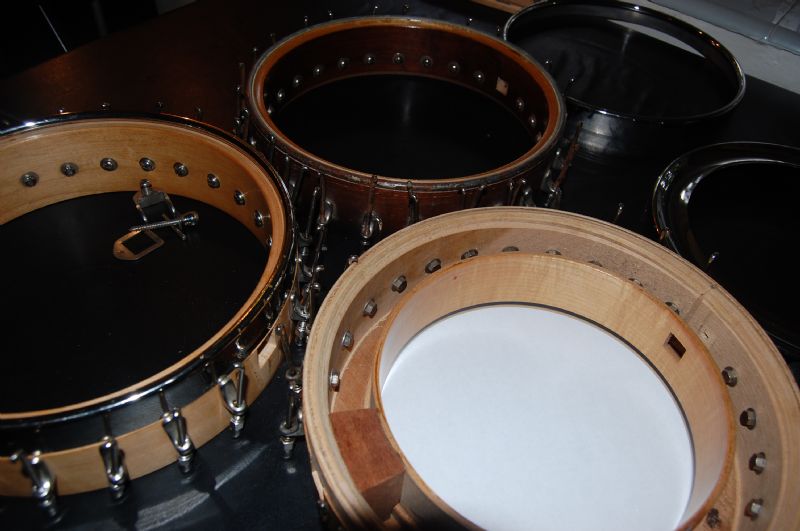 1920s non-Silverbell Bacon rims |
Polle Flaunoe - Posted - 09/27/2013: 01:28:32
Paul,
The narrow ring keeps many "names" - from half-spun pot and rod to spun-over-rod-and-skirt ring to half-spun tone ring to Little Wonder style tone ring etc.
And yes - it´s the same as found on the second version of the B&D SPECIAL model.
Polle
BrittDLD1 - Posted - 09/28/2013: 19:19:28
[NOTE: This reply started, back on 9/23/13. It's now several days late. (And many dollars short...) This posting does NOT directly address any of the recent postings after 9/24/13... And I apologize to anyone who directed a question to me -- for NOT answering -- during the last few days. I've spent MANY hours cross-checking information with my period catalogs, and my own notes -- trying to ensure my "statements of fact" were reasonably true, and based on period information. And... that my personal observations, opinions, theories, and suppositions, have some level of legitimate logic behind them. (Your mileage may vary...) I'll also apologize, for NOT answering any follow-up questions immediately. I've put-off a lot of other tasks -- and I need to get back to them. Thanks, EJB]
[Part 1]:
Bacon Enthusiasts...
I really shouldn't spend the time, right now, to dive into the whole "FF" mess. And "Esmic" --Shawn McSweeney -- has already given a proper 'short' version of the answer about the use of "FF"...
But... Here is my own short opinion on the use of "FF":
The use of the term "FF" -- to describe ANY-and-ALL Bacon banjos having the UNIQUE (patented) 'donut-shaped' resonator -- is based on more than 100 years of common practice. The term is derived from Bacon's continuous use of the FF-diamond stamp, on the majority of Bacon "Professional" model banjos produced from about 1906 to 1917(?).
Following are a few more pages of long-winded, detailed observations... (So either sign-off, now... or take your No-Doz!) I'll probably have to split this response into multiple parts -- so the BHO website doesn't choke on one long post...
o Bacon's specific terms for the "Professional" banjo's technical features:
Fred Bacon invented the unique 'donut-shaped' resonator -- which WE now often refer to, as an "internal resonator". But in his patent description (Filed: 8/22/1905 -- Granted: 6/19/1906) there is absolutely NO mention of an "internal resonator". Fred calls it an "annular chamber", "sound-chamber", or "sounding-chamber".
And, for what WE typically call a "tonering" (or "tone ring") -- Fred used "metallic ring", "metallic band", or "metallic flange". Fred typically used "metallic flange" to refer specifically to the interior dished/angled 'tongue' of the tonering. (And there is very little doubt that his design was influenced --to some degree-- by Dobson's "Silver Bell" tonering of 1876.)
o The original Bacon "Professional" banjos -- Vega-made c1905-1910 --
. . . Shown in Bacon's c1906 Hartford, CT catalog (red reprint): #1, #2, #2-Spl, #3 (=SpGC)
In his c1906 catalog, Fred again refers to what WE now call an "internal resonator" -- as an "annular chamber". And... for what WE call a "tonering" -- Fred changed his terminology slightly, to a "metal flange top".
And, again... the term "FF" is NOT even mentioned, in the 1906 catalog.
Even though the earliest use of the FF-diamond stamp, that I'VE seen (and specifically documented, on my ancient handwritten 3x5 cards) is SN-138 -- Vega-made, c1906-07. I have also specifically noted one other FF-diamond stamp in my 3x5 cards: SN- 510 -- also Vega-made, c1909-10?
I usually DIDN'T even bother to note the FF-diamond stamp on my cards -- because MOST of the Bacon "Professionals" made from 1906 to 1915, had it. It was a TYPICAL feature of the Bacon "Professional" of that period. It would have been much easier to simply note the banjos that DIDN'T have the It is possible that both of the terms -- "FF" and "internal resonator" -- might have been used in some of Bacon's pre-1910 magazine ads... But I don't have time to go through the ad copies I have, to verify that. "FF" probably WAS used. But Fred was quite consistent in ONLY using the terms: "annular chamber", "sound chamber", and "sounding-chamber" -- to describe his patented resonated-rim design. (I doubt that Fred ever used the term "internal resonator" in ANY of his promotional material.) It's MY theory that "internal resonator" is actually a much later term -- which started being used AFTER large resonators became popular, during the mid-1920s. During that later period, the term "internal resonator" would have described the DIFFERENCE between the "Professional" banjo's unusual "sounding-chamber" -- which was INTERNAL to the diameter of the rim; and the then-typical, large-diameter resonator -- which was EXTERNAL to the diameter of the rim. CONTEST: I'll send a quarter (25 cents) to the first person who can tell me what the EARLIEST promotional/ advertising 'terminology' was -- for the B&D Silver Bell's "resonator". There were 2 slightly different variants -- either will win. (And, NO... it was NOT called a "resonator" at that time.) Best-- Ed Britt -- ©2013 Go to Part 2:
BrittDLD1 - Posted - 09/28/2013: 19:21:52
[Part 2]:
o The "Professional" banjos made c1912-17(?)
. . . Models shown in the c1913 Forest Dale, VT catalog: #1, #2, Spl, GC, SpGC, Banjeaurine, B-Mando, B-Mandola
Again, "internal resonator" is NOT mentioned. Fred used his patent terminology, and refers to the "IR" as the "sounding chamber"
And again, the term "FF" is NEVER mentioned in the catalog! But I have documented several uses of the FF-diamond stamp, on Forest Dale banjos, in my old 3x5 cards.
I have the corpse of a low-end (No. 1?) F.D. "Professional", with NO serial number. But it has "THE BACON PROFESSIONAL" box stamp, and the FF-diamond stamp, on the dowel -- as well as the ivoroid name plate, with "THE BACON MFG. CO." "FOREST DALE,VT." screened onto it. It has a mahogany neck, stained dark red. The Vega-esque #2 peghead has a single star between the upper pegs. The heel has a rounded dyed heelcap, like some of the "Farland" banjos. The dyed fingerboard (27" scale), has fancy abalone inlay, with white binding.
The 11" rim has a band of diamond marquetry around the lower edge (most of it missing). Most of the resonator back (with 20 "S" holes) has completely delaminated -- and only about 75% of the inner-most lamination remains, to hold the outer-rim and inner-rim together.
The inward-protruding tongue of the "metal flange top" (spun tonering) is 1-inch wide, and is 'dished' (curved, not flat). The inward deflection of the tonering's 'dished' inner lip is .350-inch below the top-surface of the ring's outer perimeter (the rounded bearing surface for the head). The rim is a nominal 1/2-inch thick (with some delaminations, and gaps). So... the inner-edge of the tonering, extends beyond the inner-wall of the rim -- by a nominal 1/2-inch. (I believe that 'overhang' is WIDER than the overhang of the tonerings used on the 1920s Bacon "Orchestra" banjos.) There is NOT a rod-hoop between the rim and the tonering.
The banjo's overall style suggests a serial number in the late-2xxx range. (Note: The front-and-rear 'cuts' of the "Professional No.1" from the 1906 Bacon catalog -- were REUSED for the description of the "No.1" in the 1912 Forest Dale catalog. So it can't be identified, for certain, as a "No.1" -- but it probably is a No. 1.)
The higher-model F.D. banjos were made by one (or more) of the better NYC makers. (Lange is usually assumed... But they could have been made by a few other firms.)
Some of the lower models were made and/or finished by Fred's workers, at his small Forest Dale shop. Probably from semi-completed parts, made by other large makers. (The low-end F.D. banjos were called "axe-handle banjos" by Fred's student, Cliff Spaulding. To paraphrase Cliff: Because they felt like they were made by men more likely to have had experience making axe-handles, than banjo necks...)
There is a large gap between the end of the Forest Dale serial numbers, and the start of the New London/Groton serials. I have NOT seen a 'teens Bacon banjo with a serial number in the 3xxx or 4xxx range.
ONE possibility (not confirmed) is that Fred reserved a range of serial numbers (100, 500, or 1000?) -- for each CONTRACT-MAKER of banjos, that he worked with. (That's MY bet...)
ANOTHER possibility (not confirmed) is that Fred reserved a range of 1000 serial numbers --for each production YEAR. (Doesn't add-up right...)
A THIRD possibilty (not confirmed) is that WWI intervened -- and Fred could NOT get enough metal parts to make banjos, during 1917 and '18,
Bacon apparently NEVER reached a production level of MORE than 1000 banjos per year, until the Groton factory was up and running, in the early-'20s. And then (if Polle is correct) Bacon could have hit 5000 banjos per year, during the company's production high-point, in the mid-to-late-'20s.
(To add to the confusion... post-WWII Gretsch-made Bacons have serial numbers that can numerically 'mimic' Vega, Forest Dale, and Groton serial numbers. The ONLY "Bacon" banjos I've seen, with 3xxx or 4xxx serials, have been postwar Gretsch-made models. Stylistically, it's usually easy to tell that they were NOT made before WWII.)
Best-- Ed Britt -- ©2013
Go to Part 3:
BrittDLD1 - Posted - 09/28/2013: 19:24:03
[Part 3]:
o The "Professional" banjos made c1920-1926(?)
. . . Models Shown in the "1921" New London/Groton catalog (Prepared Fall 1920) -- #2, #2-Spl, GC, SpGC DLX, GC-Tenor, SpGC-Tenor ----- [NOTE: Old "cuts" from the 1912 Forest Dale catalog, were used to show rear views of the NEW upper models -- which probably weren't ready in time to take photos.]
. . . Models shown in the "1922" Groton catalog (Prepared Fall 1921) -- #2, #3-Tenor, SpGC, SpGC-Tenor.
. . . [NOTE: The "1923" catalog was NEVER produced. The "1924" catalog started-out as the "1923" catalog. But due to the development of the NEW line of "B&D" banjos -- the catalog wasn't wasn't available until August-1923, and was called the "1923-24 Catalog" in some ads.]
. . . Models shown in the "1924" Groton catalog (Prepared Fall 1922 - Spring 1923) -- #3-Tenor ONLY.
. . . Models shown in the "1925" Groton catalog (Prepared Fall 1924) -- #3-Tenor ONLY ----- [NOTE: NO "Professional" banjos were shown in ANY Bacon catalogs, or price lists, AFTER 1925.]
The serial numbers for the 'new generation' of 1920s New London/Groton-made banjos -- with "Bacon" inlaid into the peghead -- start at approximately #5000.
Fred Bacon had an office/studio/assembly-area in New London, CT as early as 1915. (He had a similar set-up in Hartford, during the 'oughts.) In late-1920, Fred came out with his NEW line of "Professional" banjos. Taking a cue from Gibson... the most notable detail was the use of the name "Bacon", inlaid into the pegheads, in pearl. And the back of the NEW "annular sounding chamber" had only TWO f-holes. (Perhaps the use of only 2 f-holes was intended to 'visually' represent the "FF" designation. Because... starting with the 1920s models, the FF-diamond stamp did NOT seem to be used again.)
NOTE: There were a few "Professional" banjos from this period made with 4 or more f-holes. They were probably 'experiments', or customer requests, and are VERY rare.
The use of holly, fancy pearl and abalone inlay, a narrow pointed heelcap with rounded-edges, a recessed-border around the heel-carving, and a celluloid nameplate on some of the early dowels -- suggest that Lange (or one of the other major NYC makers) was involved in the intial design and production of the NEW generation of 1920s Bacon banjos, during 1920 and 1921.
Fred also created his NEW line of OPENBACK "ORCHESTRA" banjos, in 1920 -- and 'introduced' them at the Guild Show, in early 1921. The new Bacon "Orchestra" models were simply openback versions of the new "Professional" models. The banjos were identical in all respects, across the two model ranges -- except the "Professional" models had the "annular sound chamber".
The typical PRODUCTION Bacon "Orchestra" banjos also had tonerings with a NARROW 'flange' extending towards the center of the rim. (Been a long time since I've had a Bacon "Orchestra" in my hands, and I never thought to measure how far the inner tongue extends toward the center of the rim. Or how far it overhangs the inside wall of the rim...)
NOTE: This new "Orchestra" tonering may be the "narrow" tonering Paul Groff keeps referring to. And the 1922 catalog clearly states: "... bell flange same as used on Professional banjos." The fit of the tonering ("bell flange") to the outside of the rim was basically the SAME for the "Orchestra" models, or the "Professional" models. With the statement above, it's obvious that a "Professional" tonering from 1921-on was interchangeable with an "Orchestra" tonering from 1921-on.
MY assumption is that Bacon started using that same NARROW tonering, on the c1922-25 "Professional" banjos, because they were becoming rapidly 'obsolete', and were being produced in increasingly lower numbers. (While the "Orchestra" models were selling in increasing numbers.) But, once the resonated Bacon Blue Ribbon, Super Blue Ribbon, B&D Super Banjo, and the B&D Silver Bell came out -- even the name "Orchestra" was dropped! The 1923-24 catalog shows the SAME images for the openback "Style C" and "Style B" -- WITHOUT the "Orchestra" name. (And the Style B image has had some details changed, by 'retouching' the photos.)
o The "ORCHESTRA" model EVOLVES into the Bacon "Blue Ribbon" -- while the "Professional" model withers and dies:
During late-1921, and early-1922, some of the earlier-style "Orchestra" models would eventually be modified -- to create the EXPERIMENTAL PROTOTYPES for new "Blue Ribbon" models. The EARLIEST Blue Ribbon prototypes were simply existing "Orchestra" models, refitted with a various prototype versions of the perforated BR tonering (no grommets), and prototype versions of the BR snap-in resonator. They were usually not sold,
but were shown to players and endorsers -- for comments, opinions, and suggestions for improvements.
NOTE: The earliest "experimental" BR I've noted, is #6379 -- which was penciled on the inside of a VERY early solid-turned BR resonator, with WOOD knobs. BUT... The early resonator was attached to #7410 -- a later, Groton-made holly Style A Tenor stamped: "THE BACON ORCHESTRA" "SPECIAL" -- fitted with an early Blue Ribbon tonering, with white grommets outside.
There were also some early "prototypical" PRODUCTION models of the BR, which were modfied by re-cutting a NEW "Orchestra" rim, and adding the perforated BR tonering, and BR snap-in resonator. Then, some of the newly designed BR peghead overlays were added to some "Orchestra" model necks-in-progess. When finished, the dowels were often marked:
"B. -- THE BACON ORCHESTRA -- R."
The "B." and "R." stand for "Blue Ribbon". All of the EARLY "B-Orch-R" necks started out as typical "Orchestra" model necks, before being modified, and they tend to be in the #6xxx serial range. (Earliest "B-Orch-R" I've noted is #6620 -- with a "Bacon" peghead, and fancy Lange-style abalone fingerboard inlay. Although, I think Shawn McSweeney might have found an earlier one...)
The very rare "1921" New London/Groton catalog was prepared in late-1920. (And has NOT been reprinted, to my knowledge.) Typically, Bacon produced the 'prototypes' of their new models in the Fall, had performers try them, made some necessary changes, and THEN began preparing the new catalog illustrations, and text. They'd price the various models, and send out their NEW Price Sheet in September. All of this was aimed at formally "introducing" their NEW models to 'The Banjo World', at the yearly "Guild" convention -- which was usually held the following April or May. (Actual name: The Guild of American Banjoists, Mandolinists, and Guitarists.)
Throughout the 'oughts, 'teens, and early-'20s, the NEW Bacon catalogs were usually printed and delivered to Bacon, several weeks before the yearly Guild show. And that yearly Fall-to-Spring catalog-production scenario seem to have held true, through 1926. (After that, Bacon no longer produced catalogs every year. And only created a new catalog, when major product changes were being introduced.)
But any new magazine advertisements usually needed to be ready a couple months BEFORE the big Guild convention. So they would be seen by players, in the major music magazines, a month-or-so BEFORE Bacon introduced their NEW models, at the Guild show.
Again... there is NO use of the terms "internal resonator" or "FF" in ANY of the (known) 1920s Bacon catalogs.
Best-- Ed Britt -- ©2013
Go to Part 4:
BrittDLD1 - Posted - 09/28/2013: 19:27:03
[Part 4]:
o Using the term "FF" to describe --ALL-- Bacon "Professional" models:
Basically... all this discussion over "FF" vs "internal resonator" is a somewhat academic exercise in semantics, and descriptive terminology. The FF-diamond stamp was added to the Professional model dowelsticks sometime during the first year (1905-06). So, the use of "FF" to describe Bacon's innovative (and at the time, visually unique) banjo, came into 'common' WRITTEN and VERBAL usage over 100 years ago!
The FF-diamond was stamped on MOST of the "Professional" model dowels -- and used continuously for 15-17 years -- until sometime between 1920 -22.
BUT, as great as the "Professional" model was (and still is)... As a viable 'product', it was already on a downward-slope by1921 -- and was basically DEAD by 1925.
With Lange's introduction of the fully-resonated, 19-fret Paramount, in 1921 -- The Tenor Boom was on! ALL of the other major makers were scrambling to bring their NEW 'Jazz' banjos to the marketplace. (But Bacon didn't really catch-up -- with THEIR 19-fret Silver Bell -- until late-1925...)
A few 'floorsweep' Professionals were made (from "old-stock" parts) later-on, into the late-'20s -- and perhaps even a few in the early-'30s.
(But "revivals' of old ideas ALWAYS occur. And reproductions and adaptations of the old Bacon "FF" design have also been made, since the mid-1970s. Most notably, those versions by The Arthur E. Smith Co., and Bart Reiter.)
According to some claims in this BHO discussion, the use of the common term "FF" INSTANTLY became obsolete, when the FF-diamond stamp was no longer used, on the NEW 1920s generation of Bacon Professionals... Even though the banjos themselves were substantially the SAME as the 1906 versions. (Except for some ornamental changes, and some relatively minor modifications to the tonering -- to keep production parts 'standardized'.)
o THE REAL QUESTION is:
WHY would we want to 'define' ALL of the Bacon "Professional" banjos by its final 4-to-6 year period-of-decline, and final death-rattle? Wouldn't it be BETTER to define the Bacon "Professional" banjos by their much-celebrated 'heyday' -- when they were at the TOP of their game, and commonly called "The Bacon FF"?
Yes, the ornament and APPEARANCE details (peghead shape, heel shape, inlay, number and shape of f-holes, etc.) changed on the 1920s models. But the underlying mechanics and construction of the "Professional" models did NOT change, substantively, in the 1920s versions. In overall form and function, it is essentially THE SAME BANJO it always was!
So, there is PLENTY of validity, in CONTINUING to refer to ALL Bacon "Professional" banjos -- from ANY period -- as "FF" models.
––– Because THAT'S what they've BEEN called... For a century! –––
The LACK of the FF-diamond stamp, on the 1920s models has ZERO bearing on the continued use of the term "FF" to describe ALL Bacon "Professional" Banjos. Were there any OTHER popular banjos -- from 1906 to 1925 -- which were ALSO commonly referred to, as an "FF"? (None that I'm aware of.) The Yosco had a similar -- but over-inflated -- form-factor. And it has been called an 'internal resonator" banjo. But I've never heard it referred-to as an "FF".
Saying that the use of a SPUN tonering -- with slightly different secondary dimensions, or features -- should PRECLUDE the 1920s Professionals from being described as an "FF", is also a VERY erroneous assumption.
There were MANY versions of different tonerings used in the "Silver Bells" over 50 years. The standard "Silver Bell No.1" of 1923, and the standard "Silver Bell No.1" of 1930, were VERY different, in MANY substantive ways: the tonering design, the resonator-flange design, the resonator construction, the scale-length, the number of frets, the reinforced neck, etc. BUT... the designation "Silver Bell No.1" REMAINED consistent -- even though the banjos didn't.
[NOTE: The Silver Bells were purposely 'downgraded' during The Depression, to make them more affordable. The Depression model Silver Bells were given multiple feature levels, and price ranges -- which were identified by adding different "variant" names, like: "Sultana Silver Bell No.1", "Serenader Silver Bell" No.1 , "Symphonie Silver Bell No. 1", etc.]
The Bacon "FF" still LIVES! (Or else... it's a zombie! ;-)
Best-- Ed Britt -- ©2013
END.....
BrittDLD1 - Posted - 09/28/2013: 20:05:09
quote:
Originally posted by BrittDLD1
In [Part 3], I wrote:... Throughout the 'oughts, 'teens, and early-'20s, the NEW Bacon catalogs were usually printed and delivered to Bacon, several weeks before the yearly Guild show. And that yearly Fall-to-Spring catalog-production scenario seem to have held true, through 1926. (After that, Bacon no longer produced catalogs every year. And only created a new catalog, when major product changes were being introduced.) ...
To clarify... Bacon did NOT produce YEARLY catalogs during the 'oughts, and the 'teens. The 1906 Hartford catalog, and the c1912 Forest Dale catalog, are the ONLY 2 Bacon catalogs produced during those decades -- that I'm aware of.
Bacon only produced GROTON catalogs, yearly -- from 1921 to 1926.
(Apologies for the mis-statement.)
Best-- Ed Britt -- ©2013
BrittDLD1 - Posted - 09/28/2013: 20:32:32
OOPS! Another glitch... A few times I refer to the Forest Dale catalog as the "1912 catalog". Those are my ancient braincells responding, and delivering some ancient BAD information.
A letter in the back of the catalog, from Burt Clark, is dated Sept 1. 1913. So it's obvious that the Forest Dale catalog was printed AFTER that date -- and should be called the 1913 (or 1914) catalog.
Burt Clark would eventually become a silent partner in The Bacon Banjo Co., Inc.
Best-- Ed Britt
Polle Flaunoe - Posted - 09/29/2013: 04:13:38
Ed,
Regarding this:
"And then (if Polle is correct) Bacon could have hit 5000 banjos per year, during the company's production high-point, in the mid-to-late-'20s."
Wrong conclusion - Bacon´s total production in the second half of the 20s (1925-29) was 13,600 banjos. With an average of appr. 2,700 per year - but in fact starting with "their highest peak ever" of appr. 3,800 in 1925 - dropping almost linearly to appr. 1,900 in 1929. They were never even close to 5,000 banjos per year.
It´s all about math and statistics - based on the inevitable consistency of the Groton SN sequence plus a large number of confirmed shipments and pick-up´s - as contained in my extended (not-so-general) database. If you and others don´t trust my infos, numbers and datings - well, I really don´t care.
The same goes for the use of "FF" - the published general database is mine - only I decide how to describe various models and styles in it. Like it or not - I don´t care. Do however notice my statement in an earlier posting:
"It seems, that most players, collectors, dealers, major music stores, museums etc. worldwide these days are using my general DB for describing and dating Bacon/B&D´s - I take, that this over time will lead to a situation, where FF will no longer be in use."
Regards
Polle
pgroff - Posted - 09/29/2013: 04:48:28
Hi Ed,
Thanks for your very detailed reply.
I think you have done an excellent job of documenting your thought process, and the reason you describe these Bacon banjo models the way you do.
This will be invaluable to researchers in the future who will be using your work for years to come. When I read books and articles that are a century old or more, I often wish I could get such an detailed "back story" from the author.
Your section number 4 deserves an answer. In particular, the question I quote below is really a straw man:
"WHY would we want to 'define' ALL of the Bacon "Professional" banjos by its final 4-to-6 year period-of-decline, and final death-rattle?"
Speaking for myself, I made no such claim. I suggested that future generations of banjo researchers, who continue to document these banjos, may want to document the features actually present in each banjo -- for example, whether an "FF" stamp is present -- and describe the banjos with terms to reflect the presence or absence of particular features.
That process of documenting those features is underway, examples including your index cards, Carl's database and Polle's databases
IMO, the FF stamp on a banjo is a definite, testable piece of information. However, the decision to call all the Bacon internal-resonator banjos "FF" models is a nickname or an insider term. There's nothing wrong with such nicknames, but they can lead to misunderstandings if the name seems to contradict some other piece of information. That latter usage would be like saying "I call all Gibson humbuckers from the 1950s and 1960s 'PAFs.'" I personally think that usage would be confusing since the detail described in the nickname would not be testable in any particular case. Some of those 1950s and 1960s Gibson humbucker pickups are stamped "PAF," some aren't, and that verifiable fact about a particular pickup in hand can be interesting if we want to learn more about different pickups, or to study the other features of a particular example. We have a general term that is fairly clear, "humbucker," to describe all the Gibson humbuckers, so it would be unnecessary as well as confusing to call them all "PAFs" when some are stamped that way, and others are not.
In the same way we have a variety of clear terms including "internal resonator" to describe the way some Bacon banjos are constructed.
But again, this is just my opinion. Your opinion, Ed, and your usage matter much more because you are the custodian of so much important and rare knowledge.
Now we have a statement from you that will help us understand your writings. When you write "Bacon FF model" or "FF Professional," you are referring to any of the Bacon internal-resonator models, no matter how they were catalogued, and no matter what kind of tone ring. You will describe such banjos as "FF models" whether or not they are not stamped that way.
Many thanks for that clarification!
Best regards,
Paul Groff
Hi Polle,
Sorry, cross-posted with you. Clearly, there will be a variety of points of view among those with the deepest knowledge of these banjos.
Again, my plea is for clear communication of our ideas so the evidence for them can be assessed. IMO, a very explict and evidence-based terminology would be helpful for that goal.
Best regards,
PG
Edited by - pgroff on 09/29/2013 05:03:31
Polle Flaunoe - Posted - 09/29/2013: 05:37:57
Paul,
"Now we have a statement from you that will help us understand your writings. When you write "Bacon FF model" or "FF Professional," you are referring to any of the Bacon internal-resonator models, no matter how they were catalogued, and no matter what kind of tone ring. You will describe such banjos as "FF models" whether or not they are not stamped that way."
Or not at all - as lately chosen by me?
I wonder - how about the Grand Concert and Special Grand Concert internal-resonator models? Are they maybe to be called FF´s as well? And maybe even Professional FF´s? They were for the first time described in the 1914 catalog called "THE BACON PROFESSIONAL BANJO" - together with the Special model and some ditto internal-resonator banjeaurine, banjo mandolin and tenor banjo-mandola models.
If so - I´ll have some problems getting the space needed in my DB. F.ex. for banjos to be called BACON PROFESSIONAL FF SPECIAL GRAND CONCERT. Hmmm?
I´ll better stick with my own "callings", I think! They are consistent and of absolutely logical consequence.
Polle
Edited by - Polle Flaunoe on 09/29/2013 05:41:46
pgroff - Posted - 09/29/2013: 05:56:00
Couple of corrections -- it's hard to proofread and edit properly within the time window allowed here on the hangout!
First, my PAF analogy should have referred to the "Patent Applied for" label or sticker rather than a stamp. I was trying to think of a good analogy that might be familiar to banjo guys. In any case, the meaning is: Some Gibson humbuckers are actually labeled "Patent Applied For" and we call those PAFs.
Second, there's an extra word in a later sentence.
Corrections:
quote:
Originally posted by pgroff
IMO, the FF stamp on a banjo is a definite, testable piece of information. However, the decision to call all the Bacon internal-resonator banjos "FF" models is a nickname or an insider term. There's nothing wrong with such nicknames, but they can lead to misunderstandings if the name seems to contradict some other piece of information. That latter usage would be like saying "I call all Gibson humbuckers from the 1950s and 1960s 'PAFs.'" I personally think that usage would be confusing since the detail described in the nickname would not be testable in any particular case. Some of those 1950s and 1960s Gibson humbucker pickups are labeled "PAF," some aren't, and that verifiable fact about a particular pickup in hand can be interesting if we want to learn more about different pickups, or to study the other features of a particular example. We have a general term that is fairly clear, "humbucker," to describe all the Gibson humbuckers, so it would be unnecessary as well as confusing to call them all "PAFs" when some are labeled that way, and others are not.
Edited to add: [In the case of the PAFs, there are other features that are correlated with presence or absence of the label, and I was curious whether the tone ring type in Bacon internal-resonator banjos is correlated (statistically, to some degree of probability) with the FF stamp. This question was actually prompted by my interest in seeing if there might be a better name we could use to describe the so called "Bacon ring."]
In the same way we have a variety of clear terms including "internal resonator" to describe the way some Bacon banjos are constructed.
But again, this is just my opinion. Your opinion, Ed, and your usage matter much more because you are the custodian of so much important and rare knowledge.
Now we have a statement from you that will help us understand your writings. When you write "Bacon FF model" or "FF Professional," you are referring to any of the Bacon internal-resonator models, no matter how they were catalogued, and no matter what kind of tone ring. You will describe such banjos as "FF models" whether or not they are stamped that way.
Many thanks for that clarification!
Best regards,
Paul Groff
Hi Polle,
Sorry, cross-posted with you. Clearly, there will be a variety of points of view among those with the deepest knowledge of these banjos.
Again, my plea is for clear communication of our ideas so the evidence for them can be assessed. IMO, a very explict and evidence-based terminology would be helpful for that goal.
Best regards,
PG
Edited by - pgroff on 09/29/2013 05:57:32
BrittDLD1 - Posted - 09/29/2013: 09:31:10
Paul Groff --
I was just reading one of your posts in the archived topic:
banjohangout.org/archive/121854
Here's a quote, from you -- describing the tonering in your 1920's Professional #3:
_______________________________________________
"... My own 1920s Bacon Professional 3 tenor had a tone ring identical to my 1920s Bacon Peerless though the ring of the Professional was cut differently and accepted a modern Stew-Mac "Bacon ff donut ring" with no modifications of rim or ring. ..."
_______________________________________________
I wish you had mentioned that the tonering in your 1920s Profession #3 was a PEERLESS style, previously -- in either of the 2 current topics on this. It would have made it MUCH easier to give you a DIRECT answer to your statement about the late-Professionals NOT being "FF" banjos.
Originally, I thought you were referring to the narrow-lipped 1920s spun tonering -- used in BOTH the "Professional" and the "Orchestra" model banjos. But, apparently you weren't. So, I'll quote the specific reasons for the Professional tonering change(s), in the 1920s. The most important statements are in the SECOND and LAST paragraphs, below:
[QUOTE]:
"...The FF-diamond was stamped on MOST of the "Professional" model dowels -- and used continuously for 15-17 years -- until sometime between 1920 -22.
BUT, as great as the "Professional" model was (and still is)... As a viable 'product', it was already on a downward-slope by 1921 -- and was basically DEAD by 1925. ..."
. . .
"... The typical PRODUCTION Bacon "Orchestra" banjos also had tonerings with a NARROW 'flange' extending towards the center of the rim. ...
NOTE: This new "Orchestra" tonering may be the "narrow" tonering Paul Groff keeps referring to. And the 1922 catalog clearly states: "... bell flange same as used on Professional banjos." The fit of the tonering ("bell flange") to the outside of the rim was basically the SAME for the "Orchestra" models, or the "Professional" models. With the statement above, it's obvious that a "Professional" tonering from 1921-on was interchangeable with an "Orchestra" tonering from 1921-on.
MY assumption is that Bacon started using that same NARROW tonering, on the c1922-25 "Professional" banjos, because they were becoming rapidly 'obsolete', and were being produced in increasingly lower numbers. (While the "Orchestra" models were selling in increasing numbers.) But, once the resonated Bacon Blue Ribbon, Super Blue Ribbon, B&D Super Banjo, and the B&D Silver Bell came out -- even the name "Orchestra" was dropped! ... "
[End QUOTE]:
The use of a "PEERLESS style" tonering in your Professional is the result of a few possible situations coming to bear on the "Professional" and "Orchestra" models, during the early-'20s:
1. As I mentioned, the "Professional" was nearing the end of it's 'life'. It was considered somewhat obsolete, at that point, and sales were dropping. PRIMARILY due to the immediate success of Lange's 19-fret, full-resonator Paramount, in 1921. So it was NOT worth 'tooling-up' to produce a NEW spun 'dish' tonering for it.
Fred was already producing the 'simplified' (and therefore 'cost-reduced') tonering for the "Orchestra" models, in 1920. So the decision was apparently to have the "Orchestra" and the "Professional" share the narrow-lipped Orchestra tonering -- reducing cost, inventory, and standardizing the fit to both rims.
2. By late-1921, even the Orchestra model was beginning it's 'transformation' into the more modern Bacon Blue Ribbon. (Probably with David Day providing strategic advice, and technical suggestions -- while remaining in "stealth"-mode.) The early B. -- Orchestra -- R. models had the narrow lip of the Orchestra tonering trimmed back, to the start of the top radius. Leaving only about a .375-inch wide section of the formed head-bearing radius, sitting directly at the top of the angled inner surface. NO rod was used UNDER the tonering.
The combination of the holes around the skirt of the tonering, AND the use of a felt-gasketed snap-in rear resonator, created something similar to what 'audio-engineers' would now call a "ported system". (But, since that was a very new field, back then. And, since neither Bacon or Day had any formal education in that field... Let's just call the BR a "Seat-of-the-pants ported-system".)
[And Polle -- The FF you showed, with the big grommets through the rim... That's a similar idea. Many of the Northeast makers were experimenting with 'ports' of various types. Gretsch produced some banjos with similar large grommets in the rim. The function of the grommets was only to 'dress-up' the drilled hole.]
3. After David Day arrived at Bacon, in Sept 1922, he began working on the Supertone/Super Blue Ribbon -- which, in effect, was the DIRECT predecessor to the B&D Silver Bell. Day also brought HIS extensive knowledge of the more-sophisticated Fairbanks and Vega tonerings.
The SuperBR tonering WAS also used in the early B&D Silver Bells. It was a spun tonering, which was firmly supported on a narrow vertical wooden ring, turned onto the top rim -- and a steel rod-hoop sat on directly on that vertical wooden ring. The radiused perimeter-bead of the spun-metal ring sat directly on the rod-hoop, making hard contact -- and transferred the forces of the head-tension directly to the rim, WITHOUT deforming the spun part.
(Some of the early FF spun tonerings had the skirt deform at the bottom of the rabbetted recess, pop OUT of the recess, and then buckle along the lower edge, when the skirt hit the tops of the bracket shoes. I've seen several early FF's that have had brass-rod hoops placed on the rim, under the tonering, for better support. And in MY opinion, the rod IMPROVED both the volume and tone.)
4. The Bacon "Peerless", first shows up in the "1924" catalog (i.e., 1923-'24). It was probably developed by Day, in 1923 -- as Bacon's version of the Vega "Little Wonder". The idea of rod-hoop, held in place by a spun-metal skirt, goes back to the 'spun-over' rims of the late-1800's. (It's simply the hoop and the top-third of the outer metal cover, of a 'spun-over' rim. Even in the '20s -- it was considered an effective 'public domain' solution, for a low-end banjo.)
So... using that simple-but-effective solution was probably less expensive, and sturdier -- than the original "Professional" or "Orchestra" spun rings.
At #9846 -- your "Professional" #3 WAS made in 1923. And it's VERY probable that using the "Peerless" tonering was part of Day's strategy to modularize the product line, speed production, lower costs, and improve quality. Again, by using 'standardized' parts, across different models, whenever possible. Day was an absolute MASTER at using 'modular' construction -- where the minor modification of standard parts, created multiple variants, at little extra cost.
But, to ME... (As long as it was MADE by some variant of the Bacon Co.)
If it LOOKS like an "FF"...
PLAYS like an "FF"...
and SOUNDS like an "FF"...
. . . it's STILL an "FF"!
(Don't take it personally! ;-)
Best-- Ed Britt
Edited by - BrittDLD1 on 09/29/2013 09:44:13
pgroff - Posted - 09/29/2013: 09:52:43
Hi Ed,
Thanks! I take your latest post as further evidence that the terms used to describe the Bacon non-Silver Bell tone rings are in total disarray -- very confusing to someone who only owns one Bacon banjo and is trying to figure it out (like Richard, above), and also likely to be misapplied (for example in a database listing different types).
I was aware from Carl's database that there were variations in the tone rings used in the Bacon internal-resonator banjos.
I happen to have 1920s open-back 17 fret Bacon Peerless with a ring identical to the ring (I believe original) that I found in my Bacon Professional 3 # 9846, when I acquired it.* The banjo was in almost mint condition with original skin head and no playing wear.
I originally wondered if that Pro 3 had been given a "Peerless" ring.
But later I discovered (and Polle recently confirmed, earlier in this thread) that this same tone ring was used in other Bacon models including some of the Specials. I have seen John Balch post photos of his Special and I think some have written about a Bacon "Special" ring. So I stopped calling that ring a "Peerless" ring and in fact I soon found other examples of 1920s Bacon Professional tenors with that same ring, for example in one sold by Wyatt Fawley and probably in Richard's banjo. I think that ring might be given a name of its own, preferably not based on the "Peerless" or any other specific model of Bacon banjo. Just IMO.
I wish you all the best in your work.
PG
*BTW, I apologize here that in some of my earliest posts I referred to my banjo as a Professional #2. When I bought the banjo on ebay, it was advertised as a "Bacon FF Professional #2 tenor banjo" and it took a while to decode the various issues involved. Since it is stamped "3" but not "FF," I would now call it a "Bacon Professional - 3 tenor banjo" and I understand that you would call it a "Bacon FF Professional - 3 tenor banjo." Great banjo anyway! For anyone interested, as shown in the photos below I have now changed the head to a renaissance (but saved the original), swapped the original tone ring for the modern replica "Bacon [donut] ring," (saving the original), changed the 4 string old Presto tailpiece for a modern Prucha replica (to save the original in case the one I use regularly should break; the Prucha is easily replaceable), and added an armrest. All reversible changes intend to enhance playability and tweak the sound, but preserve the original parts in perfect condition.
PG
Edited by - pgroff on 09/29/2013 10:05:33
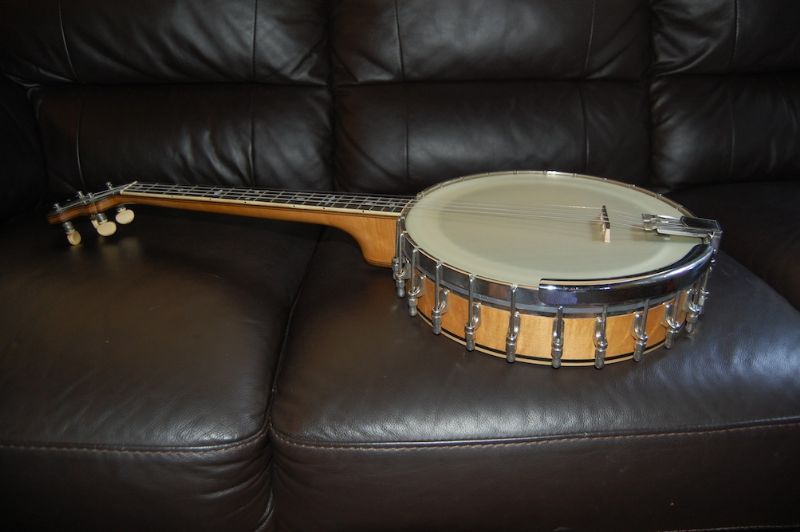 | 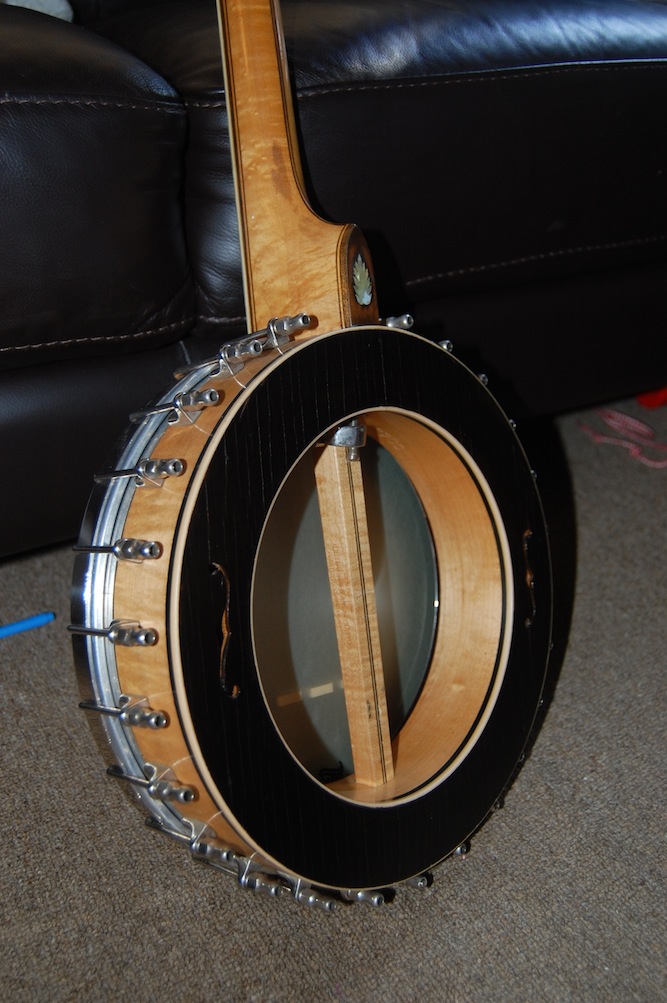 |
Polle Flaunoe - Posted - 09/29/2013: 23:22:04
Ed,
"4. The Bacon "Peerless", first shows up in the "1924" catalog (i.e., 1923-'24). It was probably developed by Day, in 1923 -- as Bacon's version of the Vega "Little Wonder". The idea of rod-hoop, held in place by a spun-metal skirt, goes back to the 'spun-over' rims of the late-1800's. (It's simply the hoop and the top-third of the outer metal cover, of a 'spun-over' rim. Even in the '20s -- it was considered an effective 'public domain' solution, for a low-end banjo.)"
The first Peerless examples were manufactured late summer 1922 - 2-3 months prior to Day´s arrival at Groton. But - as previously concluded - he had secretly worked for/with Bacon long before that. So he´ll very likely have to be credited for this model also.
BTW - I´ve always been puzzled - why did they come up with a model so very much like the existing Style B model - only somewhat simpler and thus cheaper? Plus where does its "strange" name come from?
Polle
Polle Flaunoe - Posted - 09/30/2013: 05:23:04
Ed,
"[NOTE: The Silver Bells were purposely 'downgraded' during The Depression, to make them more affordable. The Depression model Silver Bells were given multiple feature levels, and price ranges -- which were identified by adding different "variant" names, like: "Sultana Silver Bell No.1", "Serenader Silver Bell" No.1 , "Symphonie Silver Bell No. 1", etc.]"
Yet again I´ll have to disagree with you - the depression era SB and other models were not "downgraded" in any way - on the contrary - they were further developed and built in the best possible way - and they had all of the best features and parts - plus most of them did perform in an even better way - compared with the late 20s classic Silver Bells etc..
I take, that also David L. Day in his grave will agree with me regarding this.
Polle
Edited by - Polle Flaunoe on 09/30/2013 05:32:37
BrittDLD1 - Posted - 09/30/2013: 07:46:48
Polle --
As you know... The "1924" catalog (also called the "1923-1924 catalog" in some magazine ads) came out over a year late. And it is completely confusing because of that delay.
In my 4-part post, I wanted to quickly document WHEN the various models of the "Profesional" banjos were FIRST SHOWN in a Bacon CATALOG. So... my statement: "The Bacon "Peerless", first shows up in the "1924" catalog (i.e., 1923-'24)." Is correct.
You should be aware that, with my ancient computers... I can't even access your (very useful) DATABASE anymore. It shows up as a blank screen. (Thanks to the widespread use of constantly-updated "Flash" and "Java", these days...)
So... I used the word "probably" to indicate that I was making an 'educated guess' at WHEN the Peerless MIGHT have been been first-developed.
And I even typed out, "the Fall of 1922" at first. But, I figured Day had more important work to do, in the Fall of 1922, than to create a new low-level banjo. So I changed it to a later date. (But apparently, I guessed wrong...)
"The Musical Trade Review" 9/2/22 -- Announced that on August 30th, David L. Day had been appointed VP and General Manager of Bacon. He had been given a 5 year contract, beginning Sept. 20, 1922. And also noted:
"... but it is understood that Mr. Day will assume management of Bacon affairs as soon as possible after September 1. ..."
Day left Vega, the first week of Sept., 1922. And while he was scheduled to start work at Bacon on Sept. 20, 1922 -- he did show up two days early, on Sept. 18th.
The word "peerless" means: "has no equal".
A "peer" is a person of equal status. And "-less" means: "no" or "without".
(Someone who is shirtless... has no shirt. Someone who is homeless... has no home. Someone who is moneyless... has no money. So, someone who is Peerless... has no equal.)
Will answer your other post, about "downgrading Silver Bells", a bit later today.
Best-- Ed Britt
Edited by - BrittDLD1 on 09/30/2013 07:50:30
BrittDLD1 - Posted - 09/30/2013: 14:01:02
quote:
Originally posted by BrittDLD1 in "PART 4"
[NOTE: The Silver Bells were purposely 'downgraded' during The Depression, to make them more affordable. The Depression model Silver Bells were given multiple feature levels, and price ranges -- which were identified by adding different "variant" names, like: "Sultana Silver Bell No.1", "Serenader Silver Bell" No.1 , "Symphonie Silver Bell No. 1", etc.]
Hi Polle --
That Silver Bell statement was written to be brief and quick. Because I had already taken MANY days to describe -- in great detail -- (probably TOO much detail...) the 'product life' of the Bacon "Professional" banjos.
I was trying to show that near the end of its 'life' the "PROFESSIONAL" model was downgraded, and changed -- because OTHER Bacon models (the Orchestra, and Blue Ribbon) were becoming more popular. BUT... just because some of the "Professional" model's features, specifications, components, and details, had changed -- those changes did NOT mean that the "Professional" was NOT a Bacon "FF" anymore.
I was using the 'product life' of the Silver Bell, as an example, to demonstrate that changing some of a model's features, specifications, components, and details -- DOES NOT necessarily CHANGE its overall 'identity'.
1. The 1923 'standard' Silver Bell No.1 DOES NOT have the ALL of the SAME features, specifications, components, and details as a 1930 'standard' Silver Bell No.1. Many things were changed between 1923 and 1930. But it is STILL called a "SILVER BELL No. 1".
2. Sorry to tell you this... But the mid-1930s "Serenader Silver Bell", and "Medalist Silver Bell" are NOT at the same level as a 1928 'Standard' Silver Bell No. 1". And they WERE developed specifically to make a lower-cost "Silver Bell" available -- for LESS $$ -- during the Depression.
3. Due to my attempt to keep my "downgraded" comment, short and simple... I unfortunately combined a few different 'thoughts' into one short statement:
quote:
Originally posted by BrittDLD1 in "PART 4""...The Depression model Silver Bells were given multiple feature levels, and price ranges -- which were identified by adding different "variant" names, like: "Sultana Silver Bell No.1", "Serenader Silver Bell" No.1 , "Symphonie Silver Bell No. 1", etc. ..."
Let me clarify that statement...
By the mid-1930s, there were (at least) the Silver Bell models named below. EACH of those models had sets of different identifying FEATURES -- which positioned them at DIFFERENT quality levels. And each of those quality levels, required different PRICE levels -- based on the model's production COST.
BUT, instead of confusing the market with a blizzard of different features, quality levels, and prices... Bacon developed a group of "variant names" -- which provided customers with a memorable NAME for each main level of features, quality, and (approximate) price:
$110 -- Medalist Silver Bell -- (No. 1)
$120 -- Serenader Silver Bell -- (No. 1)
$140 -- B&D Silver Bell -- (standard line: No.1 to No. 9 -- $140 - $900)
$150 -- Sultana Silver Bell -- (No.1 to No. 7 -- $150 - $500)
$160 -- Montana Silver Bell -- (No.1 to No. 7 -- $160 - $500)
$160 -- Roy Smeck Stage Model Silver Bell -- (No.1 to No. 4 - $160 - $500)
$200 -- Symphonie Silver Bell -- (No.1 to No. 7 -- $200 - $475)
I'm NOT saying the quality DROPPED during The Depression. I'm saying that David Day purposely ADJUSTED the quality of each "variant" line of Silver Bells -- to have the BEST quality, for the number of dollars spent.
And that's why the "Medalist Silver Bell" (No. 1) was priced at $110 -- and the "Symphonie Silver Bell" No.1 was priced at $200. (At almost TWICE the price... there must have been SOME DIFFERENCE between those models! ;-)
The NEW, cost-reduced, lower-priced, "Medalist" and "Serenader" Silver Bells HELPED sales during The Depression. And so did some of the other new low-end 'economy-models', like the "Seville". (Which was named after Mrs. Day's maiden name: Annie Seville.)
Hope that clarifies what I MEANT to say -- about the Depression Era "entry-level" Silver Bells.
Best-- Ed Britt -- ©2013
PS: Finding David Day's grave has been on my "To Do List" -- for about 20 years, now. The issue of the Melrose, MA newspaper -- with Day's obituary (listing the cemetery) -- is MISSING from the Melrose Library's "Local History" room. (And none of the surrounding town libraries have it, either.)
Edited by - BrittDLD1 on 09/30/2013 14:17:35
Polle Flaunoe - Posted - 10/01/2013: 03:48:36
Ed,
Thanks for the clarification regarding the PEERLESS model - I had somehow guessed in advance, that your wrong dating was a mistake - and the model name isn´t more "odd" than f.ex. "NE PLUS ULTRA" - or than f.ex. Vega´s "LITTLE WONDER" etc. - LOL!
As for the construction of this model - thanks to the infos provided by you and others we know, that its "half-spun pot and rod" "tone ring" was used on other models prior to or at the same time.
We can only guess about a possible influence etc. by Mr. Day.
As for your last posting - I hate disagreeing with you - you´ve performed so many studies in the past and been so generous when spreading the results of these etc. to the banjo community.
So - I´ll for now only add some facts to your various entries above - and let you make some conclusions of your own - based on my documentable infos and your own studies/researches.
1. The 1923 'standard' Silver Bell No.1 DOES NOT have the ALL of the SAME features, specifications, components, and details as a 1930 'standard' Silver Bell No.1. Many things were changed between 1923 and 1930. But it is STILL called a "SILVER BELL No. 1".
YES - but it was called so by Bacon - opposite the FF designation.
2. Sorry to tell you this... But the mid-1930s "Serenader Silver Bell", and "Medalist Silver Bell" are NOT at the same level as a 1928 'Standard' Silver Bell No. 1". And they WERE developed specifically to make a lower-cost "Silver Bell" available -- for LESS $$ -- during the Depression.
The SERENADER SILVER BELL was for the first time manufactured in June 1928 - prior to the Depression Era. It has ALL usual SB features, parts and constructions of that time - except for the use of American Walnut (?) and a volute instead of a peghead backstrapping. Was Walnut at that time cheaper than f.ex Rock Maple - and was the volute construction maybe cheaper than the backstrapping construction - if so, this could be the reason for the slightly lower sales price. By comparison with other SB models it doesn´t seem, that the use of engraved/painted Pyralin was cheaper than the use of MOP inlays.
The MEDALIST SILVER BELL - manufactured early 1932 - early 1936 - seems to be an exact copy of the SERENADER - except for the model name and the somewhat lower price as mentioned by you. Was it a special exhibition version or was it maybe - as indicated by you - a commercial "trick" in order introducing a somewhat cheaper SB model at the market during the Depression Era? Mind you - a model exactly the same as the somewhat more costly SERENADER SB.
3. Due to my attempt to keep my "downgraded" comment, short and simple... I unfortunately combined a few different 'thoughts' into one short statement:
The Depression model Silver Bells were given multiple feature levels, and price ranges -- which were identified by adding different "variant" names, like: "Sultana Silver Bell No.1", "Serenader Silver Bell" No.1 , "Symphonie Silver Bell No. 1", etc. ..
Let me clarify that statement...
By the mid-1930s, there were (at least) the Silver Bell models named below. EACH of those models had sets of different identifying FEATURES -- which positioned them at DIFFERENT quality levels. And each of those quality levels, required different PRICE levels -- based on the model's production COST.
BUT, instead of confusing the market with a blizzard of different features, quality levels, and prices... Bacon developed a group of "variant names" -- which provided customers with a memorable NAME for each main level of features, quality, and (approximate) price:
Regarding the SERENADER SILVER BELL and the MEDALIST SILVER BELL models - do read above.
Regarding the models SULTANA SILVER BELL (manufactured ab April 1929) and SYMPHONIE SILVER BELL (manufactured ab August 1930) - both models were more costly than the classic SB model. BTW - both models got almost identical engraved/painted Pyralin coverings and XL resonators - only the SYMPHONIE got the new archtop tone ring - was this the reason for this model being even more costly than the SULTANA model?
Hmmm?
Kind regards
Polle
MikeHashem - Posted - 10/01/2013: 08:52:29
Gentlemen; I have read the following pages and thank you for all the knowledge that has been put into print. I never realized that so much could be said about one subject. ----- As some of you may know I have the original corporate stamp from the Bacon Banjo Co. Dated 1921. When Mr. Day came to the company. Did the corporation change, to the B&D Co. ,and would the corporate stamp change also? Mike Hashem PS If any of you Bacon collectors would like a copy of the stamp on your letter head or card, I would be happy to provide one for a stamped envelope. Just send me a PM for address. PPS If it isn,t gold , engraved and ebony, you have never heard a real Bacon. LOL MH
BrittDLD1 - Posted - 10/01/2013: 12:28:15
Hi Mike --
I've met you at a couple of the Lowell banjo contests -- and also at the FIGA meetings in Nashua ('mid-80s), and Providence (2005).
If that stamp is dated "1921" -- it's from the 1921 incorporation of The Bacon Banjo Company, Incorporated. The one in Groton. (And the only BANJO company Fred ever incorporated, to my knowledge.)
There NEVER was a "B&D Company"-- or a "Bacon & Day Company".
After late-1922, "B&D" was simply the BRANDNAME of the LINE of instruments designed by Fred Bacon and David L. Day.
Originally, the instruments that continued to bear the "Bacon" name, had been designed by Fred Bacon.
But, later-on (especially after 1932, when Fred retired) the "Bacon" brand was also used for some of the low-end models.
The Bacon Banjo Company, Inc. went bankrupt, in 1939. In 1940, The Fred Gretsch Co. bought all of the rights to the Bacon Co's trademarks, patents, copyrights, existing inventory, remnants, etc. And Gretsch used the "Bacon" trademark on some of their banjos, in the 1960s. (I belive the "Bacon" name was sold, to another guitar company, in the last few years...)
Is that stamp, the same one -- with the broken seal -- that Senerchia had, about 8-10 years ago?
When the Corporation was "dissolved", after bankruptcy -- the "Corporate Seal" was supposedly broken. (I have some photos of that broken metal seal, on one of my old hard drives -- which I can't access at the moment, unfortunately.)
Best-- Ed Britt
Edited by - BrittDLD1 on 10/01/2013 12:32:27
MikeHashem - Posted - 10/01/2013: 13:32:27
Thanks for the reply.--- Yes it is the same stamp, but repaired. Only the lead part of the seal was broken . I sent it to a small shop in NY and they did the repair. If I remember right , the seal 35 years ago was not broken as I had a stamping of it .Mike Hashem
BrittDLD1 - Posted - 10/01/2013: 15:34:46
Hi Mike --
That's a VERY nice historical artifact for a banjo player to own!
I believe that Day's Secretary, Mildred W. Lucy, was probably the "keeper" of that stamp. She was also the "Assistant Treasurer and Secretary" of the Corporation, at the time of it's dissolution. And also a "Director and Statutory Trustee" of the Corporation.
She was there, when Day walked in the door, in 1922. And signed-off (along with David Day) on the Warranty Deed, for the sale of the Groton property, in 1943.
I believe she lived across the river, in Waterford, CT. (On the far side of New London.)
Best-- Ed Britt
Edited by - BrittDLD1 on 10/01/2013 15:45:43
Polle Flaunoe - Posted - 10/02/2013: 01:21:51
Mike,
"PPS If it isn,t gold , engraved and ebony, you have never heard a real Bacon. LOL"
I do absolutely agree - I can´t do without mine. I can do without the gold and the engraving - but this does automatically come along with the to me essential ebony. Only this gives me the fantastic boost in the low mid and bass range, on which my classic jazz tenor playing style is depending.
Polle
Polle Flaunoe - Posted - 10/04/2013: 03:55:06
Ed,
In case, that you haven´t seen this chart of mine before - showing the appr. Groton production 1920-39:

And a chart for the serial numbers during these years:

Based on my extended database - and its many confirmed shipments/pick-up´s/provenances etc.
Surprised?
Polle
Edited by - Polle Flaunoe on 10/04/2013 04:02:24
BrittDLD1 - Posted - 10/04/2013: 11:49:13
Hi Polle --
THANKS very much for posting the new versions of your charts.
I have the Serial Number chart, from back in 2006 -- and see has changed a bit, since then. I never saw the Annual Production chart. Very useful!
I had estimated the banjos-per-year, during the late-'30s, at below 500-a-year. And perhaps as low as about 300-250-a-year. Your Production chart seems to suggest about the same output.
Good work. Greatly appreciated!
Best -- Ed Britt
Edited by - BrittDLD1 on 10/04/2013 11:53:01
Polle Flaunoe - Posted - 10/04/2013: 15:46:21
Ed,
A lot has happened since 2006 - the number of entries has more than doubled - and especially the number of confirmed dates has increased very much. BTW - 5 of these come from people living in or close to Groton - the banjos do belong to relatives to the original owners, who personally picked their banjos up at the factory. And the relatives have kept all infos about the provenances.
Many provenances tell how a banjo was picked up at a local train station - obviously not a local post office - ordered from the factory and shipped directly to the customer. It seems, that relatively few cities had dealerships. Opposite f.ex. Vega´s. Also - many banjos have the purchase date and other infos written inside the resonator.
I have over the years performed minor adjustments of my databases and charts on the run - as more and more confirmed dates did pop up. I´ll continue doing so. However for the time being I estimate, that my manufacturing dates for the 1923-31 and the 1937-38 periods have an accuracy of +/- 1 month - for the 1920-22 and 1932-36 periods the accuracy is somewhat lower - due to fewer dating reports etc..
The drop in annual production rates from 1925 to 1929 (depression start) may seem somewhat drastic - however I do personally consider 1925 a decidedly boom - due to the "modern" version of the Silver Bell - it was indeed a hit that year.
Regards
Polle
Page: 1 2
Terms of Use | Privacy Policy | Privacy Consent (EU/GDPR Only)
Copyright 2026 Banjo Hangout. All Rights Reserved.


