
DVD-quality lessons (including tabs/sheet music) available for immediate viewing on any device.
Take your playing to the next level with the help of a local or online banjo teacher.
Weekly newsletter includes free lessons, favorite member content, banjo news and more.
Premier Sponsors





|
Please note this is an archived topic, so it is locked and unable to be replied to. You may, however, start a new topic and refer to this topic with a link: http://www.banjohangout.org/archive/281757
Lyndon Smith - Posted - 03/20/2014: 11:50:15
Anyone ever had a go at making a scalloped fretboard a la Doc's Banjos?
Any ideas how to go about it?
rudy - Posted - 03/20/2014: 12:12:59
Scalloped boards seem a bit silly to me for banjo use.
If you want the same effect without purposefully scalloping your board just use jumbo wire. I'm not a fan, as the low tension of banjo strings make it very easy to pull the notes sharp if you don't use a light touch for producing clean notes. A scalloped board WILL exacerbate that problem.
It's your jo, though.
Lyndon Smith - Posted - 03/20/2014: 12:55:22
Hmmm. The scalloped fretboards are a big part of Doc's Banjos sales pitch and now grace the bulk of his banjos according to his web site. So some people must like them, as they're an expensive optional extra...
I've never seen one in the flesh nor am I likely to over in England but I'd like to hear from someone who has played one
trapdoor2 - Posted - 03/20/2014: 13:49:54
quote:
Originally posted by rudyScalloped boards seem a bit silly to me for banjo use.
If you want the same effect without purposefully scalloping your board just use jumbo wire. I'm not a fan, as the low tension of banjo strings make it very easy to pull the notes sharp if you don't use a light touch for producing clean notes. A scalloped board WILL exacerbate that problem.
It's your jo, though.
If you mean scalloping like a modern electric guitar, yes...some of those are scalloped so deep that you can't touch the board when fretting. Bad for intonation, etc.
However, Doc's Banjos are scalloped correctly and just the opposite, they help control intonation skewed by stretching the string between the frets...the scalloping is just deep enough to get a solid note and not too shallow to induce a buzz. This was the original idea behind the 1890's Hobart Middlebrooke patent and then Fred van Eps later attempt to make it commercially viable. Neither the Middlebrooke nor the Van Eps banjos suffer from intonation issues...they play remarkably smoothly.
My Middlebrooke plays like buttah. Check out Eric Stephanelli's (French banjo luthier) Van Eps recreations...I've heard they're awesome.
banjo bill-e - Posted - 03/20/2014: 14:20:14
I once briefly played a Doc's with scalloped frets and did not notice any intonation problems. I liked the banjo a lot. The fretboard felt very smooth. I've also tried a fretless Doc's at Zepps and liked it very much. Mr. Huff builds cool banjos.
jmoathout - Posted - 03/20/2014: 16:29:25
I own the Doc's (#169) that banjo-bill-e played, and I agree with him and trapdoor2; Doc's scalloped fretboards are scalloped so shallow, it's hard (for me) to go sharp. It's a very comfortable banjo to play, although wider at the nut (1 3/8") than most - and takes some adjustment time. I like Doc's work enough to have had him make a fretless for me.
I haven't seen his scalloped AND radiused fretboards.
Dogfeathers - Posted - 03/23/2014: 14:21:28
About 5-6 years ago I just by chance stopped in a music store that I rarely frequent and there on consignment was a Doc's banjo that had a scalloped fingerboard. I picked u it up to take it for a spin and fell in love right then and there.
I had never played a fretted instrument with a scalloped fingerboard before and it was just wonderful. It was easy on my fingers, easy to "slur" notes and felt like I could play a fretted and fretless banjo all in one instrument. I just loved it right then and there. From then on I kept an eye out for instruments with scalloped fingerboards and have not found many at all and when I did, there seems to be different ways of doing it. More on that below.
Over the last couple years I concluded though that the way Doc did his was the very best of any other methods that I have seen or played...which admittedly are not that many.
But I do recall that Docs method of scalloping was easy to play and very easy on my fingers too, either sliding up or down the neck and allowed to play "bluesy" sounding banjo pretty easily when the mood hit me. I took a picture of the neck profile showing the detail of the "rise and fall" of the profile. It is obviously not just a "gully" carved between the frets, see the picture below.
Go forward a year or two and I decided to have a banjo custom made and in the list of features that I wanted included was a scalloped fingerboard on the first 7 frets (excepting the 5th string). I gave what I thought was clear instructions and also included a picture of the fingerboard profile to the luthier to copy. Several months later when I received the banjo, it all came out great with one exception, and that was the scalloping. Not sure where we missed the mark but what he did was just carve deep gullies between the frets and that did not work at all. The banjo was painful to play and sliding up and down the neck would have soon sliced my fingers to pieces. The luthier apparently did not copy Docs neck profile at all and obviously not had any experience doing this to a fingerboard. I ended up having to send the neck back to him and he reworked the fingerboard and he just put on a "regular" fingerboard with no attempt at scalloping. Obviously this is something that had to be done with a watchful eye and attention to details of what I wanted. I am very happy with the banjo otherwise, but regrettably I still have a itch for a scalloped banjo.
When reviewing luthier's websites with services offered, I rarely find that option offered. Not sure if or how it can be done to an existing neck as it would certainly affect any inlays on the fingerboard so that has to be compensated for or a whole new fingerboard has to be mounted and then inlaid from scratch if that can be done with the curvy profile of the surface that would then exist.
No doubt about it, there may be others luthiers out there that have experience doing this type of work, but at this point, Doc is the only guy who does it to my liking. Personally I love to play a banjo with a properly scalloped fingerboard, and I had no problem at all with intonation. Currently I have no plans to have any more custom banjos built, but the itch for a scalloped fingerboard is still there. Try it before you knock it, it adds a pretty unique sound to your playing. YMMV
Dogfeathers
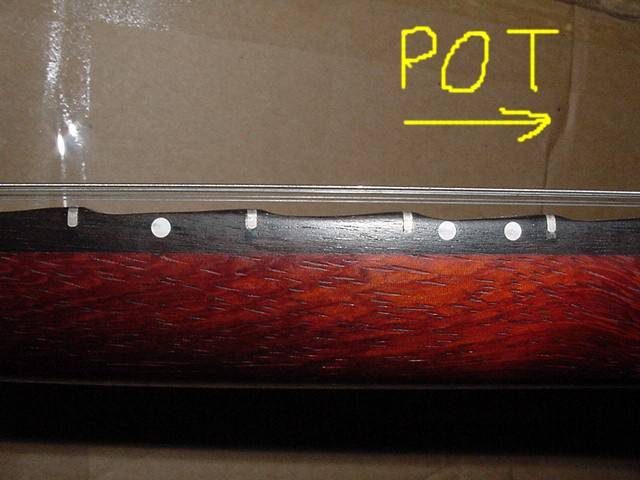 Scalloped banjo fingerboard |
Ken LeVan - Posted - 03/23/2014: 14:42:49
Dogfeathers,
Thanks for the pic. I was ignorant and confused. Now I know what this is about - not an idea who's time has come, IMO.
Ken
rudy - Posted - 03/23/2014: 15:32:21
Doc has a good shot of his scalloped board on his website if anyone needs further photos.
Quickstep192 - Posted - 03/23/2014: 16:09:50
I looked at the fingerboards on Doc's website and they're way cool. It doesn't look to me like the frets are metal, but rather a wood marker. Am I seeing that correctly?
fishingcat - Posted - 03/23/2014: 17:28:02
A recent build of Doc's that I played had very thin brass "frets" — like bar frets, but very thin. And it was a dream to play, indeed.
Doc has built necks to fit pots on occasion. You might talk with him to see if that would be an option for you.
~ Gwen
Quickstep192 - Posted - 03/23/2014: 18:33:18
Has anyone played one of Doc's bluegrass banjos? Do they have a bluegrassy sound, or are they more like a fretless?
jmoathout - Posted - 03/23/2014: 20:09:59
Note that Doc builds fretboards for his banjos, some with scallops, some not. Some scalloped and radiused, some not. Some with or without frailing platforms and/or scoops.
In a previous post I said I had Doc build me a fretless. Not exactly correct: It's a partial fretless with phosphor bronze plate in the fretless area, and scalloped frets in the fretted area.
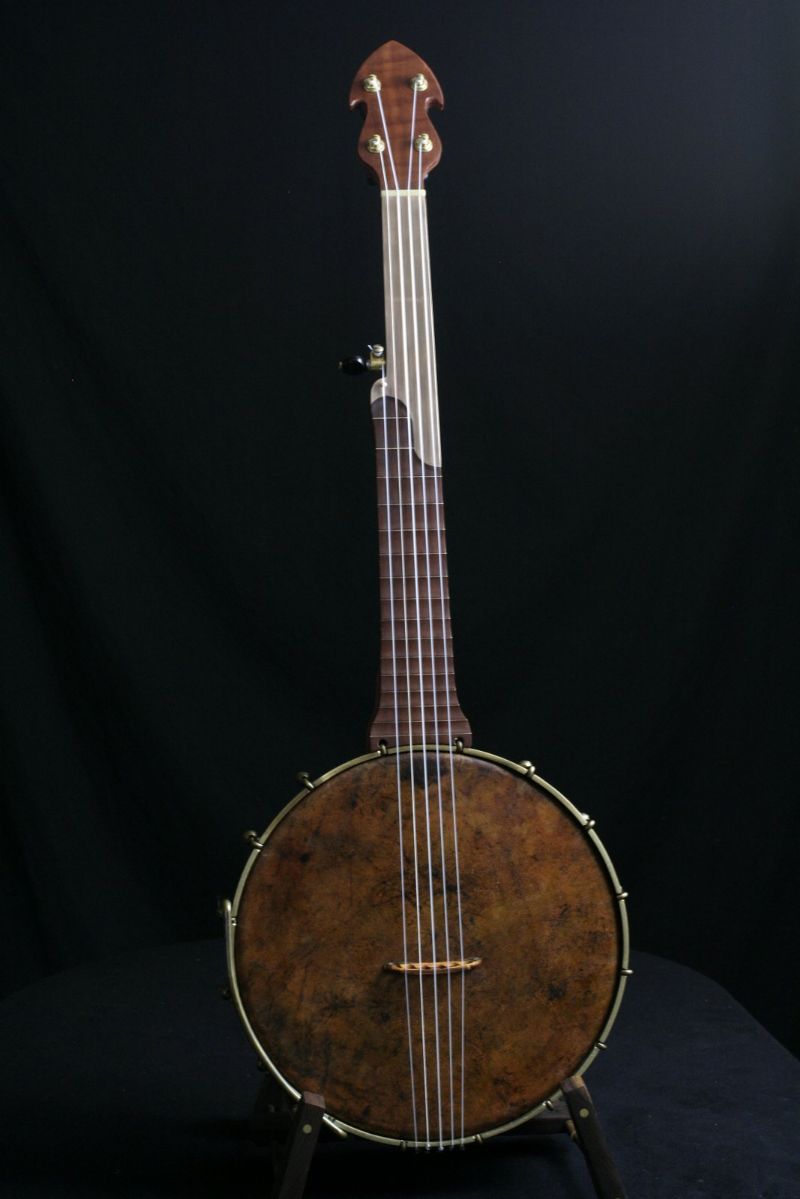 |
Lyndon Smith - Posted - 03/24/2014: 02:16:14
Dogfeathers: Thanks for the info and photo.
jmoathout: That's an amazing fretboard.
It would also appear that those that have played them, love them.
But how to make a scalloped fretboard.
From what I've read on Doc's site, they are hand made (no machining) and Doc's scallops appear to have the lowest point halfway between the frets which is different from Dogfeathers' photo (where they look like inverted escarpments).
The actual metal fret presents a problem too, does he file the top off regular fretwire? Does he have fret wire with a barbed tang but no top or does he glue in a plain metal bar?
It's an awful lot of work but it sure looks cool and from what I have read, plays really nicely...
rudy - Posted - 03/24/2014: 04:14:04
quote:
Originally posted by Lyndon SmithDogfeathers: Thanks for the info and photo.
jmoathout: That's an amazing fretboard.
It would also appear that those that have played them, love them.
But how to make a scalloped fretboard.
From what I've read on Doc's site, they are hand made (no machining) and Doc's scallops appear to have the lowest point halfway between the frets which is different from Dogfeathers' photo (where they look like inverted escarpments).
The actual metal fret presents a problem too, does he file the top off regular fretwire? Does he have fret wire with a barbed tang but no top or does he glue in a plain metal bar?
It's an awful lot of work but it sure looks cool and from what I have read, plays really nicely...
Doc's scalloped boards appear to be standard bar fret material.
lmii.com/products/mostly-not-w...-fretwire
rudy - Posted - 03/24/2014: 06:56:11
The rest of it is a matter of inlaying the bar material, leveling, (radiusing if desired) and sculpting the board to match whatever shape is preferred.
If I were to do a board like that I would cover the bar top edge in black marker and work the scallop shape so they blended up to the center of the bar fret. Whatever technique is used you would want to form to create a defined string stopping point at the center of the fret. If I were to do it I'd probably just use stainless bar strip to eliminate most any need to "re-fret" in the future.
As a side note, California luthier Danny Ferrington has used inlaid (replaceable) wood bar frets in various instruments in the past. Not recommending, just to assert that a scalloped bar fret could work very well. Again, with banjo I'd never give scallops a second thought, but the way Doc is doing it is following good engineering practice.
Regarding the deviation between Doc's photos and the photo above, I'd venture to guess that the photo is an early version; looking very "organic" and not particularly uniform. From my knowledge of playing dynamics and string function it appears that Doc's current boards strike an appropriate balance between the cleanest stopping point to the front of the fret and the proper amount of clearance behind the fret to allow the finger to exert pressure in a correct manner.
I'd venture that a uniform slope to the center of the bar fret originating from the center of the area between adjacent frets would be most likely to balance comfort with good string dynamics. The actual crown depth should be no more than the crown height of standard jumbo fret wire IMHO.
Edited by - rudy on 03/24/2014 07:12:13
DEmery - Posted - 03/24/2014: 07:23:05
Danny Ferrington; I haven't heard anyone speak of him in a while. Danny built me a "hearts and flowers" conversion neck for a TB3 Mastertone back in the 70's while he worked in Nashville. He was building guitars for Cash and inlaying that rose in the Gibson played for years by Emmy Lou Harris. All that was on his bench at the time. Interesting fellow. David E.
rudy - Posted - 03/24/2014: 07:32:57
quote:
Originally posted by DEmeryDanny Ferrington; I haven't heard anyone speak of him in a while. Danny built me a "hearts and flowers" conversion neck for a TB3 Mastertone back in the 70's while he worked in Nashville. He was building guitars for Cash and inlaying that rose in the Gibson played for years by Emmy Lou Harris. All that was on his bench at the time. Interesting fellow. David E.
I'm a groupy. He's still in Santa Monica and has an active instrument building page on Facebook. His coffee table book "Ferrington Guitars" (with accompaying demo CD) is one of the most inspiring books that has ever been written about instrument construction. Not full of nitty-gritty how to" details, but instead features the Zen of building. It's luthiery candy, not unlike Nakashima's "The Soul Of A Tree" is for custom woodworkers.
Edited by - rudy on 03/24/2014 07:39:31
kimkutsch - Posted - 03/24/2014: 15:26:47
Doc is a friend of mine and I get to spend time in his shop. He's helped me with a couple of smaller scale banjos. He is a very creative and out of the box thinker. He's always open to any crazy new ideas I have. I love his work, and he continues to make improvements to open back banjos. I've played his scalloped "fretless" banjos and I would never have considered something like that, but once you play them they are amazing. They are so smooth and easy to play. He does it by hand and it takes him an entire day to do the scalloping. It's like once you get used to playing a radiused fingerboard, I would never go back. I can't say enough about him.
Quickstep192 - Posted - 03/24/2014: 18:02:25
I dropped a note to Doc earlier today to discuss a project I have in mind. I hope I can get him interested.
Lyndon Smith - Posted - 03/25/2014: 03:14:00
Looking at Doc's bar fret wire, it does appear to be much thinner than 1.5mm. It looks more like 0.5mm.
Has anyone got a Doc's scalloped neck banjo close to hand that they could measure? It would be interesting to know...
rudy - Posted - 03/25/2014: 05:09:52
The photo in Dogfeather's post shows wider material and Doc's website photos show it to be narrower. Most builders refine their designs over time, so it's no surprise to see narrower bar used. It would be largely an issue of the look you wanted to achieve, although the larger bar would wear less. Standard nickel silver bar is going to wear just like any other n.s. fret, with wider material more resistant to premature grooving at often-used positions.
I guess I should pull out his interview with Craig Evans and re-watch it to see if he details the scalloped board. I do remember his spending a lot of time talking about rim knock notes.
Edited by - rudy on 03/25/2014 05:12:20
Lyndon Smith - Posted - 03/25/2014: 06:24:06
quote:
Originally posted by rudyI guess I should pull out his interview with Craig Evans and re-watch it to see if he details the scalloped board. I do remember his spending a lot of time talking about rim knock notes.
I would appreciate that...
jmoathout - Posted - 03/25/2014: 06:49:49
On my new Doc's partial fretless, with scallops, the wires appear to be no more than 0.5 mm, I'll re-measure in better light later and re-post if correction is needed. No way they are 1 mm
rudy - Posted - 03/25/2014: 07:36:57
quote:
Originally posted by jmoathoutOn my new Doc's partial fretless, with scallops, the wires appear to be no more than 0.5 mm, I'll re-measure in better light later and re-post if correction is needed. No way they are 1 mm
Hi Mashall, What would really be of benefit is if you could snap a macro mode closeup of the fret profiles as shown in the photo that Dogfeathers posted and add it to the discussion here. If you don't know how to post photos I can do it if you add the photo to your Homepage photos section.
Edited by - rudy on 03/25/2014 07:38:09
mikehalloran - Posted - 03/25/2014: 08:02:20
I played one of Fred Van Epps scalloped fretless banjos many years ago. It had ivory inlaid at the peaks, for lack of a better term. Impractical for metal strings, of course, but I found it easy and comfortable with the gut strings it had.
It looks to me that Doc is adapting a century old design to the modern strings used today. The only way that it works is with a thin metal fret at the peak and a shallow scallop behind.
Quickstep192 - Posted - 03/25/2014: 08:35:06
In response to Lyndon's original post...............
If I were going to try to make the scallops, I would determine the various rasiuses I needed and turn appropriately sized cylinders on the lathe and wrap them in sandpaper. I would then either use the lathe or find a way to affix those cylinders to a drum sander and sneak up on the scallop.
My more likely solution would be to try and talk Doc into making a neck for me................
Lyndon Smith - Posted - 03/25/2014: 10:06:08
jmoathout: That would agree with my observations on Doc's site. The thin edge would give a nice break-point.
I believe Doc scallops the fretboards by hand. From the YouTube videos I've seen of scalloped guitar fretboards, it's not that difficult, just very time consuming. Obviously, the guitar scallops are far too deep for a Doc style fretboard but that just means taking less wood off. Doc's scallops are very shallow...
jmoathout - Posted - 03/25/2014: 10:57:18
I tried to re-measure the fret width on a recent Doc's scalloped fret banjo (#220). It's hard to do with a caliper as there are no exposed edges. Using a ruler in mm increments, it does look close to 1 mm, maybe a bit less. I'll attach a couple of photos, one from Doc, and one from me. The official photos are not yet shown on Doc's site.
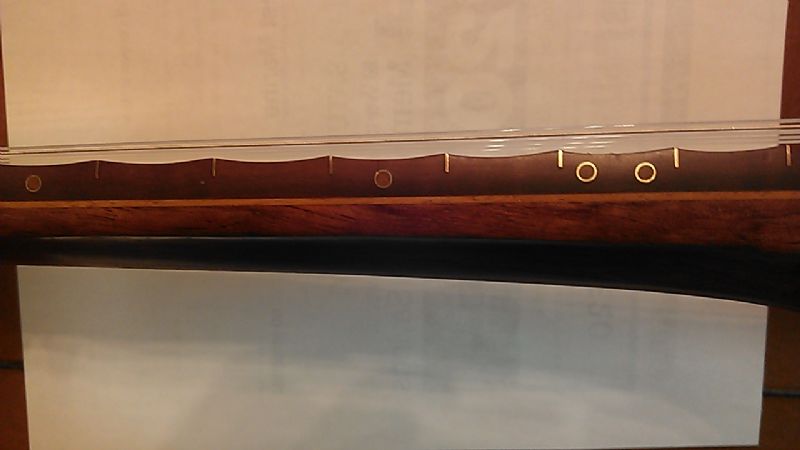 Doc's 220 |  Doc's 220 |
Lyndon Smith - Posted - 03/25/2014: 11:03:42
jmoathout: Mmmmm. They do look like 1mm in the photo. I've not found any fret bar wire under 1.5mm yet, though.
rudy - Posted - 03/25/2014: 15:30:55
quote:
Originally posted by Lyndon Smithjmoathout: Mmmmm. They do look like 1mm in the photo. I've not found any fret bar wire under 1.5mm yet, though.
The LMI website says to roll the bars in a jeweler's mill to thin it. Alternatively it would be quite easy to sand to a thinner dimension. As I said before, if I were going to go to all the trouble it would be with stainless steel.
Lyndon Smith - Posted - 04/04/2014: 02:06:51
I've found Phosphor Bronze sheet in thicknesses from 0.6mm to 1.0mm.
Is Phosphor Bronze hard enough to use as bar-fret wire?
Lyndon Smith - Posted - 04/04/2014: 02:30:02
I found this on the internet:
Strengths | Yield/Proof Stress (N/mm2) | UTS (N/mm2) |
Stainless Steel 316 | 325 | 575 |
Bronze - plate/rod - Phosphor bronze PB102 | 345 | 485 |
All figures are for guidance only, and will vary widely | ||
Lyndon Smith - Posted - 04/04/2014: 02:31:52
The full version of the above table can be found here: classicmarine.co.uk/articles/metals.htm
Phosphor Bronze appears to compare well with Stainless Steel.
banjo bill-e - Posted - 04/04/2014: 11:37:10
It might be helpful to remember that Doc's banjos are usually seen with nylon strings instead of steel. I would think that the larger diameter strings would be less prone to pulling sharp on a scalloped fretboard than the much smaller steel strings. Right?
jmoathout - Posted - 04/04/2014: 11:50:42
banjo-bill-e
Would that argument not also equally apply to regular frets rather than specifically scalloped. I imagine the difference in height between the top of the fret and the land between frets would determine the tendency toward going sharp, absent any lateral choking. I believe, but have not measured, that Doc's scallops are shallower than normal.
Lyndon Smith - Posted - 04/04/2014: 12:17:25
Normal fret crowns are about 0.040" high. About 1/25". I'd say that Doc's scallops are no deeper but I'm only going from pictures. It wood make sense to keep within the same boundaries...
banjo bill-e - Posted - 04/04/2014: 15:40:34
Yeah Marshall, I'm just speculating here but it seemed to make sense to me. I loved the way the neck on that Doc's of yours felt, and how it sounded, and I wondered at the time how it would feel and sound with steel. I played a fretless Doc's at Zepps and liked it too, and it was also nylon strung, as are most of the sound samples on his website. It seems to me that is how Doc prefers a banjo to sound, and he sure makes a good one.
Terms of Use | Privacy Policy | Privacy Consent (EU/GDPR Only)
Copyright 2026 Banjo Hangout. All Rights Reserved.


