DVD-quality lessons (including tabs/sheet music) available for immediate viewing on any device.
Take your playing to the next level with the help of a local or online banjo teacher.
Weekly newsletter includes free lessons, favorite member content, banjo news and more.
Premier Sponsors





|
Please note this is an archived topic, so it is locked and unable to be replied to. You may, however, start a new topic and refer to this topic with a link: http://www.banjohangout.org/archive/295261
beezaboy - Posted - 11/30/2014: 04:15:30
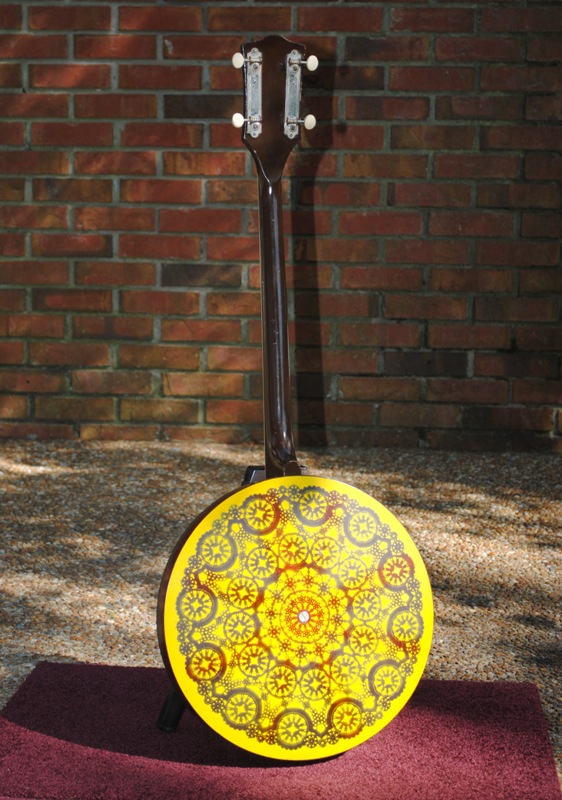
I know this sounds crazy but I've wanted an inexpensive long neck for den display to celebrate the folk era and The Kingston Trio, etc. So, I bought this Harmony on ebay.
ebay.com%2Fsch%2Fi.html...26_rdc%3D1">ebay.com%2Fsch%2Fi.html...26_rdc%3D1" target="_blank">ebay.com/itm/271689241809?ru=h...6_rdc%3D1
I wonder if the pot is original. It looks to be metal? I thought Resotones were "plastic".
Maybe it has just been painted silver.
Just wondering what you thought of this banjo.
Edited by - beezaboy on 11/30/2014 04:32:45
KingStudent - Posted - 11/30/2014: 04:58:14
I have this exact banjo! You'll like it. Yes, painted silver over bakelite. Be prepared to replace the tuners.
beezaboy - Posted - 11/30/2014: 06:41:40
Thanks KingStudent.
I found a 1964 Harmony catalog with the long neck banjo. (attached)
I see the description says "nickel rim" but I'm not quite sure what this means.
Also FWIW, I don't have 1963 catalog so don't know when the Harmony long neck was introduced but it wasn't in the 1962 catalog.
Edited by - beezaboy on 11/30/2014 06:44:30
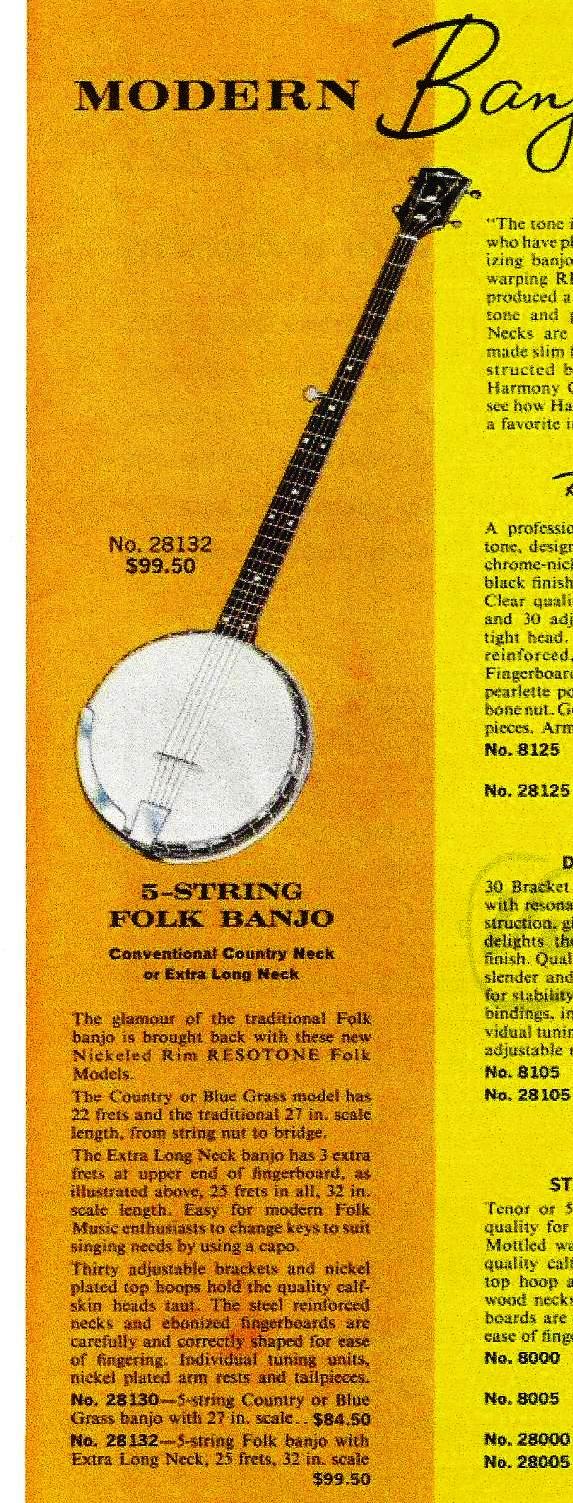 1964 Harmony Catalog |
mikehalloran - Posted - 11/30/2014: 15:46:35
These came in chrome and gold tone. I've not seen one in nickel but it's possible. Anyway, the metal covers the Bakelite.
If you built kit models as a kid, it's the same plating process the toy companies used on plastic bumpers and the like. If you didn't scrape the metal off the contact surfaces, the glue wouldn't stick.
I am guessing that this has its original tuners and plastic head. If so, this is from the post-bankruptcy era ('69 - '76) when they were still assembling banjos and selling the inventory. Had it been made earlier, the tuners would have been Waverly (the kind that disintegrated if not lubed) and it would have had a flesh head. Waverly went out of business around 1968 and I've seen these Japanese tuners on a lot of later Harmonys.
For $150, you scored!
Edited by - mikehalloran on 11/30/2014 16:01:51
beezaboy - Posted - 11/30/2014: 17:55:40
Thanks, Mike. That really helps! Although the model cars I built were pre-faux-chrome and my favorites were the Stutz Bearcat and Stanley Steamer. Just some Testers glue - no peeling required.
davidwigal - Posted - 11/30/2014: 19:07:55
Steel r e i n f o r c e d neck, Made in The U.S.A. - for $150 bucks it doesn't get any better than that 
KingStudent - Posted - 12/01/2014: 03:40:44
Mine has the skin head, which is still fine (although the years have not been kind to it!), and the neck is as straight as an arrow.
giweb - Posted - 12/01/2014: 08:26:37
These are great banjos! I have one 22 fret with resonator and three 25 fret long necks. All the long necks have the chrome plating on the plastic pot. All of the necks are straight. One long neck is an original skin head which makes it sound more like the folk sound I love. Responds to string choice and bridge changes more than other long neck banjos I have. Seems to like .010 1st and 5th string, .023 4th. 2nd and 3rd strings don't seem to matter as much. Haven't tried a wound 3rd. Be prepared to have chrome flaking off the plastic. I have heard the plastic referred to as bakelite and as phenolic resin. As I understand, bakelite is cast with no reinforcing fiber, like clarinets. Phenolic resin uses various types of cloth to reinforce the resin. Many electrical insulators are made with phenolic resin. These are usually clear resins with the reinforcing cloth very visible. When it is machined the weaving is apparent. On my 22 fret, the resonator is machined for the center mounting hole. It shows evidence of being phenolic resin. I posted a request long ago for anyone who has seen a broken Reso-Tone pot, anxious to see whether the break showed fiber or not. My other Reso-Tone with resonator is a long neck with a beautiful reddish-sunburst resonator. I like it because it is comfortable to hold and eliminates the chrome flaking. My old Harmony catalog shows the resonator as a separate accessory for their long neck banjo. All of mine were identified by the sellers as 1964 through 1967. Someone on E*Bay has NOS resonators and pots for sale. They must have been bought in the bankruptcy that Mike Halloran mentions.
If you follow all the links to these on BHO you will find mention that Pete Seeger once played one backstage and gave it his approval. Yes, you did well at 150.00 for a long neck version. Hang it on the wall or play and enjoy it. You might fall in love!
giweb
"Nothing Worthwhile is Easy!"
"Playing Music is Worthwhile!"
mikehalloran - Posted - 12/01/2014: 09:07:16
I once passed on an Old Kraftsman (Spiegel catalog) version with an unplated pot. It was sitting in a Morgan Hill junk store for $50. At the time, I had three other longnecks... I still kick myself for that one.
It's nice to see these getting some respect.
A side note: Has anyone ever seen a USA made Kay long neck? I find it hard to believe that they never came out with a competing model but I've never seen one nor a catalog listing.
wesrichards - Posted - 12/01/2014: 09:24:41
As a wall hanger these are fine. But if there are little kids around -- of an age where they put everything in their mouths -- or dogs or cats, keep 'em away from exposed Bakelite. Nasty stuff.
mikehalloran - Posted - 12/01/2014: 10:13:32
Hmmm... Bakelite was used for instrument mouthpieces for decades. I've never heard of a health issue surrounding it. I can't imagine you'd want to swallow it, of course.
It can have cloth or paper fillers or none, depending on the use. There was an old thread where someone was trying to figure out how to repair a broken Harmony pot - I don't think anyone came up with a satisfactory answer.
The Wiki is about as comprehensive as anything the casual inquirer wants to know.
en.wikipedia.org/wiki/Bakelite
beezaboy - Posted - 12/01/2014: 10:36:06
Oh, wow! Thanks so much for your experience and observations. I'm getting more excited by the minute. The seller shipped the Harmony this morning and I should have it soon.
Meanwhile, I have a resonator (attached). But, probably not apropos for this banjo. I bought the colorful resonator on ebay years ago for my Harmony tenor but ultimately had to sell the tenor with the original brown resonator but I kept the colorful one. I don't think I should put the colorful resonator on the long neck. Just not Seegerish. But, if I'm feeling a little Peter, Paul and Mary - who knows.
Also, how shall I protect the silver finish? Lightly apply guitar polish??
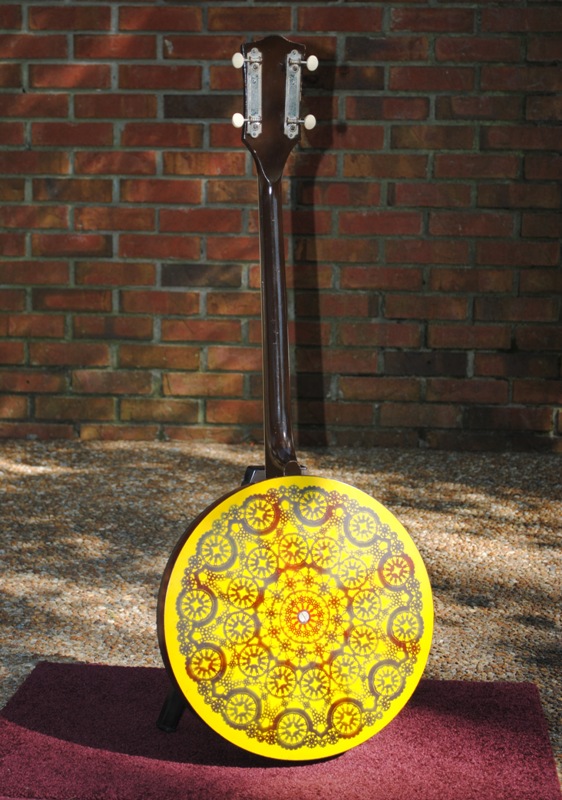 Sovereign Deco Resonators | 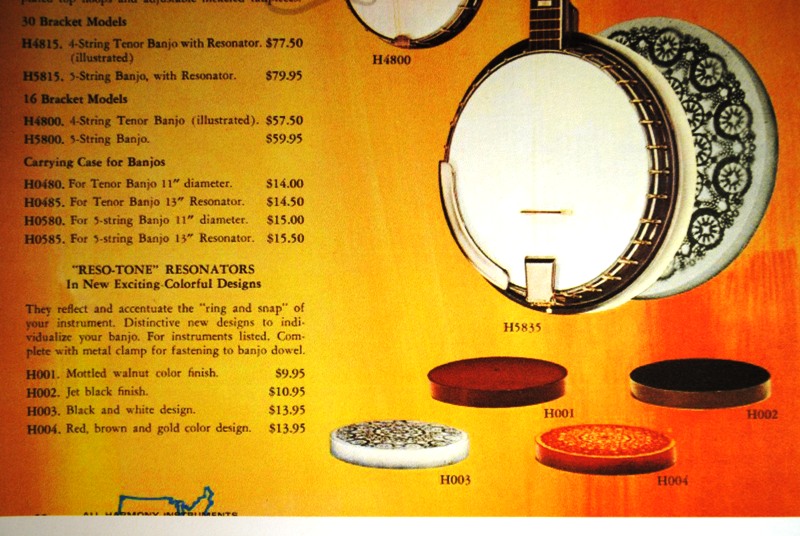 Sovereign Deco Resonators |
giweb - Posted - 12/01/2014: 13:48:14
My one Reso-Tone Long Neck with the chrome plating still intact came with a perfect original case as well. My guess is it was a present someone never wanted and it went straight to the closet where it stayed for 50 years! I have thought a lot about preserving that chrome. I feel the only salvation is a skin or membrane like a clear coat on a car. I have experience in that and the most durable of all is urethane clear with hardener. (Wear protective breathing mask!) I coated a painted wooden sign at the entrance to a river cottage 26 years ago with this finish and it still looks beautiful. The steel post and cross arm have had to have de-rusting and flat black painting done three times and I have to wipe the mildew off each spring. Yet it looks perfect!
I will replace my flaking pot with an un-plated one I got from E*Bay. I think it will look great with a black pot. The perfect one will be disassembled to a bare pot and get the clear coat urethane. This two-part urethane is not the same as furniture finish. It is an epoxy. I will apply it by spray gun as thin as I can be assured of complete coverage. The one with the resonator I will leave alone for now and see how the coating works. Ironically, as easy as it is for the flaking pot to shed tiny chrome pieces all around, I'll bet it would be very difficult to remove completely.
The separate covered tuners on the long neck are not as good as the joined open tuners on my 22 fret Reso-Tone. As Mike pointed out, they are probably disintegrating from lack of lube.
These banjos deserve better tuners and more respect!
giweb
"Nothing Worthwhile is Easy!"
"Playing Music is Worthwhile!"
mikehalloran - Posted - 12/02/2014: 13:16:09
Your picture of the Sovereign Deco Resonators shows the original style Waverly tuners. I have never measured an original set but I would be surprised if the spacing wasn't the same as posts 1-3 of the 6 string tuners. If so, you could cannibalize a set of Stew-Mac's restoration Waverly copies.

Of course, you could replace with four Grover Sta-Tites, too.
Referring to Thomas's post, a couple shots of clear coat from an auto paint place should do the trick. Have them shoot the pot while they are clear-coating a car. If you have friends who paint cars...
Edited by - mikehalloran on 12/02/2014 13:20:06
beezaboy - Posted - 12/02/2014: 14:25:33
Thank you for the advice about preserving the silver finish. I've got to clean the bracket hooks so she'll have to come apart.
PrairieSchooner - Posted - 12/04/2014: 06:35:19
I had one of these as my first banjo (except for a tenor, which was a mistake and is another story); Mine was a little rough when I got it so I refinished the neck, reshaped the peg head, added straight-through tuners, and put wood veneer over the resin pot. It went down the road long ago in some trade or another and I've always wished I still had it. I'm envious! Here she is; a little hard to see in this small photo, c. 1970:

G Edward Porgie - Posted - 12/04/2014: 09:48:55
I'd be very careful with preserving that metallic finish. Some of the plastic plating techniques of earlier times involved the use of a base coat and some also used a finish coat on top of the plastic. Back in the sixties and into the seventies, this was usually some type of lacquer, and would have been a pre-EPA product possibly not conducive to modern coatings. I'm not sure how that stuff would react to being covered over with a modern product, or whether or not the modern coating would even stick. It might go okay, but one never knows. I'd certainly run some tests on an unseen area of the pot before I'd go overboard with any type of protective finish.
Edited by - G Edward Porgie on 12/04/2014 09:49:56
Terms of Use | Privacy Policy | Privacy Consent (EU/GDPR Only)
Copyright 2026 Banjo Hangout. All Rights Reserved.