DVD-quality lessons (including tabs/sheet music) available for immediate viewing on any device.
Take your playing to the next level with the help of a local or online banjo teacher.
Weekly newsletter includes free lessons, favorite member content, banjo news and more.
Premier Sponsors





|
Please note this is an archived topic, so it is locked and unable to be replied to. You may, however, start a new topic and refer to this topic with a link: http://www.banjohangout.org/archive/317205
banjotrader - Posted - 04/11/2016: 06:08:14
Folks,
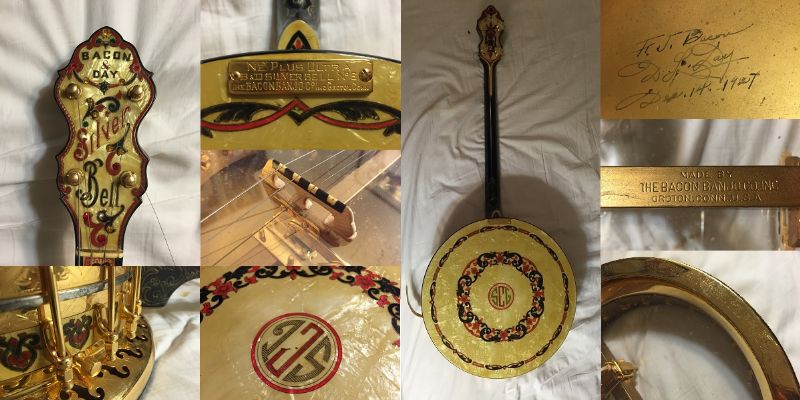
Here is my newest banjo to go in the rare side of the room. A few interesting features:
1) the earliest known factory custom Ne Plus Ultra No. 6. So very close to a No.7 + Ebony, or the #8 in looks
2) the only known to me banjo by Bacon Banjo to ever mention Day's full family name
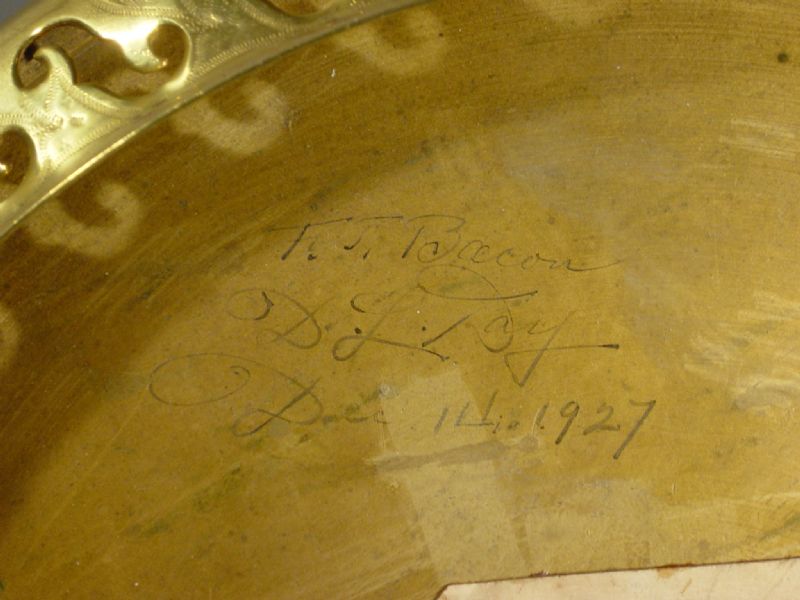
3) the only one of two banjos known to me Signed by Bacon and Day banjo, the other at the Banjo Museum.
Has full provenance to a friend of Bacon's in New Haven CT in the 1920s-1930s - Sylvio C Loro.
Has anyone, ever seen a BACON & DAY on the headstock before?
Edited by - banjotrader on 04/12/2016 06:29:34
banjotrader - Posted - 04/11/2016: 10:11:31
Yup, I was pretty surprised myself... They match known signatures in my collection. Oh and was owned by Banjo Hall of Fame member Joel Schiavone of "Your Father's Mustache" since Sylvio's death... Sylvio was Joel's banjo teacher as a child...
youtube.com/watch?v=bEn-GirfYPw
Edited by - banjotrader on 04/11/2016 10:15:11
banjotrader - Posted - 04/11/2016: 12:11:04
Mike, I'd gladly supply however it will only cause dispute. Let's just say a US "reproduction" is in its place within a certain Database.
Edited by - banjotrader on 04/11/2016 12:12:51
csacwp - Posted - 04/11/2016: 12:12:07
Please do tell. It wouldn't be the first time this has happened...
dhergert - Posted - 04/11/2016: 12:47:22
This is an absolutely beautiful banjo. Thank you for sharing pics and info!
-- Don
beezaboy - Posted - 04/11/2016: 16:29:33
"Bacon & Day" - Yowee!
That is a classic banjo.
Congrats. I'm glad it is in good hands.
BTW - Who is Day? (just kidding).
dspainters - Posted - 04/12/2016: 05:45:12
Huh, signed the same day something special must of been going on that day,
Polle Flaunoe - Posted - 04/12/2016: 06:17:52
quote:
Originally posted by Hans DenglerThis one is signed very similar to yours.
Hans - is this a banjo of yours? If so - please give me some detailed infos about it. This will possibly be of great help for my researches.
BTW - have you considered a revised offer for the SB #2? And/or - are you going to come up with offers for other SB´s in a near future. I do still keep a waiting list for European jazz tenor players wanting me to find and especially rebuild/set-up suited SB´s for them. Do let me know about this off-line.
Guys - FYI - I did last month purchase two really nice Sultana SB´s from Hans. Indeed some pleasant deals - and a pleasant seller - LOL!
Polle
Hans Dengler - Posted - 04/12/2016: 06:23:02
Hi Polle and all others,
no, it´s not my Banjo. You can visit it at the American Banjomuseum.
Hans
banjotrader - Posted - 04/12/2016: 06:24:45
The Banjo in which Hans presents above is from the Banjo Museum. Along with my own, it presents a dilemma in dating banjos based on sales vs construction. Mine is some 1000 SN variance, both presented to their owners at a special reception Mid-Dec 1927.
Needless to say, the SNs presently coded in your DB would allow for erroneous research of design during this period. One must be careful when accepting what appears to be fact as fact.
Edited by - banjotrader on 04/12/2016 06:27:39
Polle Flaunoe - Posted - 04/12/2016: 07:53:49
Hans - thanks for the PM - I´ve sent you one as well.
BTW - will someone please tell me how to find detailed pics like this at the museum web site - normally I don´t have any problems searching the net on my own - but at this site I simply can´t my way through - LOL!
Polle
banjotrader - Posted - 04/12/2016: 08:55:56
Polle - none exist... You can email them and ask to have some specifics taken... They are very helpful folks.
Polle Flaunoe - Posted - 04/13/2016: 03:35:55
quote:
Originally posted by dspaintersHuh, signed the same day something special must of been going on that day,
Dave - a "Banjo Release Party" maybe - LOL! Inclusive of a lot of signing - as usual at such release parties.
Or a celebration of the patent granted for the SB - mind you with an official date six days later?
Polle
Edited by - Polle Flaunoe on 04/13/2016 03:47:31
banjotrader - Posted - 04/13/2016: 05:07:08
Polle - Of course they would have had advance notice of the Patent approval... Its no secret Patent 1653424 (google.com/patents/US1653424) was published Dec 20th 1927. You haven't solved any mysteries... Celebrating it, sure why not...
If however, you are inclined to think that banjos post being aware of the patent approval signed this way is the case, you'll need to adjust your 1927 end-of-year given two banjos 1000+ SNs apart have these markings. Surely you of all people can figure out why... Party pooper!
Edited by - banjotrader on 04/13/2016 05:08:09
Polle Flaunoe - Posted - 04/13/2016: 08:18:41
quote:
Originally posted by banjotraderSurely you of all people can figure out why...
Exactly - if only I was told the two SN´s in question!
Polle
banjotrader - Posted - 04/13/2016: 08:44:01
Unfortunately, one I do not own, and the other I can't give you as it will cause issue for you and others who purchased the reproduction banjo.
What I meant though was that some banjos in the range of 22XXX-24XXX are obviously signed this way. The signature only allows us to know that it was created sometime before this Dec 14th 1927 date.
Having both signed in the same day hints at some sort of presentation of No. 6-9s. The earliest Dec 20th 1927 stamp isolation will no doubt help limit 1927. Your model is very close, so I wouldn't worry about it...
Polle Flaunoe - Posted - 04/13/2016: 10:21:55
quote:
Originally posted by banjotraderUnfortunately, one I do not own, and the other I can't give you as it will cause issue for you and others who purchased the reproduction banjo.
I don´t know of any "reproduction banjos" interfering with your indeed interesting and spectacular #6.
I knew in advance that you wouldn´t reveal its serial number - but feel free surprising me in a positive way by doing so!
BTW - all of the 1927 and 1928 productions are indeed well documented in my extended DB and its attachments - inclusive of also the rubber stamp - carrying the patent date - and used for the resonator insides rather shortly after the approval.
Polle
Polle Flaunoe - Posted - 04/13/2016: 10:27:46
PS!
Ed Britt has in the past mentioned one or more B&D examples seen by him - carrying the brand designation "BACON & DAY" - however he could at that time not remember where and when he saw it/them.
banjotrader - Posted - 04/13/2016: 10:32:14
re: I knew in advance that you wouldn´t reveal its serial number
Then why ask!? People buy banjos all the time thinking they are legit, and some sellers knowing otherwise. You want me to be the messenger and implicate the sellers (knowing o issues or not)!?
So what you may have documented is not entirely fact for some banjos.
Just leave it alone!
Edited by - banjotrader on 04/13/2016 10:32:54
banjotrader - Posted - 04/13/2016: 10:35:14
quote:
Originally posted by Polle Flaunoe
PS!
Ed Britt has in the past mentioned one or more B&D examples seen by him - carrying the brand designation "BACON & DAY" - however he could at that time not remember where and when he saw it/them.
Have you ever seen one, I havent...
Andy FitzGibbon - Posted - 04/13/2016: 12:21:13
I've seen a couple Vega serial numbers used on more than one banjo, where both instruments were legit. It's not impossible that Bacon made the same error once or twice.
Andy
banjotrader - Posted - 04/13/2016: 12:32:57
Agreed Andy, the two banjos in question are Ne Plus Ultras... One would expect that they had more stringent quality control for them... There are some distinguishing features that these NPU repros have (Carvings, Fonts, stamps, inlays, rim designs, shoe holes, etc..) that makes them stand out though. The banjo in question had been worked by a very experience luthier at making repros and has all the flags mentioned above. Somehow still making its way into the serial lists as original... For this reason, I dont feel right opening such a can of worms.
One thing with regard to Vega that I have uncovered is Banjos (Regular, Tenor & Plectrums) ran a sequential serialization parallel to the Mando & Guitar banjos at Vega. You'll run into many duplicates there.
Edited by - banjotrader on 04/13/2016 12:35:37
G Edward Porgie - Posted - 04/13/2016: 14:48:42
In my opinion, if there's a repro out there with a duplicate serial number on an original, people should be made aware of it. No mamby-pambying around. People's feelings aren't the issue, and any repros should be noted so that a future buyer doesn't make the same mistake an earlier buyer may have made.
It may open a can of worms, but the only way worms can be disentangled is when people are made aware of them and can then begin the unraveling process.
csacwp - Posted - 04/13/2016: 15:18:33
quote:
Originally posted by G Edward Porgie
In my opinion, if there's a repro out there with a duplicate serial number on an original, people should be made aware of it. No mamby-pambying around. People's feelings aren't the issue, and any repros should be noted so that a future buyer doesn't make the same mistake an earlier buyer may have made.
It may open a can of worms, but the only way worms can be disentangled is when people are made aware of them and can then begin the unraveling process.
I agree with this 100%.
Polle Flaunoe - Posted - 04/14/2016: 02:13:32
Three things also to have in mind:
- during the mid 20s Bacon had several workers assembling banjos and at the same time stamping the SN´s. Mistakes did happen - you´ll in my DB find several "twins" - some where discovered by their QC - an A or a X was then added to the SN on one of the twins - however many mistakes were not discovered - I don´t know why - in my DB I´ve for safety added (A) and (B) to the SN´s for these twins.
- several banjos have been reported to me with a wrong SN - I´ve myself discovered many of these mistakes - but some may still be present in the DB. Reporters are only sometimes mailing me detailed pictures of their banjos - for me to check for example the SN´s. Yesterday I got a report of another 1927 #6 NPU tenor - I´ve now asked the reporter (a large US music shop) to - if possible - mail me some pics - this example could be of great interest for me and others.
- also Bacon did sometimes "fake" - many banjos were over time up-dated or up-graded by the company. Here´s btw. a somewhat funny curiosity - the inside of a very famous banjo - mentioned for the first time in March 1927 and finished some months later - it was one or more years later equipped with the "patent stamp" by the company - most likely in connection with a factory overhaul or fresh set-up:

Polle
banjotrader - Posted - 04/14/2016: 05:20:41
"...during the mid 20s Bacon had several workers assembling banjos and at the same time stamping the SN´s..."
I'd seriously love to know how you've come to that conclusion... No evidence supports that claim anywhere that I've seen.
Shop marks and where they sit in the process are not proof of such a hypothesis and conclusion for assembly.
Overall shop workers yes, stamping though - not so fast??? You have names??
The point being made here however involved two banjos both sporting visually verified SNs.
Only after thorough inspection can one ascertain that one of the two is not like the others. Interlude (youtube.com/watch?v=Ect-kgxBb4M)
Should it come back for sale, circumstances change, etc... - I'll flag it then.
Edited by - banjotrader on 04/14/2016 05:21:38
BanjoLink - Posted - 04/14/2016: 05:58:44
I guess serial numbers are important, but as far as authenticating antique banjos, glassware, pottery, widgets, etc., the name, stamp, serial number are the last thing that an expert would look at. They look at the piece and see if all of its parts or the piece itself meets all the criteria of that particular maker. Anyone can stamp a banjo serial number, stamp a dowel stick, inlay a name, etc. Some forgers are better than others, but if someone with enough skill wants to forger a banjo, they can sure be pretty convincing.
banjotrader - Posted - 04/14/2016: 08:08:57
But one of many pictures of the questionable banjo. Some items that jump out to me in an "entirely" (i.e in combination) review - not just specific components.
1) the tone ring fit
2) what appears to be sprayed shoe bolts
3) position of the shoe bolts.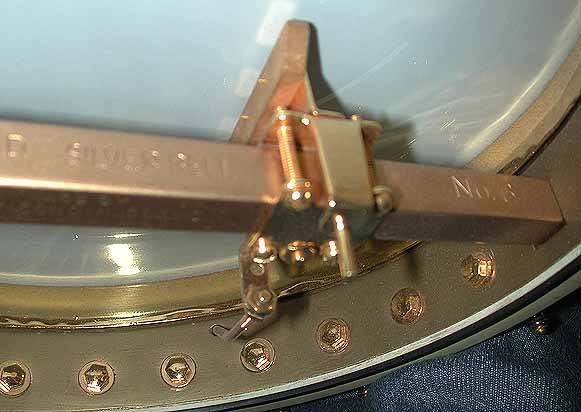
csacwp - Posted - 04/14/2016: 08:56:33
quote:
Originally posted by banjotrader
But one of many pictures of the questionable banjo. Some items that jump out to me in an "entirely" (i.e in combination) review - not just specific components.
1) the tone ring fit
2) what appears to be sprayed shoe bolts
3) position of the shoe bolts.
Wait, that was actually sold as a real NPU? I think you should implicate the dealer that sold this as legit- it's terrible looking!
Polle Flaunoe - Posted - 04/14/2016: 09:13:16
At least - at last,
The picture does IMO show a poorly maintained and ditto refinished banjo - nothing else.
- the tone ring fit is correct - but the inner lip has been deformed by pressing the ring off using an un-suited tool. As seen from time to time - the brass used for the ring is really soft - do never use a tool for getting a sticky ring off - do instead use heat.
- the bracket bolts/washers are indeed poorly spray painted - or whatever - but they are of the correct size and shape.
- the position of the bolts seems correct - the whitish inlaid ring does somehow give a wrong visual impression of the position. For comparison - another #6 NPU of appr. the same age (yet mostly (and wrongly) silver plated these days):

Polle
Edited by - Polle Flaunoe on 04/14/2016 09:24:02
banjotrader - Posted - 04/14/2016: 09:42:36
23046 isnt a great example given its many "customizations", but yes ok #3 can be deceiving. Let's just chalk all this up to a duplicate serial number, a hang over, put it to bed...
Polle Flaunoe - Posted - 04/14/2016: 10:16:18
quote:
Originally posted by banjotrader23046 isnt a great example given its many "customizations", but yes ok #3 can be deceiving. Let's just chalk all this up to a duplicate serial number, a hang over, put it to bed...
NO - SN 23046 didn´t get many "customizations" - here´s Buddy Wachters description of it:
This rare and exquisite version was Ray Brandoli’s original #6. All original parts. Neck and rim are untouched original; resonator has been stripped and lightly refinished. All metal parts except for internal bolts washers and horseshoe etc. were heavily plated with silver alloy over the original gold back in the 1950s. All engraving is still crisp. Straight neck. Excellent overall condition. Original leatherette hard-shell case also very good condition.
And NO - we can´t put the banjos in question to bed - you claimed one of these to be an US "reproduction" - I´ve proved your first "proof" wrong - now is the time to come up with other "proofs" - best done by posting all pictures at hand - and especially by revealing its serial number - obviously contradicting with the SN for your recent purchase.
We - and especially you - owe this to the B&D community and the present owner of the NPU named a fake by you.
Polle
banjotrader - Posted - 04/14/2016: 10:27:36
Polle - I'd love to entertain, but I'll pass. As for proving anything wrong, you haven't... you've offered singular explanations to individual issues; not the entire picture. Not proof..
Serious, 23046 wasnt customized???? Look at it... Not exactly run of the mill...
You're a math guy right... if you happen to be right say I dunno. 60% of the time. in combination 60% x 60%... or 60%^n is the efficiency of your answers. 5 issues, 5 answers.. 8% likehood.
It's sleeping now... Oh, I said reproductions (entire, parts, etc..) not fake. BTW, tell us more about (acoustudio.dk/BD%20Silver%20Be...27334.htm) that was withheld for a long time.
Nite Nite...
Edited by - banjotrader on 04/14/2016 10:35:58
cebracher - Posted - 04/14/2016: 11:19:04
I think we can all agree that every instrument maker has had production issues and Bacon is no more perfect than any other.
That said, there are so many ways that we can all have bad information about our banjos...
Polle and Banjotrader both come across as VERY knowledgeable individuals. Between banjos shows and jams, I've seen my fair share of banjos up close and in person, but Polle has likely laid hands on more high-end banjos than I will ever SEE in my lifetime.
With regard to the serial number application and the amount of workers involved, given the size of Bacon's operation I'd be hard pressed to assume or believe that a single person controlled that process. Even in the early 20th Century after production lines and interchangeable parts had been around for a while, few workers only did a single job.
Even Colt and Remington had several people stamping serial numbers and long before they were required to legally maintain records, they did so and even then there were mixups like sequence errors and duplicates. If the firearms industry can have such occurrences, its seems plausible for Bacon to have had similar mishaps due to what amounts to a "personnel issue".
When its all said and done, in many instances we just making our "best guess" about this stuff and proof of any particular thing may never exist.
Andy FitzGibbon - Posted - 04/15/2016: 04:48:17
quote:
Originally posted by banjotrader
One thing with regard to Vega that I have uncovered is Banjos (Regular, Tenor & Plectrums) ran a sequential serialization parallel to the Mando & Guitar banjos at Vega. You'll run into many duplicates there.
banjotrader - Posted - 04/15/2016: 05:12:42
i have 100+ of examples extracted from some 4000+SNs... collected by me, Mike Longworth data that I got from the Martin Archives, Bollman, Steve Sutherland. Vega also had a mandocello that likely followed that separate sequence, but cant be sure.
Conversions from some of these mando/guitar-banjos have obscured things as well..
BanjoLink - Posted - 04/15/2016: 06:09:30
quote:
Originally posted by cebracher
I think we can all agree that every instrument maker has had production issues and Bacon is no more perfect than any other. True!
That said, there are so many ways that we can all have bad information about our banjos... yes....usually that information comes from the person selling the banjo or what was told to the person when they bought it
- Composites exist, banjos made up from the parts of several. Sometimes its fraud, but I'm sure that's its been a matter of practicality too. Someone just had parts and wanted to create a playable instrument. Yep...that happens
- Provenance is never perfect or always available. As great as it would be to know the ownership history of our instruments, it doesn't always happen and almost never with supporting paperwork. Not necessarily so....I have seen many many banjos whose provenance is impeccable...with supporting paperwork. To me provenance is very important. There are several individuals that I will not buy from, not will buy instruments that have been trhoguh their hands. But to say provenance is "never perfect" is not correct....or at least a big leap!
- Customizing and personal preference, musicians of all kinds like things that are unique to them especially professionals. It's not a new phenomenon by any stretch of the imagination. True...especially among tenor and plectrum players.
Polle and Banjotrader both come across as VERY knowledgeable individuals. Between banjos shows and jams, I've seen my fair share of banjos up close and in person, but Polle has likely laid hands on more high-end banjos than I will ever SEE in my lifetime.
With regard to the serial number application and the amount of workers involved, given the size of Bacon's operation I'd be hard pressed to assume or believe that a single person controlled that process. Even in the early 20th Century after production lines and interchangeable parts had been around for a while, few workers only did a single job. That might be my opinion too, but I have no knowledge that was true at Bacon and I doubt that anyone does unless they can provide some evidence.
Even Colt and Remington had several people stamping serial numbers and long before they were required to legally maintain records, they did so and even then there were mixups like sequence errors and duplicates. If the firearms industry can have such occurrences, its seems plausible for Bacon to have had similar mishaps due to what amounts to a "personnel issue".
When its all said and done, in many instances we just making our "best guess" about this stuff and proof of any particular thing may never exist.
I don't disagree with the premise of your comments, but the bottom line is that each instrument ultimately speaks for itself. We may not know all of the circumstances regarding how it got that way, but we usually know whether the components are correct. That is why earlier I said that when real experts examine a widget, they do not look at the "signature" before they examine it, as that is the easiest thing to fake.....anyone can add that. The piece itself is the proof of what it is.
G Edward Porgie - Posted - 04/15/2016: 09:26:52
It would be nice if someone with plenty of time and a lot of knowledge could begin putting together some better records. Perhaps requests could be made for more than just serial numbers, but also photos, photocopies of sales receipts, information on when/where the banjo was acquired, lists of modifications, new parts, etc., copies of expert appraisals, and any other pertinent information.
A list of serial numbers, to me, is only a vague starting point when it comes to evaluating what one has. People do tend to misread one another, rumors and myth begins to overwhelm facts, and people continue to be either duped or duplicitous. With a real database with very detailed information, that could be consulted by anyone at least some of this might be circumvented.
I am in no way condemning the efforts of people like Polle Flaunoe or Banjotrader, or Ed Britt or anyone else who has taken valuable time to compile what information is currently available. In fact, I applaud their tireless efforts. But I do believe that perhaps more could/should be done in the way of making authentication a little easier..
cebracher - Posted - 04/16/2016: 00:08:04
quote:
Originally posted by BanjoLink
quote:
Originally posted by cebracher
I think we can all agree that every instrument maker has had production issues and Bacon is no more perfect than any other. True!
That said, there are so many ways that we can all have bad information about our banjos... yes....usually that information comes from the person selling the banjo or what was told to the person when they bought it
- Composites exist, banjos made up from the parts of several. Sometimes its fraud, but I'm sure that's its been a matter of practicality too. Someone just had parts and wanted to create a playable instrument. Yep...that happens
- Provenance is never perfect or always available. As great as it would be to know the ownership history of our instruments, it doesn't always happen and almost never with supporting paperwork. Not necessarily so....I have seen many many banjos whose provenance is impeccable...with supporting paperwork. To me provenance is very important. There are several individuals that I will not buy from, not will buy instruments that have been through their hands. But to say provenance is "never perfect" is not correct....or at least a big leap!
- Customizing and personal preference, musicians of all kinds like things that are unique to them especially professionals. It's not a new phenomenon by any stretch of the imagination. True...especially among tenor and plectrum players.
Polle and Banjotrader both come across as VERY knowledgeable individuals. Between banjos shows and jams, I've seen my fair share of banjos up close and in person, but Polle has likely laid hands on more high-end banjos than I will ever SEE in my lifetime.
With regard to the serial number application and the amount of workers involved, given the size of Bacon's operation I'd be hard pressed to assume or believe that a single person controlled that process. Even in the early 20th Century after production lines and interchangeable parts had been around for a while, few workers only did a single job. That might be my opinion too, but I have no knowledge that was true at Bacon and I doubt that anyone does unless they can provide some evidence.
Even Colt and Remington had several people stamping serial numbers and long before they were required to legally maintain records, they did so and even then there were mixups like sequence errors and duplicates. If the firearms industry can have such occurrences, its seems plausible for Bacon to have had similar mishaps due to what amounts to a "personnel issue".
When its all said and done, in many instances we just making our "best guess" about this stuff and proof of any particular thing may never exist.
I don't disagree with the premise of your comments, but the bottom line is that each instrument ultimately speaks for itself. We may not know all of the circumstances regarding how it got that way, but we usually know whether the components are correct. That is why earlier I said that when real experts examine a widget, they do not look at the "signature" before they examine it, as that is the easiest thing to fake.....anyone can add that. The piece itself is the proof of what it is.
Thanks John, I appreciate your comments and don't disagree with your statements. And you're right about provenance, if a banjo has been owned by one or maybe two people, yes of course we can have a perfect record of who owned it and possibly where its been. But quite often this is not the case. I also agree that provenance is important, I just don't personally expect or anticipate it with any instrument I consider buying.
And to your latter point letting "each instrument ultimately speak(s) for itself", I could not agree more. The "parts" are often the most telling for any particular instrument. I've bought instruments on Ebay and fully understand that to some extent its a leap of faith as to exactly what I'll receive and rely greatly on photos and my knowledge of various parts to make a judgment call. And I'm sure we can all agree that its a completely different situation from buying an instrument in person.
As for signatures, I see your point about them being "the easiest to fake". But this isn't necessarily the case. I have some experience with this and own some collectable signatures that include Thomas Edison and many by Bill Hanna and Joe Barbera. The latter ones I witnessed being signed as I used to be in their employ.
The thing with signatures is verifiability based on other known signatures and the frequency of their appearance. Some signatures are harder than others to verify. Walt Disney autographs are relatively rare as compared to the thousand's of autographs that Hanna and Barbera did. There are similar situations with sports memorabilia and celebrities, but they are compared against known sources and then assessments are made.
If we are going to consider the verifiability and value of any Fred Bacon and/or Daniel Day signatures, we need to know a lot more about them before we just completely discount or ignore them.
By the way, if you'd like to message me privately, I'm very curious as to which sellers you will not do business with. I wonder how many we have in common... 
Polle Flaunoe - Posted - 04/16/2016: 01:50:56
quote:
Originally posted by G Edward PorgieIt would be nice if someone with plenty of time and a lot of knowledge could begin putting together some better records. Perhaps requests could be made for more than just serial numbers, but also photos, photocopies of sales receipts, information on when/where the banjo was acquired, lists of modifications, new parts, etc., copies of expert appraisals, and any other pertinent information.
A list of serial numbers, to me, is only a vague starting point when it comes to evaluating what one has. People do tend to misread one another, rumors and myth begins to overwhelm facts, and people continue to be either duped or duplicitous. With a real database with very detailed information, that could be consulted by anyone at least some of this might be circumvented.
I am in no way condemning the efforts of people like Polle Flaunoe or Banjotrader, or Ed Britt or anyone else who has taken valuable time to compile what information is currently available. In fact, I applaud their tireless efforts. But I do believe that perhaps more could/should be done in the way of making authentication a little easier..
George - with regards to Bacon/B&D banjos I do - besides the general database as published - keep an extended version - with a lot of detailed infos for many of the banjos, various documentations (receipts, shipping infos, dates of arrival, letters, provenances etc.) and a very large pictures archive. All-in-all far too large to be published - I use it first of all for my research - plus I do often publish detailed infos and pics for various examples up for debate (or similar examples) - and also sometimes extracts going for certain features etc.
The infos in the extended version are however not for everyone to use - it calls for great expertise and insight - especially as Bacon and Day were so fast moving - opposite other brands they constantly improved their banjos and came up with new features/parts/versions on the run - however for many of these with wide overlaps in time.
Polle
banjotrader - Posted - 04/16/2016: 03:37:16
This whole idea of an extended database being too large assumes we are ignorant. I personally have a Online Database which has 15GB+ of free storage. It's by the way fully available to interested parties. It has been shared with the Groton historians to help walking tours of the old business district, library presentations, etc.. It's not about ego, or only-venue-to-shine mentality, or self-proclaimed expertise "eyes-only"; but rather responsible opensource that has personally cost financially to acquire or in time. Most of my data however isnt instrument focused or design related. That's left mostly to the "shiners". Most of which is fully backed up in the online repository as well. But I'll get to that someday too.
Edited by - banjotrader on 04/16/2016 03:38:24
BanjoLink - Posted - 04/16/2016: 05:30:17
Chris....I agree with everything you said. I'll pass on sending you the dealers that I won't consider buying from, guessing that we would have some of the same ones on the list.
Quote: "As for signatures, I see your point about them being "the easiest to fake". But this isn't necessarily the case. I have some experience with this and own some collectable signatures that include Thomas Edison and many by Bill Hanna and Joe Barbera. The latter ones I witnessed being signed as I used to be in their employ."
Agree totally. Right now there is a big controversy over some golf course architectural sketches that have appeared, one (the "road hole" at St. Andrews having the signatures of Old Tom Morris, A.W. Tillinghast, and Allister MacKenzie (designer of the Augusta National). The signatures and sketch have been authenticated by some of the leading golf memorabilia experts (and I guess the signatures too), but many questions remain. There is an extensive provenance on the sketches, but that is also causing questions. That sketch and several others are said to be valued in the seven digets, and I think a deal is being arranged with a buyer. One of my best friends who is a leading collector of golf memorabilia recently told me that if you have an autograph of Jack Nicklaus, Bern Hogan, etc., etc., you better have a photo of them signing the article or it is likely to be considered fake!
cebracher - Posted - 04/16/2016: 09:48:51
quote:
Originally posted by banjotrader
This whole idea of an extended database being too large assumes we are ignorant. I personally have a Online Database which has 15GB+ of free storage. It's by the way fully available to interested parties. It has been shared with the Groton historians to help walking tours of the old business district, library presentations, etc.. It's not about ego, or only-venue-to-shine mentality, or self-proclaimed expertise "eyes-only"; but rather responsible opensource that has personally cost financially to acquire or in time. Most of my data however isnt instrument focused or design related. That's left mostly to the "shiners". Most of which is fully backed up in the online repository as well. But I'll get to that someday too.
Trader, I'm not sure its a matter of Mega- or Giga-bytes, but more likely its a matter of time and effort. Polle and others (with my sincere thanks and appreciation) have spent many, many hours compiling as well as posting their data.
If we are suggesting a unified database, I highly doubt it should fall on anyone's shoulders in particular. In fact, I think one of the best candidates might be an organization like the American Banjo Museum.
One of the Museum's Board Members told me that they are starting a project to create a database of banjo players with the mini biographies on each one and are encouraging people to sign up and contribute their information. I think it makes complete sense for the Museum to also host an instrument database and one as detailed as we can make. I'd even be willing to donate money towards the effort and pitch in with data-entry time.
Since my band regularly donates to them, I'll see if we have some say or sway with their Board.
cebracher - Posted - 04/16/2016: 10:00:47
quote:
Agree totally. Right now there is a big controversy over some golf course architectural sketches that have appeared, one (the "road hole" at St. Andrews having the signatures of Old Tom Morris, A.W. Tillinghast, and Allister MacKenzie (designer of the Augusta National). The signatures and sketch have been authenticated by some of the leading golf memorabilia experts (and I guess the signatures too), but many questions remain. There is an extensive provenance on the sketches, but that is also causing questions. That sketch and several others are said to be valued in the seven digets, and I think a deal is being arranged with a buyer. One of my best friends who is a leading collector of golf memorabilia recently told me that if you have an autograph of Jack Nicklaus, Bern Hogan, etc., etc., you better have a photo of them signing the article or it is likely to be considered fake!
Yeah, the sports world is especially troubling in this regard and has been for quite some time. What I find particularly bothersome is when some fraudulent SOB takes a legitimate piece of memorabilia or a collectable and then fakes an enhancement like a signature in order to inflate its price. It's vandalism, pure and simple, in my opinion.
I've spotted this so many times, it infuriates me. I once made an accusation of a faked signature on an animation cell on display at a collectibles store in the Caesars Palace Forum Shops in Las Vegas. It was a Hanna-Barbera piece and I asked if there was a signature date associated with it. The sales clerk looked it up and said to me, "Oh wow, its recent. They must have had this done at an animation show within the last couple of years." As soon as this person said that I knew it was fake. The Barbera signature was perfect and smooth and flowing; it was the signature of man in fairly decent health and looked nothing like the signatures I had witnessed Joe Barbera sign in the previous 5 years where he struggled to make the initial loop in the "J" of "Joe".
OK, so maybe the clerk's information was wrong and the signature was older and possibly original, But to your point, yeah, just about everything is possible to fake and worse yet, there are SO MANY reasons to doubt their authenticity... (sigh...)
Terms of Use | Privacy Policy | Privacy Consent (EU/GDPR Only)
Copyright 2026 Banjo Hangout. All Rights Reserved.