
DVD-quality lessons (including tabs/sheet music) available for immediate viewing on any device.
Take your playing to the next level with the help of a local or online banjo teacher.
Weekly newsletter includes free lessons, favorite member content, banjo news and more.
Premier Sponsors





|
Please note this is an archived topic, so it is locked and unable to be replied to. You may, however, start a new topic and refer to this topic with a link: http://www.banjohangout.org/archive/317847
banjotrader - Posted - 04/29/2016: 09:05:05
The search continues re: banjohangout.org/archive/287533
While doing my random checks, a new banjo appeared SN 11535; were 11535-11538 all a batch of 19 fret SBs?? I have an ask into another owner of one to possible find out...
Polle, expect to get some pictures of it in the near future from its owner (Yes - so we can keep you informed as part of openness) - who may share them online here as well.
It now appears that Bacon Banjo was either experimenting, or simply went for it in Jan 1924 with its first 19 Frets line... Earliest known before this was 11566 ( a Montana SB)
The banjo in question has had considerable amounts of work done to it, but its basic frame untouched...
Edited by - banjotrader on 04/29/2016 09:07:43
cebracher - Posted - 04/29/2016: 11:01:48
I'll work on taking a full set of photos of #11535 over the weekend as well as giving as much history about it as I can. It's made the rounds having visited Tennessee and Preservation Hall in New Orleans, and now it resides in Northern California as part of my collection.
Here's the Resonator...
The label was long gone when I received it. The small metal plate says "Lea Restoration by Renee".
Edited by - cebracher on 04/29/2016 11:03:41
Gordy Ohliger - Posted - 04/29/2016: 11:33:08
Thanks for doing this, Fellows.
I'm looking forward to further photos.
Polle Flaunoe - Posted - 04/29/2016: 11:54:20
Chris - I´m looking forward for the pics - the early SB´s need to be far better documented - due to the fast and on-going development of this model in the early 20s.
A Lea/Renée restored example can however sometimes be somewhat problematic - these fantastic luthiers did often alter the vintage banjos very much. Your present picture of the resonator gives an example of this - a nice and most likely original blond solid resonator back with a newer replica F-hole flange.
Polle
cebracher - Posted - 04/29/2016: 12:55:15
Polle,
Not to tease you, but I'll do one better. I also have SB1 #12028 which is has a tenor style short neck, 23" scale, but an extended fret board with 24 frets. My other SB1 is in the 19XXX range plus the Montana I bought recently that I need to get info to you as well.
As for #11535, I'll have to ask Renee when I see her next month in Sacramento about the flange. I don't think she changed it as it had an F-hole when I received it back in 1978, but I'll double check. It was one of her earliest full restorations after Lea's passing.
I know that my tuners were replaced and have the originals around in my parts collection. I've always been very good about holding onto spare parts and accessories.
Here's a few photos of #12028...
banjohangout.org/myhangout/pho...mid=10301
Edited by - cebracher on 04/29/2016 12:59:30
Polle Flaunoe - Posted - 04/29/2016: 22:12:20
Chris,
The solid wood backs have since the beginning tended to cause the original round hole flanges to crack at the small screw holes - once exposed to severe changes in humidity - hence many flanges have been replaced in the past and present. Others were soldered and re-plated.
On top some of the solid backs have gone to pieces - a hard stroke or pressure perpendicular to the surface can fairly easy crack them - as you may have experienced yourself - I´ve noticed your description of Renée having a new back made for one of your banjos - at another thread.
I´m looking forward for pictures as well as detailed reports for your banjos.
Polle
Edited by - Polle Flaunoe on 04/29/2016 22:13:13
cebracher - Posted - 04/30/2016: 07:53:48
Actually the new back is for a brand new banjo that she and I have been working on (on and off) for the last 10 years or so. I was the first person to ask her about incorporating a solid back and it was one of the first pieces made for the project. It will use a reproduction F-hole flange that will be engraved NPU style and also have sapphires (versus crystals) in the flange like I've seen on many of the #9s on the BanjoWorld.de web site. But I will likely choose to mount them differently in order to make them more secure.
Once gain, good info and things I did not know...! I'm off to get #11535 out and start taking some pictures. I'll make a folder in my gallery for it.
banjotrader - Posted - 05/01/2016: 16:17:23
Chris enjoy the new found line in the sand... I'm sure I'll find a few others in my searches but yours is likely incredibly close to the first, if it isn't already it...
banjotrader - Posted - 05/02/2016: 05:56:14
Polle, 11538 is BTW a 17 Fret TB model - banjo.paradise.pagesperso-oran...age6.html confirmed by Philippe who has since sold the banjo to Guy. Wanted to check if maybe there had been a small order of 23" scale banjos... Still possible 11535-11537 were one order.
Polle Flaunoe - Posted - 05/03/2016: 05:35:47
A SB #3 with its original 19+5 fret neck - later factory up-graded with laminated resonator and F-hole flange, soft pedal mute and Oettinger TP.
The for now earliest long scale SB tenor in my extended DB and archive.
.JPG)
.jpg)
Polle
Edited by - Polle Flaunoe on 05/03/2016 05:38:17
Polle Flaunoe - Posted - 05/03/2016: 07:00:58
PS!
Correction of some writing errors in my posting above - the SB #3 was not later up-graded - it was up-dated - btw. most likely in 1924.
And by a long scale SB I meant a 23" scale SB tenor.
banjotrader - Posted - 05/03/2016: 07:02:33
Polle, that's a great find. Would you concur that the small inlays found below the typical 1st fret inlays is common to custom Silverbell banjos of that era? November -ish? This is fast approaching Vega's launch of the Vegaphone...
banjotrader - Posted - 05/03/2016: 07:21:30
Yes I recall having the owner (at the time) get the Matching SN picture from the Ebay Listing: (here) < the one you've attached
The previous discussion we had about it turned out that ~23" SL but was deemed an updated banjo - and possible hard to be certain of its full originality
banjohangout.org/archive/294570
Edited by - banjotrader on 05/03/2016 07:21:59
Polle Flaunoe - Posted - 05/03/2016: 07:41:17
An advice - do never look backward - do always look forward - new infos, documentation etc. do pop up - and hopefully we all have learned a lot in the time passed.
If I personally in the past have forgotten to write "for now" - this will have to be a writing error.
A good day for me is a day where I have learned something new - maybe even out-dating and/or contradicting my previous knowledge - that´s why I rarely look back.
Polle
banjotrader - Posted - 05/03/2016: 07:52:09
True, after relooking at those proportions with fresh eyes.. I still can come up close to 23" SL... For my own notes, I'll stick to a custom scale on this one.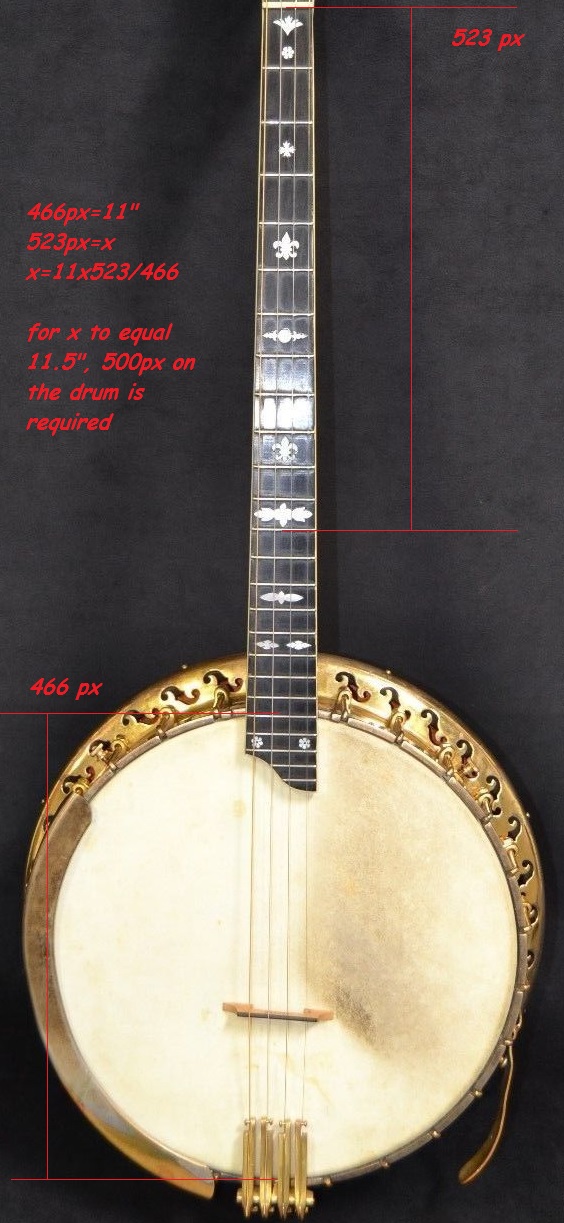
banjotrader - Posted - 05/03/2016: 08:18:22
I get ~24.5"-24.9" known all to well in the guitar realm. Likely for a plectrum player wanting Chicago Tuning.
Polle Flaunoe - Posted - 05/04/2016: 04:43:21
Gents,
The 19-fret 23" scale version of the Silver Bell was introduced late 1923 - however Bacon continued manufacturing the 17-fret 22" scale version till mid 1926.
Today I noticed a very late example of the latter for sale at Bernunzio - bernunzio.com/product/bacon-an...ll-20300/ - a rare find - and it seems all-original - sadly except for the resonator back - this seems to be a later replacement.
Polle
banjotrader - Posted - 05/04/2016: 07:19:15
And a few of these extremely late examples as well, custom requests... It should be clarified that by "Manufacturing" the intention here really means "Production", or "Non-custom"...
Here is one of the last Silver Bell banjos produced in Groton.
ebay.com/itm/Vintage-Bacon-Sil...wE6VXI87Q
Edited by - banjotrader on 05/04/2016 07:20:02
cebracher - Posted - 05/07/2016: 13:26:35
OK, finally, the link is to the photo album in my profile...
banjohangout.org/myhangout/pho...mid=10312
Please let me know if there are specific photos that you would like to see.
As for history, #11535 came into my possession in 1978. I had started taking lessons with Charlie Tagawa the year before (at age 7) and when I showed some promise in playing, he recommended to my parents that they purchase a banjo for me. Charlie located one in Tennessee and once a price was agreed upon, $1,500 at the time, it was shipped. The banjo was in good, playable condition and very solid, but the plating (gold, not silver) was showing wear. I remember having a hard time holding it without the use of a strap which I probably one of the reasons I use one to this day. I do remember it already having the Oettinger tailpiece.
I played the banjo with Charlie Tagawa's Junior Banjo Band every week and then the occasional hired gig from 1977 until it ceased in 1985. Until 1985, I only played occasionally with the Peninsula Banjo Band such as their annual Banjo Jubilee jazz festival or other big performances like when the PBB opened for the Captain and Tennille or Patti Page at local concerts or in San Francisco for the annual Cherry Blossom festival parades in Japan Town. In 1986 I got my drivers license and everything changed, I became a regular performer with the PBB, still playing #11535 every week at our local Straw Hat Pizza Parlor.
In the fall of 1987 I went off to my freshman year of college at Tulane University in New Orleans. Just before, I brought the banjo to Renee Karnes to be cleaned, repaired, restored, and mildly upgraded. As you can see in the photos, it was refinished and replated. Since it was gold when I received it originally, I had it plated in gold again. Renee suggested Nickel plating and I suspect because she did not have access to a plating company that worked in silver, so we stuck with gold.
I remember also choosing to have the sunburst effect on the wood and leaving everything as "bright" as possible. This is also when it received its first clear head and why I've put them on everything since. One of Renee's custom armrests was installed along with threaded metal inserts in the pot so that the resonator screws had something more substantial to screw into. There are also painted gold accents on the wood in the carving on the heel. Minor detail, but a nice feature. By the way, at the time Renee's sister and brother-in-law were restoring cases, so my case got the once over as well.
Renee finished it about 3 months later as I retrieved it over Christmas break and then took it back to New Orleans. About two nights later when I went down to Preservation Hall with my "new" Bacon Silver Bell is when I met Narvin Kimball and introduced myself as a Tulane student that is a banjo player from California. His one question to me was, "Did a Japanese man teach you how to play when you were younger?" My reply was, "Yep, I'm one of Charlie's kids." Narvin invited me to play and I got a good story out of it... 
From 1990 until 1999 I lived in Southern California and played with the San Fernando Valley banjo band so #11535 made the rounds in a few Catalina Island jazz festivals and other SoCal area events. I moved back to Northern California on Tuesday June 15th, 1999. I remember the date so vividly because I pulled into the driveway of my parents house and literally the first thought that popped into my head was could I make it to the pizza parlor in time to play with the Peninsula Banjo Band. It was, so I had to wait until the next week.
The next time any work was done on it was around 2002 or so when a tuner worked its way loose and Renee gave it some attention once again.
Next weekend when I see Renee at the Sacramento Banjo-Rama I will ask her if she remembers if anything was replaced besides the tuners which I believe are now Schaller. But to my recollection, the combination of parts is what I received it back in 1978. It's just "prettier" now... 
Polle Flaunoe - Posted - 05/07/2016: 16:39:44
Chris,
Thanks for the pics and your part of its history/provenance - combined with my studies plus my extended DB and pics archive I do now have a rather clear picture of its "life".
Here´s a short summary of this - prior to your purchase in 1978:
- this Silver Bell #2 was built early 1924 - besides the rather new 23" scale its features included a solid resonator back with a round hole flange, Waverly reverse geared tuners and a Presto TP.
- late 1924 / early 1925 the banjo was factory up-dated - it got a F-hole flange and a beveling of the heel cap - plus an Oettinger TP and a first generation soft pedal mute.
- over the years it was restored and re-plated/plated one or more times - and possibly the tuners were replaced. You´ll know about the latter, as you have these in stock. The plating works were rather comprehensive - causing the engraving of the pedal to disappear, it seems.
Regards
Polle
cebracher - Posted - 05/07/2016: 20:30:17
Wow, thank you Polle!! That's all very cool info to have.
By the way, with regard to the Soft Pedal Mute. Renee commented that of all of the mutes that she had worked on to that point, that she found the one on my SB2 "unique". It was a different configuration than she had seen previously. She did not go so far as to hypothesize that it was a prototype, but she did say that it was "not regular production". Which makes me wonder if it EVER had the stamping on the flat part of the pedal. The thickness of it is uniform and a fair amount of metal would have to be removed in order to remove the stamping completely.
cebracher - Posted - 05/07/2016: 20:31:30
quote:
Originally posted by Polle Flaunoe
Chris,
Thanks for the pics and your part of its history/provenance - combined with my studies plus my extended DB and pics archive I do now have a rather clear picture of its "life".
Here´s a short summary of this - prior to your purchase in 1978:
- this Silver Bell #2 was built early 1924 - besides the rather new 23" scale its features included a solid resonator back with a round hole flange, Waverly reverse geared tuners and a Presto TP.
- late 1924 / early 1925 the banjo was factory up-dated - it got a F-hole flange and a beveling of the heel cap - plus an Oettinger TP and a first generation soft pedal mute.
- over the years it was restored and re-plated/plated one or more times - and possibly the tuners were replaced. You´ll know about the latter, as you have these in stock. The plating works were rather comprehensive - causing the engraving of the pedal to disappear, it seems.
Regards
Polle
I'll start taking pics and creating separate albums for each of my banjos for your database. I hope you could download them. I'm happy to email the sets to you as well if you'd like.
Polle Flaunoe - Posted - 05/07/2016: 23:23:33
quote:
Originally posted by cebracherWow, thank you Polle!! That's all very cool info to have.
By the way, with regard to the Soft Pedal Mute. Renee commented that of all of the mutes that she had worked on to that point, that she found the one on my SB2 "unique". It was a different configuration than she had seen previously. She did not go so far as to hypothesize that it was a prototype, but she did say that it was "not regular production". Which makes me wonder if it EVER had the stamping on the flat part of the pedal. The thickness of it is uniform and a fair amount of metal would have to be removed in order to remove the stamping completely.
Chris - the mute is a first generation/version example - it´s activated via a spring and de-activated directly - it was in production for less than an year and was not generally used. That´s most likely why Renée hadn´t seen an example before.
Early 1925 a second and final version came - it looks almost the same - only it got an adjustable inside return spring - and it was both activated and de-activated directly.
The early spoon pedals are stamped (not engraved as mentioned by me above) B&D SOFT PEDAL only - I´ve seen plenty examples with this stamp almost worn away or polished off in connection with one or more re-platings. Renée knows about the issue of polished off engravings and stamps - she has over time re-engraved many B&D parts, I take - lately for an early #6 NPU belonging to Mike Hashem.
Regarding the OP - yours is indeed a very early 19-fret 23" scale SB - however not the earliest.
Polle
Edited by - Polle Flaunoe on 05/07/2016 23:30:58
Polle Flaunoe - Posted - 05/08/2016: 00:36:14
PS!
I forgot mentioning that it has a Type II tone ring. Bacon had started using this on some SB´s late 1923 - but at the time of its "birth" the Type I ring was still the predominant choice.
Polle Flaunoe - Posted - 05/08/2016: 05:08:25
quote:
Originally posted by cebracher
I'll start taking pics and creating separate albums for each of my banjos for your database. I hope you could download them. I'm happy to email the sets to you as well if you'd like.
Chris - if possible do mail me all sets directly - polle@acoustudio.dk - this way I´ll save plenty of time when saving them.
Thanks in advance
Polle
cebracher - Posted - 05/08/2016: 12:09:30
Polle,
Thanks for the additional info. I'm not disappointed that its not the earliest, but its early which is still more than most can claim and its played on a regular basis. So its having a good life...
Photos are on the way in several email. More to come...!
Chris
banjotrader - Posted - 05/08/2016: 13:13:43
quote:
Originally posted by cebracher
Polle,
Thanks for the additional info. I'm not disappointed that its not the earliest, but its early which is still more than most can claim and its played on a regular basis. So its having a good life...
Photos are on the way in several email. More to come...!
Chris
Chris, don't jump to conclusions about it not being the earliest too quick. 11109 is not a certain banjo as it has "problems" in the timeline. Statistically its what is known as an outlier. If you sample per 500 SN, something looks off... But not impossible. However, my math doesnt allow for it to be 23" scale from the picture of it either. Two varying opinions on this one... We'll likely find very few examples between 11109-11535; as we did between 11535-12056 (Which has a normal outlier sampling per 500)
Polle Flaunoe - Posted - 05/08/2016: 13:50:27
Chris - your first packages of pics have popped up - thanks.
Do continue mailing me pics of your other B&D´s - plus of course any infos of interest about them.
Polle
cebracher - Posted - 05/08/2016: 16:03:53
I guess SB1-12028 is next up for a photo session...
banjohangout.org/myhangout/pho...mid=10301
This was a bit of an impulse purchase on Ebay several years ago simply because of the extended fretboard. I had been told that a tenor scale banjo could be tuned as a plectrum in this configuration and luckily I was given correct information. The banjo is currently tuned with plectrum tuning. The banjo came from Ohio and all I know about the previous owner is that he passed away and his heirs took it to a pawn shop which then put it on Ebay and likely how I was able to buy it for $550 with shipping. They knew nothing about it and I came across the auction listing by accident since it was listed as an "antique B&D banjo" and that was it along with the photos. But at some point it appears that a "John Pastore, 3603 Riviera S. Lane, Twin Oaks, PA" is who owned the banjo at some point since he wrote his name and address on the factory label.
I now know that the round hole flange is likely its original configuration, but I am unsure of the geared tuners it currently has. It also arrived with two of the MOP fret markers missing, but with stray pieces in the gear pocket which gives me the impression that its owner intended to replace them at some point. The tuners are missing some parts such as a flanges that go between the tuner shaft and the hole in the peghead. There's also a seemingly unexplained "chunk" missing from the resonator flange at the 1 o'clock position. I guess it could have been for an Elton head heater or maybe a pickup, but it seems unlikely to me.
All in all, I think if I were to hand it over to Renee, it would clean up very nicely and become a very presentable banjo. It's still very playable, being bright sounding and loud, but I think it could benefit from a better bridge and a clean-up of the tuners.
Wha'dya think?
cebracher - Posted - 05/08/2016: 16:08:49
By the way, the photos of it with the second Silver Bell (#11535) are for comparison of the necks and scales. I was very careful laying them on top of each other... 
banjotrader - Posted - 05/08/2016: 18:13:10
As I had done in 2014, making the assumption that the distortion factor was small enough to approximate the SL of SN11109 has proven to be a mistake.. For comparison, I've taken a very close picture of one known 23" and compared it to the one shared via ebay when this banjo first came online. I do get back to 23" now, as i had done back then..  My recurring error...
Now back to the important aspect of this banjo, the fit to the timelines. What's interesting about SN11109, is that it's SOOO far off base of the trend we'd been isolating. Making it in my mind, a likely custom banjo rather than maybe a production banjo. So as we've discovered here, late '23/early '24 is by in large what appears to be a market launch vs. a soft-launch/trial of the 19 fret 23" Scale Length. None the less, a good find that we seem to have missed the importance of at the time of the original post concerning 11109.
Polle Flaunoe - Posted - 05/08/2016: 21:49:14
Chris - thanks for the next package as PM´ed.
SN 12028 is btw. one of the first SB examples with a laminated resonator back - at the time of its "birth" Bacon did for some months use both this type and the solid type.
The tuners are correct for this banjo - Waverly reverse geared. Renée will most likely have the missing bushings in stock.
Polle
Edited by - Polle Flaunoe on 05/08/2016 21:57:00
Polle Flaunoe - Posted - 05/09/2016: 05:34:06
quote:
Originally posted by Polle FlaunoeChris - the mute is a first generation/version example - it´s activated via a spring and de-activated directly - it was in production for less than an year and was not generally used. That´s most likely why Renée hadn´t seen an example before.
Early 1925 a second and final version came - it looks almost the same - only it got an adjustable inside return spring - and it was both activated and de-activated directly.
Correction - by a closer look at your pics it turns out that your mute is of a rare "in-between" version - so rare that I haven´t named it so far - it does have the second version adjustable inside return spring - but it does also have the first version in-direct activation.
Yours is the only third example for me to see so far.
Polle
Edited by - Polle Flaunoe on 05/09/2016 05:35:06
cebracher - Posted - 05/09/2016: 11:40:52
quote:
Originally posted by Polle Flaunoe
quote:
Originally posted by Polle FlaunoeChris - the mute is a first generation/version example - it´s activated via a spring and de-activated directly - it was in production for less than an year and was not generally used. That´s most likely why Renée hadn´t seen an example before.
Early 1925 a second and final version came - it looks almost the same - only it got an adjustable inside return spring - and it was both activated and de-activated directly.
Correction - by a closer look at your pics it turns out that your mute is of a rare "in-between" version - so rare that I haven´t named it so far - it does have the second version adjustable inside return spring - but it does also have the first version in-direct activation.
Yours is the only third example for me to see so far.
Polle
This is probably what Renee was referring to when she said that it was "unusual". She and I will hopefully have a fun conversation this weekend...
Polle Flaunoe - Posted - 05/10/2016: 00:23:19
quote:
Originally posted by cebracher
This is probably what Renee was referring to when she said that it was "unusual". She and I will hopefully have a fun conversation this weekend...
Chris,
Till now I had seen only two examples of this combination - a first version activator assembly and a second version mute - too few to be called something special - and besides the mute could be a replacement.
Now we have three examples - there´s still not something special about them - they are just a combination of old stock and new stock parts - but for me and my research they are valuable with regards to a dating of the complete assemblies.
Yours was most likely installed in connection with a factory up-dating as mentioned - including also a F-hole flange and an Oettinger TP - I do now feel it safe dating this work to very early 1925.
BTW - Renée did back in the days re-install the whole assembly in the way meant for the first version - with an in-direct activation - she could however had chosen the way as meant for the second version instead - with a direct activation. Do tell her this - after some thinking she´ll most likely catch the clue - LOL!
Polle
cebracher - Posted - 05/14/2016: 00:12:38
quote:
Originally posted by Polle Flaunoe
Chris - your first packages of pics have popped up - thanks.
Do continue mailing me pics of your other B&D´s - plus of course any infos of interest about them.
Polle
Hi Polle,
banjohangout.org/myhangout/pho...mid=10321
Here is SB1 #19167. It's already in your database, so I assume you spotted it on Ebay back when I "rescued" it. If I remember correctly, I bought it for less than US$500. The case has the name of "Bill Luckow" on it, otherwise I know next to nothing about its origins. I should have kept the info from the auction, but forgot to do so.
Judging by the various holes and hooks on the inside (one in the dowel stick, see photo, and 4 brass screw-in hooks next to the mounts for the 4 resonator thumbscrews) I'd venture a guess that it had a home-made head heater or wiring of some kind previously. Also, one of the F-holes has been enlarged, probably to make it easier to feed a chord or plug through.
Three of the four soldered on resonator thumbscrew mounts have broken off, but the tuners, frets, and fretboard are in decent shape.
banjotrader - Posted - 05/16/2016: 06:25:42
For anybody who might be interested, 11109 is for sale by its new owner...
Bacon & Day # 3, tenor banjo 11 inch head size, serial number 11109,
~1923, extended fingerboard, excellent condition, all original, metal parts gold plated,
perforated tone ring, Bacon & Day knee mute, planet tuners with pearl buttons,
perfect action, plays and sounds great, original hard case. € 3.250
dag.benend@gmx.de
The "All Original" part is a bit of a stretch, but still a nice banjo.
Edited by - banjotrader on 05/16/2016 06:27:26
Terms of Use | Privacy Policy | Privacy Consent (EU/GDPR Only)
Copyright 2026 Banjo Hangout. All Rights Reserved.


