
DVD-quality lessons (including tabs/sheet music) available for immediate viewing on any device.
Take your playing to the next level with the help of a local or online banjo teacher.
Weekly newsletter includes free lessons, favorite member content, banjo news and more.
Premier Sponsors





|
Please note this is an archived topic, so it is locked and unable to be replied to. You may, however, start a new topic and refer to this topic with a link: http://www.banjohangout.org/archive/339570
Ken LeVan - Posted - 02/05/2018: 17:18:22
One of the things I have always wanted since I was a teenager is a Vega Pete Seeger Banjo. Finally, after 50+ years, I got one and am in the process of restoring it to as close to early ‘60s condition as possible. I thought it might be interesting and fun for those longneck folks out there.
When I first got it, last October, I realized it had more than minor problems, and I decided to wait until I had some time to fix it. I have been so busy I couldn’t do anything with it, but I have a banjo playing friend, who is a real Kingston Trio buff coming to visit, so I have to get it into playing condition- now is the time.
It’s a 1962 model, with the sans serif logo and the amber sunburst - more or less the John Stewart kind - here’s a pic of the peghead, and by the time I took this, I had installed old 60s. Grover Rotomatic tuners, which barely fit because of the thickness of the peghead.
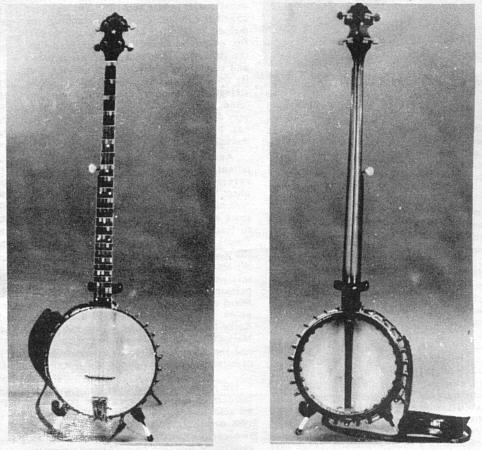
As a little background, these were made starting in the 50s, based on Pete Seeger’s banjo, which was made from an old vintage Tubaphone pot and a longer neck. A few other folksingers, like Bob Gibson, Eric Darling and Peggy Seeger adopted the model. Vega then asked Pete if they could make a model named after him, and he said “fine” declining any royalties. The first ones, in the late 50s had 28 brackets and a dowel stick, and the bracket band was thinner than the old 1/8” ones and had the brackets bolted through with heavy bolts, probably to add weight to make up for the lighter band, which had really become a trim strip..
In the 60s, they started making them with 24 brackets, and switched from the dowel stick to a system with a large aluminum tube and a 1/4” aluminum rod, designed to act somewhat like, but not exactly the same as Gibson’s “coordinator rods”.
This, and the addition of an ingenious system using set screws through the rim to adjust the neck angle sideways and up-and-down, made it easier to align the neck on these longnecks.
Throughout the whole evolution, they always used the Tubaphone tonering for PSs.
Here, you can see a close-up of the rods, along with their famous “yellow sticker” and the large bolts - if you look closely, you can see two of the set screws- there is a disclaimer on the yellow sticker telling you “Do Not” mess with these.
Here’s another couple of pics showing some of the details of these.
The correct setup for these is to have the top of the fingerboard just a hair higher or level with the string space on the tension hoop and that just a hair higher or level with the surface of the head.
It should look like this picture of an original one- the shot below is a bad picture of John Stewart’s stomach with the banjo - I’m sure the ones Vega supplied to the likes of the Kingston Trio, Hedy West, Alex Hassliev, Tommy Makem, etc., were set up the way they wanted them to be.
The one I have, had a badly vertically misaligned neck, so that the fingerboard stuck up around 3/16” above the level of the head. Plus the head crown was too high, and the head was too large (these use 10 15/16” medium crown heads), causing the flesh hoop to bottom out on the heel cut.
Also, the head was very crooked, due to the abovementioned head size problems
The REAL problem, though was that the neck sat too high because the lag screw holes had been drilled too high - I think someone at the Vega factory just got sloppy back in 1962.
SO, I had to reset the lags, and this is something that can happen with any banjo with lags, so it’s good to have a way to fix it
(1) The first step was to take off the neck and plug the lag holes with maple plugs epoxied in - I also filled the set screw dents.
(2) I positioned the neck where it should be and marked where the holes should be through the holes in the rim with a pencil.
(3) Now I could see where the holes should be, and I drilled new holes using a jig I used to use for dowel mortises on the drill press.
(4) In order to re-set the lags without splitting the heel, I chased threads using a sharp lag screw, which I waxed a little with paraffin:
(5) Then I screwed a 1/4-20 barrel-nut onto the 1/4 - 20 threads, and screwed the lags in with a socket wrench and small vice-grip.
THEN, I put the whole thing back together and it was as it should be! I checked the relative levels of everything.
I made a new bridge similar to what they would have used back in the day,strung it up and used the set screws to adjust the action, even though the yellow sticker says “DO NOT mess with these”. That was a great system dismissed by Martin, who of course, knew everything there was to know about banjos.
Voila!

Here she is - battered but unbowed. Just for the sake of authenticity, I used a Grover Perma-tension 5th peg and made a capo that is close as I can come to the ones made with enema bag tubing in the day. The tailpiece and armrest are original
Edited by - Ken LeVan on 02/05/2018 17:38:46
Alex Z - Posted - 02/05/2018: 17:35:34
A collector's item. Yet still in good hands and making music!
Fascinating explanation. Thanks for taking the time to show us.
llrevis - Posted - 02/05/2018: 17:43:27
I enjoyed reading about how you are restoring my old Vega. The Rotomatics kind throw me a little bit and I never liked the Permatension fifth peg. The setup was the way I bought it and I always assumed that was the way it was supposed to be.
I wish I could say I miss my old banjo, but I don’t.
I hope you will post more as you continue its restoration.
I read with interest every thing you post.
Ken LeVan - Posted - 02/05/2018: 17:54:28
quote:
Originally posted by llrevisI enjoyed reading about how you are restoring my old Vega. The Rotomatics kind throw me a little bit and I never liked the Permatension fifth peg. The setup was the way I bought it and I always assumed that was the way it was supposed to be.
I wish I could say I miss my old banjo, but I don’t.
I hope you will post more as you continue its restoration.
I read with interest every thing you post.
I'm glad you don't miss it. I will surely take good care of it. I think they got busy at the Vega factory at the height of the popularity of the PS, and didn't spend as much time as they should have.
I really don't like those Perma-tensions either, but they were the bomb-diggety in 1962, as were the Rotomatics (I don't like the Rotomatics much either - you have to turn them forever to change the pitch) But this is a period restoration.
It's is a piece of banjo history - When I got my 1927 Granada in 1963, I thought it was really old and it was 34 years old - this Seeger is now 53!
llrevis - Posted - 02/05/2018: 18:24:51
The pegs that were on this Seeger were Grovers ( I think). One of them failed within the first year or two and I replaced them with Ode planetary pegs purchased at their shop in Boulder. The Odes were on it until about five years ago.
Joel Hooks - Posted - 02/05/2018: 18:40:38
I have close friends that knew both Bill Nelson and one of his workers during this era. Every aspect of Vega banjos during this time was about cost. From the slice of pipe rims to the stain and finish mixed togather— it was all about getting the cost down. The Allen screws were used to cut down on the effort of a good fit on the heel. The use of co rods was because it was faster and cheaper (labor wise) to bolt a neck on than to glue in a dowel.
The guy who was working for Nelson told the story that on occasion a nice piece of curly maple would show up in the stack of neck wood. This would cause the neck cutter machine to chatter. The guy would ask Nelson if he could shape it by hand. Nelson would say that was a waste of time and burn it in the stove.
The change over to the different style of rim came about because Nelson found a company that made plywood pipe or tube. It was cheaper to buy that and slice off pieces than to make the rims.
I own (and play daily) a Wonder from this era. I had the heel recut for a proper fit and it playes and sounds fantastic. That said, it is ugly, poorly finished (all of the stain finish has worn off of the neck) and slapped together. Even the frets are installed wonky. It hangs on my office wall at work and is expendable. I did not pay much for it.
Seeing the work you do Ken, I don’t know why you would want one of these. You build Rolls Royces and Vega was building Yugos.
The good old days were not so good, at least when it comes to 60s Vega banjos.
llrevis - Posted - 02/05/2018: 19:26:58
In the early sixties there were only two choices if you lived in the Indianapolis area; Vega or Gibson. If you wanted to be like Pete it had to be a Vega.
I totally agree with the quality of Vegas. The pegs on this particular instrument had to be replaced. The plating on the hooks was very thin and they all rusted within a few years. The armrest that came with it was a piece of crap and was replaced with a Gibson type armrest. Deering’s Vega Number is a much higher quality instrument than the 62 Vega. All that being said that old Vega was until recently the best sounding banjo I ever played.
VPS - Posted - 02/05/2018: 19:58:33
It's hard to believe it ever left the factory with the neck that high. Of course, at that point they were cranking them out to meet demand, and QC had to suffer. I think calling them Yugos is maybe a little unfair, tho.......
It's always been the lore that the allen screws made for less vibration transfer between the neck and pot, and made for a lesser sounding banjo. I've played quite a few of both types over the years, and wouldn't commit to one sounding better than the other-setups and other variables make this a silly comparison. I do think it was a straight-up cost cutting measure, and Martin did away with it because they thought it inferior.
I love to see one of these getting played. They really do have a sound of their own and can be useful in many situations.
Texican65 - Posted - 02/05/2018: 20:36:17
What a sharp looking instrument Ken! Great work, that’s something to be proud of. I recently had my ‘63 Scruggs Vega restored, and I see the neck heel to rim fit on yours was HORRIBLE just like mine had been...straight from the Vega factory. So it seems that multiple banjos suffered this way, I wonder how many hundreds? Mine had a 1/4” gap at the bottom end of the heel, and the lower coordinator rod was installed too close to the upper rod...on the neck side of the rim...and he washer covered the Allen screw adjusters...so they couldn’t be adjusted....talk about poor craftsmanship at Vega!!! It’s all fixed now, heel reconstructed and no more gap...and no more Allen screw adjusters....what a powerhouse now!
It doesn’t appear that yours had the little metal plate at the end of the heel that the Allen screws make contact with? Mine did...but it’s gone now. How about a sound clip please? Again...fantastic work!
Dow
eliotkenin - Posted - 02/05/2018: 22:55:05
Eliot Kenin here.
In '57 or '58 my friend Dave Arnold bought a used extended neck Vega Whyte Laydie banjo, perhaps from Bob Gibson. It was of better quality that the later Pete Seeger Model. In '59 I lucked into a Clifford Essex style XX imitation Whyte Laydie five string made around 1920. Wanting to Imitate Pete, I took it to Johnny D'Angelico and asked him to extend the neck. At great length and volume, but politely, he told me why he wouldn't do it, and I shouldn't have it done. Next I took it to Emil DeLucia in Philadelphia, who had done work for me before. He just kicked me out of his shop. So I never had it done, and in retrospect, I'm not sorry. Especially since I'm too short to play an extended neck banjo without the cape on it anyway. I still have the Clifford Essex and play it and love it.
Now about neck attachment; I have done several six string conversions with several kinds of pots. Usually I take a Gibson style solid body electric guitar neck, glue a block onto the foot of the neck, and carve that into a heel. Then I sink three bolts into the face of the heel in a triangular pattern and bolt it into the pot. If I want to make extra sure the lower bolt stays in place, I use a carriage bolt drilled into the heel from outside and counter sink the bolt head and then fill the hole with plastic wood of the proper color.
With nuts and washers inside and outside the pot, those the ee bolts allow one to adjust the neck angle with no coordinator rods needed. It's easy
pastorharry - Posted - 02/06/2018: 02:04:31
Proud owner here of a '61 Seeger with dowel stick construction that was gifted to me. I read it was Mike Longworth at Martin that immediately did away with the Allen screw and odd sized co-rod setup, and went to two standard co-rods when Martin started making the Vega line banjos. There are some that believe that was an improvement. My fretboard sits above the tension hoop a bit, but the old girl sounds and plays so well, I probably wouldn't ever change a thing unless the head broke, then I'd probably get a low crown, this is at least the 2nd head on the banjo, I know it's not original to it. BTW; several years ago I was making retro red capos for KT nuts, I used Paige capos and a narrow red surgical tubing I bought at Gammie Home care. Great job Ken, she's a beaut !
VPS - Posted - 02/06/2018: 02:30:34
How ironic, PastorHarry. The only 2 banjos I own are a '61 Seeger and the Sullivan you traded me years ago.
I won't commit to one type VPS sounding better, but I DO think there is a difference between the rod banjos and the dowel stick models.
And Ken may not think Martin knew about Banjos, but Mike Longworth sure did!
Texican65 - Posted - 02/06/2018: 11:11:57
I’ve tried to figure out when and where they switched the con rods from the larger one with small, to both the same size small diameter. My ‘63 Scruggs has two small diameter rods, and I’ve seen later ones with that set up, and also with the larger rod setup. It’s seems very sporadic and random.
Ken LeVan - Posted - 02/06/2018: 12:04:41
quote:
Originally posted by VPSHow ironic, PastorHarry. The only 2 banjos I own are a '61 Seeger and the Sullivan you traded me years ago.
I won't commit to one type VPS sounding better, but I DO think there is a difference between the rod banjos and the dowel stick models.
And Ken may not think Martin knew about Banjos, but Mike Longworth sure did!
I'll respectfully disagree about Mike Longworth. I think the people at Martin back then were very pompous, arrogant and path dependent (as many guitar builders are concerning banjo building), Martin was very stubborn and self important, and they drove Vega, who needed competent marketing help, not design help, right into the ground.
The way a banjo works is the the strings activate the head via the bridge, and it's the head that produces the sound, just like the top of a guitar. The vibrating strings, at the same time they are energizing the head, energize the neck via the peghead. The rim does not energize the neck and is not really an important part of that equation other than in the negative - being able to rob sound away from the head if the neck is loose and wobbly or the rim vibrates too much or isn't rigid enough (same thing).
The Vega PS connection is quite rigid - it's almost impossible not to have good points of contact via the set screws, and, it makes at least as good a connection as the dowel sticks, which operate differently. I also think the aluminum rod-and-tube was a superior kind of system to either the dowel stick ot Gibson's co-rod system
Brett - Posted - 02/06/2018: 12:25:37
Interesting, this setup is different from both Boston Vega's I have (a VIP and Scruggs II), they only have one pair of allen setscrews, not the 4 you have in yours. Wonder why Vega did it 2 different ways? Was it only on the long necks they used 4 set screws?
Ken LeVan - Posted - 02/06/2018: 12:43:07
I also have a Vega pot with only 2 set screws and two 1/4" rods - not the large diameter tube. I think it's a "Professional". It also has a bracket flange and cobra hooks like they used on the "Sonny Osborne" model. Unfortunately, the yellow label is gone,so I can't date it. I always believed it was between the dowel and the rod-and-tube chronologically. I think the 4 set screws are more necessary on the longneck because if you have made longnecks with dowel sticks, as I have, you will know they are very difficult to align properly.
Bart Veerman - Posted - 02/06/2018: 13:12:08
You still need to put an eye bolt in the neck for the strap to make it a real Pete Seeger banjo 
Wonderful work!
heavy5 - Posted - 02/06/2018: 13:25:15
Bought one of these new in the 50's & think it was both Pete & Dave Guard I was trying to mimic . Enjoyed it for quite awhile then traded it in for my first D28 .
Joe Connor - Posted - 02/06/2018: 13:43:06
And to make it just like Pete's, you need a screw in the fingerboard at the 13th fret to act as a fifth-string capo.
Ken LeVan - Posted - 02/06/2018: 13:55:41
quote:
Originally posted by Joe ConnorAnd to make it just like Pete's, you need a screw in the fingerboard at the 13th fret to act as a fifth-string capo.
fretboardjournal.com/features/...-lengths/
It's not supposed to look like Pete's, but I have a customer who has been talking about one like Pete's - 28 brackets and a lignum vitae neck. I could make a pretty good duplicate of a lignum vitae neck with a light colored piece of ipe, which is about the same density as lignum vitae and would look the same.
I would definitely use the screw at the 13th fret. He illustrates that in his book.
One reason that Pete used the eye-bolt on the neck is that the lignum vitae neck was so heavy it even made a Tubaphone top-heavy.
lonesomepicker - Posted - 02/06/2018: 14:11:23
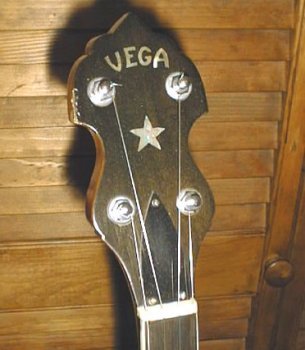
Congrats! Nice looking banjo. I waited a long time too for mine. I got it about twenty years ago. It's close to yours in serial number too. Mine is a 1963 and also has the John Stewart colored neck. And for some reason, the word Vega on the peg head is a little different. Here's a picture of mine. Play yours in good health!
Edited by - lonesomepicker on 02/06/2018 14:12:35
Joe Connor - Posted - 02/06/2018: 14:28:00
Pete bought the piece of lignum vitae that became the neck from the J.H. Monteath Co. Would you believe that the company is still in business and that they still stock lignum vitae?
VPS - Posted - 02/06/2018: 15:27:42
Hey Rick-I thought yours was a sunburst? Stewart's was blonde.
There were several variations on the logo-I'm not sure why.
Ken LeVan - Posted - 02/06/2018: 16:25:41
I believe Stewart had a couple of them, starting with a standard one when he replaced Dave Guard in Oct '61, winding up later on with the blonde 28 hook one, which may have been specially made for him by Vega.
Vega made a special one for him with blocks and stars and an exel 5th string tuner placement, but he never played it and gave it to the Cumberland trio, I think. Then, of course there was the Gibson RB-180 he very briefly played.
I don't think this banjo is identical to the one Stewart played - just Vega PS production from the point in time when Stewart replaced Guard.
The problem is, these darned photographers who did album and publicity photos never really photographed the instruments so you can see the back, count the hooks, etc. The little I know about Dave guard's banjos (he had 2) comes from a couple of bad photos showing the back where you can see the dowel. I can tell you the serial number of one was 99386.
I know very little about Stewart's.
VPS - Posted - 02/06/2018: 16:41:03
I think Stewart only played the one 28 hook blonde. I believe it's the same banjo he played in the Cumberland Three, and as far as I've ever heard his wife still has it. I'm aware of the Excel, and I think it still resides with the Shaw Brothers in New Hampshire. He gifted it to the Brandywine Singers, and Ron kind of inherited it when he rejoined after a tour in Vietnam, IIRC. He also gave one to Glen Campbell, but I have no idea what the story was on that-just saw a clip of Glen playing it and saying John Stewart gave it to him.
Dave absolutely had 2-one dowel and one rods. Both sunburst.
Great discussion, BTW. I hope you'll update on your impressions after you've played the Vega for a week or two.
Joe Connor - Posted - 02/06/2018: 17:03:58
Josh, is that the same banjo Stewart played at the reunion concert in 1981? It was interesting that John played his old Vega at that concert but Dave Guard showed up with a Gibson Mastertone.
Ken LeVan - Posted - 02/06/2018: 17:11:13
Eric Darling, before the "Pete Seeger" became a Vega model had a blonde exel - that was probably the first one. Billy Faier had a blonde one, but I don't think it was an exel. Another blonde of the John Stewart era was Alex Hassliev's exel, which had the blonde peghead . I think all the exels were blonde as standard, but not the peghead. I don't know how many Vega made, but not many. I've made 4 exels, one a conversion of a 30s Vegaphone. I also made a 2+ longneck with an exel 5th peg position.
VPS - Posted - 02/06/2018: 17:12:54
I'm 99.9% sure it is.
I think Dave Guard played that flyswatter Gibson to thumb his nose at Bob Shane and his new version of the KT. We had a discussion about this on Rick's website recently.
VPS - Posted - 02/06/2018: 17:20:45
Correction to an earlier post-Both Dave Guards banjos were dowel stick. He was in Australia by the time Vega went to rods.
My bad.
Ken LeVan - Posted - 02/06/2018: 17:26:18
The picture I posted at the beginning of this thread of John Stewart's stomach with the banjo is from a friend who scanned it out of a book he has about the trio - too bad he didn't scan the whole picture, but apparently, it's Stewart and the banjo is a 24 hook one:

Dave's second banjo had the Weather King logo crooked, off to the side, like whatever the logo is on this one.
Edited by - Ken LeVan on 02/06/2018 17:29:16
Ken LeVan - Posted - 02/06/2018: 17:37:59
Dave Guard's 2 banjos leaning against a mirror - the "second" one with the crooked logo definitely has a dowel. Looks like 24 hooks, but hard to see. As I said, those photographers never photograph the right things.

lonesomepicker - Posted - 02/06/2018: 18:57:08
Josh, I do have a sunburst. I thought that was what John played. My bad.
Joe Connor - Posted - 02/06/2018: 19:32:14
Ken, out of curiosity, what would be the price range for a job like you did? I ask only out of curiosity because a PS-5 is out of my price range. By the way, my Vega FR-5 has the same problem but the action is fine and it sounds good.
Edited by - Joe Connor on 02/06/2018 19:32:39
banjowannabe - Posted - 02/06/2018: 19:33:54
quote:
Originally posted by VPSIt's hard to believe it ever left the factory with the neck that high. Of course, at that point they were cranking them out to meet demand, and QC had to suffer. I think calling them Yugos is maybe a little unfair, tho.......
It's always been the lore that the allen screws made for less vibration transfer between the neck and pot, and made for a lesser sounding banjo. I've played quite a few of both types over the years, and wouldn't commit to one sounding better than the other-setups and other variables make this a silly comparison. I do think it was a straight-up cost cutting measure, and Martin did away with it because they thought it inferior.
I love to see one of these getting played. They really do have a sound of their own and can be useful in many situations.
I'm not at home right now so I can't check, but I'm pretty sure my Martin-built Vega Wonder (the one in my avatar) has allen screw adjustments on the neck joint. It does, however, have two co-rods as an improvement.
banjowannabe - Posted - 02/06/2018: 19:39:53
Ken, I forgot to add that prior to my post about Martin-built Vegas, I've been sitting here for at least a half hour enjoying the photos of your banjos. Really beautiful, and I agree on the satin finish. I think it makes you focus on the beauty of the wood rather than the finish.
mikehalloran - Posted - 02/06/2018: 20:36:39
Waverly went out of business in the late ‘60s. Martin switched to the Gibson style co-rods when they ran out of the aluminum tubes. Most Martin PS-5s that I’ve seen had Vega built pots with the aluminum tube.
Grover did make a Rotomatic style geared 5th that used a screw to attach it to the banjo. For a number of years, they supplied the wrong screw—it needs to be a #3 wood screw or the tuner doesn’t work well. I have three of them and will be installing one of them in a few days. I’ll take pictures. Fender Jazzmaster pickup screws ar #3 x 1” and are perfect.
Grover still sells a 5th with the metal knob but it’s not the same—probably yet another rebranding of the Gotoh 5th.
Texican65 - Posted - 02/06/2018: 21:09:41
Ken, in that photo of John Stewart’s stomach...that is a Vegalon Head on that banjo.
VPS - Posted - 02/07/2018: 00:33:33
It is a Vegalon. I believe it's also Dave Guard's Banjo.
Compare to the right banjo in the dressing room shot. Off center head stamp, 24 bracket, and appears to probably be a sunburst. These were from the first publicity photos taken at the time of the changeover-I'd guess Dave was around. These are the only photos I have ever found of John playing a banjo like this. I don't know the exact circumstances, but it's not really too shocking.
If course at this point, it can't be proven-but if anyone has a better explanation I'm all ears.
wesrichards - Posted - 02/07/2018: 05:38:45
Gentlemen... and you all/each are that... what a beautiful thread this is. A model for internet discussions. Beautiful illustrations, tons of knowledge, history and stories of this already storied banjo. And plenty of rational and reasonable disagreement without a single hair pull or choke hold. I've been a member of this group for many years now and I say that with pride and love. Of course many of us no longer have much hair to pull. And that wrinkled hand in the pictures? I have two just like that only fatter. You are all true historians!
Joe Connor - Posted - 02/07/2018: 05:58:51
Josh, are you saying that the banjo on the color picture of Stewart that Ken attached is actually Dave's banjo?
CraigRison - Posted - 02/08/2018: 18:38:02
Ken, I talked with you on the phone about a month ago about putting a 5 string Vega scale or longer neck on my 1960's "Plectrum Wonder" Vega pot (which only has 2 set screws.) and from reading your post here (Thank You!) it's neck was also set too high according to what your saying here - it's frets were (and still are with the 1950's Harmony neck (27.25" scale) I used (at least at this moment in time) level with th tension hoop for my first attempt at a conversion, cause I didn't know better - and thought it made sense not to hit the tension ring & head as much when my picking got forward on the pot into the "frailing" zone) - now I realize now there will be less string pressure on the bridge. I really still want you to install one of your necks but money & time are between it happening now. What "pushed" me into getting the "fire, courage and mental strength" to attempt my 1st "conversion "was because I thought I had lost my first nice "Masterclone" that I had for 1 week - a Japanese Washburn "Mystic" B22 (3 ply rim, bell bass tone ring, brass hardware, radius neck, etc.) cause I set it down in a real stupid spot and momentarily lost track of it and it "disappeared" ! Then 2 weeks later - and 1 day after completing the conversion and playing it out live I got an email from the lady who picked up the B22 for me THANK GOD I had one of my business cards in the case!! I ALSO thought it would really be best to perform with an All American banjo considering how much I love and respect whats left of our country!
Here's where the holes are drilled in the original plectrum neck
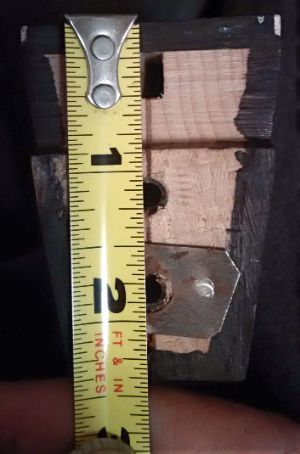
BUT to get the angle and heal of the Harmony neck right I had to sand some away and ended up causing the bridge to be too close (for optimal sound from the head?) towards the rim, I believe? The 22nd fret is almost kissing the tension hoop
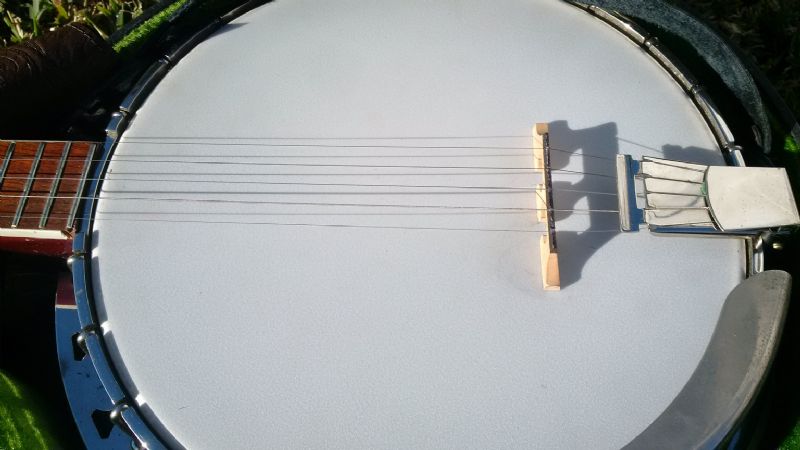
although it may not be "too bad" looks to me like archtop's edge of the tone ring also shortens the distance between the working edge of the head and the bridge - and they sound good? It sounds pretty good to my "novice banjo-wise" ears although a bit "trebly" (compared to my Masterclone & audio of those types of banjos) -but real nice clear and "jangly" with med. steel strings. I've been thinking of "steam bending" a piece of 5/8" cabinet ply if possible and making a spacer glued to the neck to bring it out further?
The intonation of the Harmony neck seems good but the frets have many "random" ones that are tapered on the ends (and some dips & bumps=wow!) - maybe I'm going to attempt to at least replace the tapered ones or can I build them up with solder (maybe even JB? ;) - Probably should at least try to smack em down? Or replace them all - no wear on them the neck was never used...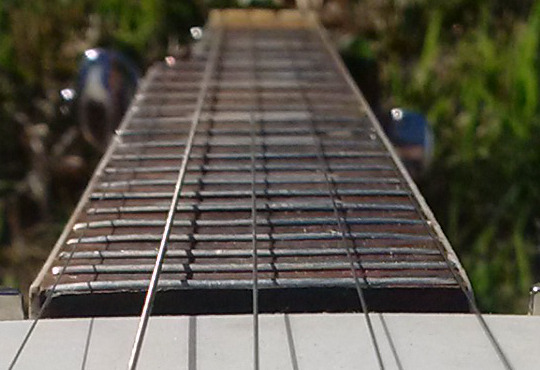
Really looks like railroad ties from the last century, tweaked by "John Henry" the Steel driving Man (not to mention his amazing steel driving wife!) when he hit the spike a little too hard :)
Edited by - CraigRison on 02/08/2018 18:41:45
mikehalloran - Posted - 02/08/2018: 20:45:01
quote:
Originally posted by Joe ConnorJosh, are you saying that the banjo on the color picture of Stewart that Ken attached is actually Dave's banjo?
That has 24 brackets. It's not one of the 2 Vega PS-5 banjos associated with Dave Guard.
Here's the mirror picture. It's easy to see that both have 28 brackets. You'll hit #7 before the 90° mark.

The banjo on the right started out like this before it got Scruggs tuners. Notice the Vega plectrum that Bob Shane is holding — he played the opening to Tom Dooley on it. I think it's a Wonder. The tuners are certainly the Waverlys with white buttons that Vega used on all low end banjos in the '50s and '60s. Harmony and other companies used them, too.

Later it got Rotomatics

Here's the picture from Mandolin Bros when they sold it. It was covered in stickers for a teaching method Dave had developed. The Scruggs tuners were gone but the Rotomatics remained. It was sold for $15,000 to help pay his medical bills. He died not long after.
The banjo on the left got with Kluson Guitar tuners.
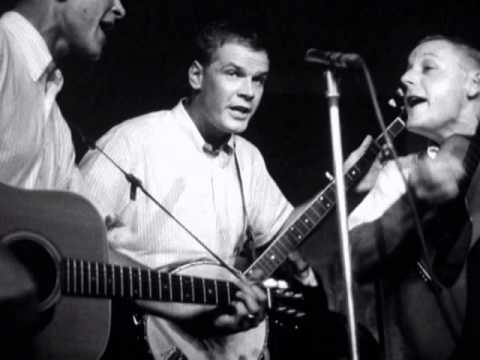
1960 concert at Notre Dame University
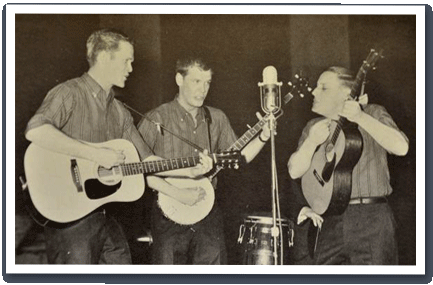
I, along with Bob Shane, helped identify it when it turned up at Carouso Music (late 1990s?). Someone repositioned the head but it looks like the same one as in yhe mirror photo.

Dave was photographed playing at least one other Vega, I think. This has planets (or Champions?) in addition to the Scruggs tuners — or is it the same one that had the Rotomatics? The picture is from 1962, after the Whiskeyhill Singers disbanded. When I spoke with Bob Shane, he said that Dave was a tinker trying to find what would work best.
The SS Stewart from the first KT album

Bob Shane with the same Stewart

What goes around... with the Whiskey Hill Singers in 1961 after Dave left the KT.
I think that's enough for now.
Edited by - mikehalloran on 02/08/2018 20:49:02
Frisco Fred - Posted - 02/08/2018: 22:36:17
61 PS-5 with single co rod and 2 set screws. The heel sets firmly against the rim. The set screws just barely kiss the heel,
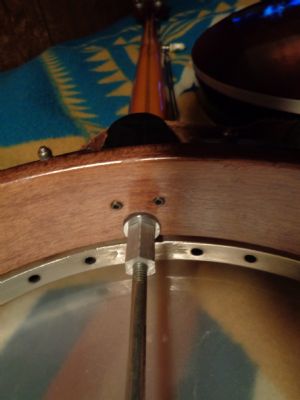
Texican65 - Posted - 02/09/2018: 10:21:21
Again...so interesting to see the different neck attachment variables in these Vegas. My Scruggs HAD the lower coordinator rod hole drilled right split in between the adjusting screws, and the washer covered the screws....so it couldn’t even be adjusted properly. No longer the case now.
Joe Connor - Posted - 02/09/2018: 10:48:39
Thanks, Mike. Great stuff. Where do you get all those great pictures?
pastorharry - Posted - 02/09/2018: 11:20:56
I read that Dave Guard changed tuners several times on the same banjo, looking for the ones that would help him stay in tune on stage. His famous line, "If I ever get this thing tuned I'm gonna have it welded!!" LOL .
Ken LeVan - Posted - 02/09/2018: 11:28:20
quote:
Originally posted by pastorharryI read that Dave Guard changed tuners several times on the same banjo, looking for the ones that would help him stay in tune on stage. His famous line, "If I ever get this thing tuned I'm gonna have it welded!!" LOL .
And Lou Gottlieb of the Limeliters would always say when Alex Hassliev was tuning his banjo between songs "I don't have to tune this bass - it comes from the factory tuned".
Edited by - Ken LeVan on 02/09/2018 11:28:47
Joe Connor - Posted - 02/09/2018: 11:36:55
The Trio's go-to luthier was Harmon Satterlee in San Francisco. He store was called Satterlee and Chapin. Does anyone know anything about him?
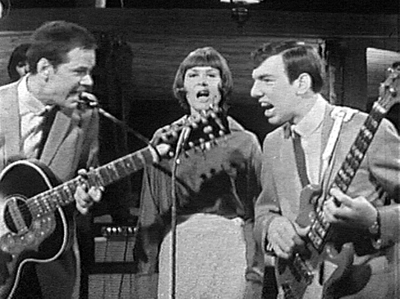
Supposedly, Dave Guard ordered a 12-string from Gibson as a special order. He liked those big-body Gibsons that he had seen the Everly Brothers playing. When Gibson delivered it, it had 12 strings, but the strings were equidistant from each other, instead of grouped in pairs. Yikes. He had Satterlee remake the guitar the way a 12-string should be, and played it on several Trio recordings. Here's Dave playing it on his TV show in Australia.
spoonfed - Posted - 02/09/2018: 11:56:09
all of this info from guys who know their stuff is most intriguing, I am a big Luke Kelly fan and I think he ended his career playing a Pete Seeger Vega after his Merlin allegedly fell apart ! I have never however, seen or heard an uncapo'd longneck played for instance in E or F, can anybody direct me to where I might hear or see one being played low ? would love to hear the "growl" some players talk about.
Terms of Use | Privacy Policy | Privacy Consent (EU/GDPR Only)
Copyright 2026 Banjo Hangout. All Rights Reserved.


