DVD-quality lessons (including tabs/sheet music) available for immediate viewing on any device.
Take your playing to the next level with the help of a local or online banjo teacher.
Weekly newsletter includes free lessons, favorite member content, banjo news and more.
Premier Sponsors





|
Please note this is an archived topic, so it is locked and unable to be replied to. You may, however, start a new topic and refer to this topic with a link: http://www.banjohangout.org/archive/341670
Ken LeVan - Posted - 04/09/2018: 18:03:49
This has probably been discussed many times before, but is it possible to dye a skin head with alcohol based aniline dye - the same kind used to dye wood?
I'm not really keen on using coffee and tea - actual dye seems like a better idea, and I know aniline dye is used to dye leather.
rcc56 - Posted - 04/09/2018: 19:52:54
I don't see why not, unless you have concerns about the alcohol degrading the skin. You can always try it on a piece of scrap.
Edited by - rcc56 on 04/09/2018 19:53:37
jamesinkster - Posted - 04/09/2018: 20:47:20
Yup, I've done it.
I only wanted a *very* subtle effect, so i just added a bit of alcohol-based aniline dye to the water while I was soaking a skin before stretching it, same as you would with tea, etc.
Seemed to work well enough, though the hard part for me is getting the exact shade I want -- you can't really tell until it has dried...
Dan Drabek - Posted - 04/09/2018: 21:08:46
Most analine dyes are pretty potent. For a calfskin head I would probably thin the stain way down with denatured alcohol and build up to the desired look with as many coats as is needed.
I've never had much luck mixing an alcohol based dye with water. Or vice versa.
DD
desert rose - Posted - 04/09/2018: 23:01:37
If its the alcohol based dyes NOT the oil based, Fiebings is extremely high quality and perfect, but it will need to be thinned
Scott
CEParagon124 - Posted - 04/10/2018: 08:05:02
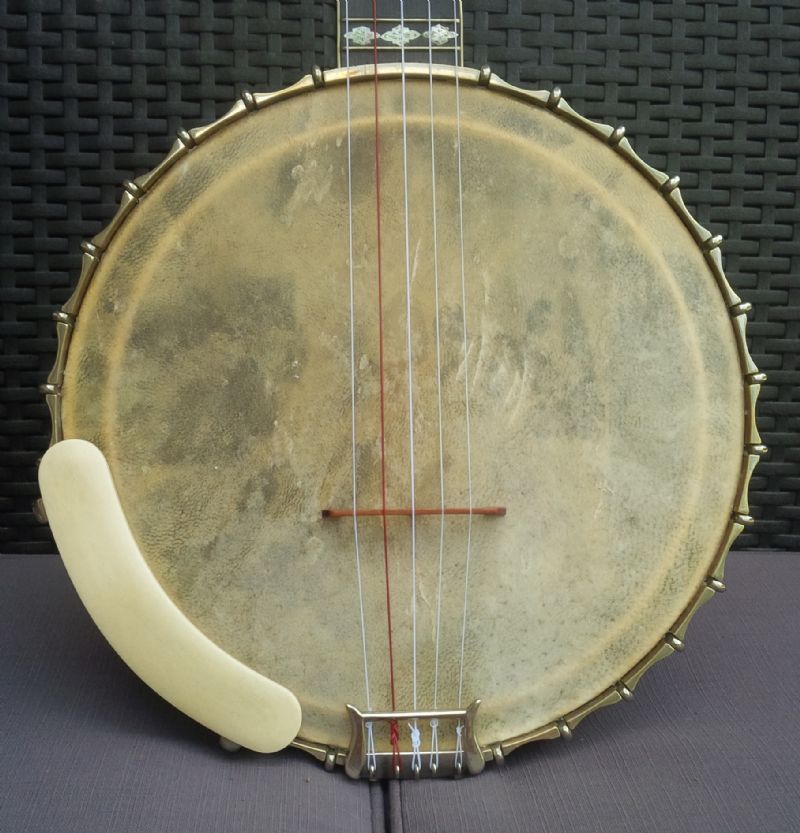
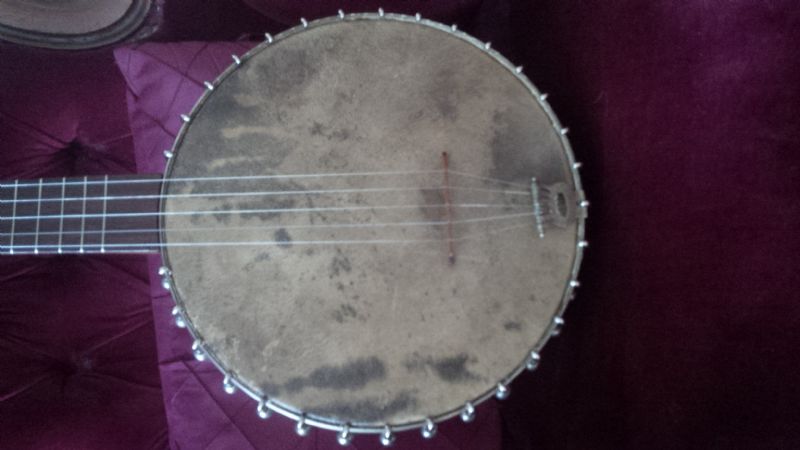
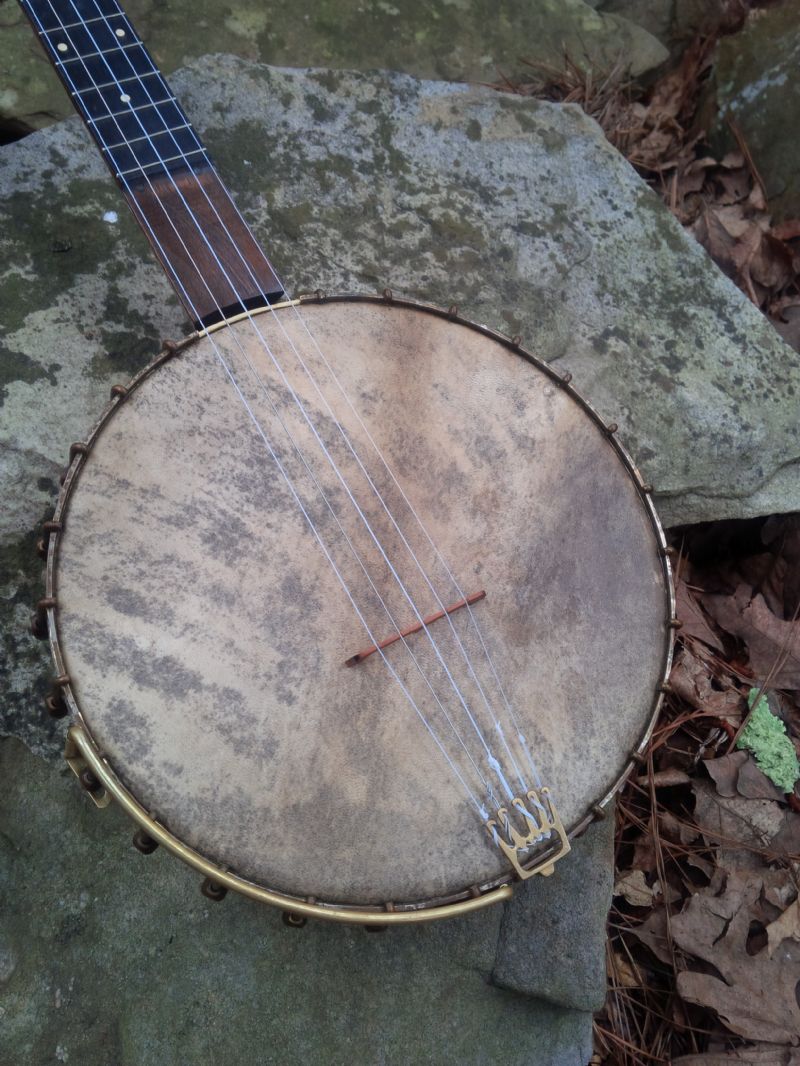
I did these three with dark oil based Min-Wax stains on both surfaces. There have been no deleterious effects to skin tightness. I have no idea whether the stain did anything to repel moisture.
Charlie Noyes
Joel Hooks - Posted - 04/10/2018: 08:59:39
I think I am finally having an old man moment! I just don't understand kids today with their stained banjo heads (shakes fist).
Seriously, this is one fad I just don't understand. Is it related to the same sort of thing as "relic" guitars?
I understand the environmental and cost saving benefits to using unplated parts but dark stained heads?
Give me a fresh white skin, or better yet Remo weatherking with no stamp from Smakula. There is also something to be said for the sparkling silver shine of good nickel plating.
Most of my banjos were built pre 1930 and don't exactly shine but the nickel still looks good.
On the other hand, my Eastman sparkles.
Ken LeVan - Posted - 04/10/2018: 09:18:20
quote:
Originally posted by Joel HooksI think I am finally having an old man moment! I just don't understand kids today with their stained banjo heads (shakes fist).
Seriously, this is one fad I just don't understand. Is it related to the same sort of thing as "relic" guitars?
I understand the environmental and cost saving benefits to using unplated parts but dark stained heads?
Give me a fresh white skin, or better yet Remo weatherking with no stamp from Smakula. There is also something to be said for the sparkling silver shine of good nickel plating.
Most of my banjos were built pre 1930 and don't exactly shine but the nickel still looks good.
On the other hand, my Eastman sparkles.
It has to do with a customer request.
Dan Drabek - Posted - 04/10/2018: 09:39:26
quote:
Originally posted by Joel HooksI think I am finally having an old man moment! I just don't understand kids today with their stained banjo heads (shakes fist).
Seriously, this is one fad I just don't understand. Is it related to the same sort of thing as "relic" guitars?
I understand the environmental and cost saving benefits to using unplated parts but dark stained heads?
Give me a fresh white skin, or better yet Remo weatherking with no stamp from Smakula. There is also something to be said for the sparkling silver shine of good nickel plating.
Most of my banjos were built pre 1930 and don't exactly shine but the nickel still looks good.
On the other hand, my Eastman sparkles.
I don't have a problem with stained heads, but this fad I could live without:
premierguitar.com/articles/Fen...ar_Review
DD
Joel Hooks - Posted - 04/10/2018: 10:55:06
I suppose it is not exactly the same as the "road worn" or "relic" guitars, but it is similar in that it is nostalgically old fashioned.
Albert Baur wrote that after he had run away as a child he was working for a book binder in New York City. His first real close exposure to banjos (besides attending minstrel shows) was when he was sent to have the marbling done. The marbling shop was a hangout for professional banjoists. There was a fad at that time (mid late 1850s) of marbling banjo heads. I presume this was done after it was mounted on the flesh hoop.
That is something that I could get behind! Marbled banjo heads.
G Edward Porgie - Posted - 04/10/2018: 11:50:42
quote:
Originally posted by Joel HooksI think I am finally having an old man moment!
Welcome to the club!
rudy - Posted - 04/10/2018: 12:24:35
I don't understand these kids today wanting to have their banjo heads marbled! 
Ken LeVan - Posted - 04/10/2018: 12:41:24
As I was researching this, I discovered that you can tie dye drum heads, and people actually do that.

jbalch - Posted - 04/10/2018: 14:27:00
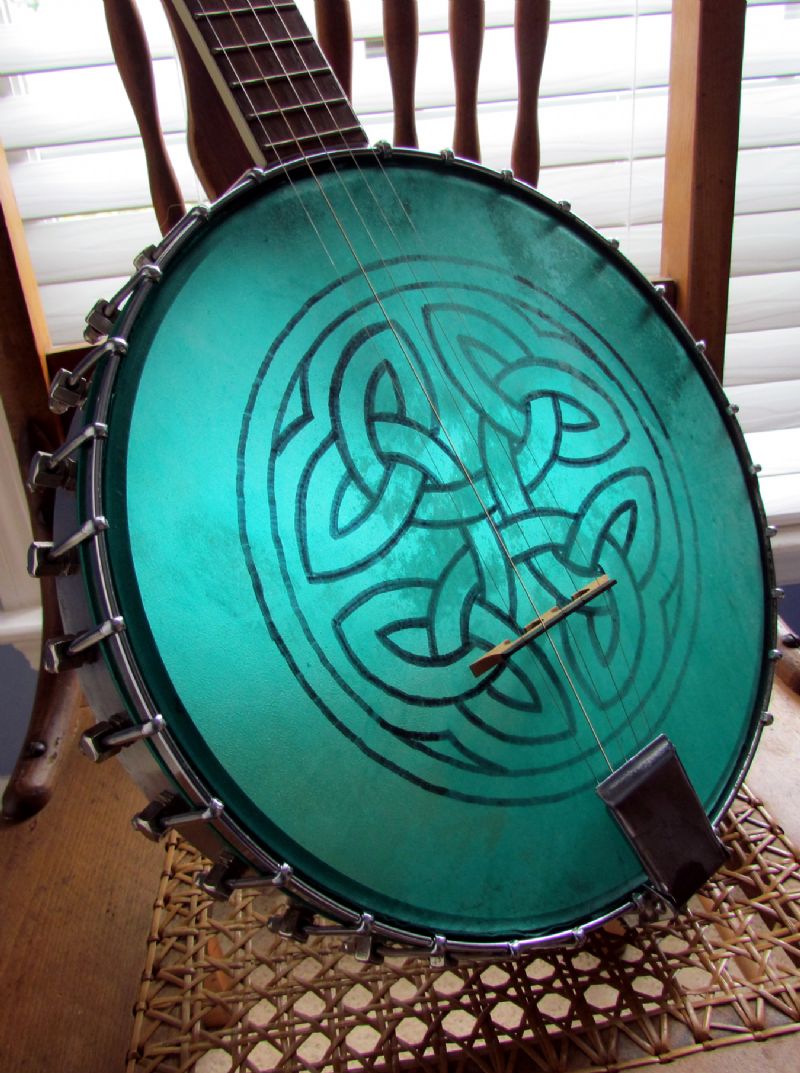
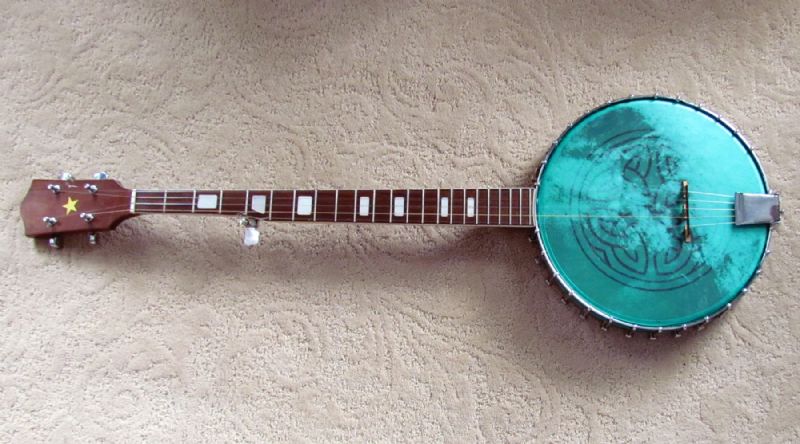
A few years ago, Bill Miller offered dyed hides in two colors. I don't know the process he used.
I tried a couple of them They worked great.
I inked a Celtic design on the green one.
Meles_Meles - Posted - 04/10/2018: 19:43:02
quote:
Originally posted by Joel HooksThe marbling shop was a hangout for professional banjoists. There was a fad at that time (mid late 1850s) of marbling banjo heads. I presume this was done after it was mounted on the flesh hoop.
If you like marbling, check out the work done by Michael Kensinger in San Francisco. He does clothing with the same floating-oil method used to marble better-quality hardcover books. (He learned his tricks at aq publisher's, too.) He's a really nice guy, and would probably love to do a banjo head. He'll be even more inclined to do it if you tell him that you were referred by Thomas from Maryland, as I own around two dozen vests that he did for me.
Ken LeVan - Posted - 04/11/2018: 04:41:09
quote:
Originally posted by Meles_Melesquote:
Originally posted by Joel HooksThe marbling shop was a hangout for professional banjoists. There was a fad at that time (mid late 1850s) of marbling banjo heads. I presume this was done after it was mounted on the flesh hoop.
If you like marbling, check out the work done by Michael Kensinger in San Francisco. He does clothing with the same floating-oil method used to marble better-quality hardcover books. (He learned his tricks at aq publisher's, too.) He's a really nice guy, and would probably love to do a banjo head. He'll be even more inclined to do it if you tell him that you were referred by Thomas from Maryland, as I own around two dozen vests that he did for me.
Sounds like the technique used to make "cockerel paper", once used to line the insides of book covers upside down - also the technique to make the icing on Napoleon pastries right side up.
I actually did that with wet concrete dyed with iron oxide pigments when casting concrete floors in my house using a rake. It never ceases to attract attention and questions about how it was done.
In order to do it to a banjo head, you'd have to stretch the head in some dead level way in order to do the "float".

Joel Hooks - Posted - 04/11/2018: 05:54:44
Yes, it was done the same way as the edges and insides of books. I have witnessed the process more than a few times and have a friend who taught the process while she was in college.
It would not be difficult and no extra special tools would be needed (nor any complicated setting). I have seen it done with wooden boxes lined with a tin tray. There is a dye that floats on the surface of a solution. That dye is mixed with something that prevents it from mixing. It is dripped on the surface and manipulated for the desired pattern. Then the paper is dipped and hung to dry.
First video that came up on youtube explains the process (as I don't really know what I am talking about).
youtube.com/watch?v=T3qcCoJ70XY
Joel Hooks - Posted - 04/11/2018: 05:55:41
I am strangely attracted to the tie-dye heads. I can't bring myself to do something like that but it is kinda cool.
Ken LeVan - Posted - 04/13/2018: 04:50:23
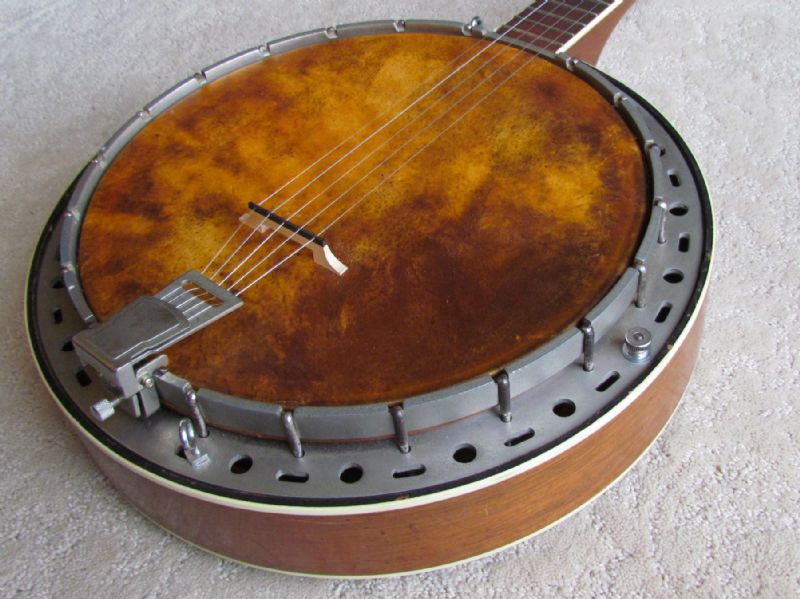
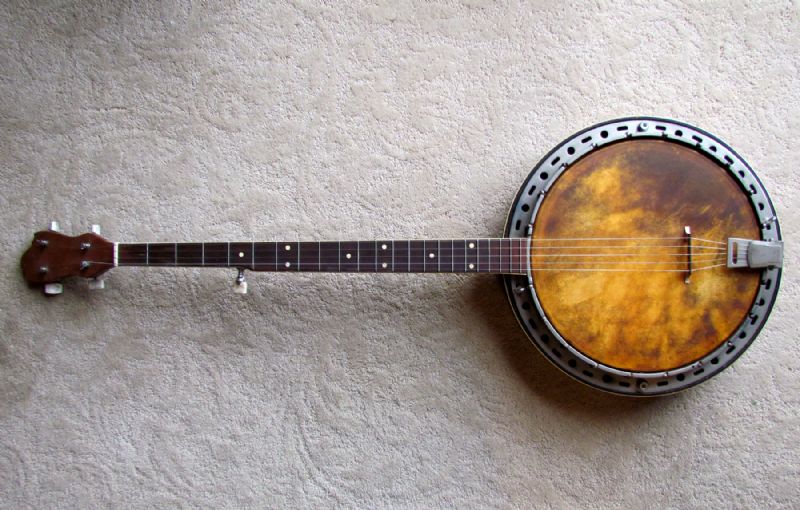
<p>I bit the bullet and just did it with a thinned-down version of the same alcohol-based aniline dye I'm using for the neck. It came out really well - no problems. I did 3 "coats" or applications. As soon as you get that dye on the head the natural mottling of the hide pops right up,almost by magic.</p>
Edited by - Ken LeVan on 04/13/2018 04:56:56
jamesinkster - Posted - 04/13/2018: 12:56:34
Very cool. Did you dye it in the water while soaking the head, or after the fact (once the head had already dried)?
Ken LeVan - Posted - 04/13/2018: 14:17:10
quote:
Originally posted by jamesinksterVery cool. Did you dye it in the water while soaking the head, or after the fact (once the head had already dried)?
I did it while the head was on the banjo - dye thinned down with alcohol and a 2" varnish brush.
I was afraid it would get streaky, but it didn't. The dry head just sucked the dye right in and actually feathered it out, and the alcohol quickly evaporated off. It was extremely easy to do - no oil, water, or anything on the head.
I'll be posting pictures of it when I am finished with that banjo.
bosborne - Posted - 05/22/2018: 06:15:23
quote:
Originally posted by Ken LeVanquote:
Originally posted by jamesinksterVery cool. Did you dye it in the water while soaking the head, or after the fact (once the head had already dried)?
I did it while the head was on the banjo - dye thinned down with alcohol and a 2" varnish brush.
I was afraid it would get streaky, but it didn't. The dry head just sucked the dye right in and actually feathered it out, and the alcohol quickly evaporated off. It was extremely easy to do - no oil, water, or anything on the head.
I'll be posting pictures of it when I am finished with that banjo.
Ken,
I noticed in one of your posts that you talked about a "customer request". I'm looking for a skin head to replace the torn one on my Chuck Lee, and this head is dyed blue, and it's a bit "splotchy" and not-uniform, which looks nice. Do you do this kind of work?
Thank you,
Brian O.
Ken LeVan - Posted - 05/22/2018: 10:24:51
quote:
Originally posted by bosbornequote:
Originally posted by Ken LeVanquote:
Originally posted by jamesinksterVery cool. Did you dye it in the water while soaking the head, or after the fact (once the head had already dried)?
I did it while the head was on the banjo - dye thinned down with alcohol and a 2" varnish brush.
I was afraid it would get streaky, but it didn't. The dry head just sucked the dye right in and actually feathered it out, and the alcohol quickly evaporated off. It was extremely easy to do - no oil, water, or anything on the head.
I'll be posting pictures of it when I am finished with that banjo.
Ken,
I noticed in one of your posts that you talked about a "customer request". I'm looking for a skin head to replace the torn one on my Chuck Lee, and this head is dyed blue, and it's a bit "splotchy" and not-uniform, which looks nice. Do you do this kind of work?
Thank you,
Brian O.
Actually, I don't.
The one I dyed broke soon after, and I don't know if it was a faulty head or the dye, so until I sort that out, I'm not going to dye any more heads.
Thanks for asking though.
Ken
Bart Veerman - Posted - 05/22/2018: 13:44:41
quote:
Originally posted by Joel HooksI think I am finally having an old man moment! I just don't understand kids today with their stained banjo heads (shakes fist).
I get it, why make them look like something else, or used 
On the other hand, folks insist on using gorgeous looking woods to make banjos and slop right over it with stains and whatever until the wood is barely recognizable...
Dan Drabek - Posted - 05/22/2018: 15:02:26
quote:
Originally posted by Bart Veermanquote:
Originally posted by Joel HooksI think I am finally having an old man moment! I just don't understand kids today with their stained banjo heads (shakes fist).
I get it, why make them look like something else, or used
On the other hand, folks insist on using gorgeous looking woods to make banjos and slop right over it with stains and whatever until the wood is barely recognizable...
A pair of Women's Levi jeans have gotten really expensive these days. And you can buy a brand new pair that have frayed edges, holes in the knees, stains and paint spatters, that cost twice as much.
I think the stained head craze is just another example of 'false tradition' we have invented. Along with raw, patinated hardware, fret scoops and plunky tone.
Not to put down the "antiquing" trend. I've done a bit of it myself. But I think of it as being fashionable rather than historical.
DD
Ken LeVan - Posted - 05/22/2018: 15:21:05
There are all kinds of ways to finish things, and patina is just one. Everything doesn't have to look brand new even itf it is - some things look better with a little character - I would never in a million years have my old Granada re-plated.
Just like everything else, It all has to do with how well it's done.
Dan Drabek - Posted - 05/22/2018: 15:44:00
I agree totally. I am a big fan of the "wabi-sabi" concept. And I think that patination can add a lot of character, beauty and interest to a piece.
The point I was making was that I think a lot of folks are under the mistaken assumption that such finishes are more historically authentic--which they are not. As far as I know, as far back as the turn of the century and before, no major American banjo maker ever used un-plated hardware or dyed heads. And their customers would probably not have bought them if they did. Just as modern buyers would not be likely to buy a new car or refrigerator that had been factory "aged."
DD
rudy - Posted - 05/22/2018: 15:47:41
quote:
Originally posted by Dan Drabekquote:
Originally posted by Bart Veermanquote:
Originally posted by Joel HooksI think I am finally having an old man moment! I just don't understand kids today with their stained banjo heads (shakes fist).
I get it, why make them look like something else, or used
On the other hand, folks insist on using gorgeous looking woods to make banjos and slop right over it with stains and whatever until the wood is barely recognizable...
A pair of Women's Levi jeans have gotten really expensive these days. And you can buy a brand new pair that have frayed edges, holes in the knees, stains and paint spatters, that cost twice as much.
I think the stained head craze is just another example of 'false tradition' we have invented. Along with raw, patinated hardware, fret scoops and plunky tone.
Not to put down the "antiquing" trend. I've done a bit of it myself. But I think of it as being fashionable rather than historical.
DD
That might be the narrative for some, but my reasoning is different for many of the items you point out. I think we have to refrain from using too broad of a brush stroke to understand people's preferences.
I'm not into the stained head thing too much, but I do prefer the other items you pointed out as falling under the general moniker of "invented false tradition".
Patinated brass hardware is simply an extension of my preferance to make my own hardware because (1) it's nice to have shoes (and other hardware) that doesn't look like everyone else's hardware, (2) I can make it with the correct base profile to keep shoes from toeing into the rim over time, (3) solid and machined brass is much stronger than the "pot metal" shoes that are sold commercially, and (4) patination simply blends with the esthetic of the instrument and provides a simple and durable finish that takes the edge off the "everything good is new and shiny" syndrome.
Neck heel scoops? I simply enjoy the extra clearance over the board when I play, and as long as you're going to incorporate a scoop there's nothing particularly wrong with enjoying something for the way it looks. I love a double ogee scoop, but freely admit turning my back to many other types of fancy embellishment such as detailed pearl work.
Plunky tone? After living with progressively worsening tinnitus as well as hyperacousis for many years I HUGELY welcome a banjo with a softer and more rounded tonality.
All part of my "25 steps toward better banjo design", what I really like is for others to not blindly accept someone else's narrative of what a "proper" banjo should be and work to find what defines their own personal banjo nirvana.
Edited by - rudy on 05/22/2018 15:49:48
Terms of Use | Privacy Policy | Privacy Consent (EU/GDPR Only)
Copyright 2026 Banjo Hangout. All Rights Reserved.