DVD-quality lessons (including tabs/sheet music) available for immediate viewing on any device.
Take your playing to the next level with the help of a local or online banjo teacher.
Weekly newsletter includes free lessons, favorite member content, banjo news and more.
Premier Sponsors





|
Please note this is an archived topic, so it is locked and unable to be replied to. You may, however, start a new topic and refer to this topic with a link: http://www.banjohangout.org/archive/347531
Joel Hooks - Posted - 10/20/2018: 17:58:08
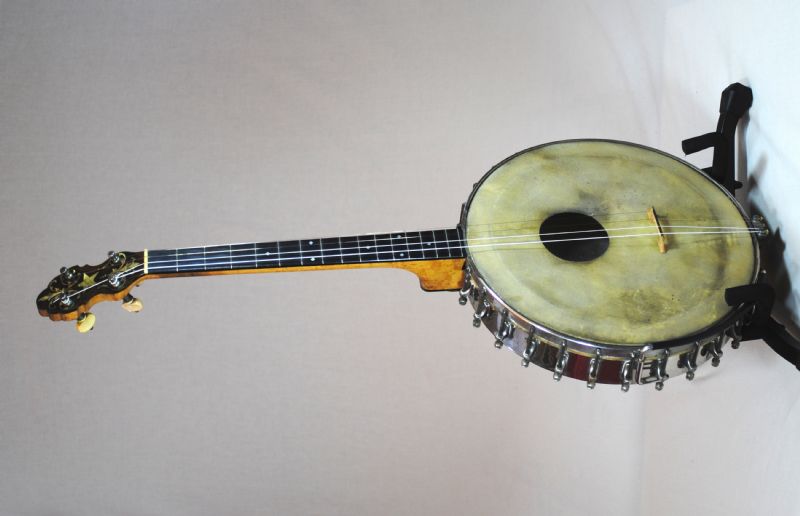
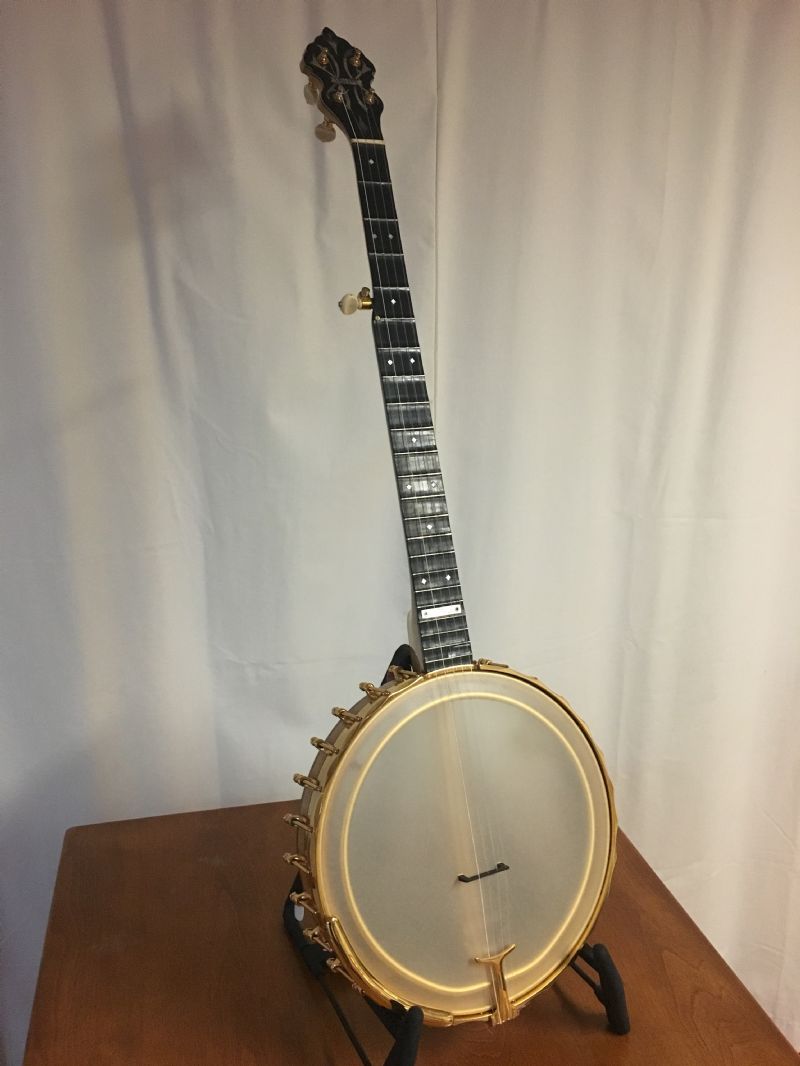
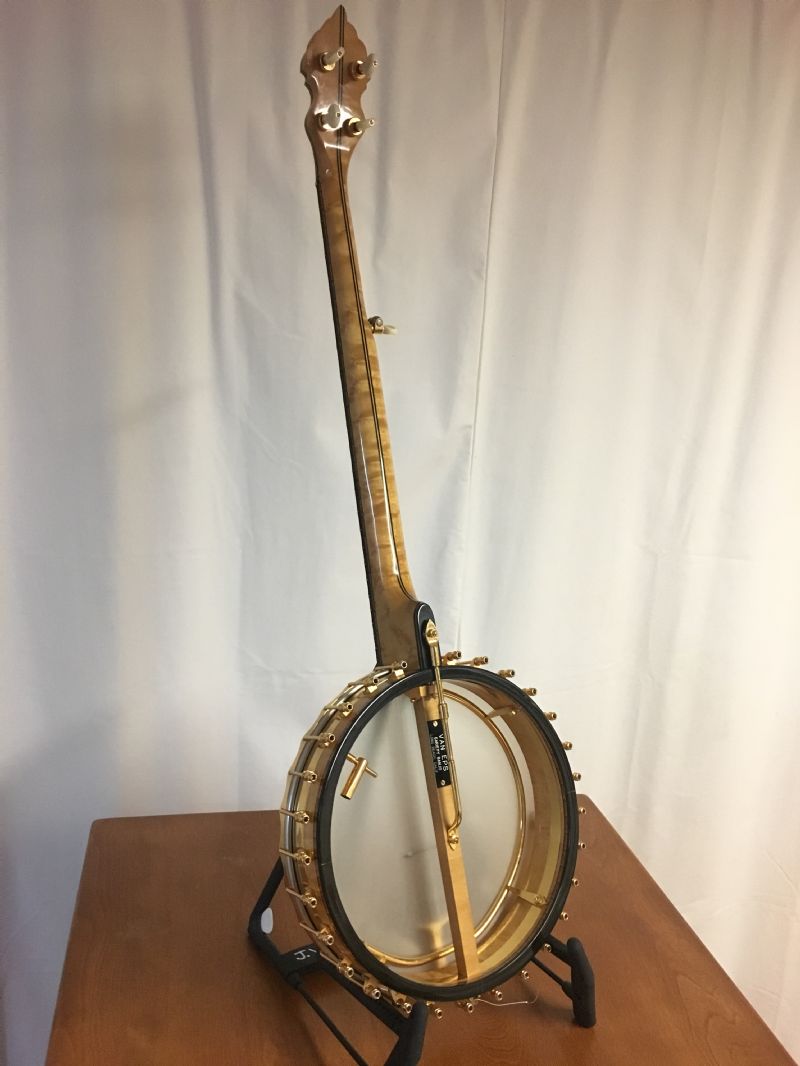
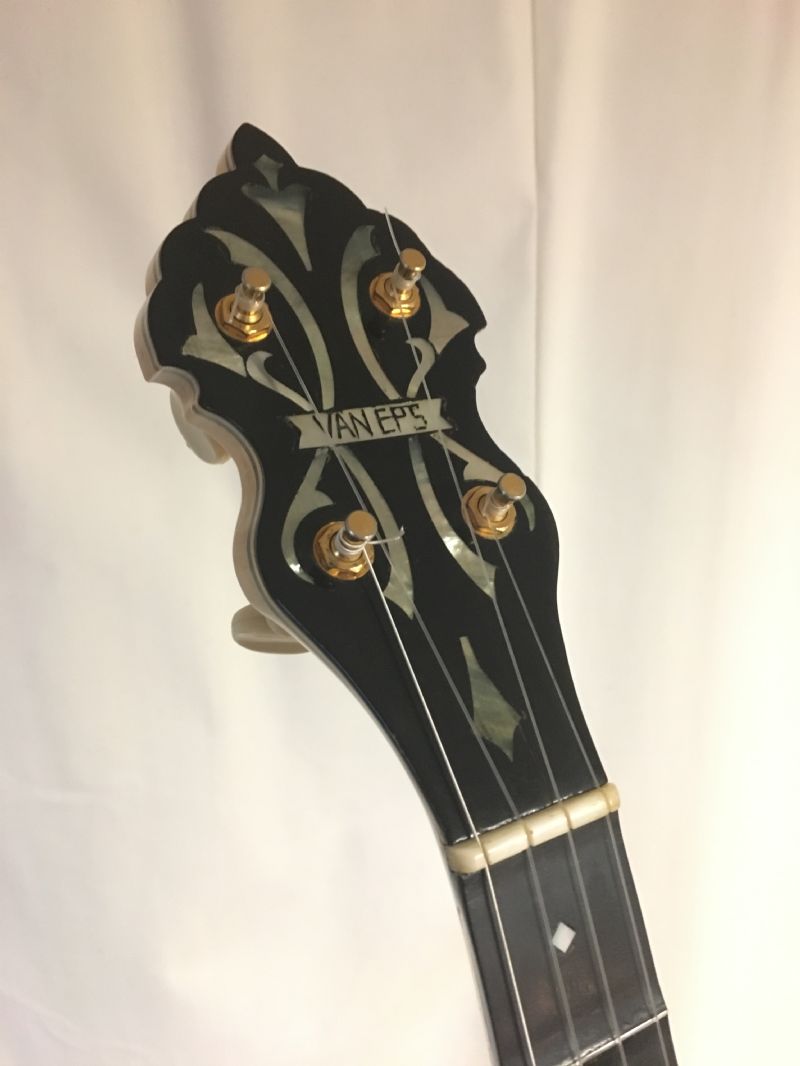
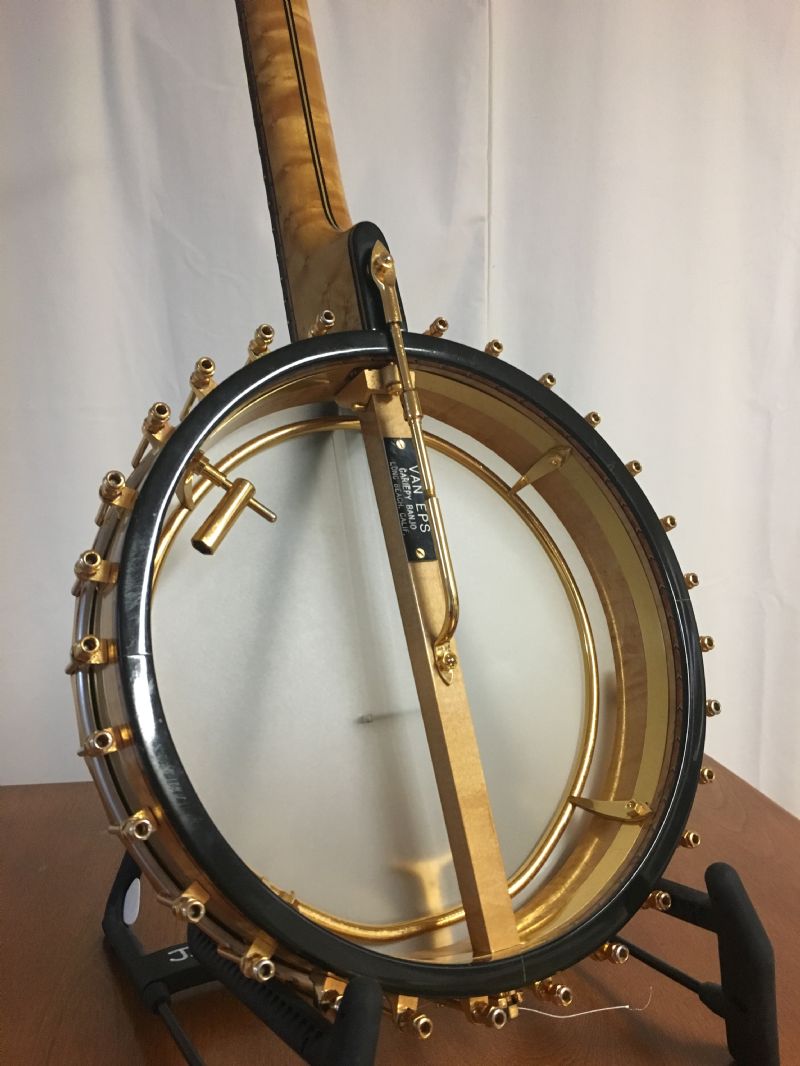
Hi folks, I recently came back from the American Banjo Fraternity Fall Rally with a new acquisition that I wanted to share.
A little back story...
If you don't know who Fred Van Eps is, please search his name on Youtube.
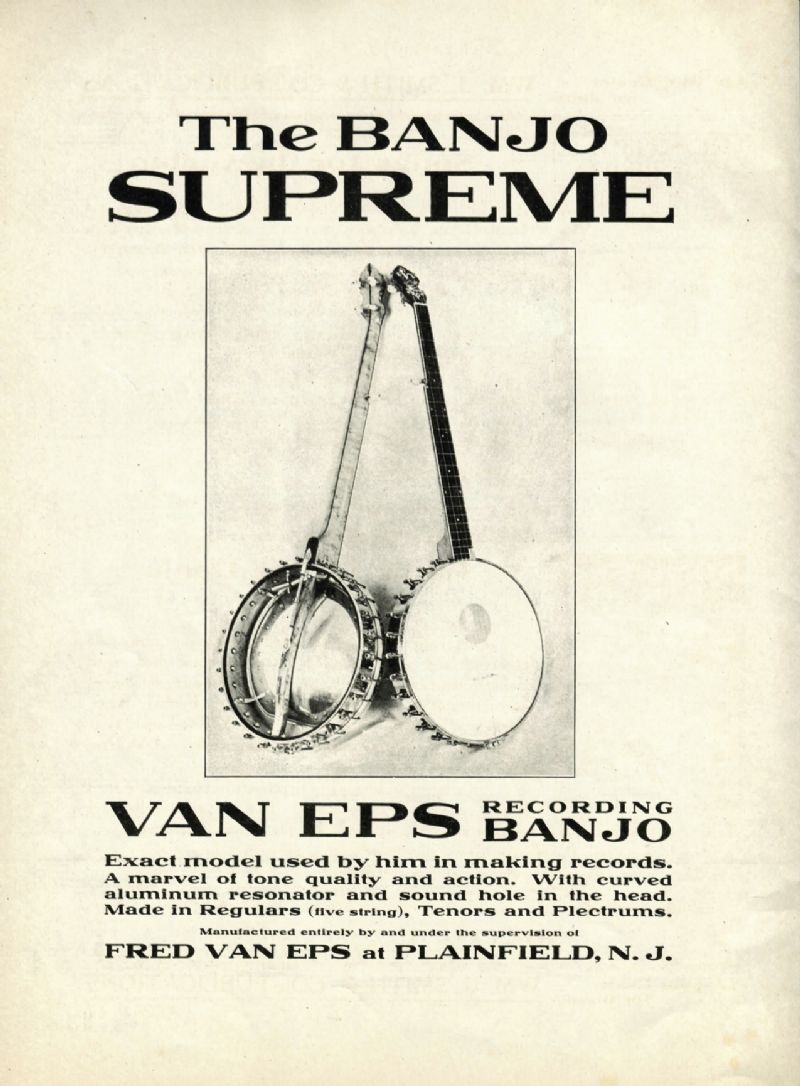
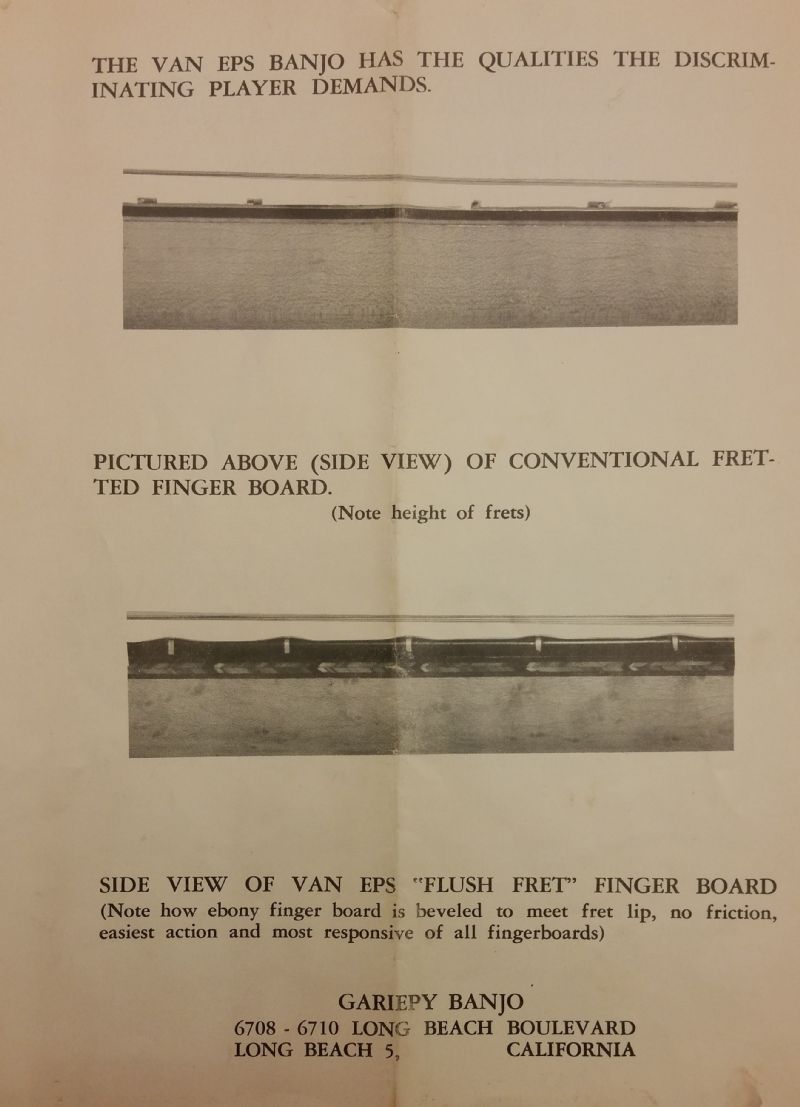
FVE built banjos until he died. Sometime in the early 1930s he developed what he called a "flush fret" fingerboard. It was actually scalloped. These "flush Fret" banjos have become sort of legendary among "classic banjoists." They are very rare, but excellent for the style.
Shortly before he died, FVE moved from Plainfield, NJ to California to live with his son Robert Van Eps. He took with him all of his banjo making tools, patterns, wood, and parts. The idea was that he and Robert were going to continue to build flush fret banjos together but at a higher volume (25 at a time, instead of the 6 at a time he usually built).
Once settled, they started making parts and he taught Robert how to make banjos (FVE had written very detailed instructions as well). Then FVE died after passing a driving test. That was 1960.
In the "5-Stringer" (newsletter of the ABF) issue after FVE passed, Robert announced that he intended to continue making FVE banjos. In issue #76 it was reported that Robert was hosting a rally at his house when he showed a stack of rims "shoulder high, "an unopened crate of parts," and "enough birdseye maple wood to make necks for a long time"-- all from FVE's stock.
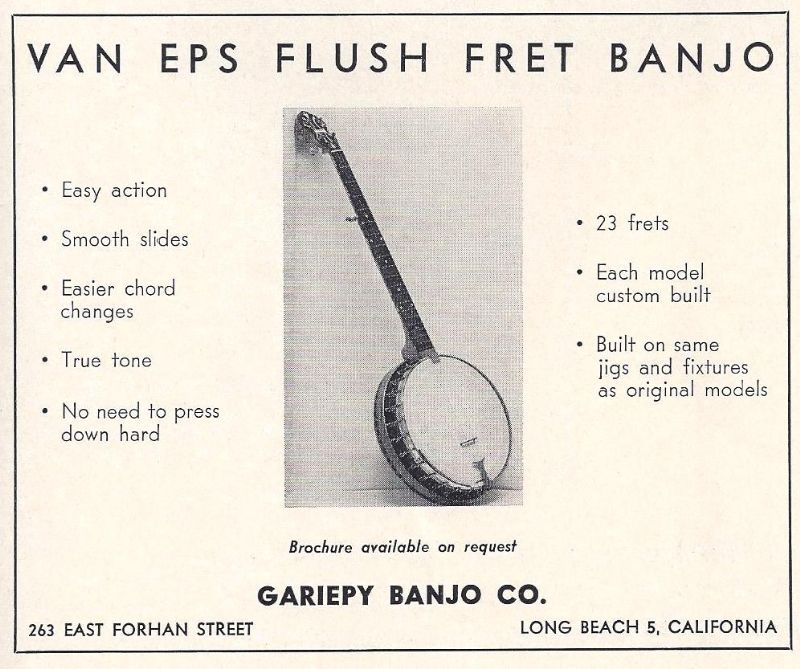
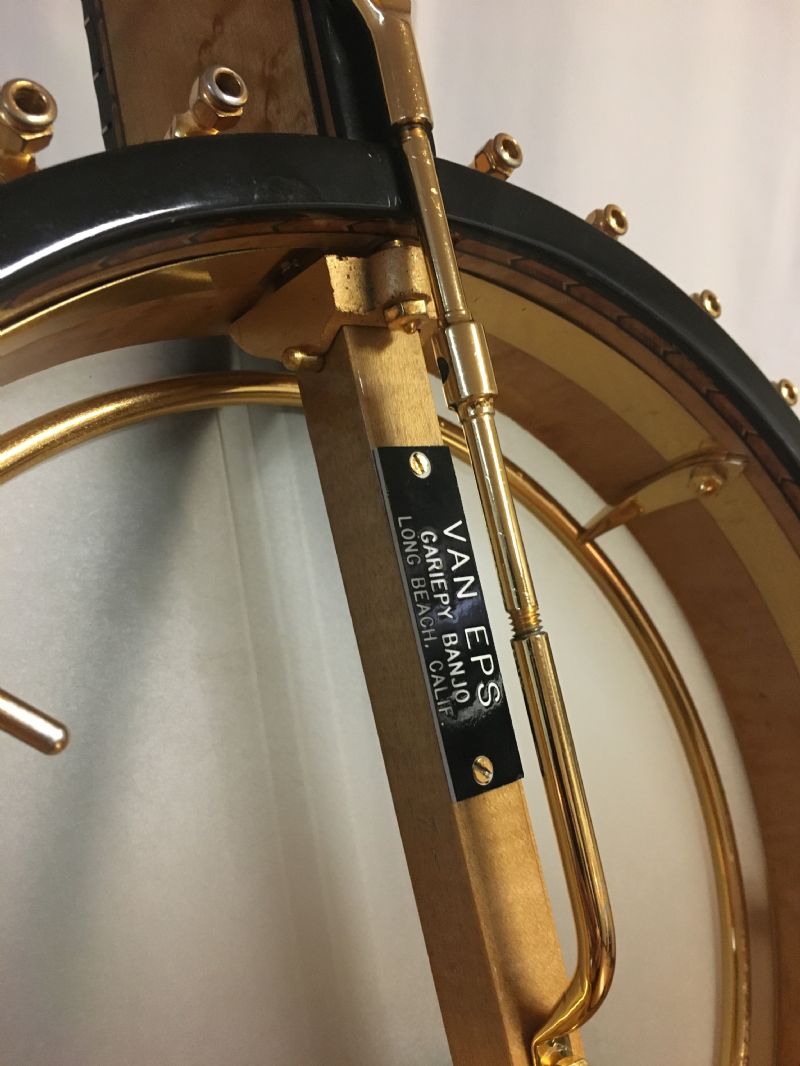
In #85 (1962) it is reported that Robert Van Eps had leased all of FVE's machinery, jigs, and all necessary equipment to ABF member Joseph Gariepy (who joined in 1961). Joseph had been previously announced as "was a friend of Fred Bacon and great admirer of his banjo playing and took lessons from him in times past." Gariepy was making his own line of "Mercury" banjos where he did all the work to make every part of the banjo except the plating (and I presume the tuners and plastic heads). He was making fully custom banjos in any length or size desired.
The banjo that FVE took to rallies was also given to Joseph as a control. Joseph was moving to a larger shop to have room for all of the equipment to build the FVE banjos. All FVE model banjos would be approved by Robert Van Eps before they were shipped.
In issue #86 it was written that he had set up a new larger shop and was making FVE style wood rims. In this issue he was referred to as Joseph (Art) Gariepy. From that point on he was called Art Gariepy.
Most of the Gariepy banjos I have seen online have many features of the FVE banjos but are still very different.
John Hoft had posted and asked about the Gariepy FVE flush fret "classical" banjos in the past. Gariepy advertised them in "Sing Out" in 1963 (the banjo pictured in the ad was a FVE make). They sold for $500! That was a lot of cash in the mid 1960s.
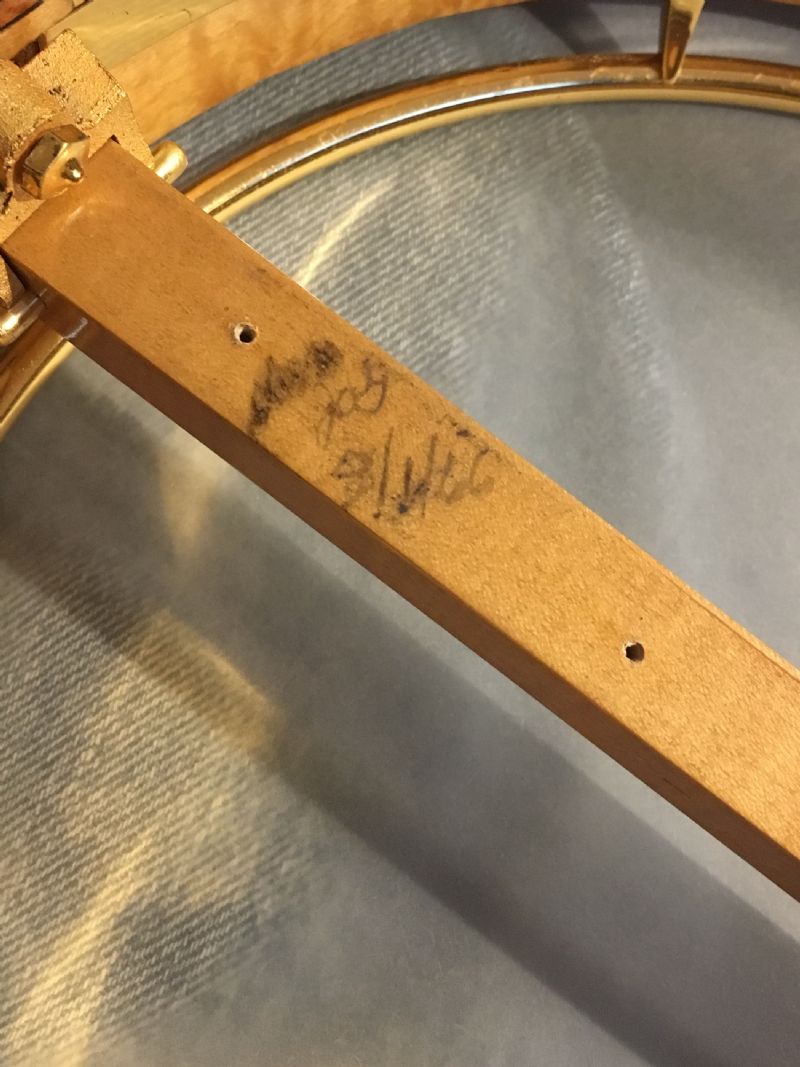
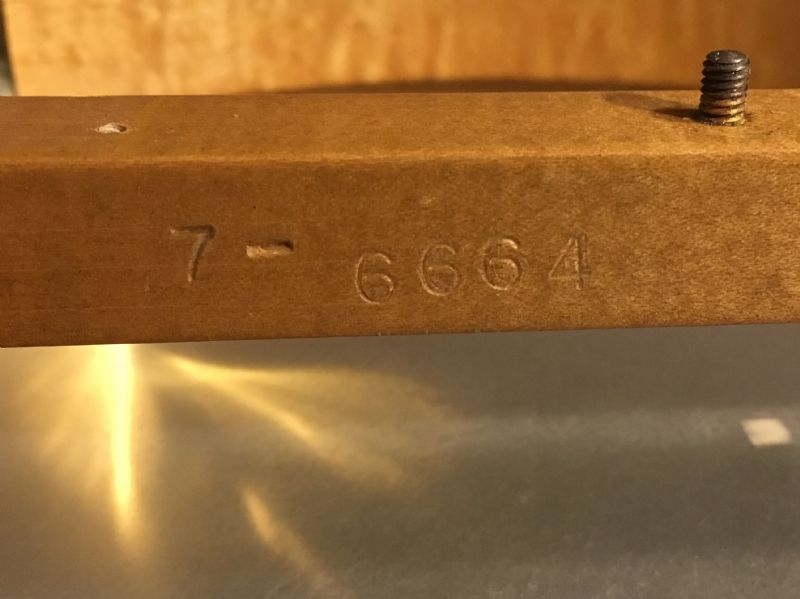
Mine was built in 1966. He had been making them for a few years by then. By 1970 the model was not found in his catalog.
I am quite pleased to have acquired one. I only know of one other (currently owned by an ABF member). I also know that one person ordered one and paid in advanced (Gariepy offered free gold plating for advanced payment in full) and never got it. It would be cool to find out if there are more around.
Mine differs from a true FVE in a several ways. First, the Gariepy has a 27" scale. FVE used a 28.5" scale.
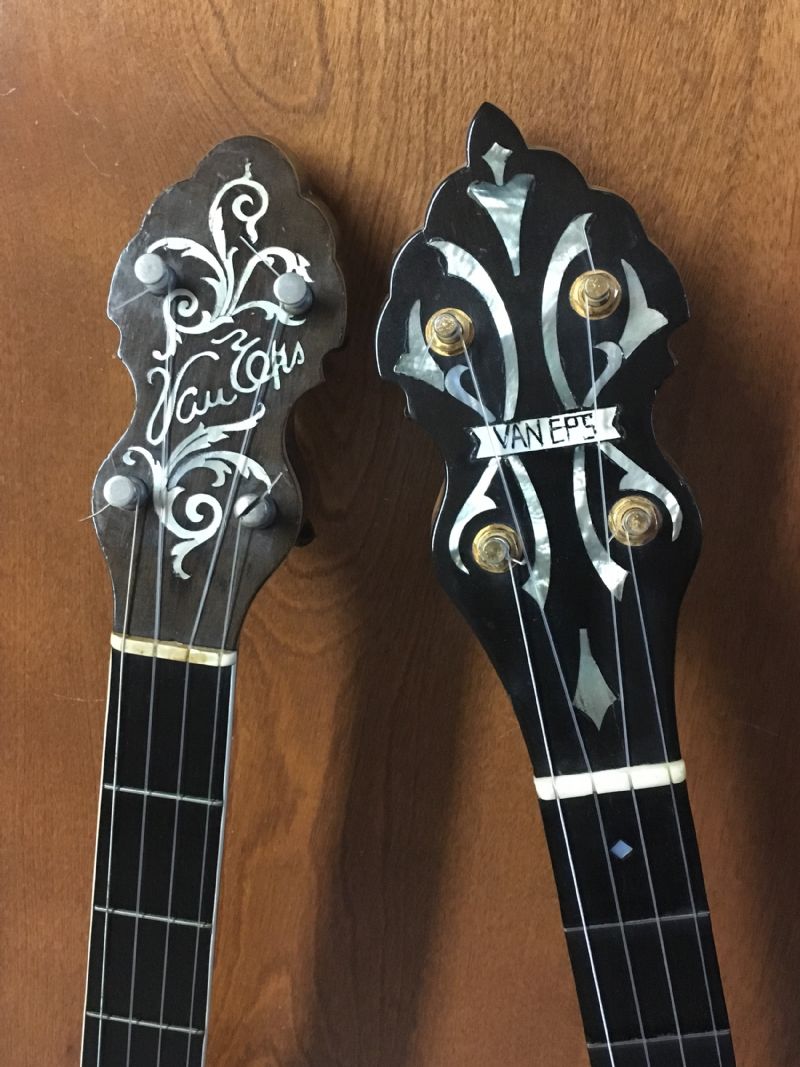
The peghead shape is what is found on other Gariepy banjos.
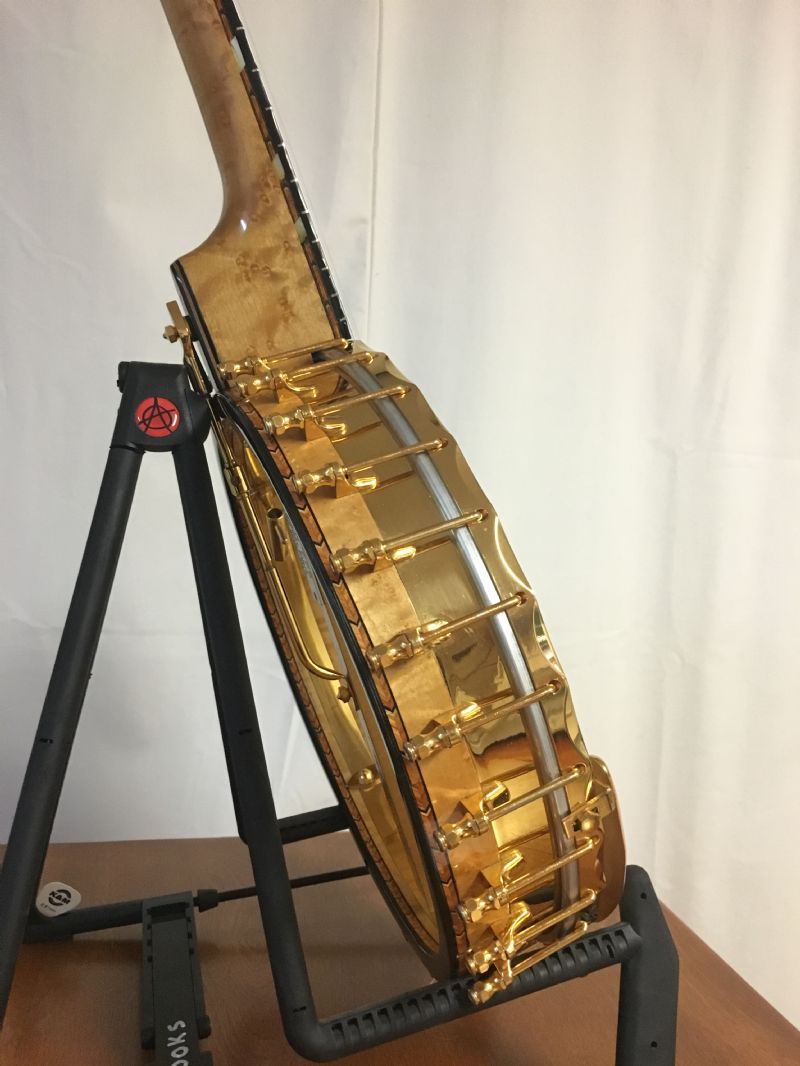
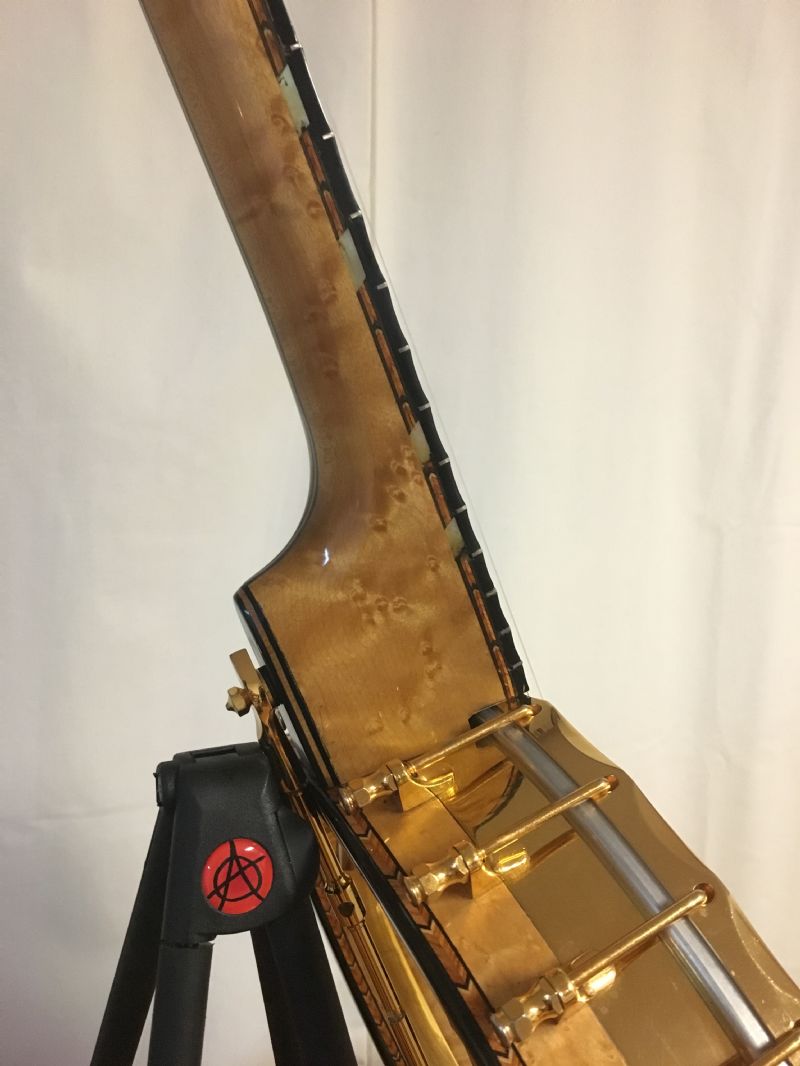
The rim has less marquetry binding than FVE used.
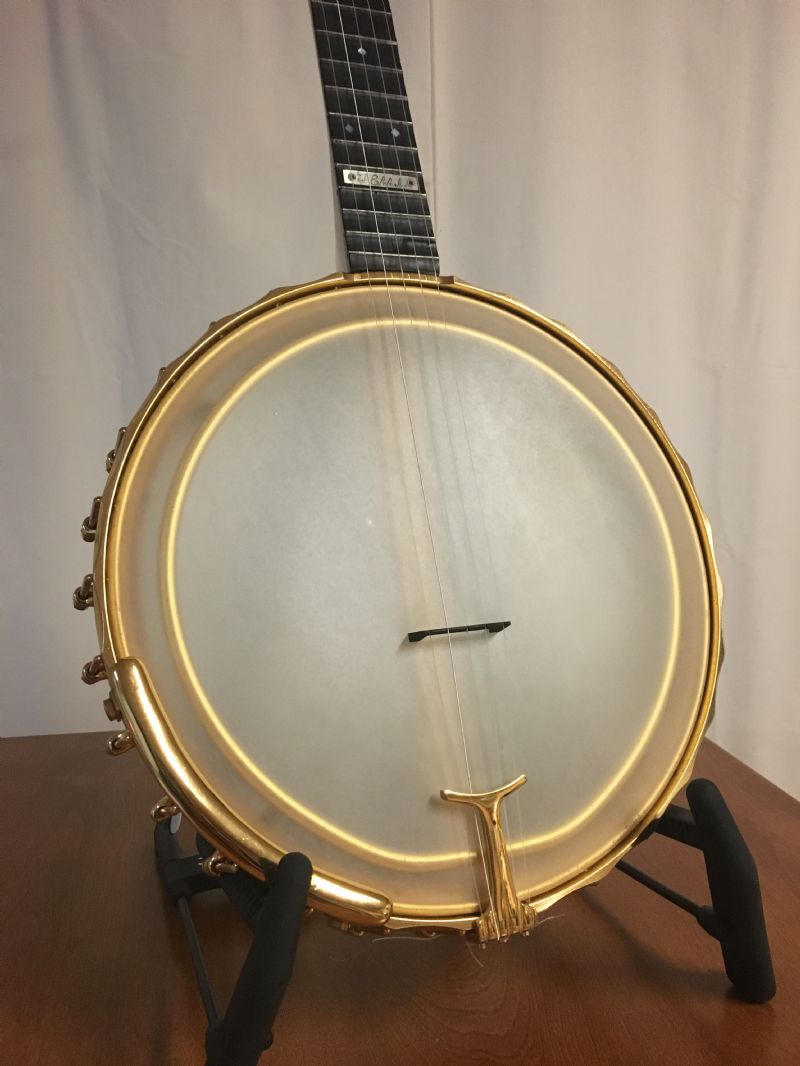
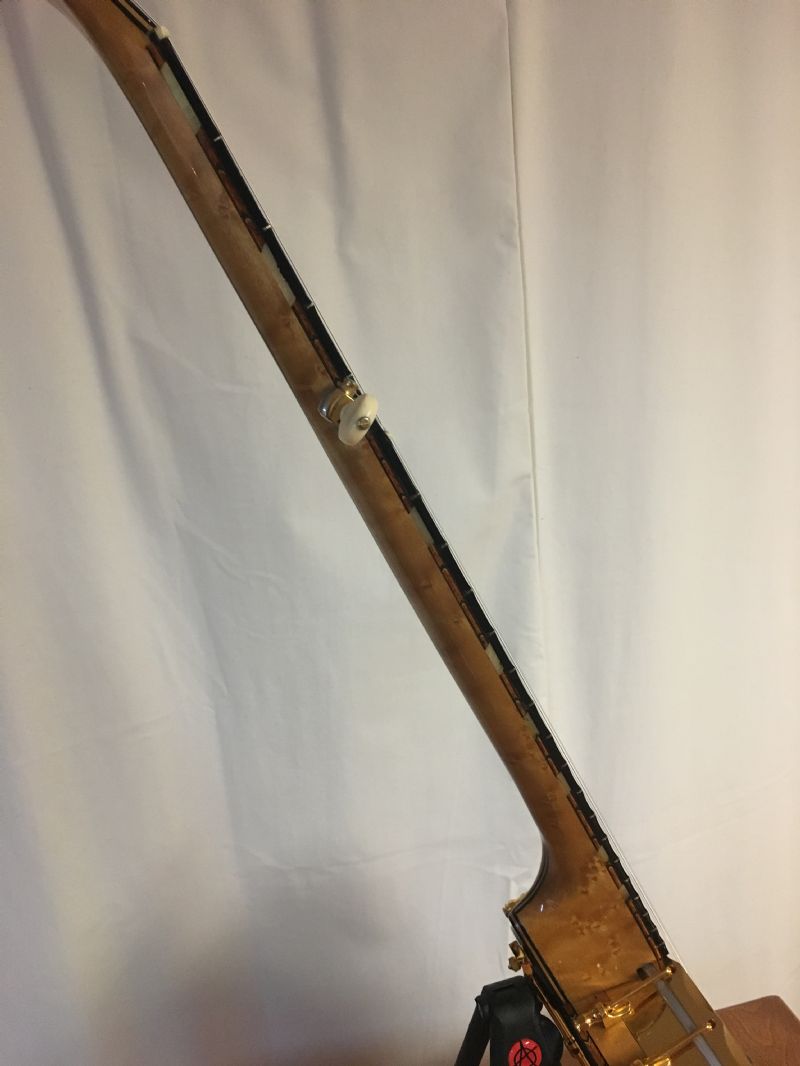
Gariepy used a truss rod (accessed through a pearl cover at the 19th position) FVE used no truss rods.
The positions are marked differently than FVE used (10th instead of 9th, etc.).
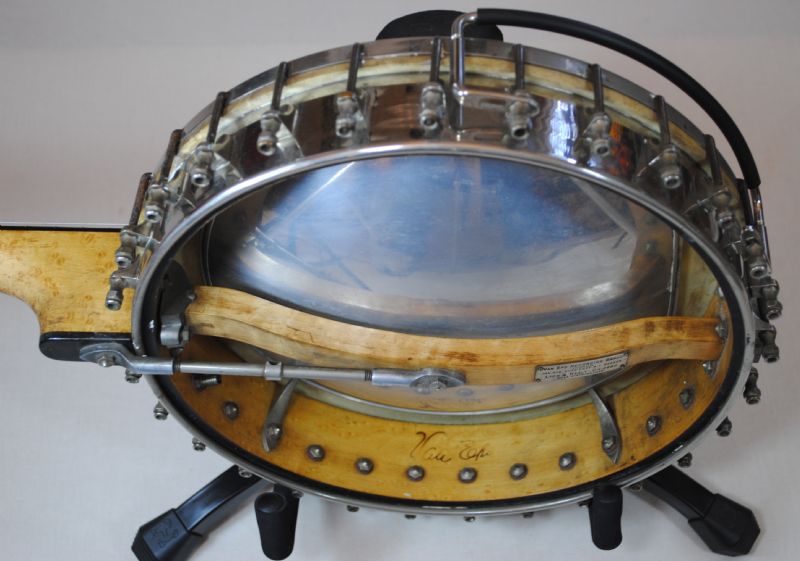
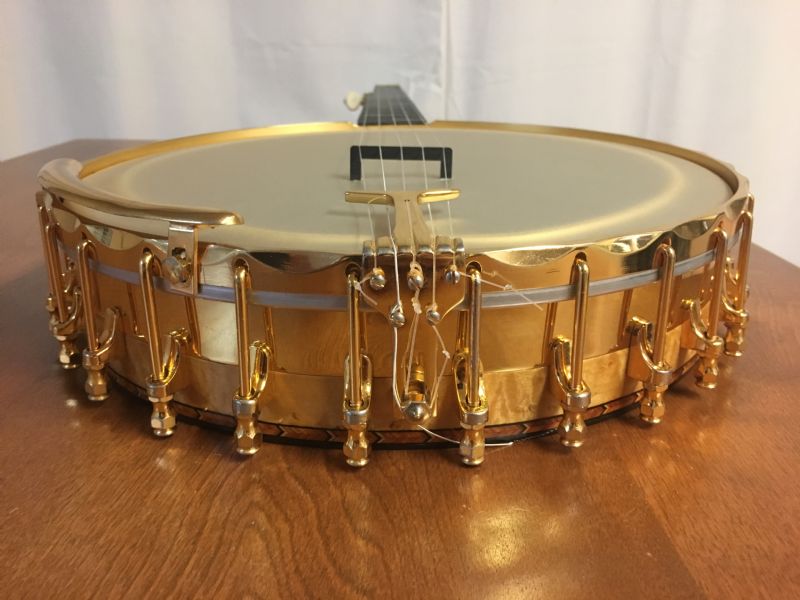
The tailpiece is made of brass (FVE used aluminum). The Gariepy tailpiece excluded the "no knot" feature (nylon strings had been in use since just after WW2).
This version has geared pegs (FVE friction pegs were an option). FVE used friction pegs having a large string barrel with a split down the middle. In combination with the large "no knot" lugs on the tailpiece he was able to replace a broken gut string quickly. There are stories about how he would keep first strings on the floor in front of him when on stage. When he would break a string the piano player would vamp while FVE put on a new string. Once tuned up they would pick up right where they left off.
The neck is 5 pieces (FVE used three most of the time).
Comparing it to other FVE banjos, the wood is clearly from the same stock. Most of the parts are identical to what FVE used too.
How does it play? It is a fantastic banjo-- the fingerboard is amazing.
Thanks for reading!
parlour player - Posted - 10/20/2018: 18:37:43
very beautiful banjos
thanks for showing the photographs .
the nearest i have got to playing a fret less banjo
is my shamisens you are in for a treat !
jun3machina - Posted - 10/20/2018: 22:37:14
Wow! What a beautiful aquisition!!! Thank you for sharing the story!
lazlototh - Posted - 10/21/2018: 04:46:10
Great find. Some sound files would be great when you get a chance.
What a beauty!
Alvin Conder - Posted - 10/21/2018: 05:32:22
Those really are very beautiful instruments. Congratulations!
Thank you for the interesting info to go with it.
beezaboy - Posted - 10/21/2018: 06:42:42
Congratulations, Joel on bringing home a great find!
Swell story and research too.
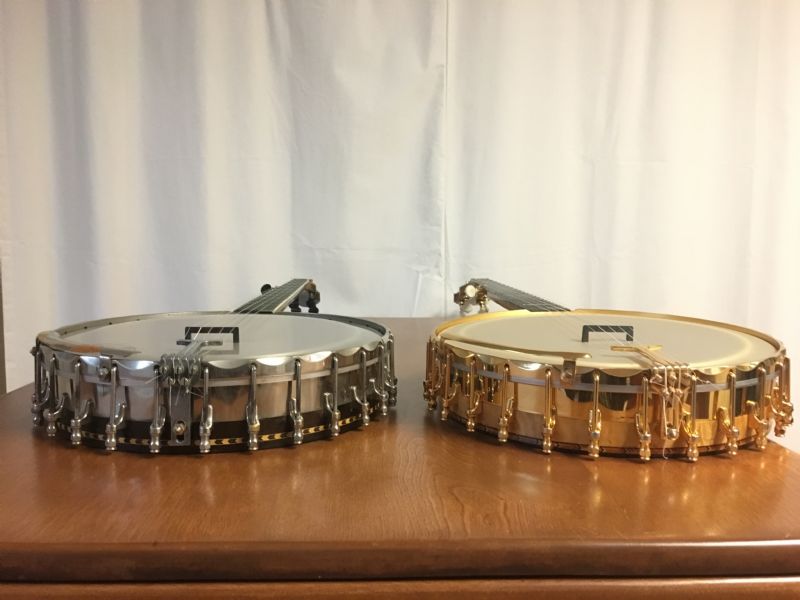
Attached are some FVE "old" and "new".
I'm a tenor banjo guy - please forgive.
Texican65 - Posted - 10/21/2018: 10:17:46
WOW, WOW, and WOW! Congratulations Joel old buddy! I'm very happy for you, and a bit envious/jealous! :)
That is one beautiful instrument, everything on it is just dripping in class and exquisite style. I can't wait to hear it.
Interesting concept with the truss rod access through the plate at the 19th...what is inscribed on the access cover? And also, are those your ebony bridges, or are they Van Eps/Gariepy made? I see on the bass side, that leg is a little higher, has to be intentional right?
Thanks for sharing, that is a real piece of history to be proud of. And thanks for the interesting story, I'd never heard any of that.
Oh also...now I know the difference in the Van Eps logo on the peg heads. i'd seen a tenor Van Eps some time ago, with the Gariepy style logo for sale on Ebay....but it didn't resemble the old logos I was used to......now I know why.
Dow
dbrooks - Posted - 10/21/2018: 13:20:40
A stunning banjo, Joel. Thanks for sharing the pics and the historical details.
David
Joel Hooks - Posted - 10/21/2018: 16:25:26
Thanks!
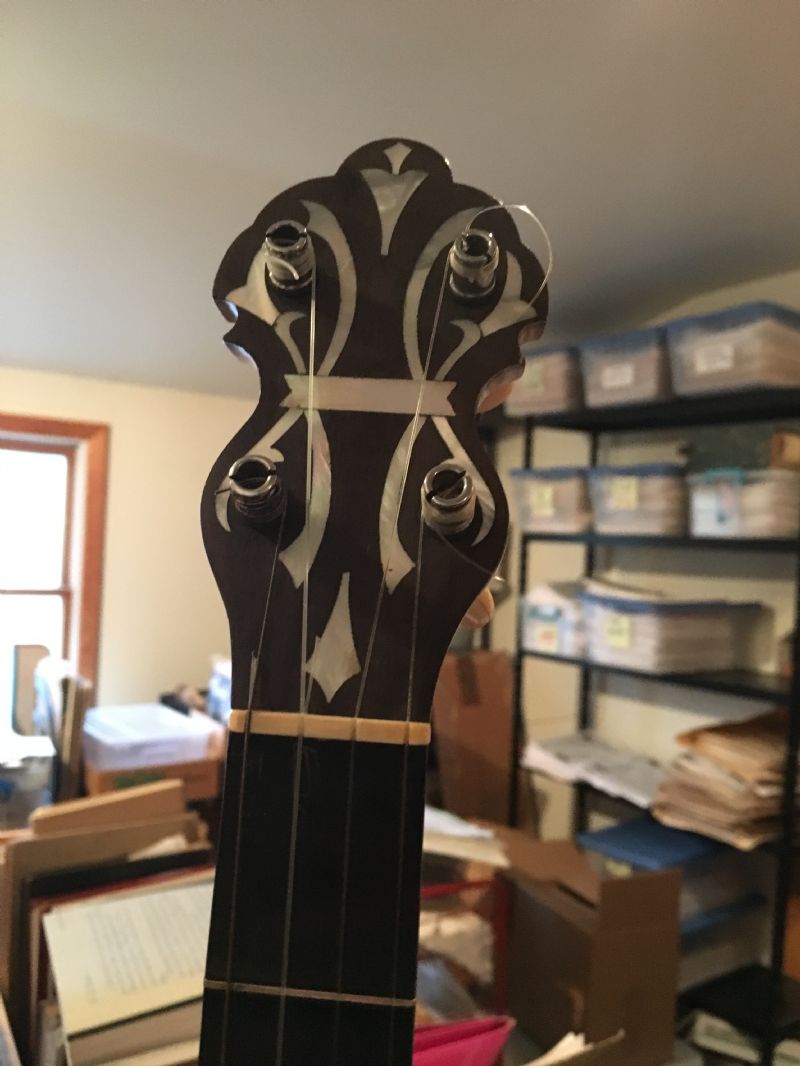
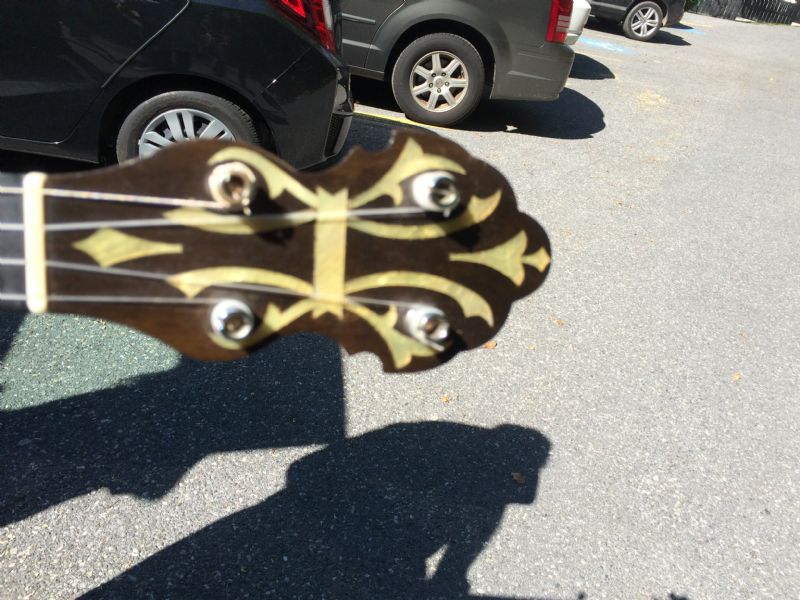
Just to be clear, the peg head inlay on the Gariepy is correct to the later FVE banjos. Only the shape is different.
The other FVE banjo posted above is a regular fretted (not "flush fret) banjo from the 1930s. I just added it for fun and comparison.
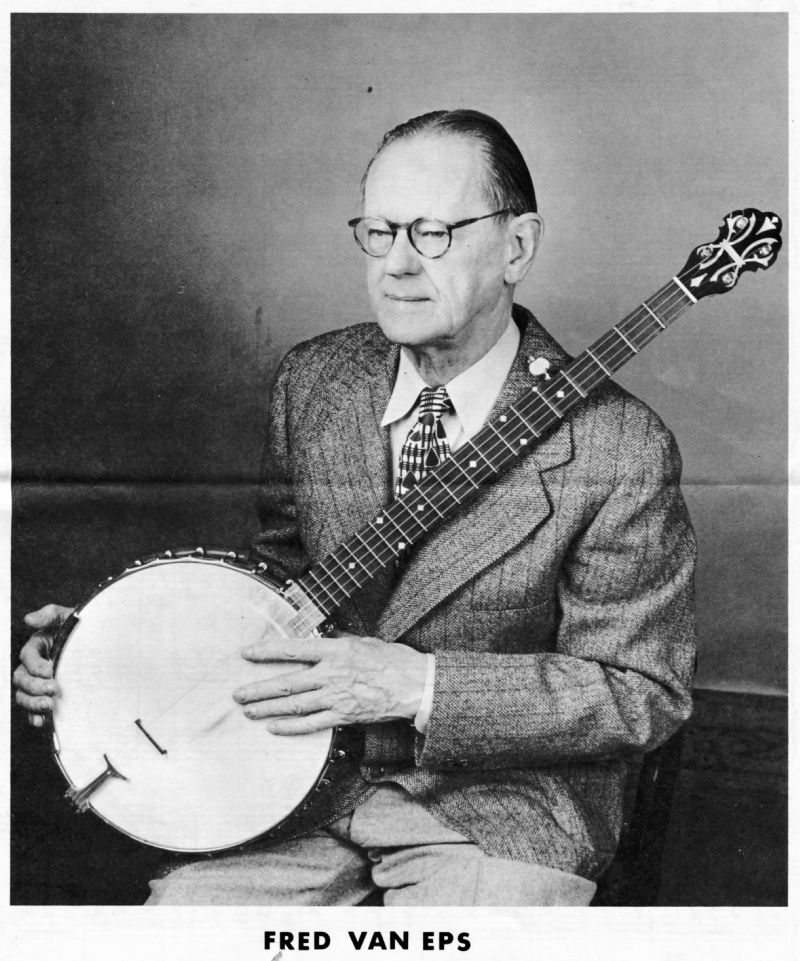
See below for photos of FVE pegheads from flush fret banjos he made (non of these are mine).
I'll see about recording something on my phone so folks can hear it.
Joel Hooks - Posted - 10/21/2018: 16:58:59
quote:
Originally posted by Texican65WOW, WOW, and WOW! Congratulations Joel old buddy! I'm very happy for you, and a bit envious/jealous! :)
That is one beautiful instrument, everything on it is just dripping in class and exquisite style. I can't wait to hear it.
Interesting concept with the truss rod access through the plate at the 19th...what is inscribed on the access cover? And also, are those your ebony bridges, or are they Van Eps/Gariepy made? I see on the bass side, that leg is a little higher, has to be intentional right?
Thanks for sharing, that is a real piece of history to be proud of. And thanks for the interesting story, I'd never heard any of that.
Oh also...now I know the difference in the Van Eps logo on the peg heads. i'd seen a tenor Van Eps some time ago, with the Gariepy style logo for sale on Ebay....but it didn't resemble the old logos I was used to......now I know why.
Dow
Keen eye about the bridge Dow. The ebony bridge is one of mine. I own two original FVE bridges (neither are usable as the notches are chipped out and one has a leg broken off). The ones I have made (limited in number) are exact size copies.
The slant is something I do with some banjos. I play with a pretty strong hand and need a lot of swing area or the strings will buzz. The slant gives me extra room for the 4th and 3rd strings while keeping the action low for the first and second. Just something I do. Chances are I will go to a flat bridge later but I tend to fuss around with bridges a lot and try different things.
Below is a recording I just did with my iphone. I don't know how accurate it represents the tone but it is something.
Alvin Conder - Posted - 10/21/2018: 19:06:56
Joel- That is some really fine playing.
The more I listen to this style of music and players like Fred Van Eps, I realize just how intricate and difficult it really is.
I know a lot of us here are mainly Bluegrass or traditional style players, but the instruments we love and play were originally designed to play mainly this style of music. A lot of us here owe a lot to those original gut string players.
Would love to see this style get more recognition, but I would have to assume that the difficulty to master it and the years it must take to get even moderately versitile puts a barrier up to most people to attempt to taclkle it.
Really well done. You should record on cylinder.
lazlototh - Posted - 10/22/2018: 03:04:33
Great playing. If there were hisses and pops, it would be hard to discern from an old recording.
Wonderful sounding.
Thank you for taking the time to do this.
Joel Hooks - Posted - 10/22/2018: 05:29:21
quote:
Originally posted by Alvin ConderJoel- That is some really fine playing.
The more I listen to this style of music and players like Fred Van Eps, I realize just how intricate and difficult it really is.
I know a lot of us here are mainly Bluegrass or traditional style players, but the instruments we love and play were originally designed to play mainly this style of music. A lot of us here owe a lot to those original gut string players.
Would love to see this style get more recognition, but I would have to assume that the difficulty to master it and the years it must take to get even moderately versitile puts a barrier up to most people to attempt to taclkle it.
Really well done. You should record on cylinder.
Thanks!
It is only difficult of one approaches it like this... One hears a piece they want to play. So they track down a TAB online and find a recording. Using their previous banjo knowledge (and some things they have read on the Ning Classic Banjo site) they proceed to learn the piece painfully note by note. Two or three months later they can play the piece. It was difficult to learn and chances are that is as far as they will go.
Sadly, this is the method commonly taken today. We are in a world where top banjoists brag about being musically illiterate. "Ear learning" is championed. That works fine for some people but it leaves one wanting in the fundamentals department.
If instead of just going after a grade B (or medium difficulty) piece like "Darktown Dandies" from scratch, one were to work through a course of study, then in the same amount of time that it took to learn ONE piece they would be able to play ANY piece of the grade level that they had worked up to (people advance at different rates).
Working from the beginning of a book like "Mel Bay's Banjo Method" by Frank Bradbury provides the fundamental knowledge needed to kick open the door of tens of thousands of banjo solos in all keys.
I started the first way... and it took me a very long time to learn the most basic and easy pieces. It was not until I sat down and spent 6 months working through a course of study that I was able to play with some proficiently. The best part is one only has to do that once.
While I memorize pieces that are "common" (known by the few other classic banjoists) or that I like, I can usually sight read A grade pieces up to speed after I play them through a few times. This comes in handy when "jamming" as I can play along on pieces I almost never play if I have the music.
Trust me, if it was difficult/hard to do I would not have done it.
Edited by - Joel Hooks on 10/22/2018 05:29:43
tucsonsean - Posted - 11/20/2018: 14:44:52
Joel--first, thanks for linking this to the Gariepy group site. Anyone wandering over there will appreciate the info. Next, great playing! I frequently seek out your videos on YouTube; I'm a great admirer. Finally, re: the recording, I assume that's played with nylon/gut strings, no picks? And, do you notice a substantial difference/improvement playing a flush-fret fingerboard? Thanks again.
Joel Hooks - Posted - 11/21/2018: 07:40:44
quote:
Originally posted by tucsonseanJoel--first, thanks for linking this to the Gariepy group site. Anyone wandering over there will appreciate the info. Next, great playing! I frequently seek out your videos on YouTube; I'm a great admirer. Finally, re: the recording, I assume that's played with nylon/gut strings, no picks? And, do you notice a substantial difference/improvement playing a flush-fret fingerboard? Thanks again.
Hi Sean, thanks! Yes, nylon only for me. Bare fingers unless I am playing "stroke style," then it is thimble.
This banjo was built for nylon and the other two owners were classic banjo players so it has never had steel on it (and hopefully never will).
I'm not sure if it was in a "5-Stringer" that I read that Gariepy was asking that when you order one of his regular banjos that you let him know you intend to use nylon strings as he builds them different than for steel. He would use smaller mandolin frets and no back angle on the neck for the proper high action.
The only people who would have shelled out $500 for a Van Eps model would have been playing classic banjo with nylon strings.
I am not sure how to describe the difference in the neck feel. It is smooth. The feel is subtle but noticeable. I *think* it plays faster and easier but that might just be in my head. I will admit that it is basically the only banjo I have played since I got it so I have become quite fond of it.
I have since changed the head for a top frosted remo weatherking (which is more "period correct" for the banjo). I prefer the top frosted. Perhaps I will make another recording with the new head.
G Edward Porgie - Posted - 11/21/2018: 13:25:01
quote:
Originally posted by Joel Hooksquote:
Originally posted by Alvin ConderJoel- That is some really fine playing.
The more I listen to this style of music and players like Fred Van Eps, I realize just how intricate and difficult it really is.
I know a lot of us here are mainly Bluegrass or traditional style players, but the instruments we love and play were originally designed to play mainly this style of music. A lot of us here owe a lot to those original gut string players.
Would love to see this style get more recognition, but I would have to assume that the difficulty to master it and the years it must take to get even moderately versitile puts a barrier up to most people to attempt to taclkle it.
Really well done. You should record on cylinder.Thanks!
It is only difficult of one approaches it like this... One hears a piece they want to play. So they track down a TAB online and find a recording. Using their previous banjo knowledge (and some things they have read on the Ning Classic Banjo site) they proceed to learn the piece painfully note by note. Two or three months later they can play the piece. It was difficult to learn and chances are that is as far as they will go.
Sadly, this is the method commonly taken today. We are in a world where top banjoists brag about being musically illiterate. "Ear learning" is championed. That works fine for some people but it leaves one wanting in the fundamentals department.
If instead of just going after a grade B (or medium difficulty) piece like "Darktown Dandies" from scratch, one were to work through a course of study, then in the same amount of time that it took to learn ONE piece they would be able to play ANY piece of the grade level that they had worked up to (people advance at different rates).
Working from the beginning of a book like "Mel Bay's Banjo Method" by Frank Bradbury provides the fundamental knowledge needed to kick open the door of tens of thousands of banjo solos in all keys.
I started the first way... and it took me a very long time to learn the most basic and easy pieces. It was not until I sat down and spent 6 months working through a course of study that I was able to play with some proficiently. The best part is one only has to do that once.
While I memorize pieces that are "common" (known by the few other classic banjoists) or that I like, I can usually sight read A grade pieces up to speed after I play them through a few times. This comes in handy when "jamming" as I can play along on pieces I almost never play if I have the music.
Trust me, if it was difficult/hard to do I would not have done it.
Excellent comments on learning to play, which should be the route taken with any style on any instrument.
Im banjobruce - Posted - 12/10/2018: 12:55:34
A truly beautiful banjo! As a point of reference however, the flush fret was invented/ patented by H. C. Middlebrooke in 1891 (pat # 463954). Middlebrooke was a prolific inventor and craftsman in the early banjo world and marketed his banjos under the LION brand. I have a 1894 LION banjo and the flush frets do indeed feel different.
Bruce
Joel Hooks - Posted - 12/11/2018: 08:13:43
quote:
Originally posted by Im banjobruceA truly beautiful banjo! As a point of reference however, the flush fret was invented/ patented by H. C. Middlebrooke in 1891 (pat # 463954). Middlebrooke was a prolific inventor and craftsman in the early banjo world and marketed his banjos under the LION brand. I have a 1894 LION banjo and the flush frets do indeed feel different.
Bruce
Hi Bruce, this is true! The Middlebrooke patent has a different pattern of scalloped fingerboard but the idea is the same. I have not played a Middlebrooke.
patents.google.com/patent/US46...oq=463954
The FVE pattern has ramps up to each side of the "fret" keeping it smooth going in each direction.
FVE's design was basically a hodgepodge of other builder's ideas.
Starting with the rim, many FVE banjos were clad rims with a William Farmer tone ring assembly (the suspended ring). Most of the later flush frets (of which this Gariepy is based on) used a 7 ply wood rim. The top of the rim is beveled like a Farland "wood rim" banjo. On top of that is a clad (or "spun") cover with wire like a Vega Regent or the later "Little Wonder." Finally it is topped off with a William Farmer ring. In a way it has three "tone rings"-- kind of overkill but it works.
The hooks set into the side of the hoop was taken from Lyon & Healy (I think-- they did market and likely built some of his banjos from 1920-21) .
The scalloped hoop was taken from the British builders (this was pretty common on British Makes).
I think the only original ideas are the tailpiece/tuners (the Gariepy was made in the age of nylon strings so it does not have the quick string change features as the originals did) and the self contained wrench (something all banjos should have).
I like to think of the FVE flush fret banjos as the culmination of different features that a working professional would want in a banjo.
Having a rather unadorned fingerboard goes back to S. S. Stewart who wrote on many occasions that fancy fingerboard inlay was just something that might fall out and need repairing during a tour. Anyone could replace a small square so that was the preference of a working pro.
trapdoor2 - Posted - 12/11/2018: 09:10:23
The Middlebrooke patent actually shows a "sawtooth" pattern where there is no real scoop, but a sheer dropoff followed by a ramp. This is, of course, simply a feature of the patent drawing. The actual Lion banjos have sort of an offset parabolic scoop where the deepest part of the scoop is about 1/3 of the way between the frets rather than in the middle like the FVE/Gariepy banjos. This really accentuates movement "up" the neck (towards higher pitches). Frankly, it feels like playing on butter (I doubt I could tell the difference between a FVE and a Lion from a feel standpoint).
I've got a Middlebrooke Lion hiding somewhere in the stacks...just need a couple of those globe brackets to complete her.
Im banjobruce - Posted - 12/11/2018: 10:07:52
You are right, the sawtooth is just an artifact of the patent drawing. The actual fingerboard is gently scooped and blended right up to the frets. I don't see this as an economically sustainable design as it would have required a skilled craftsman to hand blend each neck. Other costly features of the LION are the tunneled fifth string , the cast brass adjustable neck yolk and the hollow pot hoop. These costly features may have played some part in the banjo being relatively unadorned as well as the failure of the company. The LION Banjo Co. was founded during the mid 1890's depression and only lasted a year, so its fate was probably sealed from the start.
I do enjoy its graceful design and novel features. BTW, it seems that most of the tailpieces were lost. If you would like a pix of one let me know.
Bruce
trapdoor2 - Posted - 12/11/2018: 10:26:40
Bruce,
Yes, I would love to see detailed pix of an original Lion tailpiece! The patent drawing of the tailpiece shows a fairly common design but is pretty obviously not very robust!
With pix of an original, I can make a copy for mine. I believe 1893 is the typical date for Lion Banjos. Oddly enough, most were sold thru a distributor in Southern California. I've seen almost a dozen come out of San Diego (including mine). The Library of Congress holds a tiny little "Lion Banjo" sales brochure. I keep forgetting to ask them to make a copy for me...
Joel Hooks - Posted - 12/11/2018: 11:08:15
It is possible that FVE just did his even because it was easier to do with a spindle sander. No doubt he saw a Lion banjo to copy, or some early guitar.
His banjos are like his recordings-- he did not write anything but was able to make fantastic arrangements.
Im banjobruce - Posted - 12/11/2018: 11:26:43
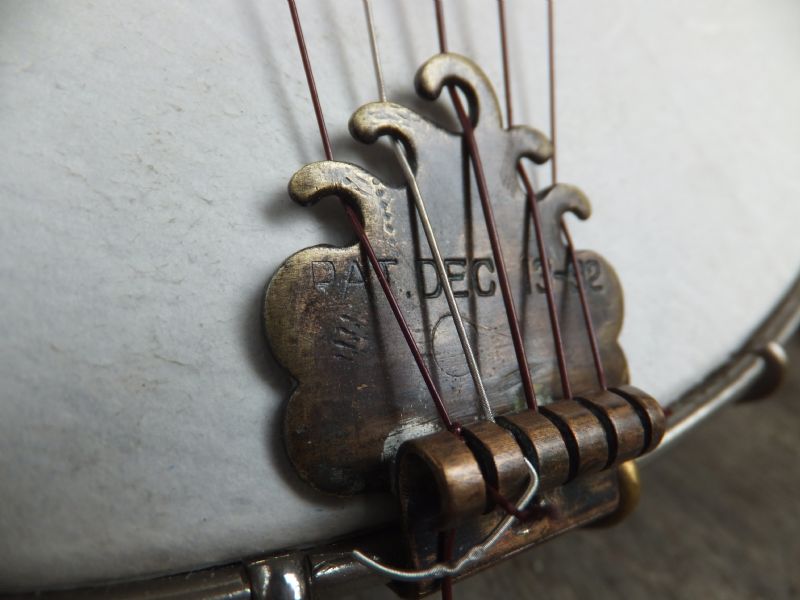
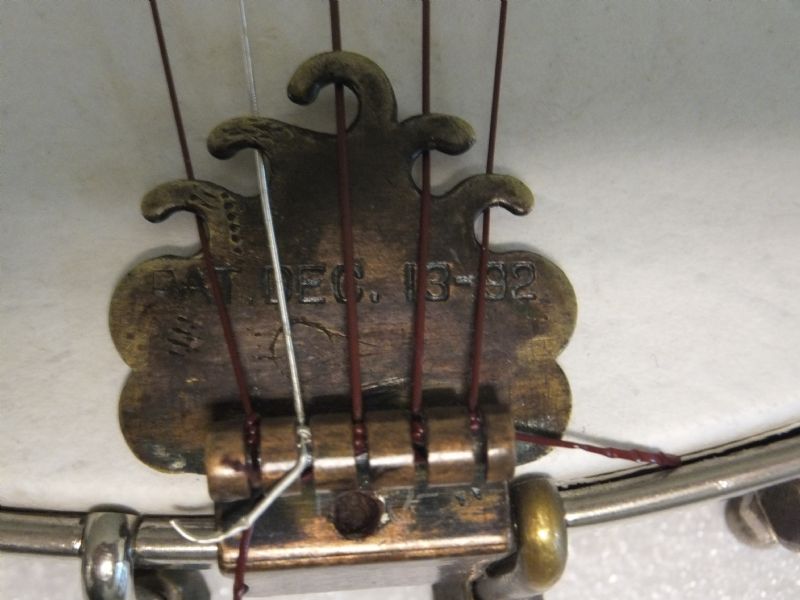
Ok. I've attached a couple of pix of the tailpiece. It has a patent date stamped on it . Amusingly, there are PAT PENDING stamped at the exit hole of the 5th string and on the peg head. Quaint.
trapdoor2 - Posted - 12/12/2018: 11:27:30
quote:
Originally posted by Im banjobruceOk. I've attached a couple of pix of the tailpiece. It has a patent date stamped on it . Amusingly, there are PAT PENDING stamped at the exit hole of the 5th string and on the peg head. Quaint.
Thank you! Totally different look from the Patent drawing...but essentially the same. Doesn't appear to have any wood in it. Does it simply clip over the tension hoop at the rear? It looks like it has a hole for a bolt, much like other TPs of the period.
Im banjobruce - Posted - 12/12/2018: 11:48:46
It just hooks over the head tension hoop, which means that if the strings are removed the tailpiece falls off. Probably why most of these banjos are missing the tailpiece. The patent drawing doesn't show any means of attachment, and it is curiously built-up, more than it needs to be. Why all the sandwiched pieces?
trapdoor2 - Posted - 12/12/2018: 16:30:46
quote:
Originally posted by Im banjobruceIt just hooks over the head tension hoop, which means that if the strings are removed the tailpiece falls off. Probably why most of these banjos are missing the tailpiece. The patent drawing doesn't show any means of attachment, and it is curiously built-up, more than it needs to be. Why all the sandwiched pieces?
I suspect the tailpiece was designed to somehow be different than the usual fare. Wood tailpieces were very common but perhaps he thought he was using the best qualities of each. When you use rivets, you really need metal on both sides of the wooden part. Pin rivets were far cheaper than tiny screws back then.
After the patent passed, he probably saw the silliness in the sandwich construction and simply had it made from brass. Apart from all the curlycues, it would be pretty easy to duplicate today.
Terms of Use | Privacy Policy | Privacy Consent (EU/GDPR Only)
Copyright 2026 Banjo Hangout. All Rights Reserved.