DVD-quality lessons (including tabs/sheet music) available for immediate viewing on any device.
Take your playing to the next level with the help of a local or online banjo teacher.
Weekly newsletter includes free lessons, favorite member content, banjo news and more.
Premier Sponsors





|
Please note this is an archived topic, so it is locked and unable to be replied to. You may, however, start a new topic and refer to this topic with a link: http://www.banjohangout.org/archive/352674
SamHatch - Posted - 04/01/2019: 16:00:55
Howdy y'all,
I'm writing a paper on the influence of Pete Seeger in the United States and I want your help. If any of y'all have been influenced by Pete (or even better, if you have a story about him) would you please comment under this and tell it?
My paper is due in two weeks, so as soon as you can type it up, the better!
Thanks in advance,
Sam Hatch
Bill Rogers - Posted - 04/01/2019: 16:44:51
Just what kind of “influence?” Musical? Political? Cultural? I assume musical, but find a focus and I, and others, can be of some help. For a college paper, you need to be narrow. Your instructor will shred it if you’re all over the place. There’s plenty of academic work on Seeger. Try to track some of it down. Forgot to ask. What’s the class?
Edited by - Bill Rogers on 04/01/2019 16:46:22
The Old Timer - Posted - 04/01/2019: 17:23:47
I saw Pete Seeger play a concert when I was in high school in the late 1960s. Being a bluegrasser, I must say I was pretty much "unmoved" until he played some 3-finger Scruggs style breaks on ONE song. He knew how to do it! That was enough to satisfy me.
kwl - Posted - 04/01/2019: 17:48:15
I agree with Bill. Can you narrow your focus? Pete inspired me with his clean up efforts on the Hudson River. His activism is in other areas also has been inspirational. I remember participating a workshop he led on work songs which gave me a new perspective on workers and their struggles. And, of course, his book on banjo playing as well as his banjo playing inspired me to buy a banjo and learn a few songs.
DH#52 - Posted - 04/01/2019: 17:57:02
I would say that Pete was as well known for his activism and causes as he was for popularizing the 5-string banjo, and you could cogently argue that he was the most influential banjoist of the 20th century. Not the most influential player, but causing more folks to take up the banjo than perhaps anyone else. I’m trying to be objective about this, so take no offense Scruggs fans.
Steve
John Gribble - Posted - 04/01/2019: 18:37:49
I think a lot of his lasting influence is somewhat second-hand, in that he influenced a lot of people who in turn influenced a lot of others. A bunch of us learned to play banjo from his book. Many of us have gone on to teach others. His use of the twelve-string guitar (and his book about Lead Belly's twelve string playing) had a similar influence. The songs he wrote, co-wrote, or adapted have been hits for many other performers. The widespread use of tab can be traced directly back to him. These are just a few of his musical contributions. His idealism and social activism were also an important influence on American culture both directly and indirectly. So a lot of his work appears to have had a lasting, if sometimes uncredited influence.
Edited by - John Gribble on 04/01/2019 18:39:11
beezaboy - Posted - 04/01/2019: 18:40:19
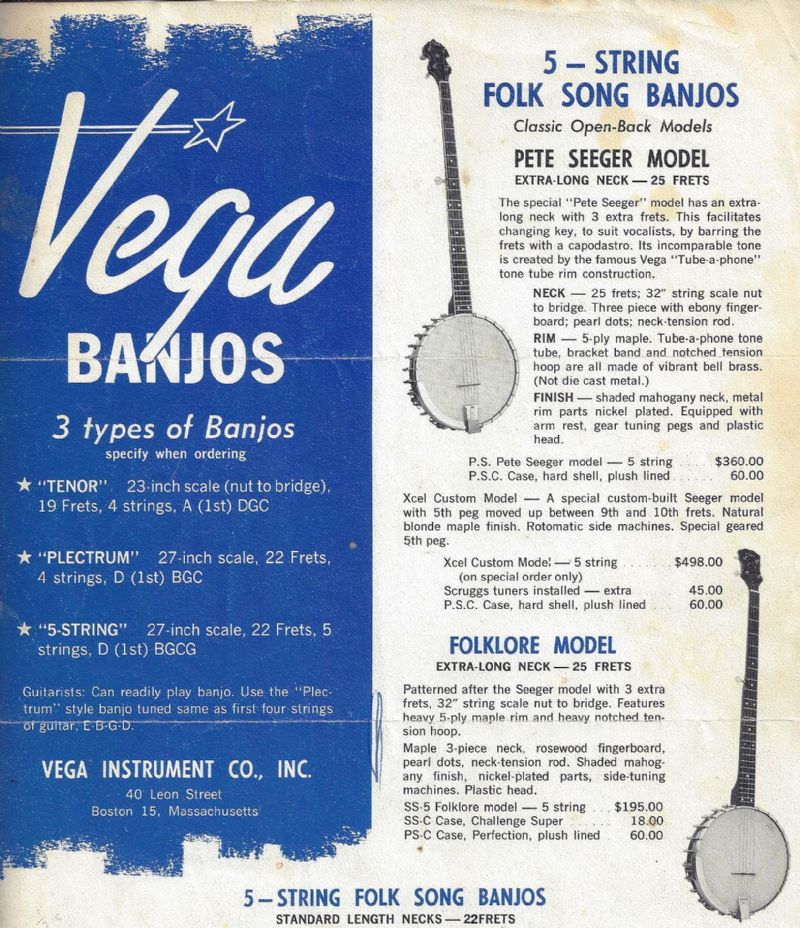
He influenced the trendy long neck 5-string banjo which became almost obligatory among the commercial folk groups of the early 1960's and you could get one from Vega!
paco0909 - Posted - 04/01/2019: 19:01:16
Don’t forget his early opposition to fascism in The Spanish civil war, in WW2, and after. He suffered blacklisting during the McArthur era of the ‘50’s. He was a civil rights leader and was an early opponent of apartheid in South Africa. He was a supporter of the Newport Folk Festival where he helped bring Joan Baez and Bob Dylan to the world. And he was there when Dylan went electric (I was in the audience that night). Pete along with many others brought many old timey, bluegrass, blues, and other “traditional “ musicians to the public in the ‘50’s and ‘60’s. The folk music “revival” was a real thing that brought attention to old and new artists. But one of the important messages that Pete always emphasized is that people could make their own music and not be entertained by Tin Pan Allley!
From Greylock to Bean Blossom - Posted - 04/01/2019: 19:10:59
I have always been immensely respectful of Pete's character: his ability to stay true to himself. Concurrently I have been disdainful of his one sidedness of seeing issues. I have respected his courage through the years: going back and facing actual stoning when playing with Paul Robeson in NY and later enduring blackballing without being bitter and still doing good work - even at summer camps for kids. I have respected his independent nature as was shone in hand building a log cabin in NY for his permanent residence to chopping wood for the fireplace till just before he died. Maybe his biggest achievement was cleaning the Hudson River. That took a whole lot to take that on. But mostly, I will respect the long long work of music he left us. Some really great stuff from the beginning to the end. And the fact that at his heart, he loved the banjo, and was a banjo guy to the core.
ken
Edited by - From Greylock to Bean Blossom on 04/01/2019 19:14:11
Foote - Posted - 04/01/2019: 19:34:06
I saw Pete twice in the late 60's, early 70's. What got me was that he had the whole room singing by the end of the first song. And he had the whole room singing parts by the second one. One man with a banjo and guitar and he controlled the very big auditoriums.
Andy B - Posted - 04/01/2019: 19:58:34
I have admired Pete Seeger’s music for most of my life. The only LP from my childhood that I still have is Pete Seeger’s American Favorite Ballads Vol. Four, received on my seventh birthday. I loved the sound of the banjo and the melodies. Pete was great at choosing memorable songs. Years later I met him at a festival in Newburgh. The band I was playing with followed Pete’s on stage and I spoke to him briefly between the shows. I told him how much his music had meant to me over many years. I suppose everyone told him something similar, but it was true and heartfelt.
gbisignani - Posted - 04/01/2019: 20:00:49
I saw him twice in the 70's. The first time at Carnegie Hall with Arlo Guthrie and the second time in a grammar school cellar. From one extreme to another. He was comfortable playing just about anywhere ! I was amazed at how much better I liked the way he did songs versus the original writers/singers. I was drafted in 1969 and when I got home I remember buying an album of his and on it was the Phil Ochs song Draft Dodger Rag. He did it so well that you couldn't be offended. In my opinion way better than Phil Ochs.
kwfolk1 - Posted - 04/02/2019: 06:08:47
I tend to think of Pete Seeger as the tiny neck of an hourglass, in that everything that occurred in American Folk Music that occurred previous to Pete's arrival on the scene, such as Leadbelly & Woody's music & songs, as well as untold others, to have been influenced, amplified and disseminated to a much larger audience. Pete was a prime mover and a major influence. If it were not for Pete & Earl, the 5-string banjo may well have become a relic of America's past, gathering dust in peoples attics. When it comes to what one thinks of as traditional American Folk Music, IMHO, there is no one better than Pete.
flyingsquirrelinlay - Posted - 04/02/2019: 06:28:07
A small correction to paco's post: The era in the late-40s and early 1950s he referred to was the "McCarthy Era" and was institutionalized in the the creation of the House Un-American Activities Commission. Seeger was called to testify about his political leanings in the 1930s and 1940s and in reply offered to play his banjo for the committee. I believe his offer was rejected :)
Ryk - Posted - 04/02/2019: 06:50:37
'The Protest Singer - An Intimate Portrait of Pete Seeger' by Alec Wilkinson is a very good source of information about Pete. Included in it is Pete's testimony before the House Un-American Activities Committee on Aug 18, 1955. Interesting as well ... probably mores to those of us who play the banjo ... is the story of his last banjo with a Pete-made neck of lignum vitae.
Chris ... thanks for that hourglass example. Great way to think of his work.
Ryk
Edited by - Ryk on 04/02/2019 06:53:11
paco0909 - Posted - 04/02/2019: 07:16:47
Thanks for the correction! Curses to my spell checking iPad!
kwfolk1 - Posted - 04/02/2019: 13:55:53
IMHO: Politically and culturally, Pete Seeger was an idealist and God bless him for that. From everything I’ve ever read, learned or been told about him, Pete endeavored to live by those idealistic values that many of the topical songs he both wrote and sang over his long career espoused. The world, however does not tolerate idealists very well at all. More times than not, idealists are the first victims of the very world view they endeavor to create. I feel that had Pete lived to see many of the ideals he used songs to promote, he would have eventually irritated and come under the scrutiny of some of the very same people who had once praised his efforts. I truly believe that had the United States adopted socialism (a truly unworkable form of government due to the negative aspects of human nature) during Pete’s lifetime, he would have been widely criticized and besmirched (taken to the woodshed) by the very same intellectuals and elites that had once honored him for his efforts.
That said: I still hold with the notion that Pete Seeger was best thing to have ever happened to the American Folk Music movement. He was a fine songwriter & a phenomenal entertainer. Even when he was preforming in large auditorium, he made you feel like he was in your kitchen, sitting across the table from you and playing that long neck banjo of his till the cows came home. Plus, Pete was the best song-leader there ever was, bar none!
He will be missed... At least by me, he will…
The Old Timer - Posted - 04/02/2019: 15:28:09
Many folks don't know or remember that Pete served his nation in the US Army during WWII, stationed in the Pacific. Wikipedia reports that although he was trained as an aircraft mechanic, he was assigned mostly to Special Services to pick, sing and entertain the troops.
chuckv97 - Posted - 04/02/2019: 15:48:23
I had the red Pete Seeger instruction book, my first banjo book. I learned some frailing & clawhammer (Cripple Creek and Shady Grove ? , not sure, I lost the book years ago) and delved somewhat unsuccessfully into his (brother Mike’s) chapter on Scruggs style. I was a folk fan in the 1960’s so I knew of his songs and his stature. I remember seeing him on the Smothers Brothers TV show soon after they had lifted the blacklist on him,, then later Johnny Cash fought the establishment to get him on his TV show.
From a very interesting article ...
“From the 1940s through the early 1970s, the US government spied on singer-songwriter Pete Seeger because of his political views and associations. According to documents in Seeger’s extensive FBI file—which runs to nearly 1,800 pages (with 90 pages withheld) and was obtained by Mother Jones under the Freedom of Information Act—the bureau’s initial interest in Seeger was triggered in 1943 after Seeger, as an Army private, wrote a letter protesting a proposal to deport all Japanese American citizens and residents when World War II ended.”
and the full article: motherjones.com/politics/2015/...fbi-file/
Edited by - chuckv97 on 04/02/2019 15:54:11
Dan Gellert - Posted - 04/03/2019: 07:04:04
AFAIK he invented the modern version of tablature notation. The adaptation of the old lute tablature system he created for his banjo-instruction book is now recognized and used by fretted-instrument players all over the world.
Ryk - Posted - 04/03/2019: 08:43:33
In a video ... i believe with his grandson ... it comes out that he originated the terms "hammer on" and "pull off".
As Chris says in his post ... Seeger was the narrow bit of an hourglass through which the old streamed into the acoustic world we now have.
Ryk
Half Barbaric Twanger - Posted - 04/03/2019: 11:38:10
I remember seeing either a newsreel or a TV news segment of Pete's testimony at the time. The senator was trying to get Pete to talk about what organizations and people he had associated with and Pete was having none of it -he was no dummy. The senator asked him about the song "Wasn't That a Time" and where he had sung it. Pete said he couldn't remember where he had sung it, but offered to sing it to the senators! They were not interested, which (IMO) was their loss (and that of us viewers of the shenanigans). He did not have his banjo with him (no dangerous weapons allowed in the senate chambers) so he would have sung a cappella :)
The lyrics to "Wasn't That a Time"can be found on-line, and are worth looking at. I've always wondered how the senators would have reacted when Pete (after singing about Hitler and Mussolini) had sung the final verse "And once again the madmen come" while looking straight at the senators!
Then again, knowing Pete, by the time he got to the end of the song he might have had the whole committee singing along with him!!
Bill
SamHatch - Posted - 04/03/2019: 12:19:51
quote:
Originally posted by Bill RogersJust what kind of “influence?” Musical? Political? Cultural? I assume musical, but find a focus and I, and others, can be of some help. For a college paper, you need to be narrow. Your instructor will shred it if you’re all over the place. There’s plenty of academic work on Seeger. Try to track some of it down. Forgot to ask. What’s the class?
The class is MUS 115, Introduction to Music Literature. I plan on focusing on his Musical and Political influence.
SamHatch - Posted - 04/03/2019: 12:30:48
quote:
Originally posted by chuckv97I had the red Pete Seeger instruction book, my first banjo book. I learned some frailing & clawhammer (Cripple Creek and Shady Grove ? , not sure, I lost the book years ago) and delved somewhat unsuccessfully into his (brother Mike’s) chapter on Scruggs style. I was a folk fan in the 1960’s so I knew of his songs and his stature. I remember seeing him on the Smothers Brothers TV show soon after they had lifted the blacklist on him,, then later Johnny Cash fought the establishment to get him on his TV show.
From a very interesting article ...
“From the 1940s through the early 1970s, the US government spied on singer-songwriter Pete Seeger because of his political views and associations. According to documents in Seeger’s extensive FBI file—which runs to nearly 1,800 pages (with 90 pages withheld) and was obtained by Mother Jones under the Freedom of Information Act—the bureau’s initial interest in Seeger was triggered in 1943 after Seeger, as an Army private, wrote a letter protesting a proposal to deport all Japanese American citizens and residents when World War II ended.”and the full article: motherjones.com/politics/2015/...fbi-file/
This article looks very interesting, I'll have to check it out. Thanks!
Half Barbaric Twanger - Posted - 04/04/2019: 11:51:30
I was one of the many people Pete Seeger influenced indirectly. I was going to a summer camp in the Berkshires and Mr. Emmons (the director of the camp) led us in sing-a-longs at campfires, etc., playing his banjo. One evening the camp had a talent show and he came out on stage and demonstrated a new technique he had learned from a book by (you guessed it) Pete Seeger, by playing "Hard Ain't It Hard" Scruggs style. I was hooked.
Fifteen years later, as I was walking across Boston Common an older gentleman hailed me (by name) and reminded me he was Dick Emmons -I remembered him as Mr. Emmons, the camp director. I was able to inform him that I had started playing the banjo and he invited me to come to the Huntington Avenue YMCA, where he gave evening classes. Unfortunately, I received a job offer that took me away from Massachusetts for thirty years, so I could never take him up on his offer.
Bill
Bill Rogers - Posted - 04/04/2019: 19:30:03
Thanks for the answer, Sam. Personally, I doubt I’d have ever taken up the 5-string but for Seeger. I started with the yellow version of hi book and went from there. As to politics, this book is a good place to start: books.google.com/books/about/M...scription. Good luck.
Jim Yates - Posted - 04/04/2019: 21:17:23
As John Gribble and Dan Gelert said, Pete revived an old method of notating lute music and gave us the form of tablature that we use today. He also invented the terms "Hammer on" and "Pull off". Were it not for Pete, we'd be talking about "left hand pizzicato" instead of "pull-off".
Paul R - Posted - 04/04/2019: 23:33:38
I have the biography. How Can I Keep from Singing?, which, while not recent, is almost exhaustingly thorough. The author lived at the Seeger property for much of his research time. It gives a sense of how it was, and how it affected Pete, when the Cold War era politics took hold. Get a hold of it if you can.
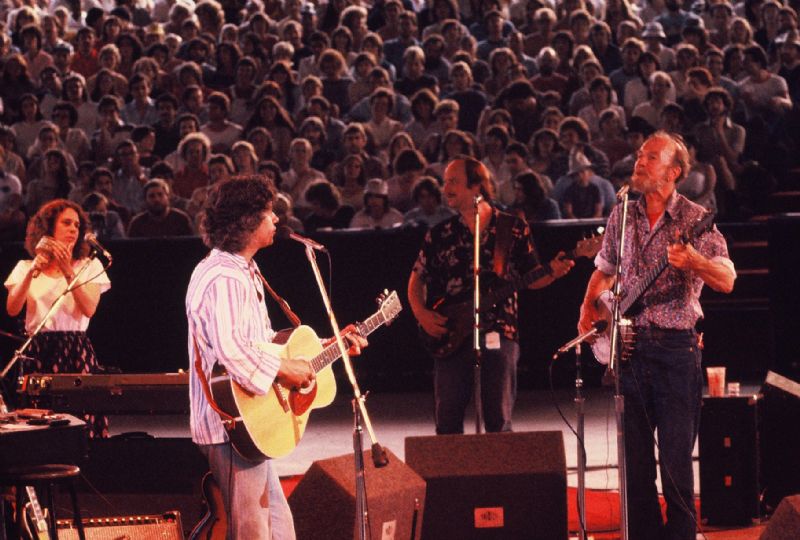
I took the photo below the second time I saw him perform, at the old (sadly gone) Ontario Place concert venue, with the revolving stage.
flyingsquirrelinlay - Posted - 04/05/2019: 05:33:45
This thread is such a great example of "oral tradition" and shining a light into the darkness. Where would we be without the Hangout?
BanjoLink - Posted - 04/06/2019: 07:03:02
quote:
Originally posted by From Greylock to Bean BlossomI have always been immensely respectful of Pete's character: his ability to stay true to himself. Concurrently I have been disdainful of his one sidedness of seeing issues. I have respected his courage through the years: going back and facing actual stoning when playing with Paul Robeson in NY and later enduring blackballing without being bitter and still doing good work - even at summer camps for kids. I have respected his independent nature as was shone in hand building a log cabin in NY for his permanent residence to chopping wood for the fireplace till just before he died. Maybe his biggest achievement was cleaning the Hudson River. That took a whole lot to take that on. But mostly, I will respect the long long work of music he left us. Some really great stuff from the beginning to the end. And the fact that at his heart, he loved the banjo, and was a banjo guy to the core.
ken
Ken .... you nailed it. I did not always (or hardly ever) agree with his politics but he was true to himself and "talked the talk and walked the walk". I admired that he did not give his convictions lip service and then do something else. He was not a hypocrite like so many others that are now out there. He let his actions speak louder than his words and he did not try and cram his beliefs down others throats.
Matt Gibson - Posted - 04/07/2019: 19:18:36
I think Pete Seeger also laid the groundwork for some of the now familiar conventions of a modern rock concert. With his sing-alongs, he encouraged a sense of community, turning the attention away from the song and the performance on stage, toward the audience and the energy it created. Without Seeger, it’s hard for me to imagine Bruce Springsteen or U2 inspiring 80,000 people to sing with them on “Born To Run” or “Where the Streets Have No Name.” The way those performers get the whole house moving in a unified aesthetic direction, with a vague but unmistakable sense of the political consequence—to me that’s the spirit of Seeger, his distinct vision for building community and a better world through music.
Edited by - Matt Gibson on 04/07/2019 19:27:45
Banjoezzie - Posted - 04/21/2019: 21:45:16
His passing convinced me that I should take up the banjo; partly because he was such a great example of some wonderful Ideals: hard work, honesty, courage in the face of adversity. And promoting these ideals through his singing and playing on a uniquely American instrument such as the banjo. In a documentary on his life, it was noted that he still lived in a humble dwelling and chopped wood while in his 80’s and 90’s. Incredible man.
My aunt had the opportunity to meet him in Chicago while he was there for a concert. I believe it was the late 50’s or early 60’’s. Asked if he was worried about going to jail for his political views, she remembered him saying that he only worried that they would not allow him to bring his banjo to jail with him.
redwing46 - Posted - 04/22/2019: 07:44:40
Try to see the video "Pete Seeger & The Power of Song"...it was broadcast on PBS a while back...
interesting , informative, and entertaining!
Helix1 - Posted - 04/22/2019: 18:24:17
I got to play some with Fred Starner who played with Pete and everybody on the Clearwater.
Fred said Pete was changing the introduction to a song every time he introduced it to a new audience.
Fred asked Pete about that.
Pete said, "I'm working on it."
That was Pete, he faced into the wind.
We used a quote of his on our tour T-shirts in Germany in 2003. "Keep Bringing People Together."
Longnecks rule.
Also i got to meet Peggy Seeger in 2004. She's a babe. I volunteer at a folk venue here In Phx. We contacted her in 2015 to come and play. She lives in England.
she said she wouldn't come over until we got out health insurance act together, she was afraid to get sick over here.
Edited by - Helix1 on 04/22/2019 18:26:15
Terms of Use | Privacy Policy | Privacy Consent (EU/GDPR Only)
Copyright 2026 Banjo Hangout. All Rights Reserved.