DVD-quality lessons (including tabs/sheet music) available for immediate viewing on any device.
Take your playing to the next level with the help of a local or online banjo teacher.
Weekly newsletter includes free lessons, favorite member content, banjo news and more.
Premier Sponsors





|
Please note this is an archived topic, so it is locked and unable to be replied to. You may, however, start a new topic and refer to this topic with a link: http://www.banjohangout.org/archive/357526
rnrushing - Posted - 10/06/2019: 20:41:10
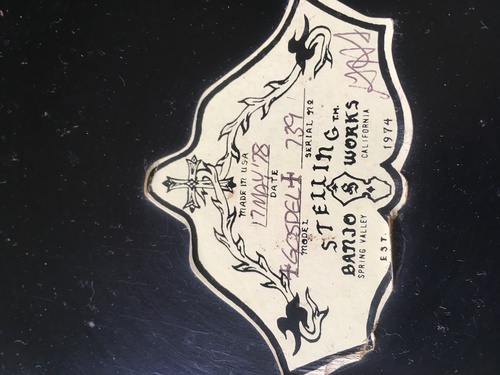
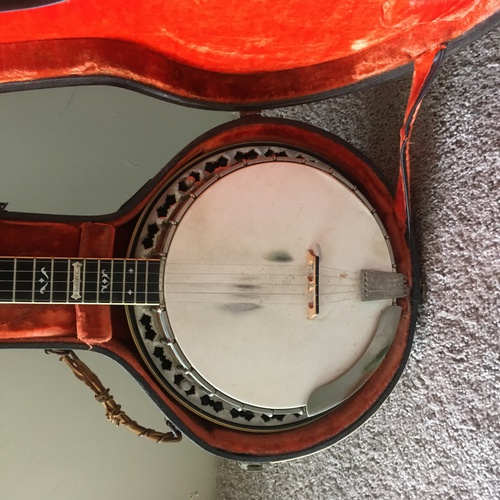
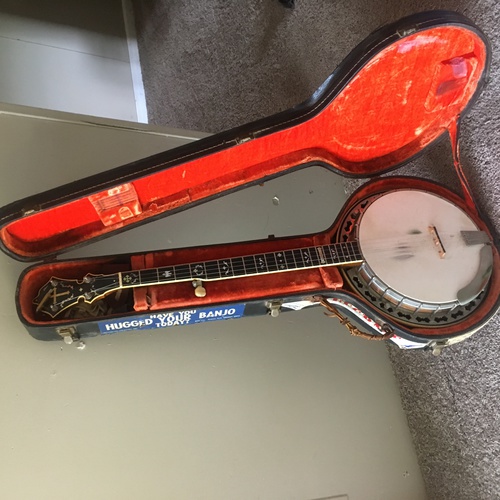
I will have an opportunity to purchase this banjo. Can anyone tell me more about it?
The tailpiece does not appear to be a Stelling tailpiece, the head has wear and all the metal needs cleaning.
Other than that appears to be in good shape.
Supposedly was used by a member of Bluegrass Kun-Tree.
I have a few more pics on my phone i could upload if needed
Alex Z - Posted - 10/06/2019: 21:13:45
I had a 1980 Stelling. In 1978, it's very likely that Mr. Geoff had not yet designed the Stelling tailpiece. He used a Kerschner before then.
It will have a block rim, which I always thought had a deeper tone than the later ply rims, until the more recent Tony Pass rims began around 2003.
You'll notice that after the 22nd fret there is a bit more of the neck before the rim, compared to later models and typical other banjos. To me, this gave a richer sound as it puts the bridge slightly more toward the center of the head.
The nut width tended to be slightly wider on these early banjos than on the present. You'll get some darn clear 3-2 pull-offs, for sure. The neck a little thinner from front to back compared to present necks. Take a look at the nut to see if it has a compensated nut. By 1978, I'd bet it does.
The tone ring I think will be slightly heavier in the early days, or maybe the flange. I know the very early banjos felt slightly heavier.
If it needs a fret job, be sure to get someone who has done a Stelling before. I think Mr. Geoff used glue at that time, so the frets are removed by first heating them up to release the glue.
Get this thing cleaned up and set up -- and maybe substitute a current Stelling tailpiece -- and it will be one spectacular sounding banjo.  1978 Gospel in good shape. Wow!
Edited by - Alex Z on 10/06/2019 21:15:25
rnrushing - Posted - 10/06/2019: 21:20:14
Thanks, i have not seen it in person yet. According to the seller it had a fret job at Stelling 5 years ago with very little use since. I'm a beginner and know very little about inspecting a used banjo but will give a shot.
GStump - Posted - 10/07/2019: 07:38:10
All correct - and most early stelling banjos also, (to my knowledge) used a standard hanger bolt for the tailpiece; as the stelling tension hoop, pin mounted tailpiece had not come into existence yet. The earlier flanges were indeed heavier than later ones. Yes, the block rim was being used at this time. I have also noted that later stelling banjos, many of those models no longer had bound pegheads. Many of the banjos from this time period used "mother of bowling ball" fretboards (a fancy name for plastic that an actual stelling employee mentioned to me - tongue in cheek of course) because according to legend, stelling was having difficulty obtaining good quality WOOD fretboard material. I also own a banjo from this time period. It has been mentioned to me that some of the necks on the banjos from this time period had warpage issues because of the Ebanol fretboards; naturally plastic and wood react to heat and/or cold differently, that is - contract and expand at different rates, but i have never had a problem with mine. I think they are GREAT banjos. Bought mine new.... which is scary because it's now over 40 years old... I must be getting old....
stelldeergibber - Posted - 10/07/2019: 07:55:28
As Alex indicates, that was the tailpiece original to Stellings at the time. I have #619,exact same tailpiece. The most important thing you should know is that this is an Ebanol Stelling. From 1977(serial #568) to August 1980(serial #1619), Stellings' fretboards were made with Ebanol, a kind of plastic-based material that was a replacement for Ebony. The only problem with this stuff is that it was prone to warping if subjected to either high temperatures(such as being in the trunk of a car too long in summer) or too long in direct sunlight. My Ebanol Stelling does not have any warpage, but this doesn't prove anything about yours, the question will be, how much heat has it been subjected to in the last forty-one years. Playing it, looking at it carefully, and ideally bringing a notched straight edge. Stewart-MacDonalds' short guitar scale (set starting between the 2nd and 3rd frets) can measure this. One possibility is that the fretboard was levelled prior to the recent fret job. If it's OK, and you buy it, remember to keep it out of direct sunlight and away from heat, that's what Mr. Stelling told me!
OM45GE - Posted - 10/07/2019: 08:15:22
The advice about the fret boards is excellent.
Stellings are wonderful banjos. If this is your first banjo, you're starting out at the top. Mine is a few years newer and never ceases to delight.
rnrushing - Posted - 10/07/2019: 09:28:39
Thanks for all the great responses and will check out the neck. I do not have a notched straight edge. Hoping all it needs is cleaning up.
rnrushing - Posted - 10/07/2019: 17:57:34
Well now i have project. I have ordered a new head from Stelling and will be taken it apart to clean and polish. Any recommendations on a good polish for the metal parts. Then on to learning how to adjust the neck as it looks like it had significant bow to it.
banjomule - Posted - 10/08/2019: 20:39:01
Congrats on the Stelling! I would recommend adding the Stelling Field Manual to your order, as it has a lot of good info for setting up your banjo. Also, ask Geoff if there are any key adjustment differences between the ‘78 and what is listed in the manual.
Good luck, and enjoy!
rnrushing - Posted - 10/08/2019: 21:17:48
Thanks, I did order the Stelling Field Manual. The original set up / adjustment instructions were in the case. First step is the new head with a good clean and polish.
Pam W - Posted - 10/13/2019: 20:16:59
Geoff recommends Simichrome Polish for cleaning and polishing the metal parts. You can get it from Amazon or other places online.
amazon.com/Simichrome-390050-M...83&sr=8-1
Ralph Stanley legend - Posted - 11/02/2019: 13:58:56
Congratulations on that fine old Stelling. Those late 70's Stellings are monsters.
For my money, arguably the finest Banjo ever built.
Enjoy
Dave
OldNavyGuy - Posted - 11/02/2019: 14:02:44
The early Stellings used a Kershner tailpiece.
I owned a '77 Starflower that I bought new directly from Geoff that had one.
rnrushing - Posted - 11/13/2019: 19:51:50
Thanks, I've been working on cleaning / polishing all the metal back to life. The tailpiece is heavily oxidized and was considering just ordering a replacement. Looking on line it looked like the Kershner.
J.Albert - Posted - 11/14/2019: 15:08:58
If you're thinking of replacing the existing Kershner tailpiece with another (Kershner), take a look at the Prucha "re-designed" Kershner that Greg Boyd sells.
It solves the problem of trying to get the 3rd string "through the hole" when you're doing a string change!
The Old Timer - Posted - 11/14/2019: 16:58:57
Was the "Gospel" model later renamed the "Master's Cross" model? Peghead looks similar.
Terms of Use | Privacy Policy | Privacy Consent (EU/GDPR Only)
Copyright 2026 Banjo Hangout. All Rights Reserved.