DVD-quality lessons (including tabs/sheet music) available for immediate viewing on any device.
Take your playing to the next level with the help of a local or online banjo teacher.
Weekly newsletter includes free lessons, favorite member content, banjo news and more.
Premier Sponsors





|
Please note this is an archived topic, so it is locked and unable to be replied to. You may, however, start a new topic and refer to this topic with a link: http://www.banjohangout.org/archive/393837
jlallport - Posted - 11/07/2023: 07:44:31
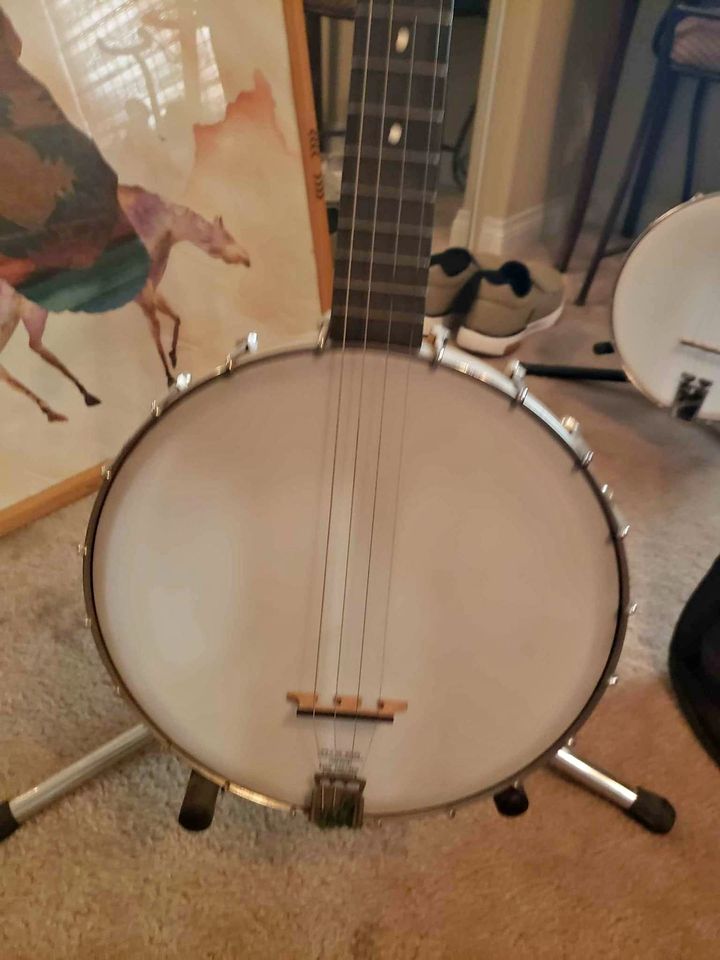
Does anybody know what this banjo is? make, time period, good for Irish or not? It has 17 frets.
see pic -
I'm looking for a relatively low cost IT banjo and this one popped up in my neighborhood. Don't know if I should try it or keep looking.
RB 250 - Posted - 11/07/2023: 10:13:42
I'm definately NOT an expert on Irish traditional music but it's always been my understanding that the Banjo of choice for that style is a Plectrum 22 fret 4 string.
rcc56 - Posted - 11/07/2023: 10:36:23
No, most Irish players prefer tenors.
They argue a lot about optimum scale length and number of frets.
I prefer shorter scales and necks myself.
I don't know exactly what you've got there, but my guess is that it's decent Chicago or New York workmanship that was sold under a myriad of brand names. It looks like a reasonably well built starter banjo. If the action is good and it doesn't cost much more than +/- $300, it should keep you busy for awhile.
If it's much more, a Vega style N [Little Wonder] or style M Tubaphone would be a better value.
Edited by - rcc56 on 11/07/2023 10:46:31
Boblamoy - Posted - 11/07/2023: 12:29:12
A 17 fret tenor, with proper strings, plays Irish tunes nicely. It looks like the nut has been modified by a triangle file and will need repair or replacement. The long screw off the dowel probably once held a simple resonator. This is not necessary, but would give you an option.
rcc56 - Posted - 11/07/2023: 12:53:58
It does need a couple of hardwood wedges cut to fit between the metal neck brace on the dowel stick and the banjo's rim. This serves to lock the neck snug against the rim.
Not a big deal for someone who has reasonable woodworking skills and a few good tools.
If you can find a good picture of the neck brace and wedges on an 1890's Stewart banjo, you'll get a better idea of how the wedges work and how things should fit together.
Edited by - rcc56 on 11/07/2023 12:55:21
Culloden - Posted - 11/07/2023: 14:21:45
This one is fine for Irish playing. This is an example of the tenor banjos that were being made in Chicago in the twenties and thirties. This one looks like it was made by Slingerland or Lyon & Healy but don't take that for gospel.
The neck brace does need the two wedges replaced. The brace on the rim stick is a resonator attachment. Some people like the add on resonators and some don't. If you want to try adding one, be patient, they come up for sale now and then. If you prefer to leave it open back then the attachment is easy to remove.
Make a new nut, or have one made, get some Irish banjo strings, and have fun.
Edited by - Culloden on 11/07/2023 14:23:50
jlallport - Posted - 11/07/2023: 14:52:37
Hey thanks for the comments. I play clawhammer OT and Celtic fiddle/mandolin. After trying a few tenors out, I'm convinced I would do better with 17 frets because of the arthritis that already sneaks up when I'm playing my other instruments. But at least I already know where the notes are!
This one can be had very cheap, but still considering new or semi-new as well. I figured this one might be one of those Chicago early 20th century types. I didn't want it to end up being a "Kay" or "Harmony". - I'll certainly examine the repair areas you folks mentioned before deciding. Seems simple enough.
Jerry Hatrick - Posted - 11/08/2023: 01:28:54
17 fret tenors are generally the best fit for Irish banjo, because the more common 19 fret tenor is a bit more of stretch, if you play with fiddle fingering (3rd/ring finger) typically playing the fifth fret notes (although some will play those with the pinkie to reduce the stretch). In my experience, 19 fret tenors do not respond as well to the low GDAE tuning as well, but I’m sure lots will disagree with that.
DSmoke - Posted - 11/08/2023: 15:18:04
Below is a link to an article I wrote about buying a banjo for Irish trad playing. I hope you take the time to read it and it answers some of your questions.
As far as the banjo you pictured. I agree with what has been mentioned, Chicago made and needs dowel brace shims. I believe it has been modified with an adjustment bracket at the end of the dowel. That's good because it SHOULD allow you to adjust the action. But, the most important aspect is SETUP! Anything other than a perfect setup will make it harder to play and sound less than ideal for Irish playing.
tradbanjo.com/pages/buying-adv...nor-banjo
jlallport - Posted - 11/09/2023: 06:34:49
Thanks Dan @DSmoke . Reading your web site is actually what made me consider looking at this banjo when it became available.
.
By setup, I'm assuming you mean: action, bridge, strings (and in this case, nut). And of course the wedges. Did I miss anything?
Parker135 - Posted - 11/09/2023: 07:15:31
quote:
Originally posted by Jerry Hatrick17 fret tenors are generally the best fit for Irish banjo, because the more common 19 fret tenor is a bit more of stretch, if you play with fiddle fingering (3rd/ring finger) typically playing the fifth fret notes (although some will play those with the pinkie to reduce the stretch). In my experience, 19 fret tenors do not respond as well to the low GDAE tuning as well, but I’m sure lots will disagree with that.
Yeah, I guess I have to disagree with that. In my experience, the longer scale length is much more forgiving in tuning and intonation compared to the shorter scale and heavier strings required, especially the G and D strings. But of course, some marvelous music can be made with a shorter scale length banjo, and if that's your preference, enjoy!
Edited by - Parker135 on 11/09/2023 07:16:09
crazyace - Posted - 11/18/2023: 03:18:49
quote:
Originally posted by RB 250I'm definately NOT an expert on Irish traditional music but it's always been my understanding that the Banjo of choice for that style is a Plectrum 22 fret 4 string.
I play Irish trad and use a 19 fret tenor as do most top Irish players. alternatively a 17 fret tenor especially if you have small hands but never a plectrum banjo the frets are too wide apart at the peg head end and are more suited to jazz .
DSmoke - Posted - 11/19/2023: 17:07:47
quote:
Originally posted by jlallportThanks Dan @DSmoke . Reading your web site is actually what made me consider looking at this banjo when it became available.
.
By setup, I'm assuming you mean: action, bridge, strings (and in this case, nut). And of course the wedges. Did I miss anything?
Also head tension, tailpiece, frets, basically everything on the banjo. I often buy banjos similar to what you're looking at so that I can be able to offer an affordable and good sounding banjo to someone who wants and "entry level" banjo for Irish trad. However, this type of banjo can often require more work than many of the much better banjos available in the $1000 range. It's also very hard to justify the cost of a refret on a banjo in the $400 price range.
Terms of Use | Privacy Policy | Privacy Consent (EU/GDPR Only)
Copyright 2026 Banjo Hangout. All Rights Reserved.