
DVD-quality lessons (including tabs/sheet music) available for immediate viewing on any device.
Take your playing to the next level with the help of a local or online banjo teacher.
Weekly newsletter includes free lessons, favorite member content, banjo news and more.
Premier Sponsors





|
Please note this is an archived topic, so it is locked and unable to be replied to. You may, however, start a new topic and refer to this topic with a link: http://www.banjohangout.org/archive/406398
ValleyBoy - Posted - 12/10/2025: 19:32:16
Been playing bluegrass (Scruggs, melodic, and single string) for 27 years, recently got a 1894 S.S. Stewart Universal Favorite and wanting to learn some classic songs. It’s a whole new world of music and I have no idea where to start. Any suggestions? Looking for something “every beginner should learn”.
trapdoor2 - Posted - 12/10/2025: 20:22:33
Assuming you mean "Classic Fingerstyle" that would have been normal for your Stewart..."Sunflower Dance" is probably the most common first tune everyone learns. It is played at every rally and is an easy jumping off piece.
You want Tab or notation?
janolov - Posted - 12/10/2025: 23:09:52
I would also recommend Sunflower Dance. There is a TablEdit tab (both tab and notation) in the BHO tab archive: banjohangout.org/tab/browse.as...p;v=14496
Here is a good tutorial; youtu.be/oJGrhQ4ZxPM
And here played on three banjos youtu.be/zlWvQoO7_Dg
Joel Hooks - Posted - 12/11/2025: 04:40:03
For classical, the amount is pretty slim. I’ll post a few links a little later to the few classical pieces I have. There is quite a bit of romantic era. These are instrumental pieces though.
Most of the songs I’ve scanned are in A notation. I don’t have a huge amount. Much of the C notation are found in the John Alvey Turner folios, but most of that is Victorian/Edwardian era English music hall type stuff.
Most of the American publications of songs, sadly, are plantation melodies (minstrel songs) or coon songs. Not the sort of thing one would want to be singing today I’d think.
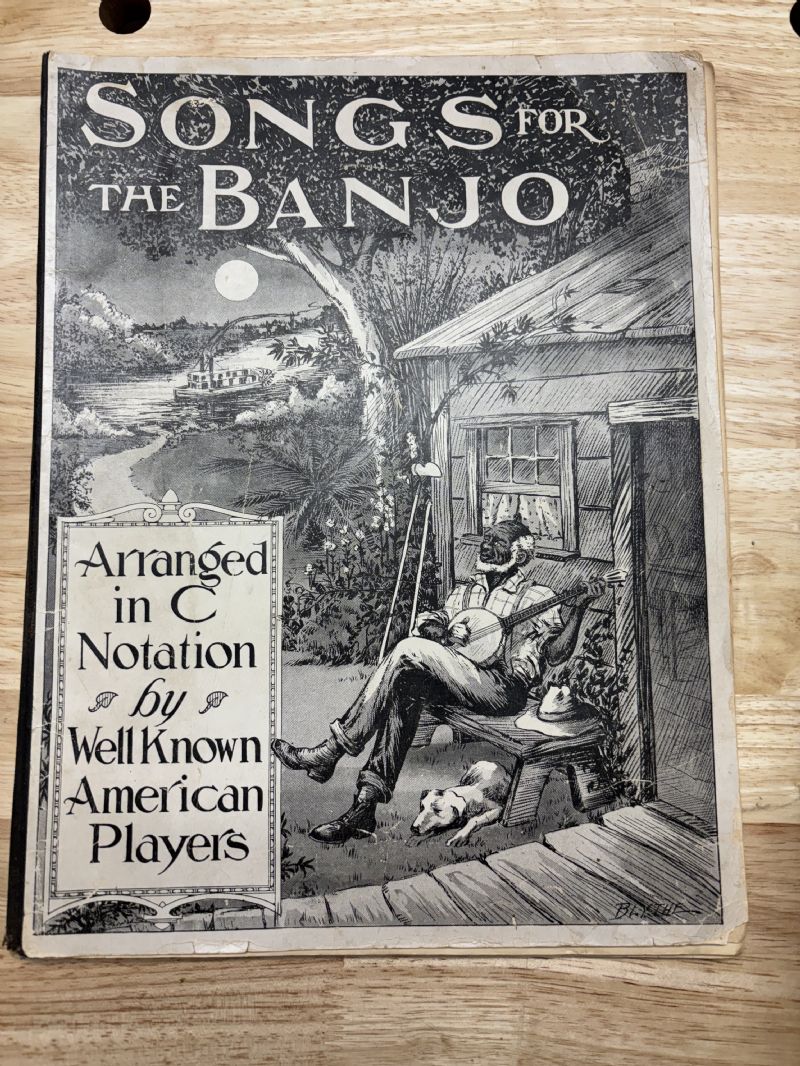
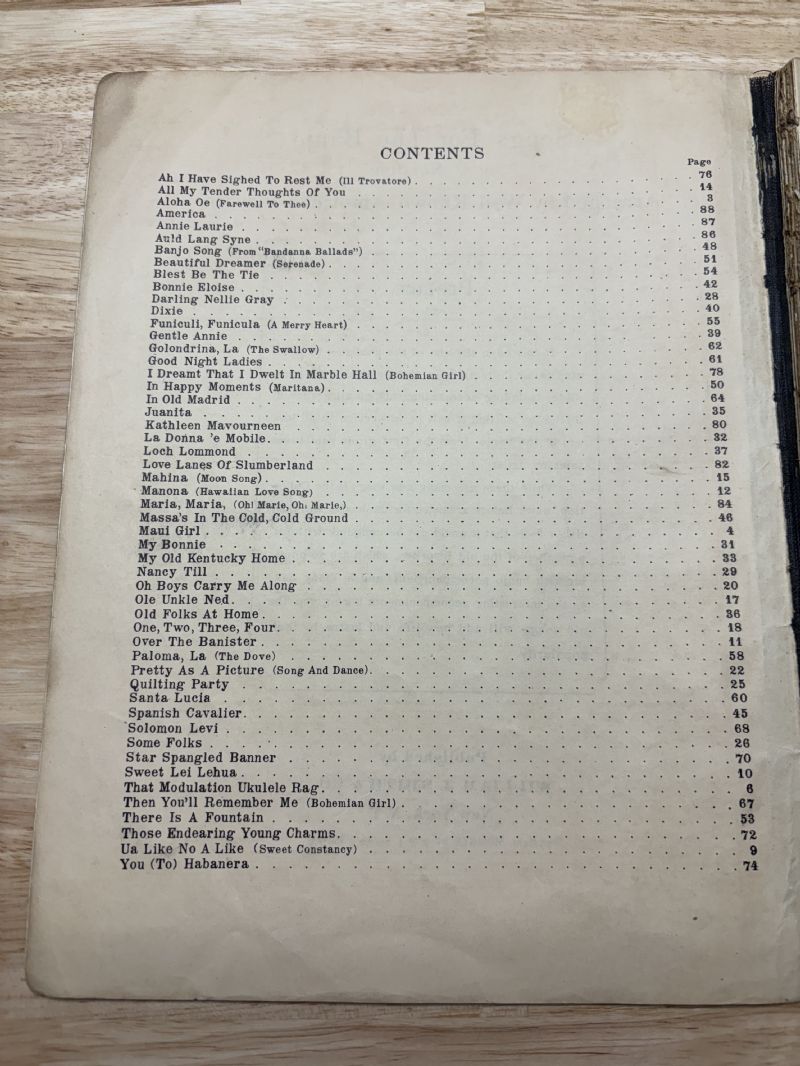
I do have a later collection “Songs for Banjo” in C notation but I think much of that is also minstrel type stuff. I’ll dig it out and post the song title list.
Joel Hooks - Posted - 12/11/2025: 11:50:57
Here is the book of songs I have, if this is what you are looking for I can try to scan it this weekend.
ValleyBoy - Posted - 12/12/2025: 11:13:59
trapdoor2 & janolov: Sunflower Dance is great, I've got that one worked out now. Any thoughts on another popular tune I should learn?
Joel Hooks: I recently read Jim Bollman & Phil Gura's "America's Instrument: The Banjo in the Nineteenth Century", which opened my eyes to a banjo world I knew nothing about (Scruggs was as far back as I really knew banjo history). S.S. Stewart really stood out to me in that book, so I bought a copy of his "The Banjo: A Dissertation" & "The Banjo Philosophically". I really like S.S. Stewart, which led me to purchasing one of his banjos (which I can't put down now). So now I'm just wanting to learn anything from the late 1800's really. I'm open minded to play anything: whatever these "elevated" banjo clubs were playing, minstrel favorite holdovers from earlier in the century, any of the songs S.S. Stewart was listing in his catalogs. It's a whole new world of music, and I really have no idea where to start. The song book you mentioned looks as good of a starting point as any!
trapdoor2 - Posted - 12/12/2025: 11:25:37
For instrumentals, go here: banjofraternity.org and go to "group numbers". Those will be a fine start.
The confusion is "songs" vs "instrumentals". Most of us don't sing 19th Cent. banjo songs as they tend to be full of racist themes/motifs. Heck, many titles of otherwise fine instrumentals are usually changed for the same reasons.
Edited by - trapdoor2 on 12/12/2025 11:29:52
Joel Hooks - Posted - 12/12/2025: 11:31:51
Okay, I understand now, I was taking “song” (usually a song is with lyrics) and “classical” literally.
So, late 19th century…
Do you want to learn to play this stuff correctly or just mess around with a couple of pieces using bluegrass technique?
If you just want to fool around with the goal of a couple of solos then by all means just find a tab and try and figure it out.
But if you want to spend the same amount of time and learn to play then I can make some recommendations for a course of study that will make all of this music available to you.
Joel Hooks - Posted - 12/12/2025: 11:33:16
Also, don’t buy anything. Most of it is scanned, and if there is something specific that is not, I might have it and can scan it.
Don’t fall for the scammers selling public domain material.
ValleyBoy - Posted - 12/12/2025: 11:44:44
I hadn't really thought much about the content in "songs" versus "instrumentals". I'm probably more interested in instrumentals, from a playing perspective, but honestly am open to all of the material, from a historical perspective. I want to learn to play them the proper way. I have always used tab for banjo in the past, but I can still read standard notation from when I learned to play piano as a kid, so happy to work it out from that direction. Any advice on that would be greatly appreciated.
Joel Hooks - Posted - 12/12/2025: 13:22:29
ValleyBoy Great!
Okay, first lesson is the most complicated to understand. The banjo prior to 1908/1909 was a transposing instrument.
The pitch is C, gCGBD but it reads as if it is pitched in A, eAEG#B. This sounds more confusing than it is. But to play anything published in the US prior to 1908 this was how it was done.
I will let William Foden explain below this. I wrote a pretty comprehensive article on this topic, but Foden is more concise.
Joel Hooks - Posted - 12/12/2025: 13:37:02
Now for the course of study. It is great that you read music, but you don't need to know how as the instruction books will teach you.
There are two books I like as a course of study.
archive.org/details/lansings-p...for-banjo
Start on page one and work progressively. Use a metronome. It might be tedious at first, but you only need to do it once.
My biggest problem with this Lansing method (and most A notation books) is that he does not introduce alternate fingering until page 17. This should really be started from the beginning. It is the very foundation to playing smoothly. If anything could be compared to bluegrass, it is alternate fingering and "rolls".
That brings me to the next book, and likely the better instruction of the two:
archive.org/details/universal-...-l-partee
You can use them both in tandem, progressively.
When you get to the point where you are able to play two part "short pieces" or etudes by sight (even just slowly), then you could add in this book...
archive.org/details/CarlFischerTutor
Don't skimp on the alternate fingering exercises in Lansing and Partee.
Work this method and you will be able to play ALL pieces within your skill level. There are tens, if not hundreds, of thousands of pieces of music to play. Many lifetimes of music, all public domain, all free, and all your property, just sitting there waiting for you.
trapdoor2 - Posted - 12/12/2025: 14:49:10
And...if you just want to learn the tunes in a more familiar format...Tab is available for hundreds of them. Software like Musescore makes converting notation to Tab very easy.
Spudwheat - Posted - 12/13/2025: 10:40:35
quote:
Originally posted by Joel HooksAlso, don’t buy anything. Most of it is scanned, and if there is something specific that is not, I might have it and can scan it.
Don’t fall for the scammers selling public domain material.
Just a side note: Copyright law: For the original artist, it is for the lifetime of said artist + 50 years. This being said, almost all music in the timeframe he's looking for is in public domain. You are right about people selling it. (I never quite understood this, as they're profiting off of somebody's work.) One way to look something up ans maybe make a quick score of it is to search: "(song title) tab free .pdf" . I have found many songs like this on the internet. If you see the tab on someone's site for sale, pull out a blank, lined music sheet and copy it down. (You might even be able to screenshot it) Very useful to do this, less time searching, more time playing.
Joel Hooks - Posted - 12/13/2025: 11:56:41
quote:
Originally posted by Spudwheatquote:
Originally posted by Joel HooksAlso, don’t buy anything. Most of it is scanned, and if there is something specific that is not, I might have it and can scan it.
Don’t fall for the scammers selling public domain material.Just a side note: Copyright law: For the original artist, it is for the lifetime of said artist + 50 years. This being said, almost all music in the timeframe he's looking for is in public domain. You are right about people selling it. (I never quite understood this, as they're profiting off of somebody's work.) One way to look something up ans maybe make a quick score of it is to search: "(song title) tab free .pdf" . I have found many songs like this on the internet. If you see the tab on someone's site for sale, pull out a blank, lined music sheet and copy it down. (You might even be able to screenshot it) Very useful to do this, less time searching, more time playing.
Just a side note: Copyright law: In the United States, anything published before 1930 (1929 and earlier), 1931 next year, is in Public Domain in the US.
People are perfectly within their right to try and sell PDFs of Public Domain music to suckers who do not know how to use google or search the Internet Archive for the scans I have put up. The very scans that people are selling.
Spudwheat - Posted - 12/14/2025: 17:52:26
quote:
Originally posted by Joel Hooksquote:
Originally posted by Spudwheatquote:
Originally posted by Joel HooksAlso, don’t buy anything. Most of it is scanned, and if there is something specific that is not, I might have it and can scan it.
Don’t fall for the scammers selling public domain material.Just a side note: Copyright law: For the original artist, it is for the lifetime of said artist + 50 years. This being said, almost all music in the timeframe he's looking for is in public domain. You are right about people selling it. (I never quite understood this, as they're profiting off of somebody's work.) One way to look something up ans maybe make a quick score of it is to search: "(song title) tab free .pdf" . I have found many songs like this on the internet. If you see the tab on someone's site for sale, pull out a blank, lined music sheet and copy it down. (You might even be able to screenshot it) Very useful to do this, less time searching, more time playing.
Just a side note: Copyright law: In the United States, anything published before 1930 (1929 and earlier), 1931 next year, is in Public Domain in the US.
People are perfectly within their right to try and sell PDFs of Public Domain music to suckers who do not know how to use google or search the Internet Archive for the scans I have put up. The very scans that people are selling.
Great info (re: '31...) What I wrote was from an old copyright book I had years ago. It's good to know, b/c if you see something old, published in someone else's stuff, you can just copy it down.
ValleyBoy - Posted - 12/14/2025: 18:07:07
This has been a great start, working on the A notation now, then I'll move onto the C notation. Since there are so many tunes available to learn, I guess that does circle me back to my original question. Of all these tunes, are there any really popular ones that folks back in the late 19th century would all agree on? I did check out the ABF list and will work those up.
Also, is it safe to say when I see a tune in the Key of A, D, or E, that it is in A notation?
Joel Hooks - Posted - 12/15/2025: 06:18:07
In my opinion, the best action is to continue with the course of study. When the you have internalized alternate fingering and are able to read to the 10th position then you could start exploring published solos while continuing through the methods.
When it comes to C notation, the best course is Mel Bay's Banjo Method by Frank Bradbury. This is such a great course that for instruciton it is better than all others, including anything in A. But this method was published in the 1960s and is outside of the "late 19th century".
Regarding how to tell what system. Look at the lowest note and where the 5th string note is. The 5th will either be double flagged or have a small "0" above it. Once you work the course of study you will quickly be able to figure it.
For US publications the general rule, though not 100%, is that anything before 1908-1909 is going to be in A notation (with normal acceptions). Some US publishers started putting out tandem editions in C around 1900. After 1908 it is a mixed bag but is typically noted on the music by "American System" (A) or "English System" (C), "Universal System" (C), etc.
This ultimately was the death blow to the regular banjo's popularity.
ValleyBoy - Posted - 12/18/2025: 08:51:52
Amazingly enough, I picked up a copy of Frank Bradbury's book at a local thrift store a few months ago, before I realized I was going to get into this side of banjo. But I'm working through the Lansing and Partee books for now, and will hold off on that one until I work through the Carl Fischer book. I don't mind taking the long road approach. Thanks for all of the help.
pinenut - Posted - 12/18/2025: 09:54:30
quote:
Originally posted by Joel HooksFor US publications the general rule, though not 100%, is that anything before 1908-1909 is going to be in A notation (with normal acceptions). Some US publishers started putting out tandem editions in C around 1900. After 1908 it is a mixed bag but is typically noted on the music by "American System" (A) or "English System" (C), "Universal System" (C), etc.
This ultimately was the death blow to the regular banjo's popularity.banjofraternity.org/wp-content...r_219.pdf
EEB - Posted - 12/20/2025: 09:44:15
quote:
Originally posted by ValleyBoyBeen playing bluegrass (Scruggs, melodic, and single string) for 27 years, recently got a 1894 S.S. Stewart Universal Favorite and wanting to learn some classic songs. It’s a whole new world of music and I have no idea where to start. Any suggestions? Looking for something “every beginner should learn”.
The one thing I would add is not to let the pre-recording era subvert or defeat the huge benefit of listening and internalising the pulse or 'feel' of these tunes. The temptation is to solely follow the easiest route and listen to cylinder or early disc recordings. That's fun and fine in proportion; but there is a need to bear in mind these recordings are a snapshot of mostly post 1900 playing by a small select few professional players. And often tempo, pitch and clarity are all over the place making sensing 'feel' a bit stilted.
One audio support I find particularly useful is to listen to one of the excellent pianists who make a specialism of recording 19th century popular sheet music. I find good, real playing offers a far more sensitive insight than the artificial sound files that apps like MuseScore generate.
As with any musical form listen, listen, listen and absorb. You then have a tangible gift of 'feel' to impart in your playing.
Edited by - EEB on 12/20/2025 09:50:17
jonc - Posted - 12/31/2025: 17:46:43
Pachelbel Canon is always a winner if you want to do a real classical piece.
chords are D, A, Bm, F#m, G, D,G,A
just pick out the chord notes and play it over and over
exvagabond - Posted - 12/31/2025: 17:59:05
quote:
Originally posted by ValleyBoyI hadn't really thought much about the content in "songs" versus "instrumentals". I'm probably more interested in instrumentals, from a playing perspective, but honestly am open to all of the material, from a historical perspective. I want to learn to play them the proper way. I have always used tab for banjo in the past, but I can still read standard notation from when I learned to play piano as a kid, so happy to work it out from that direction. Any advice on that would be greatly appreciated.
Hal Leonard's Bach for Banjo has 20 tabs, including Minuet 1 from the Anna Magdalena Notebook. She was Bach's wife.
Terms of Use | Privacy Policy | Privacy Consent (EU/GDPR Only)
Copyright 2026 Banjo Hangout. All Rights Reserved.


