DVD-quality lessons (including tabs/sheet music) available for immediate viewing on any device.
Take your playing to the next level with the help of a local or online banjo teacher.
Weekly newsletter includes free lessons, favorite member content, banjo news and more.
Premier Sponsors





|
Please note this is an archived topic, so it is locked and unable to be replied to. You may, however, start a new topic and refer to this topic with a link: http://www.banjohangout.org/archive/406757
corkymiller46 - Posted - 01/06/2026: 14:34:17
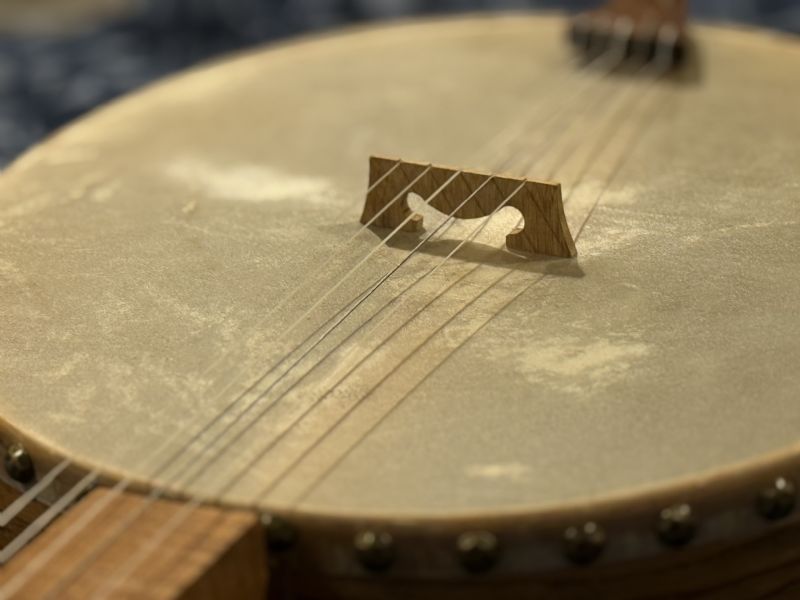
I’ve begun the nylgut & fretless adventure and after years of steel clawhammer, I’m having trouble inadvertently knocking the bridge over. Is this just a matter of a different playing style, or are there bridges that are more stable- a larger foot on the bridge, or adhering it to the skin somehow?
pinenut - Posted - 01/06/2026: 15:17:55
quote:
Originally posted by corkymiller46I’ve begun the nylgut & fretless adventure and after years of steel clawhammer, I’m having trouble inadvertently knocking the bridge over. Is this just a matter of a different playing style, or are there bridges that are more stable- a larger foot on the bridge, or adhering it to the skin somehow?
They kick around and move quite a bit with nylon strings, but, don't usually tip easy.
Pics of the bridge?
Edited by - pinenut on 01/06/2026 15:18:06
pinenut - Posted - 01/06/2026: 19:31:53
quote:
Originally posted by corkymiller46I can’t seem to load an image
"+ADD PHOTO" into your profile page as media and then copy and paste it into the forum with "Rich Text" selected.
Edited by - pinenut on 01/06/2026 19:35:32
corkymiller46 - Posted - 01/06/2026: 20:48:21
Well uploading photos here is the least intuitive process I’ve encountered in many years!
A Drum On A Stick - Posted - 01/06/2026: 21:13:20
It's hard for me to tell from the angle of the photo. But it looks to me like the bridge is pretty far up the head. If you move it an inch or two back towards the tailpiece, it should be more stable.
I usually position it so the fifth 'fret' is positioned just past the fifth string peg. I do this by finding the point on the 1st string where it sounds the same as the 5th string played open. Moving the tailpiece up or down the head will change where that point is. You'll have to retune after each adjustment.
Usually doing that places the bridge a bit further back than yours appears to be.
If you don't care about using the 5th string peg as a reference point, then you can put the bridge anywhere you want. Fretless is freedom :)
Edited by - A Drum On A Stick on 01/06/2026 21:17:45
Culloden - Posted - 01/06/2026: 21:52:34
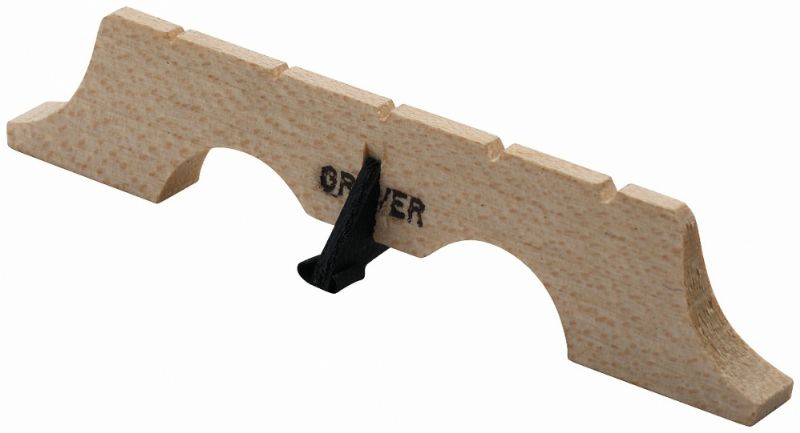
You might try this. It's called a Grover Non Tip bridge. I have used them before with nylon strings and they work pretty well. I don't think Grover makes them anymore but you could put a WTB ad in the classifieds and see if anyone on here has one they would sell.
Edited by - Culloden on 01/06/2026 22:07:17
banjobrewer - Posted - 01/07/2026: 03:31:08
If the bridge is where you like it according to scale you may just need a bridge with a thicker foot profile.
Dan Gellert - Posted - 01/07/2026: 10:14:55
If you want to keep the bridge where it is, its stability can be improved by using a longer tailpiece and/or a longer tail hanger (gut, wire, whatever), and making the string spacing on the tailpiece close to the same as it is on the bridge.
johnedallas - Posted - 01/16/2026: 01:38:30
quote:
Originally posted by A Drum On A StickIt's hard for me to tell from the angle of the photo. But it looks to me like the bridge is pretty far up the head. If you move it an inch or two back towards the tailpiece, it should be more stable.
I usually position it so the fifth 'fret' is positioned just past the fifth string peg. I do this by finding the point on the 1st string where it sounds the same as the 5th string played open.
Yes, by the photo I'd say that the bridge looks as if it were right in the middle of the head. This would give a different acoustic effect than the more usual position, which is more towards the tailpiece. Fretted banjos are built to have the bridge off-center. To get the bridge of a fretted banjo into the position the luthier designed it for, we measure the distance from the nut to the 12th fret and double that for the distance nut to bridge. Of course, you can't do that with a fretless banjo, because, obviously, you have no 12th fret to go by. But you do have a 5th-string pip, and this is equivalent to the 5th fret on a fretted banjo. And the distance from the nut to the 5th fret is exactly half the distance from nut to 12th fret. So the correct-as-designed distance for nut to bridge is exactly 4 times the distance for nut to 5th-string pip! No guessing about it! Works for fretted and fretless banjos!
Cheers,
John
Edited by - johnedallas on 01/16/2026 01:39:48
EEB - Posted - 01/19/2026: 02:14:36
As you explain you are new to nylon strings, I wonder if string tension is the mix too?
From your photo the combination of tall bridge, distance from the tailpiece and low string tension may be affecting pressure applied to the bridge and causing the bridge to be less stable? Maybe also head tension? With modern nylon and nylgut string sets the assumption is commonly made that they’re a one-size-fits-all. The variability of banjo scale lengths mean that correct tension ‘off the shelf’ is more a matter of luck.
Does the bridge issue occur when you are tuned higher and your strings are under slightly more tension? If it doesn’t, you’ve probably found the (main) problem and need to buy a set that will enable bridge stability in your playing range of lower and higher tunings. If it does continue to occur I’d be inclined to experiment with strings of higher tension.
I'm constantly fitting nylon and natural gut strings and setting up a wide and idiosyncratic variety of 19th century fretless and flush-fret/raised fret banjos. I've learned not to expect uniformity and one-size-fits-all when it comes to strings. There are calculations that can be applied for precision, but probably not necessary on a modern banjo with the availability of modern strings of different tension. Just experiment.
Edited by - EEB on 01/19/2026 02:29:43
Terms of Use | Privacy Policy | Privacy Consent (EU/GDPR Only)
Copyright 2026 Banjo Hangout. All Rights Reserved.