
DVD-quality lessons (including tabs/sheet music) available for immediate viewing on any device.
Take your playing to the next level with the help of a local or online banjo teacher.
Weekly newsletter includes free lessons, favorite member content, banjo news and more.
Premier Sponsors





|
Please note this is an archived topic, so it is locked and unable to be replied to. You may, however, start a new topic and refer to this topic with a link: http://www.banjohangout.org/archive/407539
trapdoor2 - Posted - 02/27/2026: 21:12:56
quote:
Originally posted by danielburdettI wonder how this banjo sounds…
You don't buy this one for the sound. Probably sounds like any other properly setup Gibson.
southerndrifter - Posted - 02/28/2026: 05:25:50
quote:
Originally posted by danielburdettI wonder how this banjo sounds…
I played it and I was not impressed. It didn't sound like what I expected an original prewar flathead Gibson to sound like. But I love that banjo mostly because of it's history. It's original owner lived near Danville, Va and it was sold a 2nd time out of a pawnshop in Martinsville, Va. Jim Mills said he spent a great deal of money just trying to see the banjo. Not only did he not get to see it, he couldn't even get a photo of it! There are still many people who believe Gibson never made a 5 string version of the All American in the prewar years!
banjered - Posted - 02/28/2026: 07:55:43
My girlfriend's check is on the way!
Now we need a blind fold test between this banjo and a Goodtimes and see how the 20 person vote goes.... banjered
The Old Timer - Posted - 02/28/2026: 09:19:14
Check out the PLECTRUM Original full weight flat head All American at Carter's in Nashville, and it's price point.
Bill Rogers - Posted - 02/28/2026: 12:14:22
How many serious banjo collectors can just write a check for that? Maybe a few—but would they want it?
banjoy - Posted - 02/28/2026: 12:39:37
I'm just wondering why the banjo had to be restored, why it had to be re-fretted, re-plated and refinished with only one owner at that time. Did that owner play the crap out of it? This seems implausible to me. This is not explained at all.
I think it's funny that you can add this to a shopping cart to buy it. Just breeze through checkout, you know, like buying donuts.
Andy FitzGibbon - Posted - 02/28/2026: 15:32:19
quote:
Originally posted by banjoyI'm just wondering why the banjo had to be restored, why it had to be re-fretted, re-plated and refinished with only one owner at that time. Did that owner play the crap out of it? This seems implausible to me. This is not explained at all.
Probably a combination of the era it was done, when there was generally less of a conservation mindset, and the fact that C. C. Richelieu is the one who did the work. He seems to have been quick to replate and refinish whether it was really necessary or not, an approach shared by much of the tenor banjo community that he did lots of work for, along with most people who were doing instrument work during that era.
Edited by - Andy FitzGibbon on 02/28/2026 15:32:55
banjoy - Posted - 03/01/2026: 05:04:48
quote:
Originally posted by Andy FitzGibbonquote:
Originally posted by banjoyI'm just wondering why the banjo had to be restored, why it had to be re-fretted, re-plated and refinished with only one owner at that time. Did that owner play the crap out of it? This seems implausible to me. This is not explained at all.
Probably a combination of the era it was done, when there was generally less of a conservation mindset, and the fact that C. C. Richelieu is the one who did the work. He seems to have been quick to replate and refinish whether it was really necessary or not, an approach shared by much of the tenor banjo community that he did lots of work for, along with most people who were doing instrument work during that era.
Thanks for those insights. So as I understand it probably didn't need these things done, but was just a way to keep an instrument pristine? The question remains in my mind, why was it necessary unless the instrument were very well played... frets don't degrade themselves LOL.
It seems the conventional wisdom has always been to leave things as-is, that restoration would reduce the value of something. But because of who did the work, it maintains its value? Just asking because I'm curious, that's all. I guess this all only makes sense to those who have a quarter of a billion dollars laying around to drop on a banjo, For the rest of us, it's entertainment. A curiosity.
banjoy - Posted - 03/01/2026: 05:23:47
Brain bubble and still waking up. I meant in my above post a quarter of a million dollars, not billion. Too late to edit. Either way, it's more than I'll ever see :)
Andy FitzGibbon - Posted - 03/01/2026: 05:38:47
quote:
Originally posted by banjoy
Thanks for those insights. So as I understand it probably didn't need these things done, but was just a way to keep an instrument pristine? The question remains in my mind, why was it necessary unless the instrument were very well played... frets don't degrade themselves LOL.It seems the conventional wisdom has always been to leave things as-is, that restoration would reduce the value of something. But because of who did the work, it maintains its value? Just asking because I'm curious, that's all. I guess this all only makes sense to those who have a quarter of a billion dollars laying around to drop on a banjo, For the rest of us, it's entertainment. A curiosity.
To be clear, I have not seen this banjo in person and have no insider knowledge, so anything I say regarding it specifically is pure speculation.
In the 60s, when Richelieu worked on this All American, the prevailing philosophy among people working on fretted instruments was repair rather than conservation. More on the model of an auto repair shop, or factory repair departments like Martin and Gibson. An instrument with a scratch got a full refinish, a guitar with a cracked top got the top replaced, an instrument in need of a refret might instead get a new fingerboard or a whole new neck.
The conventional wisdom having always been to leave things as-is assumes the object in question has some sort of value as a historic artifact or collectible. In the late 60s, many of the instruments in question (including this All American) had not yet achieved that status. They were just 30-40 year old instruments at that point, and were viewed more through the lens of utility than collectability. Kinda like if you took a 1991 Cadillac to a garage today.
In addition, Richelieu was primarily a tenor banjo player and maker, and that scene has a longstanding tradition of keeping instruments "flashy" with regular replating and refinishing, as well as upgrading. I could see him replacing the frets for reasons other than wear... maybe they were too small for his taste, or maybe they were loose and refretting was just easier.
desert rose - Posted - 03/01/2026: 05:48:25
Andy your observations are correct, the vintage world hasnt always focused on what its focused on today, and absolutely any one involved in tenor banjos knows their focus is show room pristine is the only thing acceptable, tarnish, minute scratches are taboo, A bluegrass vintage banjo would be a embarassement to be seen with, paint gone plating gone black marks on the head.
banjoy - Posted - 03/01/2026: 05:57:38
Thanks for all these insights. Not being a collector, it's all academic for me at best. But I think there are lots of folks who would be embarrassed about bluegrass banjo in general LOL!!! Enough banjo jokes to back that up...
(Just kidding!. I'm kidding!!?)
BanjoLink - Posted - 03/01/2026: 14:40:35
I sort of cringed when I saw mr. Richelieu's name associated with it. He was a very nice man, but has already been mentioned tenor and plectrum banjo repair/builders do not think like bluegrass folks. Nuff said!
Laurence Diehl - Posted - 03/01/2026: 16:25:14
quote:
Originally posted by Andy FitzGibbonquote:
Originally posted by banjoyThanks for those insights. So as I understand it probably didn't need these things done, but was just a way to keep an instrument pristine? The question remains in my mind, why was it necessary unless the instrument were very well played... frets don't degrade themselves LOL.It seems the conventional wisdom has always been to leave things as-is, that restoration would reduce the value of something. But because of who did the work, it maintains its value? Just asking because I'm curious, that's all. I guess this all only makes sense to those who have a quarter of a billion dollars laying around to drop on a banjo, For the rest of us, it's entertainment. A curiosity.
To be clear, I have not seen this banjo in person and have no insider knowledge, so anything I say regarding it specifically is pure speculation.
In the 60s, when Richelieu worked on this All American, the prevailing philosophy among people working on fretted instruments was repair rather than conservation. More on the model of an auto repair shop, or factory repair departments like Martin and Gibson. An instrument with a scratch got a full refinish, a guitar with a cracked top got the top replaced, an instrument in need of a refret might instead get a new fingerboard or a whole new neck.
The conventional wisdom having always been to leave things as-is assumes the object in question has some sort of value as a historic artifact or collectible. In the late 60s, many of the instruments in question (including this All American) had not yet achieved that status. They were just 30-40 year old instruments at that point, and were viewed more through the lens of utility than collectability. Kinda like if you took a 1991 Cadillac to a garage today.
In addition, Richelieu was primarily a tenor banjo player and maker, and that scene has a longstanding tradition of keeping instruments "flashy" with regular replating and refinishing, as well as upgrading. I could see him replacing the frets for reasons other than wear... maybe they were too small for his taste, or maybe they were loose and refretting was just easier.
when you consider what happened with Earl and JEMainers banjo, Bill Monroe's mandolin that sounds about right.
kyleb - Posted - 03/02/2026: 07:49:12
quote:
Originally posted by danielburdettI wonder how this banjo sounds…
i sounds great, i got to play that banjo, its an amazing prewar flathead. It was repaired, I dont remeber the frets being large, but honestly i was just in awe when i got to play it that i didnt really examine it in detail. According to the listing its been refretted, replated and laqured which i dont really like, but its also the only one in existance, so you cant be too picky. Contact John and ask all the questions, he is really open about everything he sells and im 100% sure he has all the details on everything that has been done to it. As far as sound, its got the prewar flathead "it" factor.
Edited by - kyleb on 03/02/2026 07:54:14
The Old Timer - Posted - 03/02/2026: 07:52:41
What was Jim Mills' famous advice to a guy considering buying a replated gold pre war Gibson? Something like "Don't do it, you'll never get your money back."
My personal taste is against replated/refinished, because I have seen such AWFUL jobs done! On Gibsons at least. And not by Richilieu or that lady Renee Karnes (sp?). Any engraving usually gets polished of buffed until it is very faint, then filled in with overly generous nickel plate and a thin coat of gold plate. Refinished with change in the appearance of the stain, and again overly generous thickness of Zip Gard or whatever kind of new finish, looking "plasticky", like it was dipped.
However, perhaps Richilieu, Karnes etc might do their restorations several quantum leaps better that what I've seen done on Gibsons...
For background, my taste in "restorations" undoubtedly comes from my Dad, who owned two old things that others often had "restored". A Winchester Model 12 shotgun, and a 1946 Gibson Southern Jumbo. Both VERY well worn from honest use, and showing it. Dad always told me and anyone else who asked, NEVER get the shotgun reblued and NEVER get the guitar refinished! So I haven't, and I'm glad I didn't. Consequently, 15 years ago I passed on buying an otherwise very nice 1928 Granada that Gibson refinished (not a terrible job) and replated (disgusting job -- see above).
Edited by - The Old Timer on 03/02/2026 07:57:21
kyleb - Posted - 03/02/2026: 07:58:51
quote:
Originally posted by The Old TimerWhat was Jim Mills' famous advice to a guy considering buying a replated gold pre war Gibson? Something like "Don't do it, you'll never get your money back."
My personal taste is against replated/refinished, because I have seen such AWFUL jobs done! On Gibsons at least. And not by Richilieu or that lady Renee Karnes (sp?). Any engraving usually gets polished of buffed until it is very faint, then filled in with overly generous nickel plate and a thin coat of gold plate. Refinished with change in the appearance of the stain, and again overly generous thickness of Zip Gard or whatever kind of new finish, looking "plasticky", like it was dipped.
However, perhaps Richilieu, Karnes etc might do their restorations several quantum leaps better that what I've seen done on Gibsons...
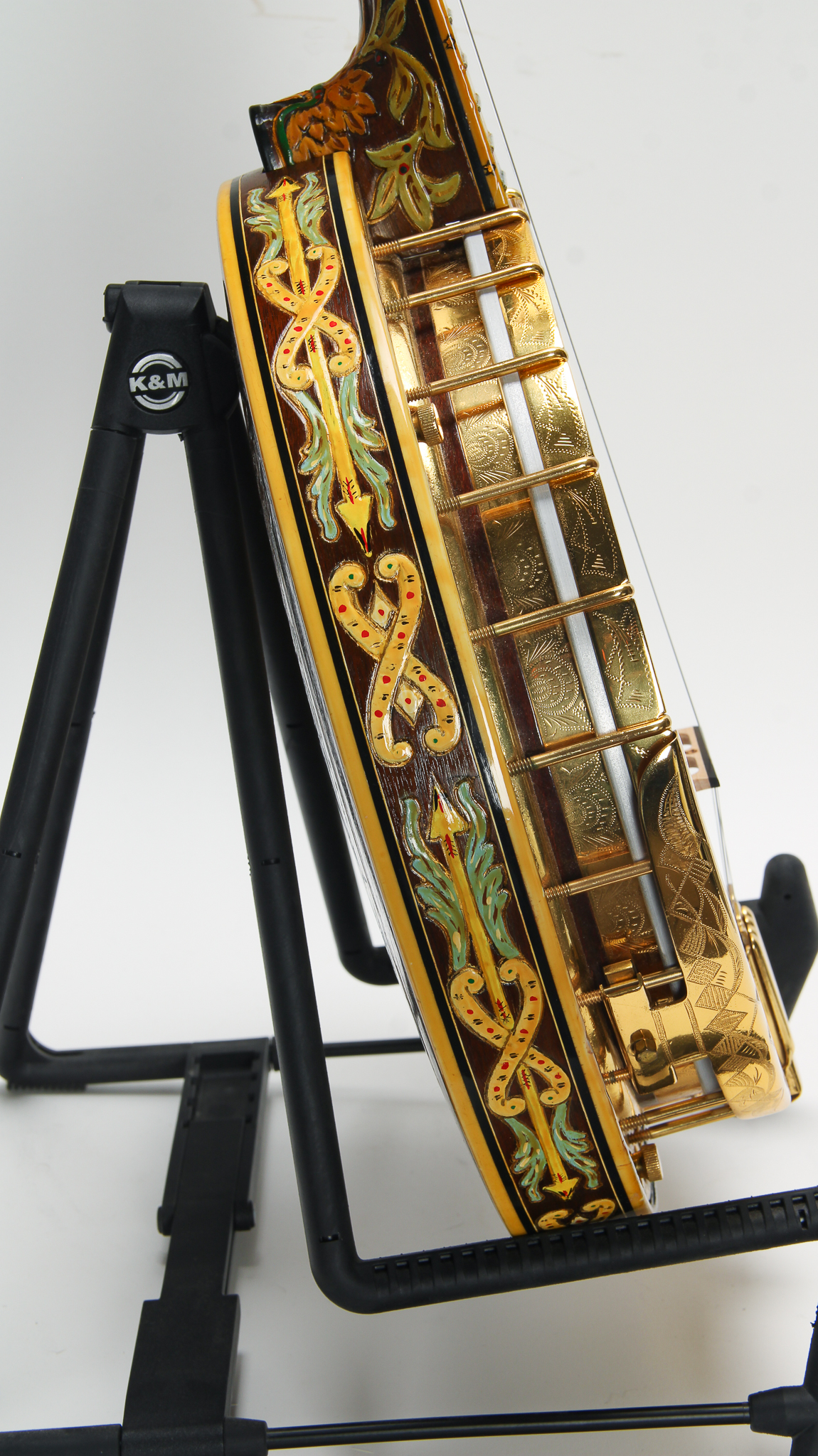
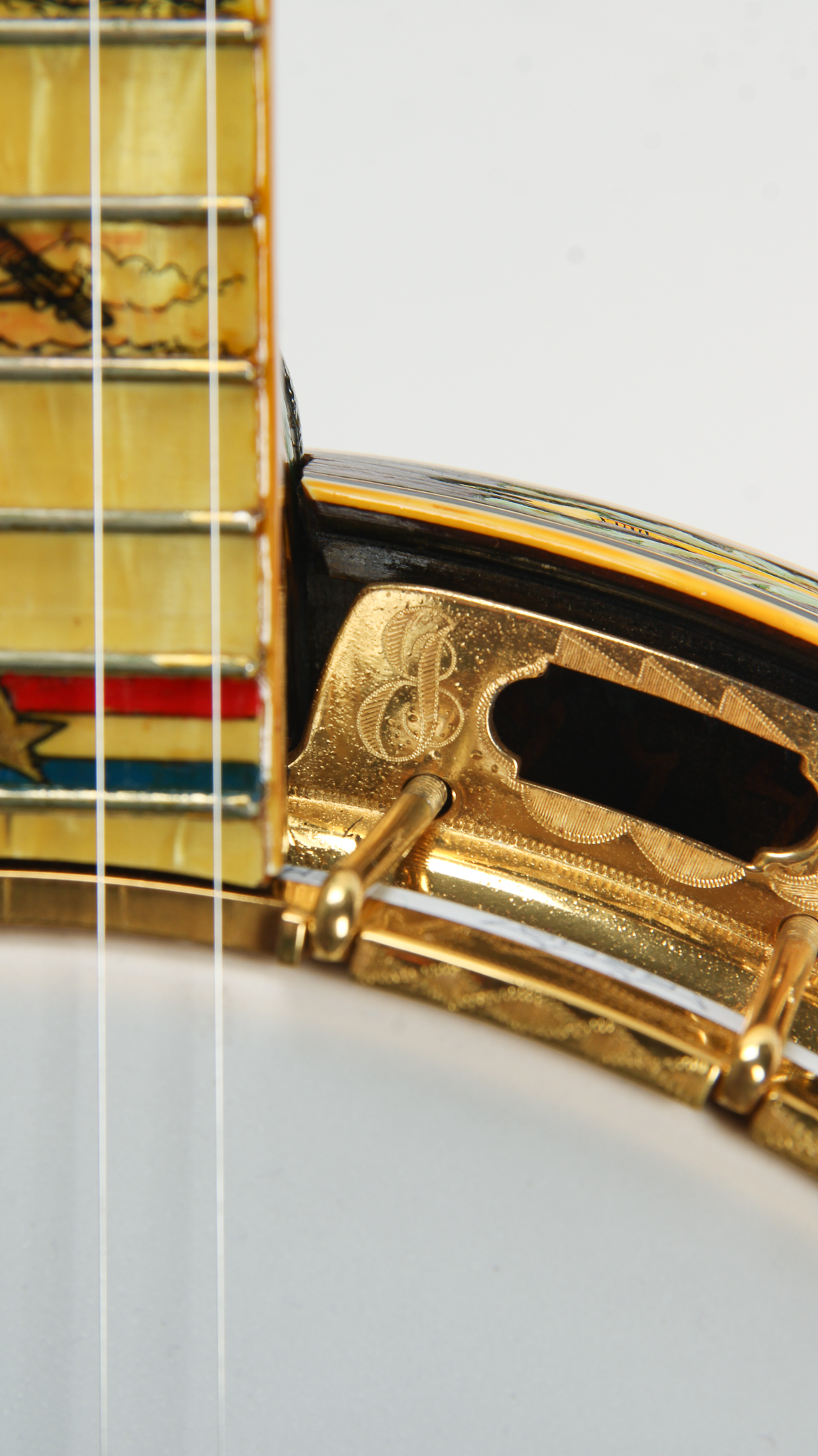
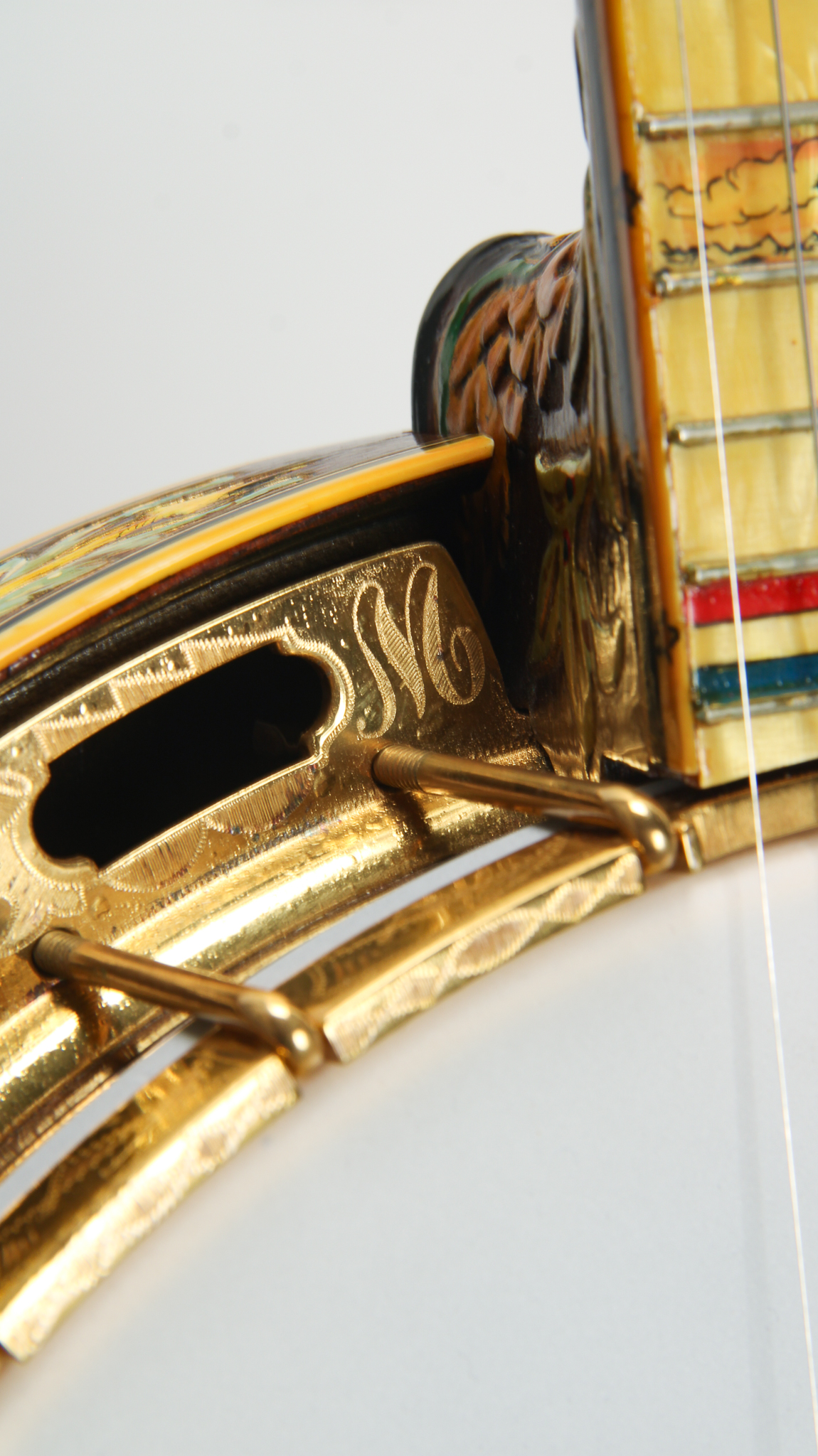
the engraving is really strong on this banjo, you can even see it in the pictures, andi saw that in person, i dont know anything about replating but this banjo doesnt have the problems youre describing. 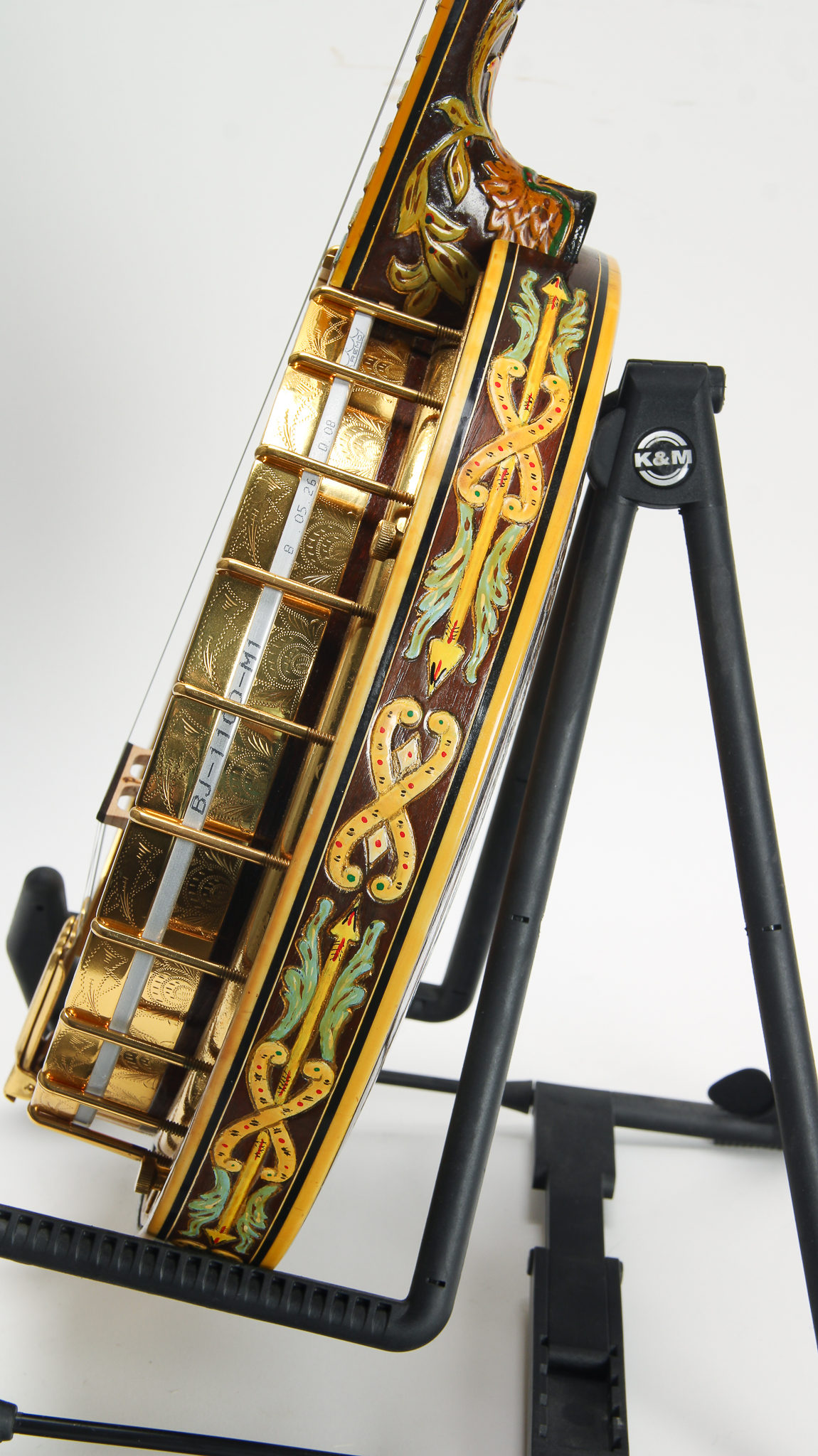
The Old Timer - Posted - 03/02/2026: 10:41:20
My goodness! Excellent appearance of the engraving. Richelieu must know some things that don't seem to be common knowledge (or practices) among the bluegrass banjo restorers.
Thanks for the photos. They have opened my mind a bit.
mbet - Posted - 03/02/2026: 11:41:59
Someone should buy that and put a conversion tenor neck on it, just to even the score a bit.
Jon Borcherding - Posted - 03/02/2026: 11:48:20
K&M makes some nice stands, but $250,000 seems kinda steep.
kyleb - Posted - 03/02/2026: 12:54:29
quote:
Originally posted by Jon BorcherdingK&M makes some nice stands, but $250,000 seems kinda steep.
im guessing it sees the stand for 10 minutes at most during a photohoot.
southerndrifter - Posted - 03/02/2026: 13:20:47
quote:
Originally posted by The Old TimerMy goodness! Excellent appearance of the engraving. Richelieu must know some things that don't seem to be common knowledge (or practices) among the bluegrass banjo restorers.
Thanks for the photos. They have opened my mind a bit.
Richelieu re-engraved the banjo after the replating.
southerndrifter - Posted - 03/02/2026: 13:31:14
As far as the number of owners this banjo has had, CL Pennelle, from Danville, Va was the original owner. He was a local performer who played very regularly on radio and personal appearances throughout the 30s. Bill "2 ton" Bryson bought it in the 40s and played very often in and around the central North Carolina area. I don't know who the 3rd owner was, but Bob "Red" Roberts owned it in the late 60s. It finally was bought by the proprietor of Buck's Musical Instruments in Pa, where it had remained until his death. So I would imagine the banjo was quite worn by the time Richelieu did the restoration.
CaseyJones - Posted - 03/03/2026: 21:06:10
quote:
Originally posted by danielburdettI wonder how this banjo sounds…
Hey Daniel, on this reverb link, if you go to the very last picture, it is a video of a guy playing it and you can get a good listen to it
danielburdett - Posted - 03/03/2026: 21:21:42
quote:
Originally posted by CaseyJonesquote:
Originally posted by danielburdettI wonder how this banjo sounds…
Hey Daniel, on this reverb link, if you go to the very last picture, it is a video of a guy playing it and you can get a good listen to it
reverb.com/item/78514863-gibso...g-ca-1931
Sweet! Thank you! It sure sounds like a banjo to me... I think I'll stick with what I've got for th time being...
CaseyJones - Posted - 03/03/2026: 21:33:31
quote:
Originally posted by danielburdettquote:
Originally posted by CaseyJonesquote:
Originally posted by danielburdettI wonder how this banjo sounds…
Hey Daniel, on this reverb link, if you go to the very last picture, it is a video of a guy playing it and you can get a good listen to it
reverb.com/item/78514863-gibso...g-ca-1931
Sweet! Thank you! It sure sounds like a banjo to me... I think I'll stick with what I've got for th time being...
My thoughts were the same.
My banjo sounds pretty good to me, and the price tag had two less zeros on it than that one
BanjoLink - Posted - 03/05/2026: 08:58:59
quote:
Originally posted by southerndrifterquote:
Originally posted by The Old TimerMy goodness! Excellent appearance of the engraving. Richelieu must know some things that don't seem to be common knowledge (or practices) among the bluegrass banjo restorers.
Thanks for the photos. They have opened my mind a bit.Richelieu re-engraved the banjo after the replating.
Lynwood, not to get too technical, but the re-engraving would have been done before the re-plating ..... if you are talking about the metal parts!
southerndrifter - Posted - 03/05/2026: 15:08:08
quote:
Originally posted by BanjoLinkquote:
Originally posted by southerndrifterquote:Richelieu re-engraved the banjo after the replating.
Lynwood, not to get too technical, but the re-engraving would have been done before the re-plating ..... if you are talking about the metal parts!
Good info! I wasn't sure of the proper procedure. I just was told that the engraving had been redone by Richelieu. That's why it looks so pristine.
Edited by - southerndrifter on 03/05/2026 15:08:51
BanjoLink - Posted - 03/06/2026: 05:26:56
quote:
Originally posted by southerndrifterquote:
Originally posted by BanjoLinkquote:
Originally posted by southerndrifterquote:Richelieu re-engraved the banjo after the replating.
Lynwood, not to get too technical, but the re-engraving would have been done before the re-plating ..... if you are talking about the metal parts!
Good info! I wasn't sure of the proper procedure. I just was told that the engraving had been redone by Richelieu. That's why it looks so pristine.
Lynwood ..... I used to wonder how it was done too until I started having brass golf putters engraved for presentations and then having them gold plated. I always wanted the engraving sharp and not filled in when the putter head was plated. It turns out that the average gold plating process is on;y .5 - 1 micron thick. Heavy gold plate is 2.5 microns ........ and that is 100 millionth of an inch!
Julio B - Posted - 03/08/2026: 12:56:20
I saw that banjo (one of one!) at Banjothon many years ago. Interesting, but I would not want it.
J.Albert - Posted - 03/08/2026: 13:17:18
Lynwood wrote:
" It finally was bought by the proprietor of Buck's Musical Instruments in Pa, where it had remained until his death..."
Wouldn't that be Karl Dieterichs?
eljimb0 - Posted - 03/15/2026: 12:41:23
I can say with certainty that nobody ever will cut that rim. ...If people could pay 100 bucks to play it for 10 minutes. It would be paid off in a few years. (idea!) ...Then give it to the Smithsonian where we would all own it forever.
BanjoLink - Posted - 03/16/2026: 09:31:42
quote:
Originally posted by The Old TimerMy goodness! Excellent appearance of the engraving. Richelieu must know some things that don't seem to be common knowledge (or practices) among the bluegrass banjo restorers.
Thanks for the photos. They have opened my mind a bit.
Dick .... you are right about the plating. It is the buffing and getting it prepped for plating that messes up or dilutes the engraving, not the plating process. The plating is so thn it is not going to fill in sharply engraved metal
Terms of Use | Privacy Policy | Privacy Consent (EU/GDPR Only)
Copyright 2026 Banjo Hangout. All Rights Reserved.


