DVD-quality lessons (including tabs/sheet music) available for immediate viewing on any device.
Take your playing to the next level with the help of a local or online banjo teacher.
Weekly newsletter includes free lessons, favorite member content, banjo news and more.
Premier Sponsors





|
Please note this is an archived topic, so it is locked and unable to be replied to. You may, however, start a new topic and refer to this topic with a link: http://www.banjohangout.org/archive/407564
Page: 1 2
GS - Posted - 03/01/2026: 10:26:42
Only the second time I've had to change strings - I think I did better the first time - and would like to run a couple of questions by you all in preparation for the next string change.
I did watch a few videos, some more clearer than others, but I still managed to make a pig's ear out of things. Thankfully they're holding tension...but it could've been better. A LOT BETTER!
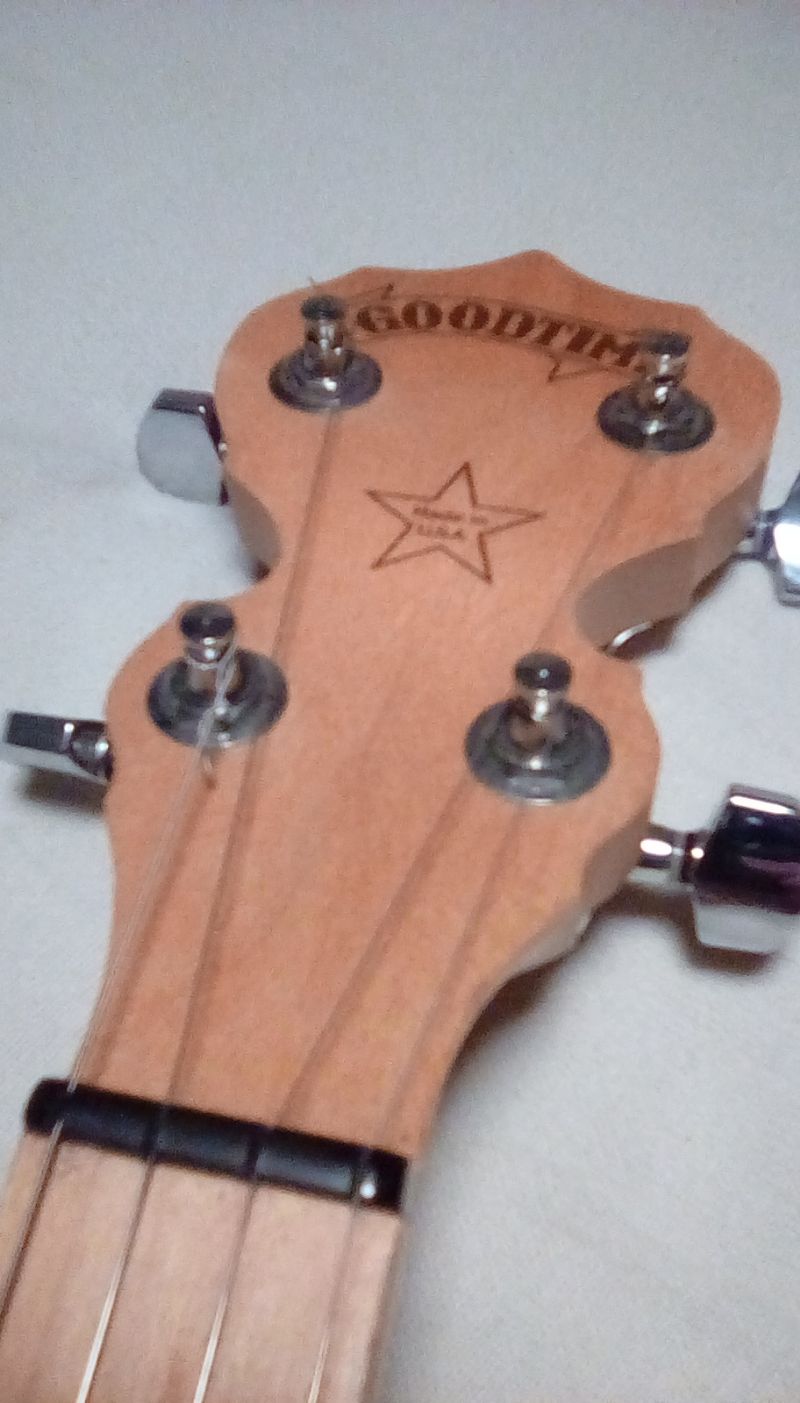
With the deering banjo, all tuners turn in the same direction (i.e. away from the nut to tighten the string) but the other banjo I have only two tuners tighten string tension in this direction, the other two do so by turning in the opposite direction.
If my image uploads, I realise I've not fed the string in to the peg from the inside on all strings - do you need to feed in from the inside? I think by this stage I was just trying to save the strings as they'd gotten a couple of kinks in them, and I'd not gotten enough string wrapped around a couple of the pegs.
Are string winders a help or not that necessary? Any advice is greatly appreciated.
Out of interest, is three and a half hours a record for a string change?!?!?
GS
Edited by - GS on 03/01/2026 10:28:19
Texasbanjo - Posted - 03/01/2026: 10:52:37
I HATE to change strings, so I can empathize with you. Once you do it a few times, it does become easier (or it did for me). I still look before I unwind a string to be sure which way it winds. I remember only one string at a time, usually starting with the high D string (1st string). I get it close to in tune. Then do the others the same way. I usually stretch the strings when I'm through winding them as I find they seem to need that stretching for some reason. Then I finish tuning the new strings. It usually takes 2 or 3 different times of checking the tuning and playing the banjo to get them settled where they stay in tune. Others may do it differently and that's okay, too.
I've never used string winders so for me, they aren't necessary. Do they help? I don't know. Maybe they do help others.
I feed the strings from the inside out. Just seems to work better that way.
I think 3.5 hours must be a record. I remember it taking me nearly 2 hours the first time I changed strings. After that, it got easier and quicker.
Owen - Posted - 03/01/2026: 10:54:25
Tongue-in-cheek, three and half hours sounds about right ............. give-or-take ... depending on how many other chores you fit in. 
kbiinde2 - Posted - 03/01/2026: 11:02:49
Practice "may" make it easier and faster, may never be "perfect"..
I haven't used a winder to this point, just never felt the need I suppose..
I usually wind from the inside in relation to the nut, but I have an acoustic guitar with one post (outside turn)..
My least favorite is changing strings on a Mandolin.. geesh.!
Don't give up.. kb
GS - Posted - 03/01/2026: 11:21:16
Thanks for your replies, folks, it's appreciated. I guess 3 1/2 hours was a bit of a stretch...but it was heading that a way! I knew it would have taken up a chunk of time, but the rest of my Sunday afternoon plans went out of the window.
I should've stuck to playing the triangle - I would've been proficient by now 
Culloden - Posted - 03/01/2026: 11:22:20
A string winder is not very expensive if you want to try one. On a banjo with planetary pegs, it's pretty useless but, on a banjo with guitar tuners, it saves a lot of time.
reubenstump - Posted - 03/01/2026: 11:28:13
It's still not intuitive to me, but maybe I'm not as smart as my mon thought.
Anywho, Deering has some good videos about all sorts of maintenance and setup tasks. The third one down is a good start.
deeringbanjos.com/pages/banjo-tech-videos
heavy5 - Posted - 03/01/2026: 11:33:01
Use your capo to capture the strings at about the 5th fret then clip them apart at about the 3rd fret , then remove them from tail piece & u are left w/ short pcs to remove from pegs . U can then re capture the new strings one by one w/ the capo from the tailpiece so they are not flailing around in your face . New strings should be wrapped around pegs so they exit pegs towards the center of the peghead .
banjered - Posted - 03/01/2026: 11:51:16
A capo is GREAT for putting ON the strings. It's the "third" hand you need to do a good job! Hook the new string to the tail piece, pull it taut toward the headstock, and while keeping it taut, capo the string about the 3-4th fret. You'll find other tricks to smooth things out as you change more strings.
And to answer your question – YES, you did set a world new time record for changing strings! Congratulations! banjered
lucas73b - Posted - 03/01/2026: 12:10:35
Changing strings is an occupation I tend to postpone forever. Therefore, when I am finished, I find it useful to write down the date (and the thickness of the strings), on a sticker inside the rim reminding me when it is time to repeat the exercise.
Flyguy - Posted - 03/01/2026: 12:48:29
Depending on how you interpret it the strings do go into the hole from the inside out. Looks to me from the picture that the B and high D strings are wound the wrong way. That would make the knobs turn the same way for all four strings.
Or maybe I have been doing it wrong all these years......
KCJones - Posted - 03/01/2026: 13:01:57
I used to always change my own strings but I discovered my local shop will install strings for free if you buy them there. They didn't have the string set I wanted at first but I asked and now they stock them for me. They're like a dollar more than online but I support the local shop and don't have to change strings myself.
Edited by - KCJones on 03/01/2026 13:02:28
RB-1 - Posted - 03/01/2026: 14:29:35
quote:
Originally posted by lucas73bChanging strings is an occupation I tend to postpone forever. Therefore, when I am finished, I find it useful to write down the date (and the thickness of the strings), on a sticker inside the rim reminding me when it is time to repeat the exercise.
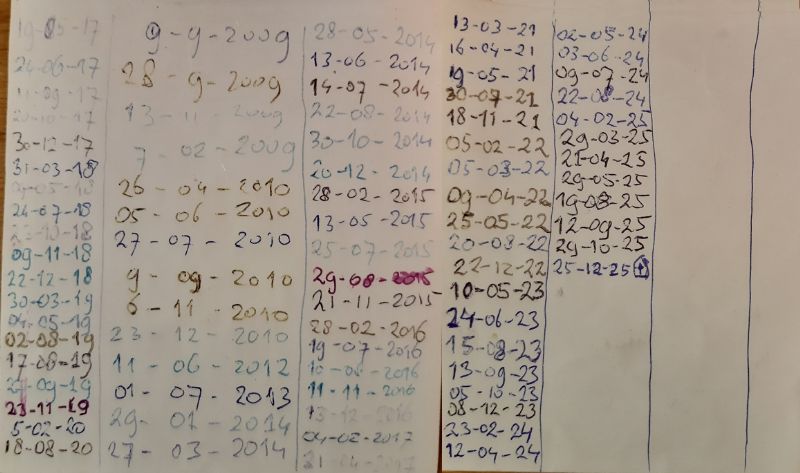
I usually won't be waiting till the cows come home... Having said that, our number of gigs has gone down dramaticly these past 20 years (combination of factors), so sometimes sting life is just a week, but sometimes few months.
I used changing them a few days before a concert and writing down the date.
I can see exactly when the busiest periods were  :
:
ssduke - Posted - 03/01/2026: 14:36:04
George is correct. You always feed the string through the tuning post from the inside to the outside. In other words from the middle of the peghead toward the outer edge of the peg. You have done that for the low D and G strings, but have fed the B and high D strings from the outside of the post to the inside. That is the reason those pegs need to be turned in an unexpected direction to tension the strings.
Elderly Instruments has a 3 minute video on restringing a guitar, but the method applies to banjos, as well.
youtu.be/pnuMVpigLqo?si=0kb-kOfYQ5Ex6kh3
And so you don’t feel bad about your pioneering efforts, go to this page on Frets.com and scroll to the last image showing a really remarkable restringing job somebody did on their guitar.
frets.com/FretsPages/Musician/...ing2.html
The Old Timer - Posted - 03/01/2026: 14:36:27
A string winder's purpose is to change strings FAST. You shouldn't be striving for speed. Use the old motto Slow is Smooth, and Smooth is Fast.
You will get better with practice. Be patient.
I save the paper sleeve from the string package and write the date of string change on it, and leave it in the case with the banjo. That also tells me what brand and gauge of string I happen to have put on.
As far as winding on a new string from the OUTSIDE of the peg shaft, it's mostly a matter of taste, UNLESS the longer string happens to touch the peg shaft of the shorter string. In your photo it indeed appears your 2nd string "might" be touching the 1st string peg shaft. That's not good for keeping in good tune, nor for string life. However, some folks do it. Dr. Ralph Stanley famously put his 3rd and 4th strings on from the outside because (I guess) he liked all 4 of his Planet tuners to turn the same direction. Gibson famously used the Kluson "stair step" tuners that were MADE to turn all the same direction on all 4 strings, which sure baffled a number of pickers who didn't expect that! These were on Gibson Mastertones from 1954 to about 1970.
Edited by - The Old Timer on 03/01/2026 14:40:57
HSmith - Posted - 03/01/2026: 23:54:05
Hi
As with so much in the banjo world, there's no absolute right and wrong, just what works for you. I (and most players) string my banjos with the string entering the post from the inside, but it's not mandatory! It's certainly true that string changing can be an awkward chore, but it becomes quicker and easier over time. The Hangout 'Learn' pages have some useful tuition on banjo maintenance and repair, and one item is on string changing. Here's a link frets.com/FretsPages/Musician/...str1.html
GS - Posted - 03/02/2026: 01:31:05
quote:
Originally posted by banjeredA capo is GREAT for putting ON the strings. It's the "third" hand you need to do a good job! Hook the new string to the tail piece, pull it taut toward the headstock, and while keeping it taut, capo the string about the 3-4th fret. You'll find other tricks to smooth things out as you change more strings.
And to answer your question – YES, you did set a world new time record for changing strings! Congratulations! banjered
Woo hoo, I set a world record! Man, I hope I get better at this changing strings - it wasn't a fun task. Yeah, the capo might help. A third hand? I think a third and a fourth would have been ideal yesterday. I guess it is a case of practice, learning tricks, banjered.
GS
GS - Posted - 03/02/2026: 01:35:04
quote:
Originally posted by FlyguyDepending on how you interpret it the strings do go into the hole from the inside out. Looks to me from the picture that the B and high D strings are wound the wrong way. That would make the knobs turn the same way for all four strings.
Or maybe I have been doing it wrong all these years......
Yeah, flyguy, b and d high strings are wound the wrong way. I was a tad flustered by this stage and just wanted them on! Thanks for your reply.
GS
GS - Posted - 03/02/2026: 01:38:02
quote:
Originally posted by KCJonesI used to always change my own strings but I discovered my local shop will install strings for free if you buy them there. They didn't have the string set I wanted at first but I asked and now they stock them for me. They're like a dollar more than online but I support the local shop and don't have to change strings myself.
Maaaan, I wish that was an option for me. Do you think they'll do it for me? I'm in the North East of England!
GS - Posted - 03/02/2026: 01:47:23
quote:
Originally posted by ssdukeGeorge is correct. You always feed the string through the tuning post from the inside to the outside. In other words from the middle of the peghead toward the outer edge of the peg. You have done that for the low D and G strings, but have fed the B and high D strings from the outside of the post to the inside. That is the reason those pegs need to be turned in an unexpected direction to tension the strings.
Elderly Instruments has a 3 minute video on restringing a guitar, but the method applies to banjos, as well.
youtu.be/pnuMVpigLqo?si=0kb-kOfYQ5Ex6kh3
And so you don’t feel bad about your pioneering efforts, go to this page on Frets.com and scroll to the last image showing a really remarkable restringing job somebody did on their guitar.
frets.com/FretsPages/Musician/...ing2.html
Thanks for your reply, Steven. I wish my strings looked as neat as those done by the elderly instruments fella. Maybe one day. Yeah, the frets.com link gave me a chuckle! Cheers.
GS - Posted - 03/02/2026: 01:51:55
quote:
Originally posted by The Old TimerA string winder's purpose is to change strings FAST. You shouldn't be striving for speed. Use the old motto Slow is Smooth, and Smooth is Fast.
You will get better with practice. Be patient.
I save the paper sleeve from the string package and write the date of string change on it, and leave it in the case with the banjo. That also tells me what brand and gauge of string I happen to have put on.As far as winding on a new string from the OUTSIDE of the peg shaft, it's mostly a matter of taste, UNLESS the longer string happens to touch the peg shaft of the shorter string. In your photo it indeed appears your 2nd string "might" be touching the 1st string peg shaft. That's not good for keeping in good tune, nor for string life. However, some folks do it. Dr. Ralph Stanley famously put his 3rd and 4th strings on from the outside because (I guess) he liked all 4 of his Planet tuners to turn the same direction. Gibson famously used the Kluson "stair step" tuners that were MADE to turn all the same direction on all 4 strings, which sure baffled a number of pickers who didn't expect that! These were on Gibson Mastertones from 1954 to about 1970.
Thanks for the reassurance about getting better with practice - I hope so! Thankfully, the second string is not touching the first peg shaft. Have a good day
GS
GS - Posted - 03/02/2026: 01:55:02
quote:
Originally posted by HSmithHi
As with so much in the banjo world, there's no absolute right and wrong, just what works for you. I (and most players) string my banjos with the string entering the post from the inside, but it's not mandatory! It's certainly true that string changing can be an awkward chore, but it becomes quicker and easier over time. The Hangout 'Learn' pages have some useful tuition on banjo maintenance and repair, and one item is on string changing. Here's a link frets.com/FretsPages/Musician/...str1.html
Thanks for your reply, Harry. That link will be helpful. Enjoy your day.
GS
GS - Posted - 03/02/2026: 01:58:05
quote:
Originally posted by reubenstumpIt's still not intuitive to me, but maybe I'm not as smart as my mon thought.
Anywho, Deering has some good videos about all sorts of maintenance and setup tasks. The third one down is a good start.
deeringbanjos.com/pages/banjo-tech-videos
Thanks for your reply, reubenstump. I'm pleased I posted this topic, it seems like string changing can be a pita for even the most experienced banjo folks. Have a good day
GS
Owen - Posted - 03/02/2026: 07:25:27
I didn't examine all the responses closely. I change strings quite infrequently, but I think changing them one string at a time helps me... and it could even help me to get it in the correct octave??
reubenstump - Posted - 03/02/2026: 08:03:52
If you have the intonation set where you like it and mark the bridge with pencil marks on the head, changing one string at a time as Owen suggests can save time and maybe even some aggravation. Having said that, learning how to change your strings and set intonation are useful skills to learn, even if you never become an expert.
Edited by - reubenstump on 03/02/2026 08:04:08
RB-1 - Posted - 03/02/2026: 08:25:28
quote:
Originally posted by reubenstumpHaving said that, learning how to change your strings and set intonation are useful skills to learn, even if you never become an expert.
That would be at least one step into the right direction.....
Edited by - RB-1 on 03/02/2026 08:25:49
RB-1 - Posted - 03/02/2026: 08:28:04
quote:
Originally posted by OwenI didn't examine all the responses closely. I change strings quite infrequently, but I think changing them one string at a time helps me... and it could even help me to get it in the correct octave??
Apart from some major maintenance on the banjo, who wouldn't change strings one at a time? 
Owen - Posted - 03/02/2026: 08:31:21
I dunno... maybe the people that first remove them all, and/or those that use a capo or tape to hold them in place??
Edited by - Owen on 03/02/2026 08:39:32
RB-1 - Posted - 03/02/2026: 08:33:41
quote:
Originally posted by The Old TimerI save the paper sleeve from the string package and write the date of string change on it, and leave it in the case with the banjo. That also tells me what brand and gauge of string I happen to have put on.
Such coincidence... 
Dick, that's what I've been doing exactly the same for many years now. That was the picture I posted: 
RB-1 - Posted - 03/02/2026: 08:46:27
quote:
Originally posted by OwenI dunno... maybe the people that first remove them all
To me that would be a sure sign of 'not thinking'.... 
GS - Posted - 03/02/2026: 09:36:45
quote:
Originally posted by reubenstumpIf you have the intonation set where you like it and mark the bridge with pencil marks on the head, changing one string at a time as Owen suggests can save time and maybe even some aggravation. Having said that, learning how to change your strings and set intonation are useful skills to learn, even if you never become an expert.
Yeah, the head is marked for the bridge where the intonation is good; good enough for me, anyway. It's the string change that's the issue. I'll get there. Anyway, that's this string change done, for this banjo, until at least 2030!!!
GS - Posted - 03/02/2026: 09:38:41
quote:
Originally posted by RB-1quote:
Originally posted by OwenI didn't examine all the responses closely. I change strings quite infrequently, but I think changing them one string at a time helps me... and it could even help me to get it in the correct octave??
Apart from some major maintenance on the banjo, who wouldn't change strings one at a time?
Out of curiosity, is there a way to change all five strings at the same time?!?! I'd go for that!
Edited by - GS on 03/02/2026 09:44:02
RB-1 - Posted - 03/02/2026: 09:58:49
quote:
Originally posted by GSOut of curiosity, is there a way to change all five strings at the same time?!?! I'd go for that!
Only for people with ten hands.....
Owen - Posted - 03/02/2026: 10:04:50
To me "change" involves removal as well as re-stinging. You can get half way to "all at the same time" by removing them all before starting to re-string. Surely half-way is a good first step.
Dean T - Posted - 03/02/2026: 10:08:43
quote:
Originally posted by RB-1quote:
Originally posted by OwenI didn't examine all the responses closely. I change strings quite infrequently, but I think changing them one string at a time helps me... and it could even help me to get it in the correct octave??
Apart from some major maintenance on the banjo, who wouldn't change strings one at a time?
I do. At least every other string change, I take them all off. I always have my heads marked for bridge location so no problem there. I like to clean all the marks off the head, and all the fret gunk. And do an inspection of all the hardware and adjustments. As a career aircraft mechanic who has strung a million miles of safety wire, I enjoy changing banjo and guitar strings.
steve davis - Posted - 03/02/2026: 10:14:21
By comparing 12th fret fretted notes to 12th fret harmonics it's very easy to correctly place the bridge in its best intonating location when removing all the strings and putting on new ones.
Especially when removing all the strings when replacing the head.
gentrixuk - Posted - 03/02/2026: 11:25:22
I find it helps to give the string loops a bit of a squeeze to make them narrower before putting then on the hooks, and a gentle bend in the area that bends over the head. Not too much, though - don't want to weaken the string. It helps them stay in place as you start to tighten them.
Jon Borcherding - Posted - 03/02/2026: 11:45:29
My (questionable) advice:
Change a couple sets of nylon strings.
After that, steel strings will be like a walk in the park!
We have a swear-jar at my house. The contents always seem to grow when I change strings.
johnedallas - Posted - 03/03/2026: 06:14:42
quote:
Originally posted by gentrixukI find it helps to give the string loops ... a gentle bend in the area that bends over the head. Not too much, though - don't want to weaken the string. It helps them stay in place as you start to tighten them.
Yes, that definitely makes the job easier!
Cheers,
John
johnedallas - Posted - 03/03/2026: 13:43:44
A bit off-topic, this thread reminds me of a concert I once attended by a young Irish folk-singer and her band. The singer herself also played the guitar - great music!
Anyway, right in the first verse of a song, a string broke on her guitar. She didn't bat an eyelid, just kept on singing, with the others keeping the backing going. As she sang, she removed the broken string, then produced a new one from who knows where, and began to fit it to her guitar, still singing all the time. In the last verse of the song, she was strumming her guitar again. In tune!
The thunderous applause was well earned!
Cheers,
John
Adam Sea - Posted - 03/03/2026: 18:36:54
I enjoy changing strings. I'm with Dean T , I remove all the strings and take the opportunity to do a thorough cleaning and maintenance on my instruments. I oil up the fretboard, clean the frets, polish the wood and get any build up around the tuners. I check all the screws, bolts, j-hook nuts and the head tension.
I do the same with my guitars.
Moonshiner Mark - Posted - 03/04/2026: 07:32:40
I like to experiment with different tailpieces so every time I change my strings I have to take them all off to change the tail piece.
The first time I changed my strings I went through three sets cuz I kept breaking the loops off.
GS - Posted - 03/04/2026: 07:45:08
quote:
Originally posted by Jon BorcherdingMy (questionable) advice:
Change a couple sets of nylon strings.
After that, steel strings will be like a walk in the park!
We have a swear-jar at my house. The contents always seem to grow when I change strings.
I was thinking of getting a nylon strung banjo - don't think I will now, it's bad enough changing steel strings!
J.Albert - Posted - 03/04/2026: 13:58:06
I wouldn't use a string winder unless you're SURE it won't damage the finish on the side of the peghead.
That said...
Best way to change strings is on a bed or a couch.
You want to lay the banjo down with the rim end on the bed, and the peghead resting on your knee or nearby.
Have the strings laid out in front of you (in the packaging).
Do them ONE AT A TIME. I usually do 4th, 3rd, 2nd, 1st and end up with the 5th.
Take the old one off. Adjust the peg so the opening in the shaft is at a 45-degree angle from the head, with one opening pointing at the nut.
Hook the new string on the tailpiece.
Run the other end through the opening in the shaft (it will be pointing outwards).
Now, bring the bare end back inward around the shaft (not tight yet).
Take care that the loop end is still on the tailpiece (or close to where it should be, even if it slips off).
Run the bare end UNDER the opening where it went in.
Now, pull it tight against the shaft, "bending it over itself".
The idea is to use the string's own tension (as you tighten it) to "lock it" in place.
Aside:
If you go to the C.F. Martin guitar site, I think they may still have a downloadable pdf with good pics on changing guitar strings -- you want to do it the same way on the peghead end of the banjo.
Now, make sure the loop end is where it should be as you tighten up the string.
As the string winds around the peg shaft, you want the windings to be BELOW the previous one.
Once they're all on, I use a pair of wire cutters to trim off the excess.
airport-security - Posted - 03/04/2026: 17:14:34
I used to play the baroque lute. 13 courses, 24 strings total on friction pegs. I think it takes me 8 minutes to string a banjo.
GS - Posted - 03/05/2026: 03:43:02
quote:
Originally posted by J.AlbertI wouldn't use a string winder unless you're SURE it won't damage the finish on the side of the peghead.
That said...
Best way to change strings is on a bed or a couch.
You want to lay the banjo down with the rim end on the bed, and the peghead resting on your knee or nearby.
Have the strings laid out in front of you (in the packaging).
Do them ONE AT A TIME. I usually do 4th, 3rd, 2nd, 1st and end up with the 5th.
Take the old one off. Adjust the peg so the opening in the shaft is at a 45-degree angle from the head, with one opening pointing at the nut.
Hook the new string on the tailpiece.
Run the other end through the opening in the shaft (it will be pointing outwards).Now, bring the bare end back inward around the shaft (not tight yet).
Take care that the loop end is still on the tailpiece (or close to where it should be, even if it slips off).Run the bare end UNDER the opening where it went in.
Now, pull it tight against the shaft, "bending it over itself".
The idea is to use the string's own tension (as you tighten it) to "lock it" in place.Aside:
If you go to the C.F. Martin guitar site, I think they may still have a downloadable pdf with good pics on changing guitar strings -- you want to do it the same way on the peghead end of the banjo.Now, make sure the loop end is where it should be as you tighten up the string.
As the string winds around the peg shaft, you want the windings to be BELOW the previous one.Once they're all on, I use a pair of wire cutters to trim off the excess.
Thanks for taking the time to reply, J.Albert, I like your explanation. You make it sound so easy! One big issue for me was the not getting the string tight enough on itself before the winding (and then probably winding the wrong way!). I also didn't leave enough slack. I think it was just lack of practice on my part, and hopefully I'll get better. I've taken a screen shot of your reply for reference.
I did have the banjo on a bed, peghead on my knee...then it went this a way and that a way and I realised I needed a third hand!
if I'm stuck in future, I'll give you a shout!
GS
Edited by - GS on 03/05/2026 03:44:43
GS - Posted - 03/05/2026: 03:55:28
quote:
Originally posted by airport-securityI used to play the baroque lute. 13 courses, 24 strings total on friction pegs. I think it takes me 8 minutes to string a banjo.
"I used to play the baroque lute. 13 courses, 24 strings total on friction pegs." Wow, dios mio!
"I think it takes me 8 minutes to string a banjo." No one likes a boaster!
(I'm joking, btw. One day, that'll be me! Yeah, right!)
GS
writerrad - Posted - 03/06/2026: 13:06:08
Nothing can improve the sound of a banjo, other than getting a better banjo or banjo player, than changing the strings when needed Starting on guitars when i was 14 or 15 which would have been in 62 or 63 and on banjos since 98, this seems an ordeal to me though I have done it perhaps a thousand time maybe more.
I usually find a video with Chad Koptic of Deering's being my favorite. I have Chad directing string changes over 3 decades, He goes from a grunt on the Deering Production line in a tee shirt, to nowadays when Chad is Vice President of total responsibility dressed better .
You never get over the angst and fear.
Edited by - writerrad on 03/06/2026 13:20:38
writerrad - Posted - 03/06/2026: 13:25:21
quote: Josh white the great blues and folk singer used to do this as a regular part of his act. He would be playing a blues, break a string nd keep going on the solo while changing strings. I figured out that over 30 years, he is recorded to have broken the string and gone on in a performance during the same song 3 times, hmmm
banjered - Posted - 03/07/2026: 06:19:03
About bending the loop before hooking it to the tailpiece hook, bend it on the upper part of the loop. Surprisingly, if you bend it on the thick double strands just above the loop it weakens the string so much it IS prone to breaking. Don't ask me how I know this.....banjered
Page: 1 2
Terms of Use | Privacy Policy | Privacy Consent (EU/GDPR Only)
Copyright 2026 Banjo Hangout. All Rights Reserved.