DVD-quality lessons (including tabs/sheet music) available for immediate viewing on any device.
Take your playing to the next level with the help of a local or online banjo teacher.
Weekly newsletter includes free lessons, favorite member content, banjo news and more.
Premier Sponsors





|
Please note this is an archived topic, so it is locked and unable to be replied to. You may, however, start a new topic and refer to this topic with a link: http://www.banjohangout.org/archive/407641
frankabr. - Posted - 03/06/2026: 14:22:49
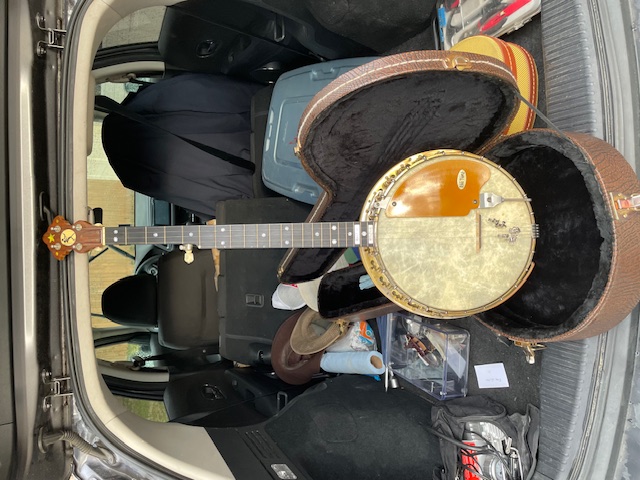
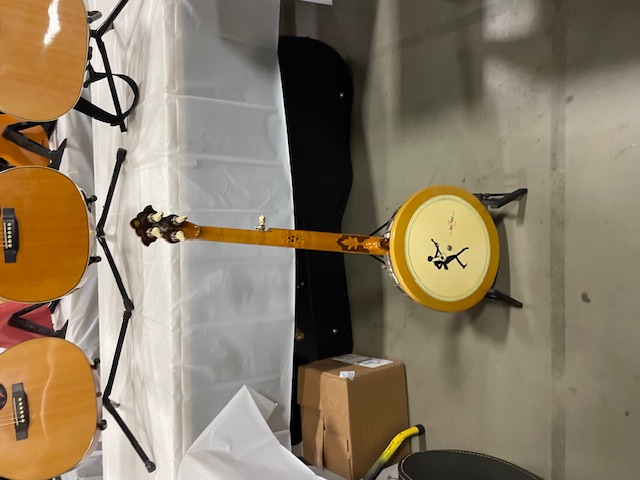
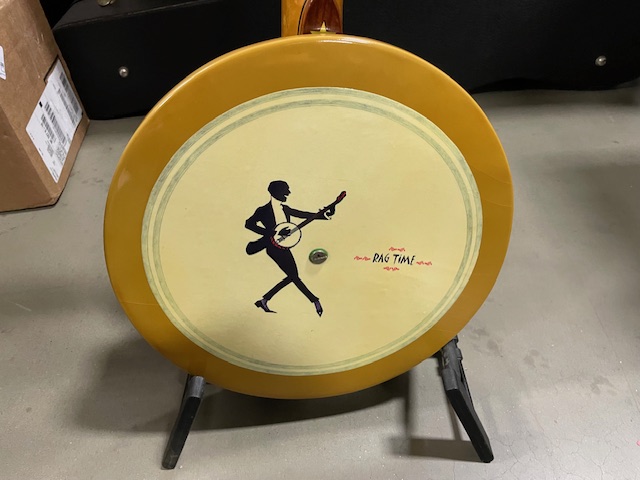
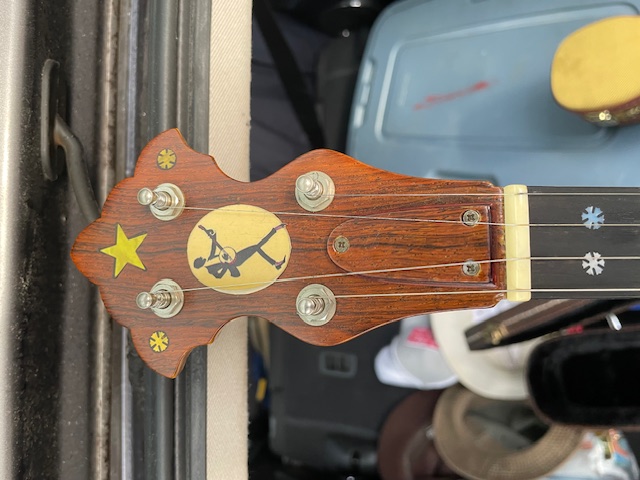
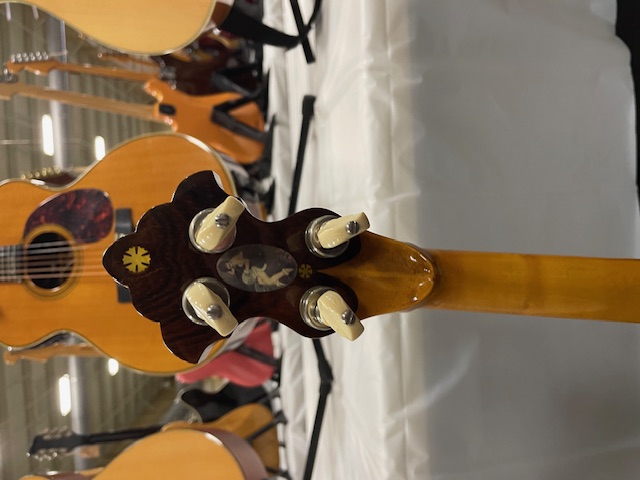
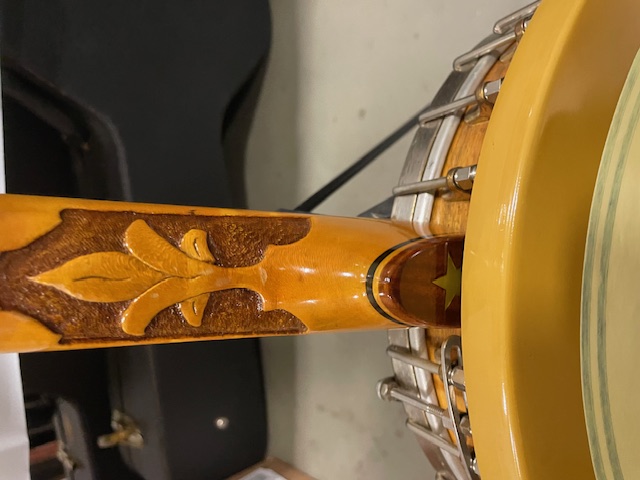
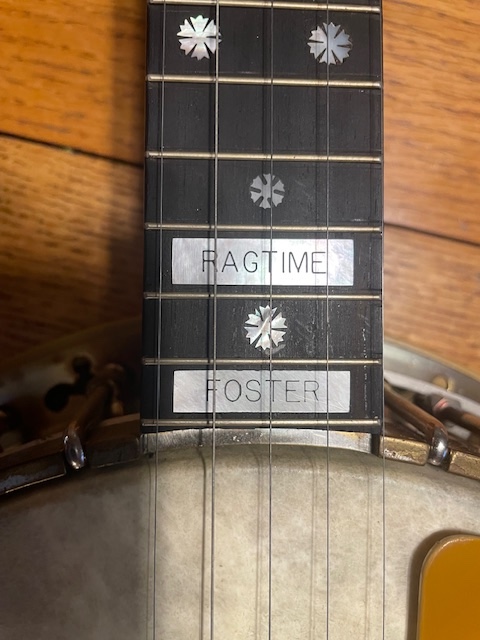
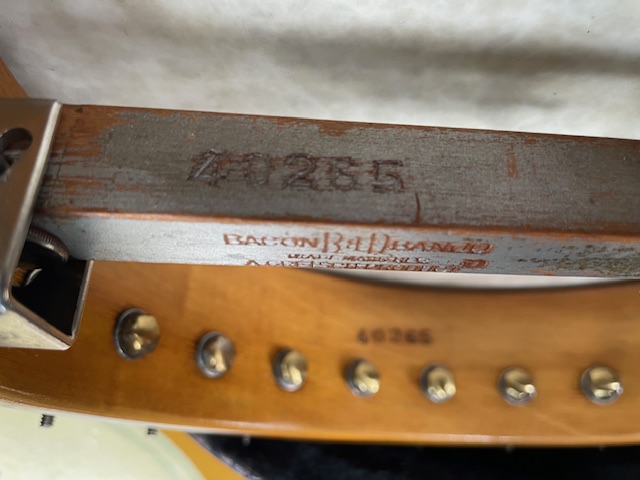
When the man opened the case at the BEE-3 Vintage Guitar Show in Asheville, I did a double take. I've never seen anything like this banjo. It is a "Rag Time Banjo" When I took off the resonator, I saw the words B & D on the Dowel and "Gretsch Product." Serial Number is 402XX, which would be a part of a short continuation of Bacon Serial Numbers after Gretsch took over Bacon in 1938. I would date this Banjo to 1939/1940. Gretsch used Bacon parts early after the takeover. Has anyone seen anything like this in Five String or even Tenor?
frankabr. - Posted - 03/06/2026: 14:27:14
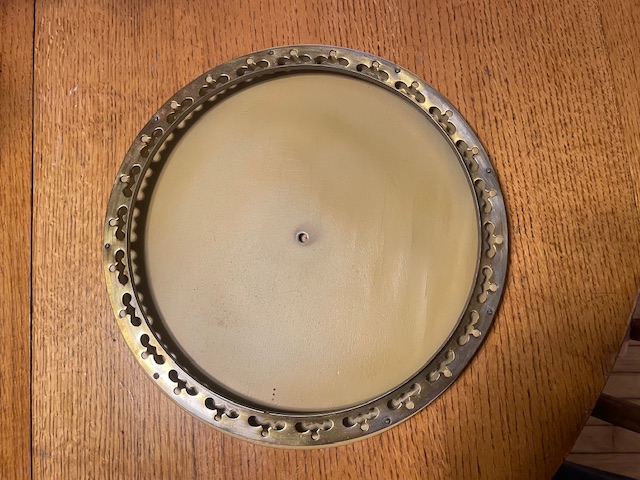
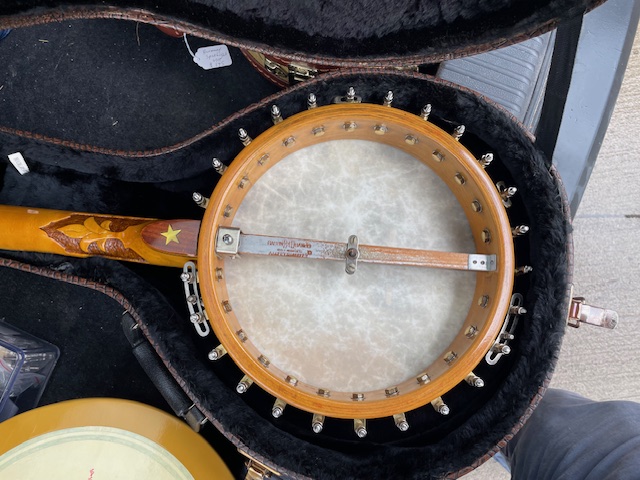
Here are pictures with the resonator off, appears to have a hoop tone ring.
Banner Blue - Posted - 03/06/2026: 14:29:04
Bunches of us are going to the show. Is it for sale at a booth? Could be legitimate.
Bob Smakula - Posted - 03/07/2026: 06:12:16
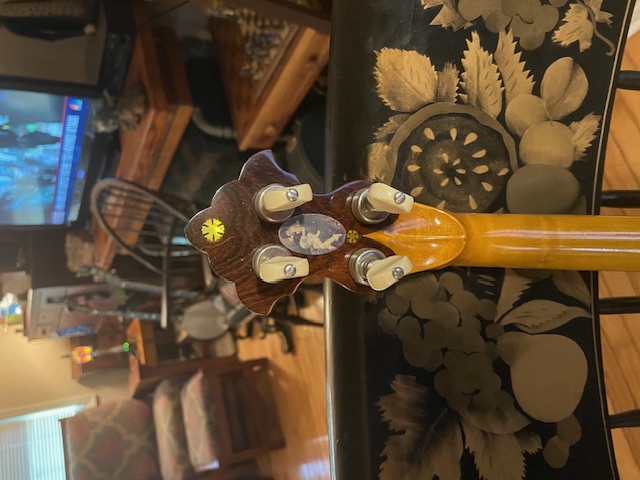
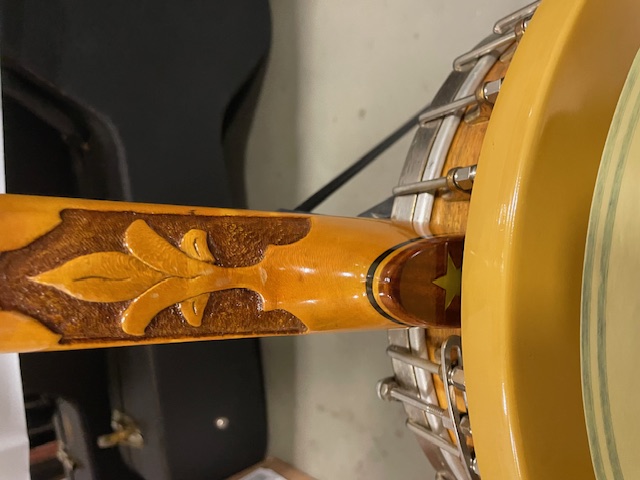
The neck does not look like a Bacon or Gretsch product. The red flag for me is the truss rod. Gibson's trussrod patent expired 2-27-1940, but not everyone jumped on to the truss rod band wagon immediately. Other details that lead me to my opinion is the peghead shape, heel carving, and volute. None of those look like Bacon or Gretsch designs.
Still, an interesting banjo and would be fun to see in person.
Bob Smakula
Joel Hooks - Posted - 03/07/2026: 07:43:45
Yeah, looks to me like a self made neck and modified rim, perhaps using 1960s or 1970s Gretsch "Bacon" parts (perhaps a tenor rim).
The pick guard or finger plate is attached to a Hartnett Tone Bar.
Andy FitzGibbon - Posted - 03/07/2026: 16:20:17
I'd also say it's a homemade or heavily reworked neck on a Gretsch/Bacon rim.
frankabr. - Posted - 03/07/2026: 16:43:08
At BEE-3 Show in Asheville, George Gibson, who is a friend, believes it to be a Gretsch Headstock. On the dowel stick, it says "Bacon B & D Banjo," Second line, "MADE" Illegible, Third Line, "A Gretsch Product"
Serial Number is consistent with Bacon, but would be after Gretsch took over in 1938. Best Guess, Early 40's. The number on the dowel matches the rim.
The graphics look too professional to be someone's custom job, and are consistent with the level I have seen on late B & D, as well as period Vega Banjos (Vega Vox, etc.).
My take; It was a prototype banjo, probably a Bacon idea that Bacon did not finish, and that Gretsch decided to complete. The idea of a Rag Time themed banjo in 1940 was certainly interesting but not something that would succeed well in the market, so they nixed it. It was supposedly owned by a "well known banjo collector who passed away the years ago."
writerrad - Posted - 03/07/2026: 17:21:41
The Bacon and Day factory in Groton Connecticut was destroyed by what New Englanders of my generation call the Hurricane of 1938. Most of the trees in Connecticut were blown down by it. Houses were actually blown across Long island Sound from Long island to CT.
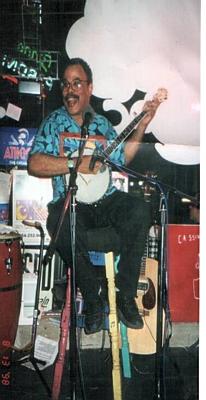
The owners of Bacon (I think Fred had died by then) eventually decided to sell what remained usable in equipment and parts in Groton to Gretsch of Brooklyn who made some Bacon models with leftover parts. After production resumed in Brooklyn after WWII, Gretsch increasingly started calling whatever models they wished Bacon Banjos including new banjos that Fred Bacon and David Day had not imagined. I attach an ancient picture of myself from back around 2003, playing my Gretsch Bacon Belmont, a banjo that had no link with Bacon or Groton or David Day, and nothing with Belmont in the Bronx, but much with the Gretsch factory in Brooklyn. They should have called it the Eastern Parkway banjo if they wanted to be true to life.
The idea that anyone in the era of Ragtime would have called a banjo a Ragtime is silly., That Bacon and Bacon and Day would have called a banjo this, seems completely impossible and out of character. Being a Hartford man I have followed the Bacon sales stuff. This is not how Fred Bacon and David Day marketed their instruments. I have a book of endorsements of Bacon banjos from the 20s that gives the impression Bacon and Day might not have sold a banjo to anyone who could not sight read standard notation in at least 4 keys and perhaps transpose.
The Ragtime huckstering is more what Gretsch would do!
This banjo is a Gretsch product from Brooklyn. I have no animus to it for that. Though I grew up in Hartford. I had wonderful years living in Brooklyn. If anyone puts out an Eastern Parkway banjo, or a St Vincents Hospital Banjo, I might buy one.
Edited by - writerrad on 03/07/2026 17:27:49
kyleb - Posted - 03/09/2026: 16:55:35
I agree this is not a gretch or bacon and day made neck. The truss rod is the dead giveaway as that was protected by Gibson by patent at the time this pot was made. Also, it looks homemade, it doesn’t quite match the pot. This is an assembled banjo, not a factory banjo. The resonator looks refinished as well. Also why would gretch make a five string rag time banjo? That makes zero sense. What do the blocks say on the neck? Again, that's another red flag that the neck isn't original as block inlays with writing is a Gibson thing.
Edited by - kyleb on 03/09/2026 16:59:50
frankabr. - Posted - 03/09/2026: 17:14:35
p.s. This is definitely not a "home made neck." George Gibson believes the banjo to be Gretsch, it is also marked "Gretsch Product on dowel stick. It was either a custom order or luthier made banjo. I tend to believe it is a One Off, could have been a prototype. The neck is clearly Not "home made"
kyleb - Posted - 03/09/2026: 18:34:26
It’s 100 percent a gretch bnd dowel rod. And likely a pot. I believe that . I bet foster is the maker who put it all together , there’s a really good luthier named David foster , look him up, maybe it’s one of his.
frankabr. - Posted - 03/09/2026: 18:48:45
I emailed and sent him pictures, I'll let you know if I get a response
Joel Hooks - Posted - 03/10/2026: 05:23:56
So to recap:
The banjo neck does not conform to any known Gretsch design.
The craftsmanship, shape, and general style does not conform to any known extant example of Gretsch's work.
The finish work is not in the style known from Gretsch.
The inlay and heel carving is not consistent with any known work from Gretsch.
The peghead access truss rod is not consistent with Gretsch.
The dowel rod shows more age than the neck.
Logical conclusion: This must be a super special, one of a kind prototype banjo designed by Gretsch but never put in production for some reason.
That seems reasonable.
Joel Hooks - Posted - 03/10/2026: 05:42:23
quote:
Originally posted by kylebI agree this is not a gretch or bacon and day made neck. The truss rod is the dead giveaway as that was protected by Gibson by patent at the time this pot was made. Also, it looks homemade, it doesn’t quite match the pot. This is an assembled banjo, not a factory banjo. The resonator looks refinished as well. Also why would gretch make a five string rag time banjo? That makes zero sense. What do the blocks say on the neck? Again, that's another red flag that the neck isn't original as block inlays with writing is a Gibson thing.
Gibson's truss rod patent expired in 1940. After February 1940 it was fair game.
But the OP neck was not made by Gretsch.
Jbo1 - Posted - 03/10/2026: 13:10:04
My understanding is that dowel sticks can, and have, been removed from necks and applied to other necks, due to breakage, or conversion from 4 to 5 strings, etc. That could be the case here. I know next to nothing about Gretsch, but the carvings on "commercial" necks I've seen seem to have much more graceful and symmetrical designs. Here there is too much background and not enough leaves that should flow better from one leaf to the next. It's a very interesting looking banjo, but it does look like the neck and pot are not a match. My two cents, of which you can deduct 1 3/4 cents due to my lack of Gretsch knowledge.
Andy FitzGibbon - Posted - 03/11/2026: 06:35:13
quote:
Originally posted by Jbo1My understanding is that dowel sticks can, and have, been removed from necks and applied to other necks, due to breakage, or conversion from 4 to 5 strings, etc.
True. I have done this job many times.
csacwp - Posted - 03/12/2026: 06:11:08
This is clearly an aftermarket neck attached to a Bacon/Gretch pot. It's not a "prototype."
Ira Gitlin - Posted - 03/12/2026: 06:57:13
Apart from whatever clues the physical object offers, I'm wondering when in popular culture ragtime, as a nostalgic trope, might have been on people's minds. Certainly it was there by the 1970s, with Joshua Rifkin's Scott Joplin albums and especially Marvin Hamlisch's soundtrack to The Sting. But does mid-century ragtime awareness go back earlier? If so, how much earlier?
Edited by - Ira Gitlin on 03/12/2026 06:57:37
Joel Hooks - Posted - 03/12/2026: 08:12:19
quote:
Originally posted by Ira GitlinApart from whatever clues the physical object offers, I'm wondering when in popular culture ragtime, as a nostalgic trope, might have been on people's minds. Certainly it was there by the 1970s, with Joshua Rifkin's Scott Joplin albums and especially Marvin Hamlisch's soundtrack to The Sting. But does mid-century ragtime awareness go back earlier? If so, how much earlier?
Just after WW2 there was a general nostalgia for a fictionalized version of the "Gay 90s". This version was very colorful, covered in red and white stripes, and topped with a straw boater hat. There has been plenty of work done on the various stages and versions of "Gay 90s" nostalgia, even recent youtube essays do a decent job. This is why and when the "old fashioned" marketing emerged.
In 1950 a book was published titled "They All Played Ragtime". The impact of this book was large and started what is now called "the Ragtime Revival". This got bundled with the "Gay 90s" nostalgia.
There are a few easy examples of this nostalgia. Main Street USA from Disney Land and the "Mustache Bar"/"Ice Parlor"/"Pizza Parlor" fad, notably Shakey's Pizza and Your Father's Mustache (and copies of those). People like "Ragtime Bob Darch" were leaders of this nostalgia (and even composed new rags and passed them off as "found", an example is Calliope Rag).
Through the 50-70s, young persons clad in candy stripe vests, lace sleeve garters, and Styrofoam skimmers strummed the heck out of tenor and plectrum banjos based on this "Gay 90s" nostalgia playing a stylized mashup of jazz and ragtime.
Ragtime, 1920s Tin Pan Alley, and WW1 songs were all rolled into this hodge podge of nostalgia.
The Sting movie did cause another surge of interest in the 70s.
Ira Gitlin - Posted - 03/12/2026: 08:23:53
quote:
Originally posted by Joel Hooksquote:
Originally posted by Ira GitlinApart from whatever clues the physical object offers, I'm wondering when in popular culture ragtime, as a nostalgic trope, might have been on people's minds. Certainly it was there by the 1970s, with Joshua Rifkin's Scott Joplin albums and especially Marvin Hamlisch's soundtrack to The Sting. But does mid-century ragtime awareness go back earlier? If so, how much earlier?
Just after WW2 there was a general nostalgia for a fictionalized version of the "Gay 90s". This version was very colorful, covered in red and white stripes, and topped with a straw boater hat. There has been plenty of work done on the various stages and versions of "Gay 90s" nostalgia, even recent youtube essays do a decent job. This is why and when the "old fashioned" marketing emerged.
In 1950 a book was published titled "They All Played Ragtime". The impact of this book was large and started what is now called "the Ragtime Revival". This got bundled with the "Gay 90s" nostalgia.There are a few easy examples of this nostalgia. Main Street USA from Disney Land and the "Mustache Bar"/"Ice Parlor"/"Pizza Parlor" fad, notably Shakey's Pizza and Your Father's Mustache (and copies of those). People like "Ragtime Bob Darch" were leaders of this nostalgia (and even composed new rags and passed them off as "found", an example is Calliope Rag).
Through the 50-70s, young persons clad in candy stripe vests, lace sleeve garters, and Styrofoam skimmers strummed the heck out of tenor and plectrum banjos based on this "Gay 90s" nostalgia playing a stylized mashup of jazz and ragtime.
Ragtime, 1920s Tin Pan Alley, and WW1 songs were all rolled into this hodge podge of nostalgia.
The Sting movie did cause another surge of interest in the 70s.
Thanks. I did have some vague awareness of that kind of thing, but wasn't sure about the timeline. It looks like that postwar phenomenon was as much--or even more--about nostalgic branding as it was about the music. (I note that in situations like that, the finer points of the music and actual history get blunted/erased/homogenized.)
writerrad - Posted - 03/12/2026: 08:29:21
Yeah and that's the kind of ragtime Gretsch would have embraced in a hot minute. It is absolutely the opposite of the way Fred Bacon and David Day advertised their banjos even int he epoch of real ragtime.
writerrad - Posted - 03/12/2026: 08:41:02
quote:
Serial Number is consistent with Bacon," but would be after Gretsch took over in 1938. Best Guess, Early 40's. The number on the dowel matches the rim.
Gretsch stopped making musical instruments in 1942 and did not resume making them until 1946 so that they could carry out war production.
Gretsdch did not "take over" in 1938. The 1938 hurricane completely wrecked everything in the coastal areas of Connecticut including the factory in Groton. The storm was so strong that entire houses were blown from Long Island to Connecticut. Most trees in Connecticut except a tiny portion of old growth trees in the northwest corner bordering Massachusetts and NY state were blown down. Groton factory is right on the water. It is the same place the US Submarine fleet is or at least used to be based.
The Bacon factory like almost everything else in Groton was wrecked and flooded. Forgetting exactly where it was in Groton, it was either on or not far from the water. It was flooded and the building was wrecked. There was nothing to take over.
Gretsch did not take over. Whoever was running Bacon decided to GIVE UP rather than rebuilding or salvaging the wreck. They sold what was salvageable to Gretsch. These people took what they had to the Gretsch factory, then in Brooklyn, and started marketing banjos as Gretsch Bacon banjo. However, they STOPPED like many other instrument makers in early 1942 due to WWII. They did not make any instruments until 1946.
When they did, they began introducing new features, or using different techniques. Gretsch began calling instruments it had made previously Bacon banjos, offering banjos as Bacons that Bacon had never made, and that had absolutely nothing to do with anything that had gone on in Groton.
The phony ragtime craze did not start until quite late in the late 40s, and was in full bloom by the mid 1950s and early 1960s. No one would believe Day who really ran the operation while Fred Bacon was usually elsewhere would have sold a "ragtime" banjo.
If you go through all the Bacon sales material from the early 20th century which I have, there is no mention of ragtime or even a hint of jazz even if they were marketing tenors and plectrum banjos to orchestra players.
On the other hand, HOW DOES THIS BANJO SOUND! How does it play, what is it good for. What is the best thing about it.
Edited by - writerrad on 03/12/2026 08:59:39
writerrad - Posted - 03/12/2026: 09:07:49
Just another point. The phony ragtime craze that started in the late 1940s and continued through the 1950s oddly had almost nothing to do with five-string banjos. In the true era of Ragtime from the 1890s to about 1920, of course, the five string banjo was a central component of ragtime as the five-string banjo was a major component of most forms of popular music and Black music (Ragtime started as a black music taking the name from "rags" a popular black name for dance parties in Kansas and Missouri in those days.
However disconnected from the great banjos Fred Bacon had David Day make for him at various places (Day made "Bacon" banjos at Fred's behest when he was still at Vega and a couple other places before Bacon and Day was started), at least this banjo flows from a recognition that the five string banjo was a decisive intrument in the era of Ragtime, rather than the tenor or six-string.
banjobard - Posted - 03/12/2026: 10:30:25
quote:
Originally posted by writerradJust another point. The phony ragtime craze that started in the late 1940s and continued through the 1950s oddly had almost nothing to do with five-string banjos. In the true era of Ragtime from the 1890s to about 1920, of course, the five string banjo was a central component of ragtime as the five-string banjo was a major component of most forms of popular music and Black music (Ragtime started as a black music taking the name from "rags" a popular black name for dance parties in Kansas and Missouri in those days.
However disconnected from the great banjos Fred Bacon had David Day make for him at various places (Day made "Bacon" banjos at Fred's behest when he was still at Vega and a couple other places before Bacon and Day was started), at least this banjo flows from a recognition that the five string banjo was a decisive intrument in the era of Ragtime, rather than the tenor or six-string.
Very cool to hear these tidbits! I had heard that the term ragtime was applied from the outside - people calling it "ragged time" because of the syncopation. But knowing how much rags are talked about in the lyrical content, it makes so much more sense to be describing dances
writerrad - Posted - 03/12/2026: 12:24:22
Ragtime was a massively important musical and social movement that is unfortunately largely misunderstood because some of the misinformation the post WWII pseudo and light weight ragtime pop music jazz craze. Both Blues and Jazz and other music were spin offs that began as forms of Ragtime.
It began as a cultural and behavior pattern r by Black young people in similar ways to those we have seen in regard to hip-hop or rap or rock and roll. Like Hip Hop or Jazz there were styles of clothing mostly by young people associated with ragtime, claims that it encouraged promiscuity, the use of drugs especially cocaine, and general depravity. It was widely condemned from the pulpit.
Ragtime was an internation phenomena even if it did begin in Kansas, Missouri, Louisiana and adjoining areas. Both popular music song and tune hustlers and opera and "classical" symphony composers and Tin Pan Alley song hustlers were prominent in ragtime.
The five-string banjo was at the center of ragtime. That seems to be little known, largely due to the damage done to our view of Ragtime by ragtime revival tenor and plectrum banjoists in the late 1940s and 1950s and early 60s. .. For example., the most prominent Ragtime composer Scott Joplin grew up in a house where both his mother and father played the 5-string. Joplin advertised himself as a BMG teacher in his home town before he left for New York. The tenor was not even widely known or specified until about 1908, although it arose as a practical instrument due to the spread of popular couple dancing that was at least partially due to the spread of ragtime and other popular dancing.
Earl Scruggs whose word should be gold to all banjoists of any type said several times that to get good at the banjo you had to know a bit of ragtime.
The biggest hole in banjo history the relationship between the five string banjo and ragtime. In many ways the era of and practice of Ragtime was a high point the influence of the banjo. Unfortunately, banjo historians have not done the workt hat should be done about the banjo and ragtime.
However, these Gretsch instruments had little to do with classic ragtime.
Ira Gitlin - Posted - 03/13/2026: 06:38:49
quote:
Originally posted by writerrad(Ragtime started as a black music taking the name from "rags" a popular black name for dance parties in Kansas and Missouri in those days.
Is that connected to the fancy duds someone might have worn to a dance? I'm thinking of "Duncan and Brady"--first recorded in 1929 as "Been On The Job Too Long"--with its line (in some versions), "They went right home and they re-ragged in red".
youtube.com/watch?v=ngM23Edogzc
youtube.com/watch?v=NmWy4hJBOPc
Edited by - Ira Gitlin on 03/13/2026 06:39:27
banjobard - Posted - 03/15/2026: 10:28:54
quote:
Originally posted by Ira Gitlinquote:
Originally posted by writerrad(Ragtime started as a black music taking the name from "rags" a popular black name for dance parties in Kansas and Missouri in those days.
Is that connected to the fancy duds someone might have worn to a dance? I'm thinking of "Duncan and Brady"--first recorded in 1929 as "Been On The Job Too Long"--with its line (in some versions), "They went right home and they re-ragged in red".
youtube.com/watch?v=ngM23Edogzc
youtube.com/watch?v=NmWy4hJBOPc
I've heard that same line "re-ragged in red" in the song Ella Speed.
The term 'glad rags' is still in use
and thanks Tony as always for your wealth of knowledge. I'd heard a bit of it from Jerron Paxton, so there's at least one person out there setting the record straight to the concert-going public, but I agree that it's been a gap in our awareness for far too long.
When Bill Keith recorded Nola in his 'melodic style', I'm not sure if he had ever heard the classic banjo style being played, the style that the tune was written for. Ragtime and Classic style banjo players of course had been playing 'harp style' melodic banjo generations before Keith and Bobby Thompson and the other steel string melodic players came around... forgotten about just long enough for it to be re invented. Earl Scruggs of course did hear those earlier players who were still playing when he was growing up, and one can't help but wonder if his 3-against-2 rhythms weren't influenced by the ragtime players... who also were playing every one of the finger patterns that became his rolls, and more.
i happened to grow up around a lot of contemporary ragtime piano players - Scott Kirby, David Thomas Robert's, Frank French, and my dentist, Jack rummel was also one, and hosted a ragtime radio show for an hour a week. They all recorded albums with my dad and often came all the way from New Orleans to do so, staying at our house for a week or two at a time. I attended the Rocky Mountain ragtime festival a couple times in my youth. They all distanced themselves a lot from the vibe of the 40s/50s pop ragtime stuff. But instead of getting back to it's deeper roots as a Stringband tradition, they went the other way and approached it as a classical tradition, playing tunes that were as evocative of Joplin as they were of Chopin. So even though I was probably exposed to more ragtime than just about anyone of my generation living outside of New Orleans, including some of the best interpreters of Joplin's music, and grew up with a banjo playing father who taught me much about all sorts of American roots music history, I still only learned last year that Joplin started out as a banjo player, who was taught by his mother who also played banjo, and that iconic pieces such as the maple leaf rag started out as banjo tunes. Thanks to folks like you and Jerron, this history is finally becoming unburied.
I'm also appreciative that folks like Jerron and Clinton Davis and Kit Stovepipe are bringing back the ragtime guitar playing style. Starting in the 70s there were a lot of fingerstyle guitar players who recorded piano rags in a more straightforward fingerstyle way, but now we finally have folks bringing back the 'sporting right hand' and double-thumb bass note styles of the real ragtime guitar players like Blind Blake and Gary Davis, and playing more of the Stringband ragtime tradition. But now I have digressed a lot from the topic of Gretsch banks...
Edited by - banjobard on 03/15/2026 10:30:46
Terms of Use | Privacy Policy | Privacy Consent (EU/GDPR Only)
Copyright 2026 Banjo Hangout. All Rights Reserved.