DVD-quality lessons (including tabs/sheet music) available for immediate viewing on any device.
Take your playing to the next level with the help of a local or online banjo teacher.
Weekly newsletter includes free lessons, favorite member content, banjo news and more.
Premier Sponsors





|
Please note this is an archived topic, so it is locked and unable to be replied to. You may, however, start a new topic and refer to this topic with a link: http://www.banjohangout.org/archive/407653
Jourdain31660 - Posted - 03/07/2026: 11:43:20
Hello everyone, I wanted to know how to determine the weight of a bridge? I'm looking for a slightly heavier bridge than the one I have, to get more bass on my banjo. However, I never see the weight listed online. Does the height of the bridge necessarily increase the weight? And does the height increase the bass on the banjo? (I have a 5/8 bridge) Thank you all for your help. :)
Doug Knecht - Posted - 03/07/2026: 13:00:56
Bridge makers use a gram scale. Most bridges start at about 2.15 grams and on up from there. Bridges at 2.4 grams and up are going to increase the low end. Bridges 2.3 grams and below will be crisper. Ideal bridge ? Usually 2.25 grams or so. I have one that is 2.5 grams, making the tone bassier. My favorite bridge right now is a KatEyz Snuffy Smith at 2.28 grams.
A taller bridge adds mass to the bridge, and is bassier, except that then you have to fix the action problem. Sometimes it's just as easy to stick with 5/8" and tell the bridge maker to aim the mass up around 2.3 - 2.5 grams, or whatever numbers you're playing around with. Good luck!
banjered - Posted - 03/07/2026: 13:39:40
Right now I have Sampson bridge from Elderly Music. It is a heavy, compensated, and 5/8" bridge.. I have it on my 12" Stone banjo with just the rim for a tone ring, with Minstrel Nylgut strings lowered down from the key of G to the key of E. It makes for a mellow clear tone that i use to back up my singing such as it is, folk songs. Others who say non-steel strung banjos should have a lightweight, non-ebony cap bridge are looking for the snappy, loud, bright sound of banjo classical music of the 1890s (?). My set up works great for my purposes. banjered
davidppp - Posted - 03/07/2026: 16:44:27
A heavier bridge will also give you more sustain. Raising the tailpiece will give a similar more-bass enhancement as heavier bridge without the increased sustain.
For heavier bridge, short of DIY, you can cut out a bit of wood to put under the feet. So-called craft sticks, popsicle sticks, tongue depressors, or coffee stirrers are possible sources of the raw material.
randybartlett - Posted - 03/07/2026: 17:49:38
Some of the bridges from Sullivan banjo seem to be heavier than most. I figure they sold them that way so you could just send them to whatever weight you want
kat eyz - Posted - 03/07/2026: 18:50:04
Probably the quickest way to get a heavier bridge on your banjo is find a local jewerly store and nicely ask them if they could weigh your bridge. When you know your bridge weight call some bridge makers tell them what you got and that you would like a slightly heavier bridge weight and you should be in business
lightgauge - Posted - 03/08/2026: 03:33:24
They can also be weighed on a reloading powder scale, if you know anyone who loads their own ammo. They weigh in grains but can easily be converted to grams.
desert rose - Posted - 03/08/2026: 06:03:03
quote:
Originally posted by kat eyzProbably the quickest way to get a heavier bridge on your banjo is find a local jewerly store and nicely ask them if they could weigh your bridge. When you know your bridge weight call some bridge makers tell them what you got and that you would like a slightly heavier bridge weight and you should be in business
Great advice Mike
How are you! I really miss our IBMA get togethers, those were treasured times for me.
Jourdain31660 - Posted - 03/08/2026: 06:15:37
Merci beaucoup a tous pour tous vos conseils !! J'apprécie l'aide que vous m'avez apporté !
Owen - Posted - 03/08/2026: 08:12:48
Just thinking (?) out loud, as I've never weighed a bridge, but would drilling some holes be a feasible way to reduce weight? ... or epoxy-ing in something [BB pellet, semi-precious stone, etc.] to increase the weight? ... or would it all be an ill-advised crap shoot / exercise in futility?
Edited by - Owen on 03/08/2026 08:13:37
martyjoe - Posted - 03/08/2026: 08:25:35
I definitely drill holes to reduce weight. The concept of adding epoxy to me is a nonstarter because if epoxy had the right tonal qualities (which it doesn’t) I would just make the bridge out epoxy in the first place.
RB3 - Posted - 03/08/2026: 13:11:02
In addition to the banjo, I'm also into archery. Below is an Amazon link to the type of digital scale I use to weigh the components that are used in building arrows. These scales are also very useful for determining the weight of banjo bridges. These scales work well, and they're quite inexpensive.
Edited by - RB3 on 03/08/2026 13:14:16
steve davis - Posted - 03/08/2026: 16:57:41
A bridge scale needs to go to 2 decimal places as in 2.25 grams.I'm making a heavier (by request) 2.40 gram bridge for a customer wanting a "deeper" tone.
My favorite bridge scale is my ProScale LC-50.It measures in hundredths of a gram and cost less than $20.
Bart Veerman - Posted - 03/09/2026: 05:14:49
Shopping for cars or dates by weight makes zero sense and regardless of what some may say, it's not any different for banjo bridges.
Edited by - Bart Veerman on 03/09/2026 05:23:13
Ira Gitlin - Posted - 03/09/2026: 07:23:09
quote:
Originally posted by kat eyzProbably the quickest way to get a heavier bridge on your banjo is find a local jewerly store and nicely ask them if they could weigh your bridge. When you know your bridge weight call some bridge makers tell them what you got and that you would like a slightly heavier bridge weight and you should be in business
Or, if you know any serious drug dealers....
Owen - Posted - 03/09/2026: 07:40:47
I'm pretty sure my son-in-law has a scale that will weigh to the required accuracy. I think I'm gonna weigh all my bridges [i.e. the ones that aren't on a banjo]. I'm also pretty sure I won't be putting that info to any good use, but, but, but, I've heard that "knowledge is power." 
=====================================================================================================
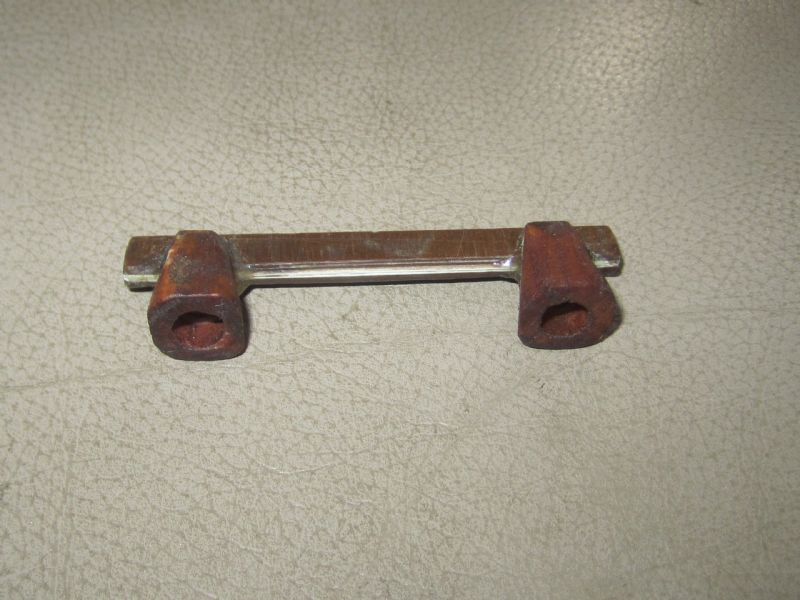
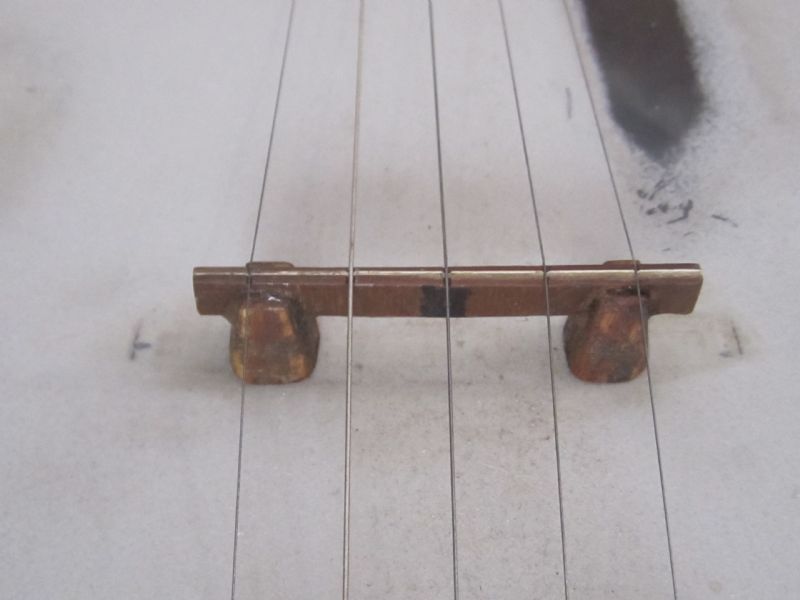
Fwiw, I've tried making a few "far out, man, far out" bridges ........ and predictably (?) the results have been less than impressive. However, this bad boy .... legs from some mystery Asian pallet wood and crosspiece made from Formica (?) and attached with epoxy .... went from "pretty bad" to, "sounds okay.... very similar to all my other modestly priced run-of-the-mill bridges" when I reduced its weight by shortening the legs about 1/16" and drilling holes up into the feet.
Edited by - Owen on 03/09/2026 07:54:08
steve davis - Posted - 03/09/2026: 10:38:50
When everything is sounding great weigh the bridge the next time you change strings.
It's a simple part of the useful bits of information.
kat eyz - Posted - 03/11/2026: 08:26:40
quote:
Originally posted by desert rosequote:
Originally posted by kat eyzProbably the quickest way to get a heavier bridge on your banjo is find a local jewerly store and nicely ask them if they could weigh your bridge. When you know your bridge weight call some bridge makers tell them what you got and that you would like a slightly heavier bridge weight and you should be in business
Great advice Mike
How are you! I really miss our IBMA get togethers, those were treasured times for me.
Scott those days were super fun !!! To listen to you and Silvio talk bridges was such an inspriation to me ! I soaked up yalls knowledge and pointers to me like a dry sponge ! lol So glad we crossed paths back then
steve davis - Posted - 03/13/2026: 09:29:48
Bill Keith used to wrap a banjo string around the feet of a Grover bridge.
Owen - Posted - 03/16/2026: 17:45:19
quote:
Originally posted by OwenI'm pretty sure my son-in-law has a scale that will weigh to the required accuracy. I think I'm gonna weigh all my bridges [i.e. the ones that aren't on a banjo]. I'm also pretty sure I won't be putting that info to any good use, but, but, but, I've heard that "knowledge is power."
=====================================================================================================
Fwiw, I've tried making a few "far out, man, far out" bridges ........ and predictably (?) the results have been less than impressive. However, this bad boy .... legs from some mystery Asian pallet wood and crosspiece made from Formica (?) and attached with epoxy .... went from "pretty bad" to, "sounds okay.... very similar to all my other modestly priced run-of-the-mill bridges" when I reduced its weight by shortening the legs about 1/16" and drilling holes up into the feet.
The jury is in! I guess I wasn't clear enough in my request to our SIL, so he weighed 'em [chem lab at school] to the nearest 1/10 gram. The four v-e-r-y modestly priced ones are 2.2, 2.6, 2.7 and 3.1g. My seven hand-crafted [cough, cough] look-somewhat-like-a-bridge range from 2.8 to 4.7g. The one-of-a-kind Formica one pictured ^^ is in the middle at 3.4g. [Man, talk about getting more info than you bargained for........ .  ]
]
steve davis - Posted - 03/17/2026: 09:33:07
The problem with weighing to the nearest tenth is that there is a considerable tonal difference between a 2.21 gram bridge and a 2.29 grammer,but the 1 decimal place scale will call them both 2.2 grams.
Cockrum_Studios - Posted - 03/21/2026: 21:09:34
I've gotten a few of these and they are within +/- 0.015 of my Milligram balance. You'll also find that bridges can vary in weight due to humidity and air pressure/attitude changes if you're measuring at 0.01g
Also, it's important that your scale is on a level surface.
I make bridges in 3 weight ranges: bright, medium, and dark.
Edited by - Cockrum_Studios on 03/21/2026 21:13:00
Helix - Posted - 03/22/2026: 20:09:15
I bought my metric scale at Harbor Freight. I make bamboo race car bodies for my HO 1/64 set and the plastic ones you get are 13 grams, so my bamboo ones are anywhere between 17 and 24 grams.
The banjo bridge material and grain alignment makes a difference in my considered opinion.
I use a Bart Veerman on my #001 all bamboo Jackrabit. She hops.
steve davis - Posted - 03/25/2026: 05:04:45
quote:
Originally posted by Cockrum_StudiosI've gotten a few of these and they are within +/- 0.015 of my Milligram balance. You'll also find that bridges can vary in weight due to humidity and air pressure/attitude changes if you're measuring at 0.01g
Also, it's important that your scale is on a level surface.
I make bridges in 3 weight ranges: bright, medium, and dark.
steve davis - Posted - 03/25/2026: 05:07:06
The bridges I've made weigh the same no matter the weather or barometric readings.
Cockrum_Studios - Posted - 03/25/2026: 14:17:37
Mine vary by about 2 milligrams in weight (not mass) with air pressure which is consistent with difference in air density that they replace (~0.1% between high and low barometric pressure). Also, I see about a 25mG increase (in weight and mass since the water is now inside of the bridge) which is assume is due to moisture coming into the roasted wood after they are made in the first few days. Although I'm not in an exceptionally dry climate. Id assume that there would be some amount of loss there also.
It takes an analytic balance to measure this. I have one from my precision reloading for rifle ammo.
Chris
Cockrum_Studios - Posted - 03/25/2026: 14:24:25
Here is more info on variations in weight when doing precision measurements
raptor-scientific.com/resource...s-of-mass
BTW. I completely agree that bridge weight makes a big difference but I think that the properties of the wood overshadow minute .1-.2g difference based on testing I've done. I've got about 10 hours of bridge testing video that I'm planning to post someday. I've seen different sound from bridges of the same weight/density made from the same board (CNC cut to within +/- 0.002")
steve davis - Posted - 03/26/2026: 13:37:21
The testing I've done has to do with differences I've noticed after making around 1000 bridges.
Each bridge has been played by me on my Cox banjo to make sure I'm pleased with the tone.
I have no problem hearing a difference between a 2.1 gram bridge and a 2.25 gram bridge.
I like the ease of regulating what leaves my shop using the weight of the bridge as a guide.
Grain orientation and number of grains are other useful bits of information for consistency's sake.
Alex Z - Posted - 03/26/2026: 13:55:25
Do two bridges that weight the same -- say both 2.25 grams -- always sound the same?
Cockrum_Studios - Posted - 03/26/2026: 13:55:30
Ok, you win. I've only made about 800 so far ;)
One never had one of yours but I hear good things about them.
I separate mine in to 3 weight ranges and will do special requests for weight when requested. I mark them to the nearest 0.05g when I weigh them.
Edited by - Cockrum_Studios on 03/26/2026 14:06:54
Cockrum_Studios - Posted - 03/26/2026: 14:05:54
Generally, two bridges of the same weight. shape (height design/maker), and material (maple, roasted maple, roasted walnut, bog oak, teak, etc ) will have a similar sound.
Assuming the same banjo, head, head tension, strings, and setup.
quote:
Originally posted by Alex ZDo two bridges that weight the same -- say both 2.25 grams -- always sound the same?
Edited by - Cockrum_Studios on 03/26/2026 14:11:05
Alex Z - Posted - 03/26/2026: 15:21:51
Similar, I can understand. Am looking for more specifics in order to understand the degree of importance of weight.
What I'm asking is that if two bridges are the same weight to the nearest .01 gram, for example 2.25 grams,
(a) are they always so similar that the player can't tell which one is on the banjo? Or
(b) are they sometimes different enough that one can be distinguished from the other?
Thanks.
Owen - Posted - 03/26/2026: 17:37:03
Wouldn't that ^^ depend on the hearing ability/acuity of "the player"?
I suspect that a normal listener [whatever that means] would not detect such minute differences, but for those 'way off at the right end of the spectrum [or maybe even past it, if their posts are believable] apparently it's a regular occurrence.
.... always/never/without exception?? ...generally/usually/sometimes??
[And in the interest of full disclosure, I'm 'w-a-y off at the left end of the spectrum. ]
Bart Veerman - Posted - 03/26/2026: 17:47:59
quote:
Originally posted by Alex ZDo two bridges that weight the same -- say both 2.25 grams -- always sound the same?
NOONOONOONOONOOOOOOOOOOOOOOOOOOOOO!
steve davis - Posted - 03/26/2026: 21:44:27
Getting bridges to sound "the same" when their weights are equal is a matter of other variables being "in line" also.
My earlier point of weighing to the second decimal place is critical when comparing bridge tonality because of the amount of changes in the tone per fractions of a gram.
This disregard of the effect of minute weight changes makes it seem as if two bridges of equal weight don't sound the same.
When the second decimal place is ignored,seemingly equal weight bridges sound different from each other when in fact they are not the same weight.
Of course there are also differences in tone when the grain lines of the base wood are lined up differently.
Two bridges that seem the same at first glance can be constructed quite differently when all parameters are explored and "measured".
lazyarcher - Posted - 03/27/2026: 08:08:10
quote:
Originally posted by Bart Veermanquote:
Originally posted by Alex ZDo two bridges that weight the same -- say both 2.25 grams -- always sound the same?
NOONOONOONOONOOOOOOOOOOOOOOOOOOOOO!
Completely agree 100%!
When I was making and marketing Beaver King Bridges, I used exclusively sunken maple recovered from the Great Lakes. A totally different wood than regular maple. A 2.25 gr bridge of sunken maple would sound entirely different than the same weight regular maple...and...even within the use of sunken maple 2 bridges of the same weight might sound different based on where in the billet the blank came from. With sunken maple, and with other regular maple I used, weight most certainly was a factor in the tone of the bridge, but the blank structure itself was more important..IMHO.
steve davis - Posted - 03/27/2026: 08:22:50
Jimmy Cox gave me a chunk of submerged maple 20 years ago.He said in making bridges from it it would sound good if I slightly lessened the weight of the bridge compared to "regular" dry maple.He liked a good "crack" in banjo tone,imo.
kat eyz - Posted - 03/28/2026: 12:13:53
quote:
Originally posted by Alex ZSimilar, I can understand. Am looking for more specifics in order to understand the degree of importance of weight.
What I'm asking is that if two bridges are the same weight to the nearest .01 gram, for example 2.25 grams,
(a) are they always so similar that the player can't tell which one is on the banjo? Or
(b) are they sometimes different enough that one can be distinguished from the other?
Thanks.
if you have a 2.25 walnut & a 2,25 hard maple being compared i would say you could probably hear a difference. If you have 2 hard maple bridges and both weigh 2.25 and one bridge is lets say 5 years old and the other is a new bridge your trying out they might sound extremely similar ....or they too could be slightly different to where you would say to yourself " i like my old bridge a little better than this new bridge " If i use a particular hard maple source from my shop that i know has a LIGHTER than average density/weight and make a 2.25 bridge from it and then make another 2.25 hard maple bridge from my shop that i know has a HEAVIER than average weight these 2 bridges will most likely be slightly different . The difference is final dimensions of the 2 bridges the heavier density maple will be a thinner bridge ...the lighter density maple will produce a "fatter" bridge . the thinner bridge will give a faster note decay...the fatter one will give a little more sustain . This is not a hand grenade / firecracker difference but i can hear it in this situation. Now...if i use the SAME maple source and make 2 bridges both at 2.25 weight AND the bridges are Sister bridges meaning one bandsaw cut separates the 2 blanks these 2 bridges will be near identical in tone to where i can not tell the difference in them .
lazyarcher - Posted - 03/29/2026: 08:25:05
quote:
Originally posted by kat eyzquote:
Originally posted by Alex ZSimilar, I can understand. Am looking for more specifics in order to understand the degree of importance of weight.
What I'm asking is that if two bridges are the same weight to the nearest .01 gram, for example 2.25 grams,
(a) are they always so similar that the player can't tell which one is on the banjo? Or
(b) are they sometimes different enough that one can be distinguished from the other?
Thanks.
if you have a 2.25 walnut & a 2,25 hard maple being compared i would say you could probably hear a difference. If you have 2 hard maple bridges and both weigh 2.25 and one bridge is lets say 5 years old and the other is a new bridge your trying out they might sound extremely similar ....or they too could be slightly different to where you would say to yourself " i like my old bridge a little better than this new bridge " If i use a particular hard maple source from my shop that i know has a LIGHTER than average density/weight and make a 2.25 bridge from it and then make another 2.25 hard maple bridge from my shop that i know has a HEAVIER than average weight these 2 bridges will most likely be slightly different . The difference is final dimensions of the 2 bridges the heavier density maple will be a thinner bridge ...the lighter density maple will produce a "fatter" bridge . the thinner bridge will give a faster note decay...the fatter one will give a little more sustain . This is not a hand grenade / firecracker difference but i can hear it in this situation. Now...if i use the SAME maple source and make 2 bridges both at 2.25 weight AND the bridges are Sister bridges meaning one bandsaw cut separates the 2 blanks these 2 bridges will be near identical in tone to where i can not tell the difference in them .
This is exactly why I was using sunken maple. Very dry, and a bridge lets say 2.1 gr would have the profile of a regular maple bridge up around 2.5-3gr. You could have a light responsive bridge with a bigger footprint and top. The maple allowed me to use a bit more African Blackwood on the top which again added to a bit more focused clean sound.
steve davis - Posted - 03/30/2026: 06:50:07
I thought of another reason I have such repeatable tone in my bridges of the same weight.
In 2010 I bought 25 bd/ft of Sullivan roasted maple boards which represent 95% of my bridges so far.
Wonderful bridge wood and extremely consistent in performance.
Terms of Use | Privacy Policy | Privacy Consent (EU/GDPR Only)
Copyright 2026 Banjo Hangout. All Rights Reserved.