
DVD-quality lessons (including tabs/sheet music) available for immediate viewing on any device.
Take your playing to the next level with the help of a local or online banjo teacher.
Weekly newsletter includes free lessons, favorite member content, banjo news and more.
Premier Sponsors





|
Please note this is an archived topic, so it is locked and unable to be replied to. You may, however, start a new topic and refer to this topic with a link: http://www.banjohangout.org/archive/407979
goode21 - Posted - 03/30/2026: 07:14:29
I picked this up in a storage locker and I am not a banjo person, so out of my depth on this one.
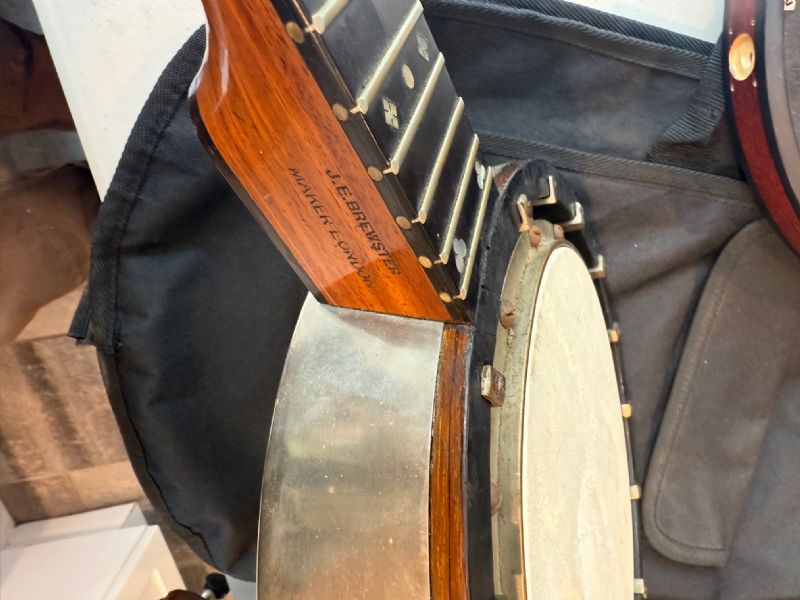
It is stamped “J.E. Brewster / Maker London,” and the back of the headstock is numbered 1280. I'm new, so I can only post a couple pics. I think I can post more after the original post is up. Let me know if you'd like to see something specific to help witht the ID
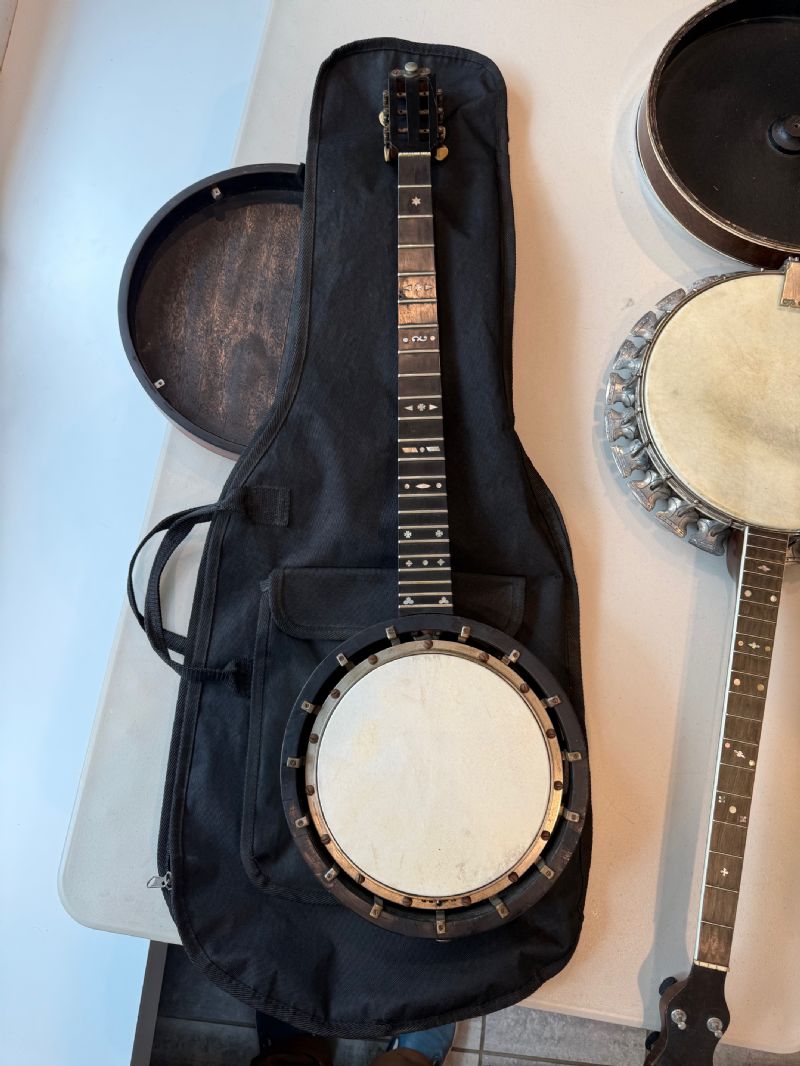
Does this look original, or has it been pieced together from parts? Any idea on approximate age, model, or value?
Thanks so much for any help.
Ryan
The Old Timer - Posted - 03/30/2026: 09:32:01
Well, I only know a little, but that pot has the typical look of English "zither banjos". Zither banjos frequently had more strings than American made banjos too -- your's appears to have 6 tuners, compared to the typical American 5 strings of the mid 1800s.
csacwp - Posted - 03/30/2026: 10:53:54
quote:
Originally posted by The Old TimerWell, I only know a little, but that pot has the typical look of English "zither banjos". Zither banjos frequently had more strings than American made banjos too -- your's appears to have 6 tuners, compared to the typical American 5 strings of the mid 1800s.
The zither banjo was strung with five strings, a mixture of steel, gut, and silk. The sixth tuner is just a byproduct of using ready-made guitar tuners (and a desire for symmetry). There are six and seven string variations, but they're an exception rather than the norm.
Zither banjos aren't mid-19th century instruments, though they are often incorrectly associated with mid-19th century American closed back models that commonly featured more than five strings. They are late-19th to early-20th century instruments.
Though the zither banjo was an English phenomenon, it was invented and brought to that country by Alfred Cammeyer, an American.
Edited by - csacwp on 03/30/2026 11:00:08
Joel Hooks - Posted - 03/30/2026: 11:04:58
You have a Zither Banjo. These use the unique stringing of 5 strings (zither banjos are 5 string banjos). Thin wire 1st, 2nd, and 5th, gut (nylon) 3rd, and copper wound over floss 4th.
They have 6 pegs because Alfred Cammeyer (who developed it) liked the symmetry as well as using machine pegs with wire strings. That was what he used when he had the first one made in Brooklyn and took it with him to England. And that format stuck.
Value= nothing. Sorry. The fact that these were pumped out for decades and there is zero demand for them today, means they have no value. They tend not to age well, so even in perfect and playable condition might get $100-$200 or so if someone was looking for one.
A common problem with them is that they get strung with all wire strings and stored in attics. The sound chamber deforms and the action becomes unplayable.
J. E. Brewster was a teacher who sold instruments out of his studio (which was common). This was likely made by one of the bigger makers such as J. E. Dallas or Windsor.
Joel Hooks - Posted - 03/30/2026: 11:10:23
For the zither banjo timeline, Cammeyer arrived in London in the spring of 1888. Before that time there were only two, the one Cammeyer brought with him and one other he had made for a woman in the US. He could not get anyone interested in it in the states.
Pretty much from the moment he arrived in London his design became popular and there is evidence that within months of his arrival in 1888 that "production" zither banjos were being sold.
To recap, prior to 1888 there were two zither banjos. By 1889 there were lots (in England).
AndrewD - Posted - 03/30/2026: 11:17:33
vintagebanjomaker.com/brewster
As they all said. Nobody plays zither banjos nowadays, but many did from about 1885 to 1920. So if you want one they are available every day on UK ebay for not much. The metal cladding on the pot is sort of unusual, but doesn't really affect the value.
Stephen John Prior - Posted - 03/30/2026: 11:28:34
Most likely made by J E Dallas. At present my reckoning is it dates to 1892. It would be good to see a photo of the back of the instrument.
goode21 - Posted - 03/30/2026: 18:51:19
Wow...thanks for the speedy and insightful responses! Very informative. I'll likely do a "free to a good home" post on my local Marketplace.
Stephen John Prior - Posted - 03/31/2026: 01:51:38
quote:
Originally posted by Stephen John PriorMost likely made by J E Dallas. At present my reckoning is it dates to 1892. It would be good to see a photo of the back of the instrument.
Slightly unusual example as the metalwork on the rim is not engraved. All the examples I have seen so far have been nicely engraved. Some are fully clad and some half clad.
Terms of Use | Privacy Policy | Privacy Consent (EU/GDPR Only)
Copyright 2026 Banjo Hangout. All Rights Reserved.


