





For those interested in the African roots of the banjo
132 Members, Created 1/27/2011 - 
Administrators: Marc Nerenberg (owner)
From Marc Nerenberg on 1/28/2011 9:47:12 AM
The instrument is a Kona, an instrument of the Dogon people who live on the very remote Falaise of Bandiagara in central Mali. I visited them in 1981, when trecking around West Africa with my tiny fretless in tow (see lower picture in my avatar), asking everyone if they had ever seen any similar instruments, because I wanted to see how they were played. I was repeatedly told that I would have to go further into the countryside to find them.
The Dogon live on the side of a huge and impenetrable cliff, where they have been relatively aloof from the people around them for many hundreds of years. When my wife and I arrived in Dogon country (being guided by an 11 year old boy who spoke French, so he and I had a common language) I was asked to play the banjo first for the village chief, and then for all the children in the village, who proceeded to dance for me to my playing.
As darkness fell, a young man carrying a kona appeared from between two huts. I played for him, he played for me, and then, he wiggled the knots tying the strings of his instrument to the stick that is the neck, and got himself in tune with me, and we played together. This is what we played, and it is indeed "Reuben" which is actually a West African melody that is still current in that part of the world.
What was so remarkable to me was that we both used the same right hand technique: clawhammer (or rapping, knocking...etc.) As far as I can tell, I was the first person to find clawhammer playing in Africa and recognize it as such. (Ken Perlman wrote a little piece on this in the Banjo Newsletter in 1984 or 1985.)
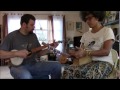
The instrument consists of a skin covered gourd impaled by a stick, with some fishing line tied on. The one I am playing in the video was acquired the next day from its maker, and is a particularly small one...about half the size of the one I'd seen the night before. When I got it, it had only one string. the maker told me he had run out of string, so I later added two more according to a discussion we had about how they should be attached.
I only saw it played the one time...never encountering another one, and I was a little worries that maybe I just thought it looked like clawhammer technique, but noted Canadian banjo player Jayme Stone (also a BHO member) made pretty much the same trip a few years ago, and found the same instrument - with two strings (in his case called a Konou) played the same way, which he also identifies as clawhammer style.
A few years ago I met another Dogon, who was working in Tanzania, and we discussed the different terms Kona and Konou, and he confirmed my suspicion that the words simply meant "one-stringed" and "two-stringed".
6 Comments | |
 | Marc Nerenberg says: |
 | GirlAnachronism says: |
| Marc Nerenberg says: |
| GirlAnachronism says: |
 | BanjoFris says: |
Post a Comment | |
| You must be logged in and a member of this group to post a comment. | |
|
"Banjar" T-shirts - order now for festival jam season! |
|
Forum Post: (untitled) |
|
|
At The Purchaser's Option - Rhiannon Giddens at Augusta Vocal Week 2016 |
|
Event: (untitled) |
|
|
Seprewa & Gourd Banjo Improv #1 |
|
Kick Up De Debble On A Holiday: Berghan & Weems |
|
Forum Post: (untitled) |
|
|
"Mô ti zwazo" (Little Birdie) |
|
Une Jolie Musicienne |
|
Forum Post: (untitled) |
|
Terms of Use | Privacy Policy | Privacy Consent (EU/GDPR Only)
Copyright 2026 Banjo Hangout. All Rights Reserved.