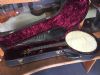
Greetings! I am new to the group and I just got my CEB5 today...loving it. I am used to playing a nylon string banjo and I'm finding the noise when I slide or even changing chords to be very distracting and loud. Are there nylon strings for a cello banjo that are not wound or is there something I can do that will take the screech down a peg or two?
10 Comments |
 | mike gregory says:
3/20/2025 3:55:01 PM
I used nylon "Leader Line" from a fishing tackle supply store on a few standard size banjos.
Do NOT know how thick leader line can be had, but I DO know that, unlike regular fishline, it's NOT designed to stretch much.
Also, on some banjos, I used thin line, twisted together, to make thicker line.
No screech from those.
Best wishes for a successful outcome.
|
 | dhergert says:
3/20/2025 5:03:58 PM
Nylon musical instrument strings that are wound are usually done that way so that the strings don't have to be too thick. The windings add mass so thinner strings can be tuned to pitch without being floppy.
I've tried using monofilament fishing lines and even some monofilament strings from my double bass on my CEB-5 (tuned octave-low DGBD)...
The problem is that the CEB-5 tuner post holes are too small for any monofilament strings that would be thick enough to sound passable on this banjo. And, there isn't a lot of metal to spare with these tuner posts, so drilling the holes bigger would very likely weaken them enough that I'd be concerned.
A person could potentially purchase electric bass tuners and install them on their cello banjo, but on a CEB-5 the 5th string tuner post hole might be hard to work with.
This was not something I was interested in doing, so after trying all kinds of alternative strings, I installed the lowest 4 (EADG) D'Addario Chrome Steel flat wound guitar strings on my CEB-5 for the DGBD strings, and then another of these flat wound G strings for the 5th (G) string.
This set works very nicely, lasts basically forever, and with the Renaissance head actually sounds pretty close to nylon.
I also had the folks at Gold Tone make some nice bone-crowned bridges for me to use with these strings, and have been enjoying this setupl for a number of years.
I really loved the sound of the original nylon strings that came with my CEB-5, but with the amount of playing I was doing, they only lasted about a week before the windings parted. So I had to find a workable alternative.
Best of luck with your CEB-5 string search!
|
| dhergert says:
3/20/2025 5:08:21 PM
Nylon musical instrument strings that are wound are usually done that way so that the strings don't have to be too thick. The windings add mass so thinner strings can be tuned to pitch without being floppy.
I've tried using monofilament fishing lines and even some monofilament strings from my double bass on my CEB-5 (tuned octave-low DGBD)...
The problem is that the CEB-5 tuner post holes are too small for any monofilament strings that would be thick enough to sound passable on this banjo. And, there isn't a lot of metal to spare with these tuner posts, so drilling the holes bigger would very likely weaken them enough that I'd be concerned.
A person could potentially purchase electric bass tuners and install them on their cello banjo, but on a CEB-5 the 5th string tuner post hole might be hard to work with.
This was not something I was interested in doing, so after trying all kinds of alternative strings, I installed the lowest 4 (EADG) D'Addario Chrome Steel flat wound guitar strings on my CEB-5 for the DGBD strings, and then another of these flat wound G strings for the 5th (G) string.
This set works very nicely, lasts basically forever, and with the Renaissance head actually sounds pretty close to nylon.
I also had the folks at Gold Tone make some nice bone-crowned bridges for me to use with these strings, and have been enjoying this setupl for a number of years.
I really loved the sound of the original nylon strings that came with my CEB-5, but with the amount of playing I was doing, they only lasted about a week before the windings parted. So I had to find a workable alternative.
Best of luck with your CEB-5 string search!
|
| dhergert says:
3/20/2025 5:09:46 PM
(Sorry for the duplication! Caused by browser refresh.)
|
 | CherElaine says:
3/21/2025 8:27:27 AM
Thanks for the information and suggestions. I also read about someone using the Aquila Minstrel Strings but I don’t know if they will be too loose to have tuned down an octave below a standard banjo tuning. I suppose I could leave the 4th and maybe 5th strings wound and shift the rest of the set.
|
| CherElaine says:
3/21/2025 2:12:57 PM
Thanks for the information and suggestions. I also read about someone using the Aquila Minstrel Strings but I don’t know if they will be too loose to have tuned down an octave below a standard banjo tuning. I suppose I could leave the 4th and maybe 5th strings wound and shift the rest of the set.
|
| CherElaine says:
3/21/2025 2:22:26 PM
Thanks for the information and suggestions. I also read about someone using the Aquila Minstrel Strings but I don’t know if they will be too loose to have tuned down an octave below a standard banjo tuning. I suppose I could leave the 4th and maybe 5th strings wound and shift the rest of the set.
|
 | caseyjust says:
3/27/2025 1:48:03 PM
Just a thought; tuning to a higher key. I am satisfied with using the Bella Fleck baritone strings tuned up to C as I . I found the G octave to be too low.
|
| caseyjust says:
3/27/2025 3:08:37 PM
to clarify my previous post: If the strings are too loose maybe tuning up 3rd or 5th would help. I realize my setup is unorthodox because I use the Goldtone humbucker and run it thru an old Fender Champ for gigs. Anyway, I have an EQ on my pedalboard that along with a compressor gives what I need.
|
| CherElaine says:
3/27/2025 6:12:27 PM
Hey Caseyjust, are those nylon strings?
|
Post a Comment
|
You must be logged in and a member of this group to post a comment.
|