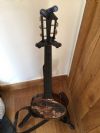
How do you all go about setting the head tension on your Doc's banjos? I tried to use a Tama Tension Watch drum head gauge, but I got the head up to 80 and broke a j-hook. I read in the forums that folks like 89-92 or so. Now I am scared to crank them down again. I was fiddling with with the setup and can't seem to get it back to where it sounded when I unpacked it. I should have left well enough alone, but I do want to know how this thing works.
The sound I am getting now seems to be a little echoie or wavers when strings are struck. It is a renaissance head with medium gage phosphor bronze strings.
8 Comments |
 | jmoathout says:
2/17/2013 6:06:54 PM
Ouch! WHERE did the hook break? You may want to search for John Balch's procedure for head tension. I'd take the tension off all around and then tighten finger tight and try the sound. Then tighten all the hooks about 1/8th turn and see how it sounds. Basically, go by sound rather than an instrument at this point. At some point the banjo should come alive. Stop. Then see what the drum dial says for reference. Maybe the hook had a defect??
|
 | roguegaston says:
2/17/2013 7:49:49 PM
I think the hook probably did have a defect. I will try your procedure after I get a replacement hook. I think part of the sound being off is just me imagining things.
Thanks!
|
 | Rattlesnake says:
2/18/2013 1:54:24 AM
Thats an interesting one, breaking a hook, though in the back of your mind theres always the cringe that something will break. Never used a gauge, always gone by feel much as jm says as these banjo's are pretty much an individual animal.
|
 | darrenjahn says:
2/18/2013 6:17:20 AM
Bummer! I do exactly what jmoathout described. I hand tighten the nuts, then tighten the nuts with a wrench using an alternating pattern around the rim (like a drum head or the wheels on a car), but I only go just an 1/8 or maybe 1/4 turn on each nut. You get to where you can tell when you're close just by the feel when you push down on the head, but I always let my ear be the guide. Like a drum head, you can also tap your way around the outside of the head (without a bridge on the head) and listen carefully for a continuity of pitch. Sometimes a hook or two gets kind of out of whack with the rest which can really detract from tone. Once I've got it dialed in, I find I don't have to adjust it much, and if I do, it's just an 1/8th of a turn at time max.
|
| roguegaston says:
2/19/2013 8:55:26 PM
If Doc doesn't have any extra hooks I am thinking about trying these. Has any one else tried them? store.rickardbanjos.com/tension-hooks/
|
| roguegaston says:
2/20/2013 10:10:25 PM
Doc is sending me a few replacement tension hooks and said that breaking them is not that uncommon, so all is good. This time will go up slowly on the tension and try to listen for a good sound rather than trying to get to a number on the gauge.
Thanks everyone!
|
| jmoathout says:
2/21/2013 6:15:13 AM
That's good to hear. While going by ear is probably the best, another tool - should you be interested - is a drum torque Regal Tip. It allows you to apply the same torque to all the nuts. Granted, there are folks who argue that frictional differences can lead to false readings, there are others who swear by them. John Balch advised me to go by ear as has been discussed, and then maybe check against any loose nuts with the drum torque.
|
| jmoathout says:
2/21/2013 6:20:13 AM
That's good to hear. While going by ear is probably the best, another tool - should you be interested - is a drum torque Regal Tip. It allows you to apply the same torque to all the nuts. Granted, there are folks who argue that frictional differences can lead to false readings, there are others who swear by them. John Balch advised me to go by ear as has been discussed, and then maybe check against any loose nuts with the drum torque.
|
Post a Comment
|
You must be logged in and a member of this group to post a comment.
|