





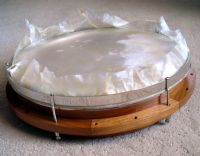
For all things related to the use of SKIN BANJO HEADS. Calf, goat, possum, hairy, shaved, stained, pre-mounted. You name it.
380 Members, Created 3/28/2011 - 
Administrators: jbalch (owner)
From Tom Berghan on 10/18/2013 5:26:42 AM
I often see people asking about how to set the tension on a hide head (and, people ask the same about Mylar heads too!).
I have been playing with hide heads for nearly five years now, and I have endeavored to learn all about heads in general, both Hide and Mylar, and I feel pretty solid on the subject now. By the way, yes, I have ripped a few in the process, and even deformed Mylar in this learning process.
Here is what I have learned, and some of it is opinion I suppose, but I believe that 98% of subject matter experts would agree with me. However, there is no definitive manual on the subject and, like me, it therefore takes people a long time to learn what many others already knew.
1) There is no difference in tensioning a Hide head from a Mylar head. The process is the same and the tension winds up being the same (for all practical purpose) . . . I am referring to that tension where the majority of players agree that the head becomes extremely resonant. (Where the banjo sounds good!)
2) That tension, where this "resonance" occurs, is, when tapped, the head will sound a pitch in the range from G# to A-Natural, or even higher. NOTE: Some banjo players like to go even higher than A-Natural.
3) The pitch, in and of itself, is not important . . . it is just a phenomenon that occurs when the head is sufficiently tight to become very resonant. So, when the head becomes resonant, and you tap on it, you will get a pitch of at least G# or higher, and, as I said, some players like to go even higher than A-Natural (they go even tighter).
4) What happens when the "tap-pitch" is below G#? Answer: The head doesn't resonate as well. It will sound hollow and tubby. I personally do not like the sound of a "too loose head," for any type of banjo (Open back or Resonator), or any type of style (Picking or Clawhammer). In my opinion the head needs to be sufficiently tight to become resonant, and when that happens the tap-pitch will be G# or higher . . . Hide Head or Mylar Head . . . it is the same. 11-inch or 12-inch diameter - I have found it is the SAME.
5) What happens when the "tap-pitch" is above Bb? Answer: Well, the banjo head will still be very resonant and still sound excellent, but the head will be nearing the tension where a hide head will rip, and even Mylar will begin to deform (I have done it!).
6) Now . . . many, many people have a very hard time hearing the tap-pitch. Well, do not worry because OTHER phenomena can be observed when the head is at the "resonant-tension." Our BHO friend Steve Davis brought to my attention the fact that the head will depress right at the feet of the bridge. The tighter the head, the LESS the depression. So, if you prefer, you can forget all about the tap-pitch and just measure the depression at the bridge instead. And it is really EASY to do. Here is how to do it.
METHOD: The amount of head deflection caused by the pressure of the bridge, bearing down on the head, is an indicator of the head tension. It can be measured with a straight edge and a coin. A United States Quarter is about 0.07 inches thick and just fits under a 10" straight edge at the foot of the bridge when the tension produces a tap-pitch of A-Natural . . . which is the tension I personally like. I purchased a wooden ruler for 95 cents and cut two inches off one end. Position the straight edge parallel to the strings so it runs near the bridge. When the tension is at A-Natural, the quarter will fit tight in the gap between the straight edge and the head near the bridge. If the head is tighter, the quarter binds between the straight edge and the head. This can be a good way to keep you from over tightening the head and tearing it. The straight edge is 10 inches long to fit inside the hoop, and slightly off center when you lay it alongside the bridge. The 10 inch ruler and US Quarter also work fine on a 12 inch diameter head.
A-Natural ... quarter
G#...2 dimes
I hope that helps! I find that whenever my banjo stops sounding resonant, I just take out the ruler and quarter from my case and check the gap . . . and it always happens that the head has loosened up just a wee bit and so I make the quick adjustment and it always sounds great once again! By the way, I use hide heads for most of my banjos because I love the sound of the banjos on those old 78 RPM recordings of both classic bluegrass and classic old-time music! If the weather gets really dry, I use the same method to make sure the head is not becoming too tight.
And now an unsolicited commercial plug - I use John Balch Hide Heads!
10 Comments | |
 | C Nyal de Kaye says: |
 | Tom Berghan says: |
 | blindsniper says: |
| Tom Berghan says: |
| Tom Berghan says: |
 | carlb says: |
| Tom Berghan says: |
 | Frailblazer says: |
| Tom Berghan says: |
 | ChuckS says: |
Post a Comment | |
| You must be logged in and a member of this group to post a comment. | |
|
Forum Post: Drum dial settings for vellums |
|
|
Forum Post: (untitled) |
|
|
Forum Post: (untitled) |
|
|
Forum Post: (untitled) |
|
|
Forum Post: (untitled) |
|
|
Forum Post: (untitled) |
|
|
Forum Post: (untitled) |
|
|
Forum Post: (untitled) |
|
|
Forum Post: (untitled) |
|
|
Forum Post: (untitled) |
Terms of Use | Privacy Policy | Privacy Consent (EU/GDPR Only)
Copyright 2026 Banjo Hangout. All Rights Reserved.