





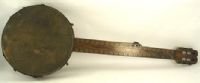
A discussion group for those interested in all aspects of 7-string banjo playing, design, construction and history.
15 Members, Created 7/24/2018 - 
Administrators:
From m06 on 5/21/2022 2:18:16 AM
Extensive contemporary documentary evidence details how Joel Sweeney and other American banjo players introduced and popularised the banjo to the early Victorian British public. The vehicle for this popularisation of the banjo was it's inclusion in their minstrel shows that they brought with them from the south-eastern US in the 1840's. Sweeney's first British performance was straight off the boat in Liverpool in April 1842. In succeeding years his and other similar shows toured a circuit of tavern hall venues that were the pre-cursors of the music hall. The American minstrel tours also included the earliest of these brand new music hall venues.These purpose-built music halls were being rapidly constructed in every expanding urban centre across Britain from Liverpool, Manchester and Glasgow, to London, Bristol and Plymouth to entertain the large new urban populous. The American minstrel shows were a ready fit for music hall and became hugely popular and widely imitated in early Victorian Britain.
The 'first introduction' of the banjo to Britain is a harder claim to justify in the busy maritime world of the early 19th century. The sight and sound of a banjo may already have reached the eyes and ears of seamen, dockside passers-by and inhabitants of Britain's Atlantic ports. Many sailing ships on the Atlantic routes had African-Americans among the crew. Music and dance have always been favourite pastimes of sailors at their leisure.
Urbanisation and the increasingly densely populated cities created a new phenomenon; a large paying audience of city-dwellers who had been uprooted and transplanted from their rural culture and traditions. The Ethiopian or minstrel shows and the American 5-string banjo provided these audiences with novelty and, for the first time, a distinctly American form of entertainment. This coincidence of venue and ready-made act was culturally a timely and symbiotic relationship. Very quickly copycat British minstrel troupes started to appear mimicking the style of the American performers. By this uptake at home minstrelsy as entertainment moved beyond the big cities to towns and small village venues in every corner of the British Isles. Troupes busked on street corners and along seaside promenades in summer. These home-grown troupes needed a banjo. This gave rise to small scale local manufacture. Like another contemporary new introduction the concertina, by this process of popularisation, the banjo was quickly assimilated into the English vernacular musical context.
But the one striking feature that stands out is the early adaptation of the English-made banjo to 7-string. And what is to date the earliest known English banjo tutor of 1852 was instructing not American stroke-style as demonstrated nightly by Sweeney and his fellow countrymen, but instead a 4-finger up-picking style. This despite the fact that contemporary banjo songsters published in England at this time reflected and largely conformed to the standard American tune repertoire popularised by the touring shows.
This begs the question why, when introduced to this new instrument, did the English so readily adopt the American tune repertoire and retain the characteristic short drone string but idiosyncratically adapt the string configuration by adding two extra strings? Why seven and not five? To what pre-existing technical familiarity were makers adapting their English-made banjos?
It is logical to suppose that the answer is discoverable in the English musical context immediately preceding the arrival of Sweeney. From around 1800 the wire strung English guittar was gradually superseded by the six double course gut strung Spanish guitar. An instrument that English soldiery encountered and wrote home about on their campaigns in the Peninsular War with Spain. By 1810 the original double course stringing had changed to six single strings. By the 1830's the accessible and relatively easy to play Spanish guitar had become popular beyond elite aristocratic soirées. Domestic servants, clerks and shop workers became keen students of this instrument. The decade before Sweeney disembarked on Liverpool's quayside with his banjo saw an extraordinary guitar boom in England. Is this the technical familiarity that influenced the makers of the English-made banjo to add two additional long strings to the American 5-string banjo?
3 Comments | |
Peter FM says: | |
Peter FM says: | |
 | Cana Rochbell says: |
Post a Comment | |
| You must be logged in and a member of this group to post a comment. | |
|
MP3: English 7-string c.1870 (2) |
|
|
MP3: English 7-string c.1870 (1) |
|
|
Forum Post: (untitled) |
|
|
Forum Post: (untitled) |
|
|
Forum Post: (untitled) |
Terms of Use | Privacy Policy | Privacy Consent (EU/GDPR Only)
Copyright 2026 Banjo Hangout. All Rights Reserved.