 | JohnTheWhite says:
10/19/2012 10:04:17 AM
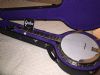
I spoke with Warren once about the action on my RS. When I e-mailed him he said to call him. That is my suggestion; especially since Warren is really nice and interesting.
This is what I remember from the conversation. First, Warren describes "action" as the distance from the top of the string to the top of the fret board as measured by an ordinary carpenter's ruler with the end clip just on top of the string. Others describe action as from the string to the top of the fret as measured by a spark plug feeler gauge from the bottom of the string to the top of the fret. Also, Warren uses the 17th fret; not the 22nd as some others do.
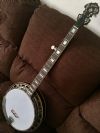
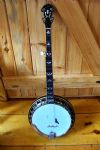
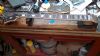
I don't recall Warren's guidelines, but here are the settings on my RS banjo. The first thing to check is your truss rod adjustment. With a capo on the 1st fret and the 4th string depressed at the 22nd fret I measure .016 gap between the bottom of the 4th string and the 7th fret with a feeler gauge. I have never adjusted this from when I received the instrument, but this measurement needs to be right in this range, 1/64 inch. For my action I measure 1/4 inch using Warren's method at the 17th fret.
Here are a couple of other things I have learned. The head needs to be tightened to g# and the bridge needs to be correctly positioned. Also, the bottom of the bridge needs to be parallel with the banjo head. On a RS with the original bridge the back edge is perpendicular to the head and the edge toward the peg head angles back to be perpendicular with the strings. If the bridge is too upright the feet won't fit exactly flat on the head, and this will raise the action - and sound not so incredible.
The adjustment of the coordinator rods is sort of a black art. Ron says that the top coordinator rod near the head should be minimally tight, so that the rim doesn't bind with the tone ring. Of course with no pressure the tension of the strings would compress the rim bowing it out to the sides. So you want the top rod to be tightened so that it exactly matches the string pull. I think that' about 1/4 turn beyond finger tight. Of course messing with the top coordinator rod can change your bridge placement. The other thing to check is that the rods are snug against the neck with the nuts completely loose. This is done by putting a nail in the hole of the rod and tightening. If this isn't right the neck will be loose even if the coordinator rods are adjusted properly.
This done, according to Warren, you can use the lower coordinator rod to lower the action by tightening the nut outside of the rim. You must first loosen the inside nut and tighten it again after the adjustment. I believe that Warren recommends 1/4 inch at the 17th fret (his method) as close to a minimum. Much lower and you risk fret buzz, which often isn't audible, but really takes the edge off the sound in a bad way.
|
| JohnTheWhite says:
1/19/2013 6:11:10 AM
I recently watched the setup videos that Warren put on YouTube. I found that after years of tightening the head I had closed the gap between the fingerboard and the tension ring. I completely relaxed the head and the coordinator rods and started again. I retightened the head evenly making sure that the gap didn't close, and tightened both coordinators about the same listening for the point it started to open up, but not a flare if overtones. Finally I set the bridge with an electronic tuner and made sure that the send string 15th fret had a nice sustain. The action was slightly under 3/16" string to fretboard on the 22nd fret. If anything a little low. Those videos were a big help.
|