




I have a question.
I have read many discussions regarding tail pieces and how they affect the tone by increasing pressure on the head,the break angle of the strings etc.
Do any of you guys use an Ebony tail piece or maybe a wooden one and if you do ,do you notice a substantial difference to metal tailpieces .
I realise the ebony ones will be “floating “ much the same as a no-knot,
I am going to buy or make one just for fun,but wondered if you have any opinions on them.
Clifford essex makes one .
Just curious
Thank you

I have never noticed any difference. Typically I use wood for nylon strings, metal for metal strings. It depends far more on what I have on hand and what "look" I'm going for.

I am in the "what is appropriate to the banjo" camp. Besides early "tubs", the only banjos I have wooden tailpieces on are Alfred Weaver banjos (which were OEM).
Aside of long tailpieces that put a lot of downward force on the bridge (such as Van Eps or Kerschner), my human hearing does not notice much if any difference. But I also can't hear a notable difference between gut and nylon.
Where appropriate I make my own ebony tailpieces for my early banjos strung with gut or rectified nylon. I really enjoy the process of making them and over time have become quicker and more efficient. Some are exact copies of original items that I’ve collected, others are to my own modified design. I keep templates to make the job easier.
I can’t claim to be able to isolate the effect of just the tailpiece in the overall set-up; I just know that they work well in the set-up that I prefer.
Not difficult to make either. If you haven’t worked with ebony before, be aware that even though known for its hardness it can fracture. Though I’ve only ever had this happen when filing a replacement ebony nut.
I started with ebony tailpieces and now make all my tailpieces, nuts and bridges. Experimenting with bridge wood, weight and design can give a player significant additional input into the tone of their banjo.
Edited by - EEB on 04/06/2026 06:14:06
Thank you Gents,I only play openback ,clawhammer and nylon strings so I feel that the simplicity of an ebony piece would work just fine and I have some nice wood tomwork with.
Thank you for your opinions,very much appreciated
quote:
Originally posted by kaydeeThank you Gents,I only play openback ,clawhammer and nylon strings so I feel that the simplicity of an ebony piece would work just fine and I have some nice wood to work with.
Thank you for your opinions,very much appreciated
quote:
Originally posted by kaydeequote:
Originally posted by kaydeeEEB do you attach with a bolt or use a much thicker piece of nylon to tie the tail piece on please .
Thank you Gents,I only play openback ,clawhammer and nylon strings so I feel that the simplicity of an ebony piece would work just fine and I have some nice wood to work with.
Thank you for your opinions,very much appreciated
…if detail photos of an original ebony tailpiece would be helpful just let me know.
There are detailed drawings of the Weaver tailpiece online if you intend to make an exact copy.
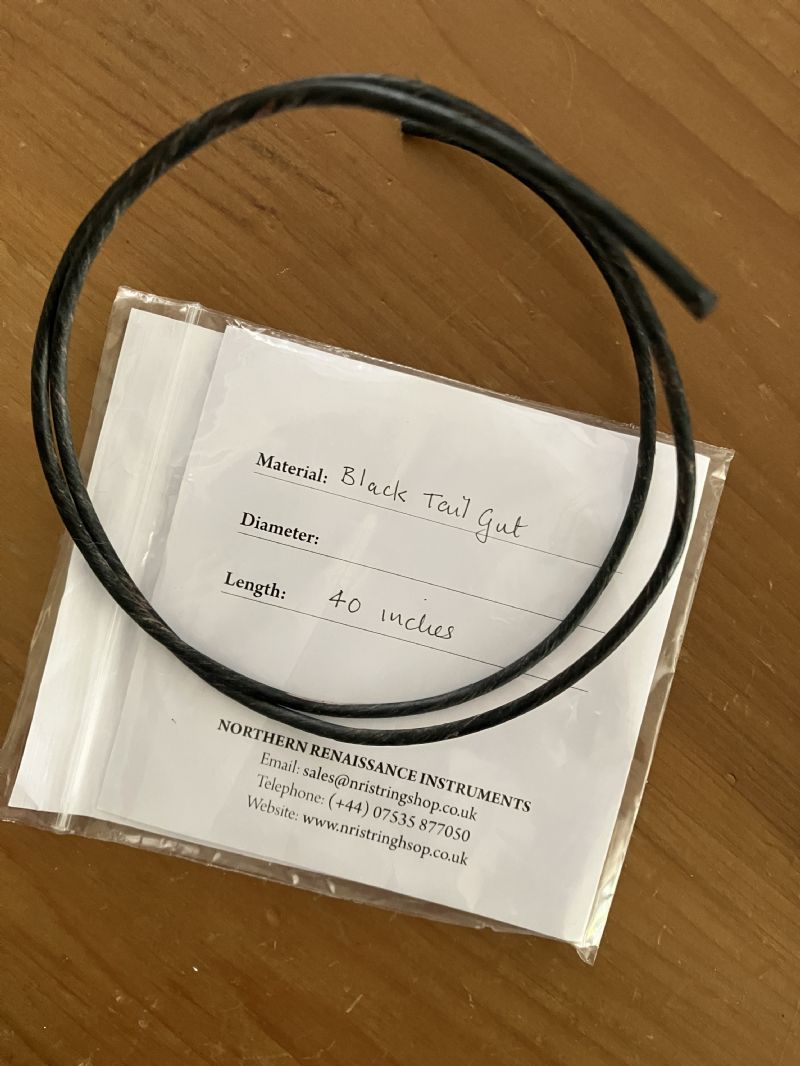
Sue at NRI sells black tail gut. This is perfect for securely attaching ebony tailpieces.
Edited by - EEB on 04/06/2026 06:24:56
That would be most helpful EEB,thank you
This is the tail gut that I use, just to give an idea of the necessary gauge. I buy more than I need for one banjo so that I always have some handy.
Edited by - EEB on 04/06/2026 06:35:30
I see that you play clawhammer. I should point out that my banjos fitted with ebony tailpieces are used for fingerstyle.
Personally I like a weightier tailpiece and down pressure for clawhammer with steel strings. I got rid of all the no-knot tailpieces I had, and prefer to use either a metal Fielding or Price tailpiece, depending on the banjo.
But there are no rules and experimenting to find what you prefer is fun!
Edited by - EEB on 04/06/2026 06:46:01
There's an ebony tailpiece on my Lame Horse 5-string openback. It's flat, fan-shaped, single bolt fixing through to the end bolt. The entire banjo is made with various exotic tonewoods -- no tone ring -- and it sings sweet and bright with steel strings, very articulate.
No way for me to tell how much the tailpiece contributes to the overall tone of the banjo one way or the other. Its flat design is such that it probably doesn't put as much down pressure on the strings as other tailpieces. And the strings are fixed through holes in the front edge of it, rather pulling over the top from the rim. Still, I like it just the way it is and never consider swapping out this tailpiece for anything different.
At the same time, I've never considered putting an ebony tailpiece in place of the (normally) brass tailpieces on any of my other banjos, either...
Thank you gents,The present (metal) tailpiece is adjusted to apply little or no down pressure and sounds just to my liking.I don’t expect an ebony one to be identical but if it is 90% as good ,that’s fine by me,and it will look better.
quote:
Originally posted by kaydeeThank you gents,The present (metal) tailpiece is adjusted to apply little or no down pressure and sounds just to my liking.I don’t expect an ebony one to be identical but if it is 90% as good ,that’s fine by me,and it will look better.
Ebony tailpieces are beautiful. Victorian workers took time to curve and shape for aesthetic effect where they could have left surfaces flat. Alfred Weaver is on record as saying he preferred not to have gut strings in contact with metal at any point.
While on the subject of ebony, one thing that puzzles me is why the vast majority of banjo bridges are capped with ebony? A bridge is critical to tone production. Ebony is tonally dead; anyone who doubts this should build a bridge out of it and find out for themselves. Plenty of indigenous tonewoods are hard enough to withstand steel strings uncapped. 1/8" of inert material between strings and bridge wood makes no sense tonally.
Edited by - EEB on 04/06/2026 14:27:48
I've got one of those Essex wooden tailpieces on my nylon strung Tilley. The original boxwood one had been destroyed by metal strings. I had a no-knot on it for years. I can't hear a difference.
quote:
Originally posted by EEBquote:
Originally posted by kaydeeThank you gents,The present (metal) tailpiece is adjusted to apply little or no down pressure and sounds just to my liking.I don’t expect an ebony one to be identical but if it is 90% as good ,that’s fine by me,and it will look better.
Ebony tailpieces are beautiful. Victorian workers took time to curve and shape for aesthetic effect where they could have left surfaces flat. Alfred Weaver is on record as saying he preferred not to have gut strings in contact with metal at any point.
While on the subject of ebony, one thing that puzzles me is why the vast majority of banjo bridges are capped with ebony? A bridge is critical to tone production. Ebony is tonally dead; anyone who doubts this should build a bridge out of it and find out for themselves. Plenty of indigenous tonewoods are hard enough to withstand steel strings uncapped. 1/8" of inert material between strings and bridge wood makes no sense tonally.
The modern bridge was developed by A. D. Grover and later Grover Jr. This was in the early 1920s.
Every single design element was changed in response to the damaging effects of wire strings and pick played wire strings.
The ebony cap was first added as an inset piece. In all cases this was added to minimize wire from cutting in the wood or chipping due to pick playing.
The wide feet were added to prevent sinking onto the head from the added pressure from wire.
The mass and third support were added to prevent sagging.
The modern bridge, like the modern wire string banjo, are in essence designed for pick playing.
Edited by - Joel Hooks on 04/06/2026 19:34:31
Maybe I wasn't clear in my comment about my puzzlement? I think we're all aware of how the advent of steel strings brought about change to bridge design. But change doesn't generally imply a single solution that remains unquestioned for a century. Specifically in relation to the 'universal' ebony bridge cap there are common tonewood options that withstand the additional down pressure of steel without inserting the tonally deadening effect of ebony into the mix.
I use an uncapped dogwood bridge on a modern steel-strung banjo. The banjo maker handed me that bridge (which he made) at a fiddle convention some years after I bought the banjo from him. Eight years on, and that same bridge sounds fine on that banjo and shows no wear. That was what originally got me thinking - and then experimenting for myself with local tonewoods.
Edited by - EEB on 04/07/2026 00:49:57
I'd choose a wooden tailpiece over a no-knot, especially for old-style low bridge/light gut strings setup. If you make the string spacing on the TP the same as it is on the bridge, it very much reduces the tendency of the bridge to move laterally on the head. Also the shorter after-length (of the strings between the bridge and TP) can eliminate most of the sympathetic ringing there (which is often mistakenly called "overtones").
Edited by - Dan Gellert on 04/07/2026 19:40:28
Sounds interesting, pictures please!!!
quote:
Originally posted by Dan GellertI'd choose a wooden tailpiece over a no-knot, especially for old-style low bridge/light gut strings setup. If you make the string spacing on the TP the same as it is on the bridge, it very much reduces the tendency of the bridge to move laterally on the head. Also the shorter after-length (of the strings between the bridge and TP) can eliminate most of the sympathetic ringing there (which is often mistakenly called "overtones").
Thank you Dan, I did actually wonder about this as I only use light rectified nylon strings by Clifford essex and I do find the bridge moves a little during playing ,so thank you You have confirmed my thoughts ,A picture would be nice if you can find the time,so off to the garage to make and design a tailpiece ,I have some nice ebony .
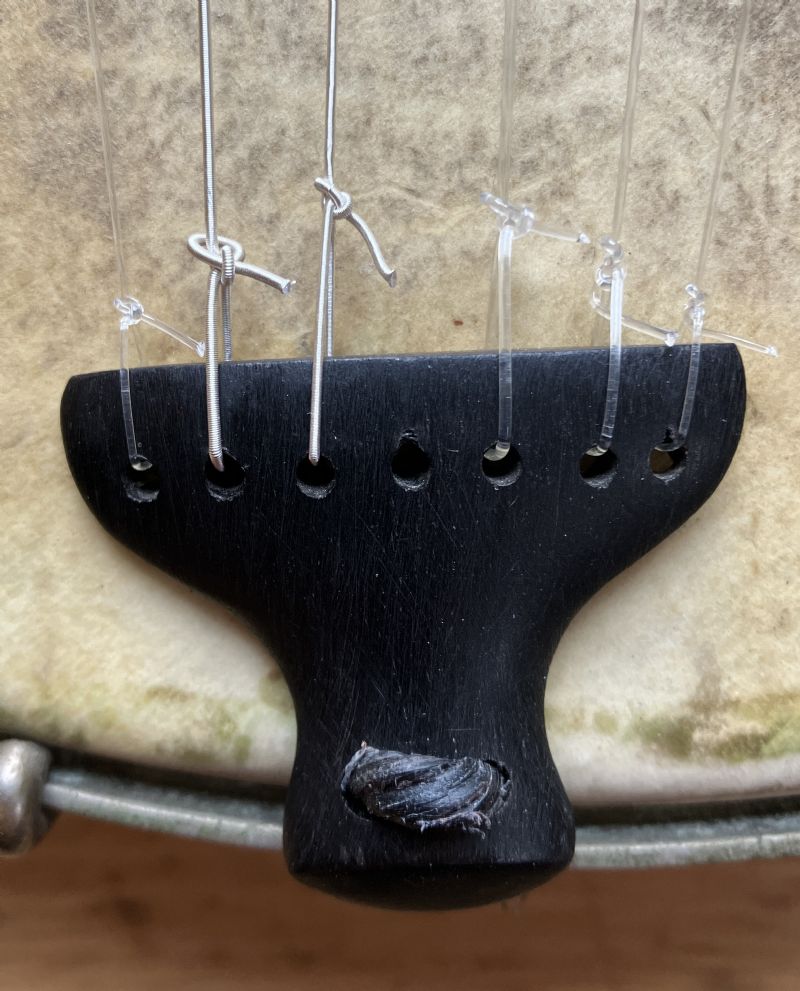
Here is another common 19th century design for an ebony tailpiece. This one is original to an early G. P. Matthew 7-string banjo c.1883.
Edited by - EEB on 04/08/2026 05:49:12
Ebony tailpiece on an Alfred Weaver 5-string c.1894.
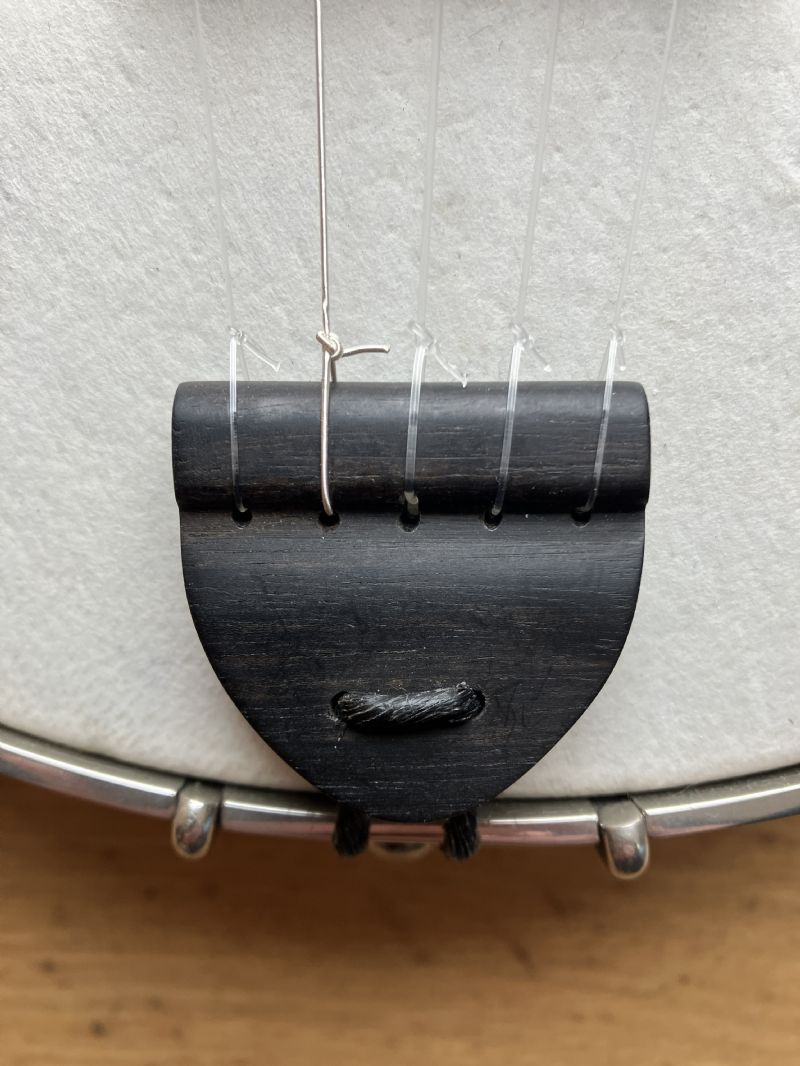
Thank you EEB,I do like the Clifford essex weaver tailpiece,nice and simple .
Terms of Use | Privacy Policy | Privacy Consent (EU/GDPR Only)
Copyright 2026 Banjo Hangout. All Rights Reserved.