





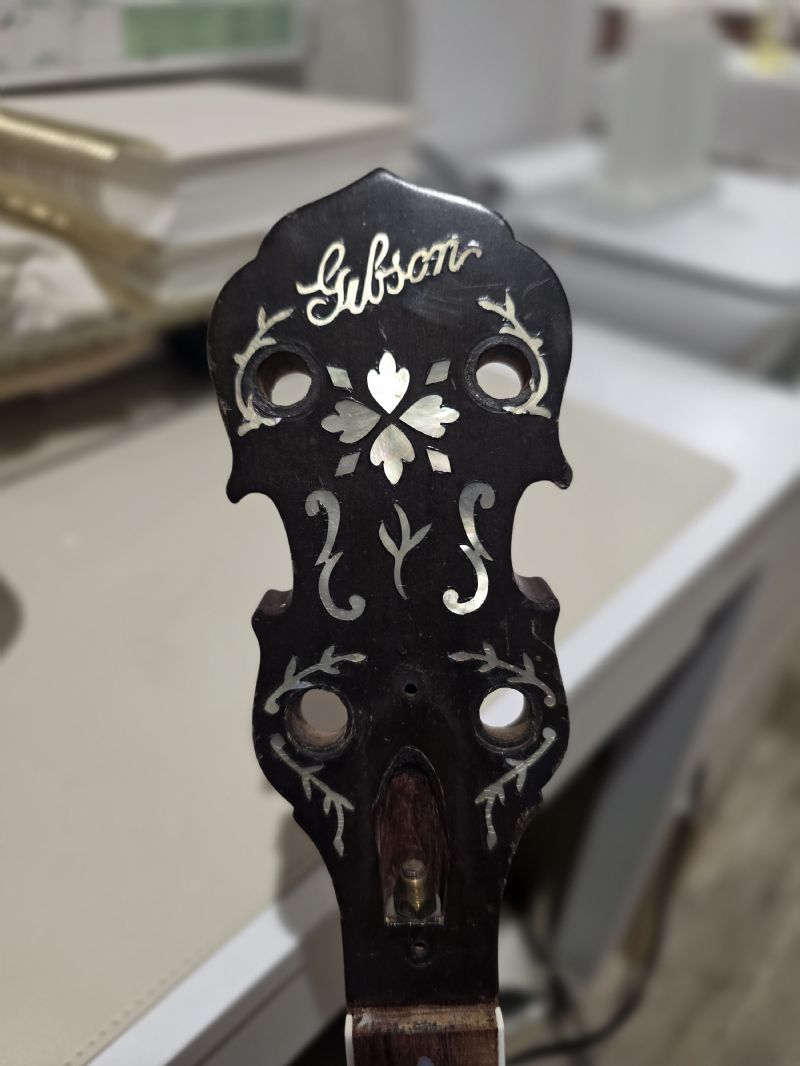
I recently acquired some 5 string necks that belonged to Barry Palmer. I identified the others, but I can't ID this one. I'm assuming it's had a fretboard change, and it's pretty obvious he (or someone prior to him) was going to rework the heel but never got around to finishing it. If consensus is that it's a replica neck, I'll finish the heel for a project...if it's a Gibson neck, I believe I'll pass it along to someone looking for a conversion neck. What are your thoughts, and why? Thanks, y'all!
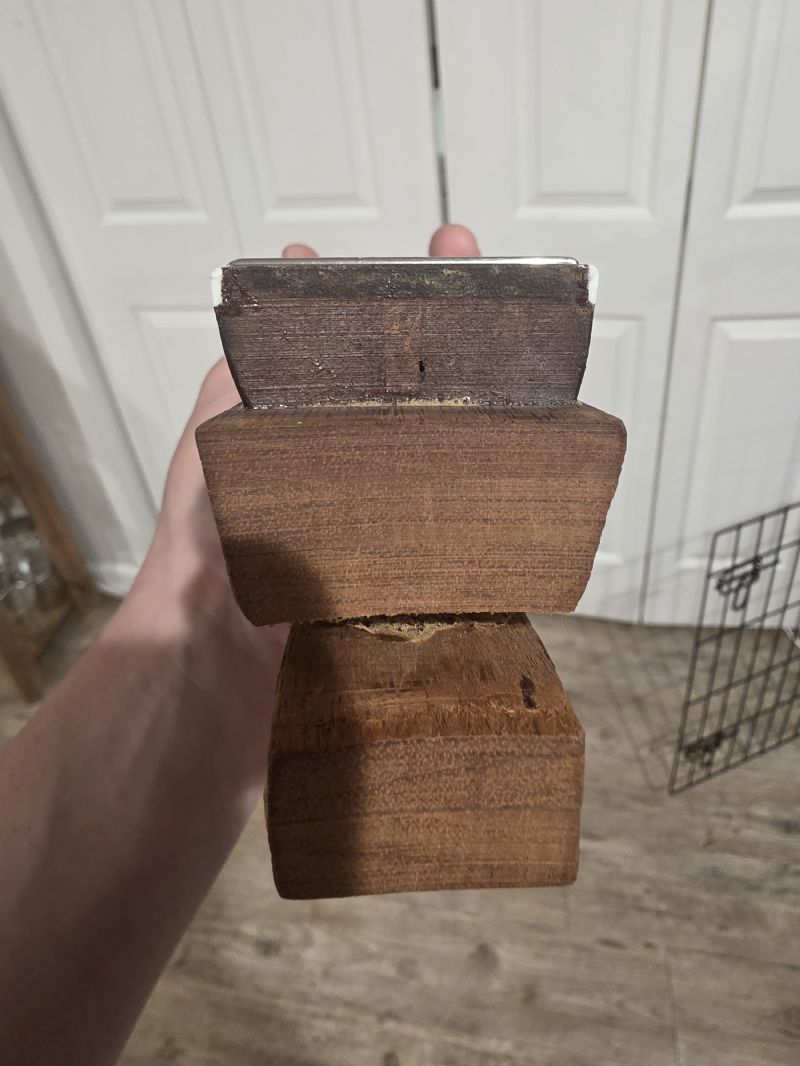
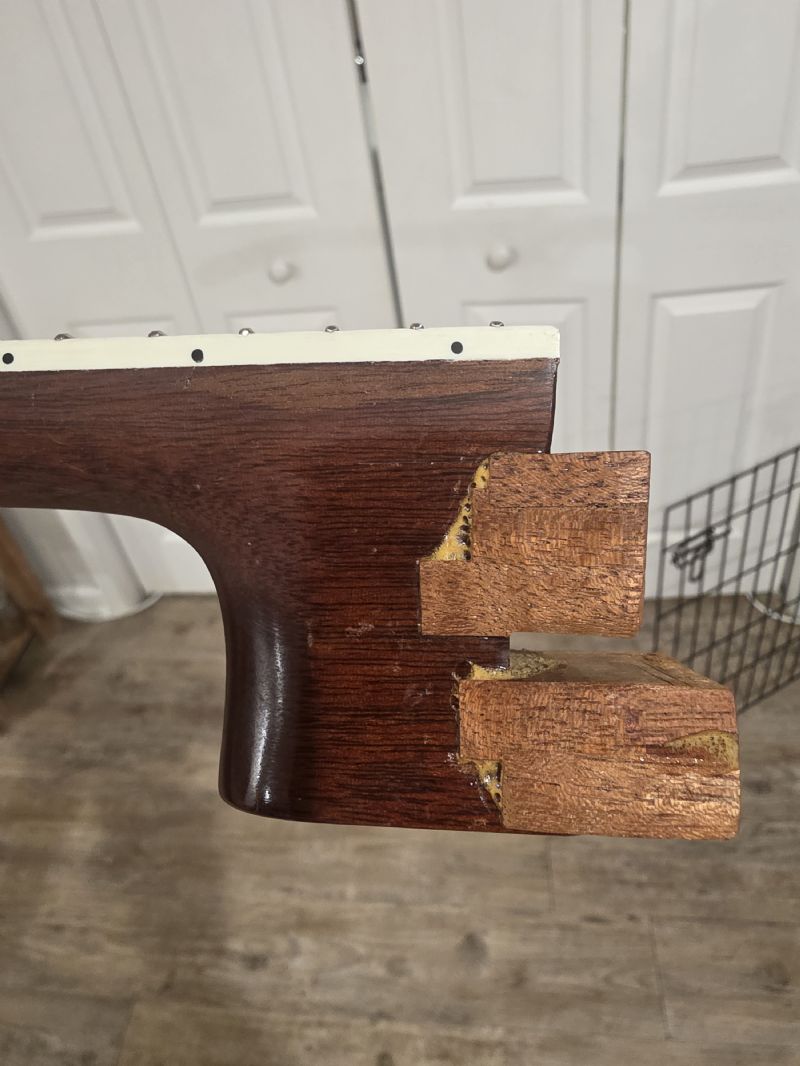
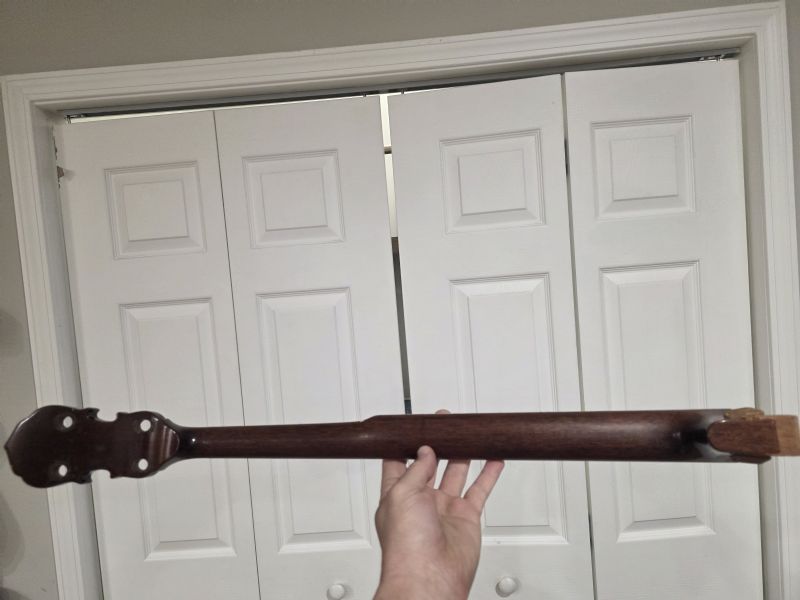

Is that a common way to rework a heel? It seems like an excessive amount of wood to be removed to then replace with a patch.

One thing is for sure. They use Gorilla glue to attach the added wood. The expanding of the glue makes a huge mess to clean. Plus, Gorilla glue absorbs vibration, which takes away from the tone.
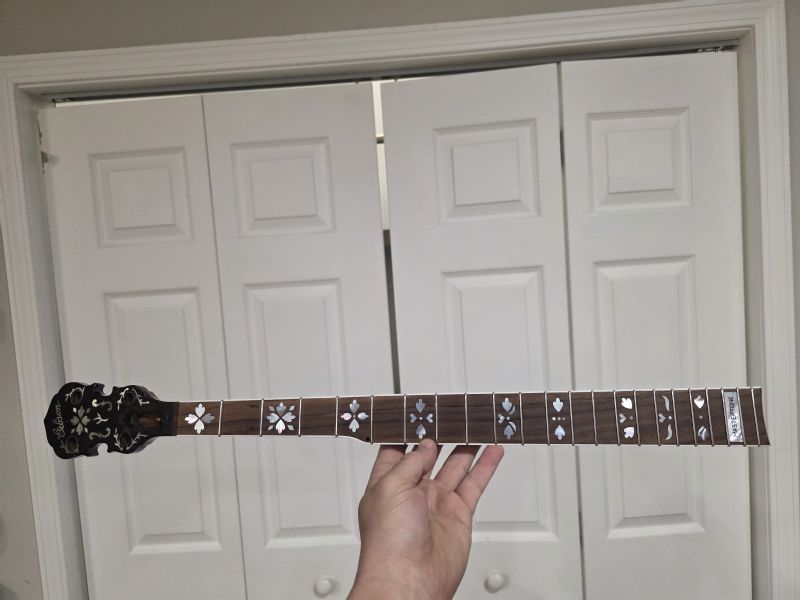
Height of the binding, size of the dots, exposed fret ends and color of the wood suggest to me this is not an original Gibson neck. Of course, I could be wrong.
While this may not be a typical way to rework a heel to change neck angle, it may have been appropriate for whatever the previous owner was trying to repair or change: a serious break, some problem related to the lag bolts, convert from one-piece flange to two-piece, raise or lower the neck's connection to the pot. These are just guesses; no way to know.
Maybe they added so much wood as insurance they added enough.
I'm impressed by the way they left a sliver of original wood at the bottom of the heel, so the bottom surface won't show the work that was done.
I have a 70s RB250 neck that a previous owner converted from working with two-piece flange to one-piece. All that required was adding wood to the lower lag area of the heel.
quote:
Originally posted by Old HickoryHeight of the binding, size of the dots, exposed fret ends and color of the wood suggest to me this is not an original Gibson neck. Of course, I could be wrong.
While this may not be a typical way to rework a heel to change neck angle, it may have been appropriate for whatever the previous owner was trying to repair or change: a serious break, some problem related to the lag bolts, convert from one-piece flange to two-piece, raise or lower the neck's connection to the pot. These are just guesses; no way to know.
Maybe they added so much wood as insurance they added enough.
I'm impressed by the way they left a sliver of original wood at the bottom of the heel, so the bottom surface won't show the work that was done.
I have a 70s RB250 neck that a previous owner converted from working with two-piece flange to one-piece. All that required was adding wood to the lower lag area of the heel.
This fella had a handful of necks that were in a similar state (regarding the heel work), so I assumed he was hoarding up for 2PF banjos. He was one of the creators of Banjothon (and had a wonderful collection of PW Gibsons and Martin guitars.) so I trust his reasoning lol!
It's hard to see in the pictures, but the fretboard inlays are not up to what I would consider "modern" Gibson quality standards. Because of that and how new the fretboard wood looks, I assume the fretboard is new. In fact, the only thing that's made me wonder about this neck is how good the headstock looks when compared to the fretboard. (Or am I wrong?) This is probably the worst of the necks though, so I'm tickled with what I have regardless of this one!
quote:
Originally posted by BanjourThis fella had a handful of necks that were in a similar state (regarding the heel work), so I assumed he was hoarding up for 2PF banjos.
I'm close to the limit of the little I know about these things.
My initial reaction was conversion of two-piece flange fit to one-piece. What makes me question that is what I addressed before: the bottom surface of the heel extending into the new wood area. In a heel cut for two-piece flange, the lower portion ends at about the same place as the upper. That's because the skirt on a TPF rim is nearly a full 11-inch outside diameter, same as the O.D at the tone ring skirt where the upper part of the heel makes contact. The bottom of this heel suggests the lower lag area was longer. Or maybe I'm being mislead. I don't know.
If this neck was not originally made for TPF, then maybe there's a needed repair going on.
OR: If the fretboard is a replacement, it could be thicker than what was originally on the banjo. As I said in my previous comment, that could require relocating the lag bolts to keep the surface of the fretboard at a good height relative to the pot. If there wasn't enough wood to move the lags, it would have to be added, leading to the substantial work we see here.
I couldn't begin to guess at the originality of the headstock or fretboard inlays.
I think there are plenty of home-based builders who would be able to complete and use this neck.
Edited by - Old Hickory on 04/10/2026 10:55:48
To me, the peghead inlays look to be less consistent than usually seen on factory instruments. Fretwork does not look to be Gibson work.
My opinion would be a fair replica.
Replica Gibson neck. Gibson didn't make that exact fretboard inlay set. It's not really a style 4, a Granada or a Scruggs. What wood is the neck? Looks a bit like walnut to me.
Terms of Use | Privacy Policy | Privacy Consent (EU/GDPR Only)
Copyright 2026 Banjo Hangout. All Rights Reserved.


