




Page: 1 2
Does anyone have any advice for playing English music using bluegrass technique? I love playing bluegrass technique but, being English, I don't much enjoy folk music from the U.S. The problem is that I can't find any tabs English music, so I will need to write them myself. The two main issues are that English music is typically in 3/4 or 6/8, and that it is usually more melodically complex than Bluegrass. Does anyone have any advice on how to tackle these issues?
Below is a link to a tab I made for the English Classic "John Barleycorn"
hangoutstorage.com/banjohangou...42026.pdf

How are you defining "English Music?" That could be Handel, Purcell, Britten. Or it could be George Formby or Freddie Mercury.
It may be worth noting that Celtic music derived from Ireland and Scotland are certainly heavy influences in modern banjo music, particularly fiddle tunes. It's also worth noting that 3/4 time is regularly used in bluegrass, often (but not always) in a gospel setting.
Perhaps you can give us some music samples of what you're looking for.

Sounds as though you might rather be playing what I refer to as Irish music or jigs and reels. You might check in on the 4-string Irish and related forum as that one might have more your kind of music.
If you like more melodic, you can put melodic phrases in bluegrass style music and maybe that would help make it sound more like you want it to sound. There are lots of 3/4 or waltz type songs (vocals) in bluegrass music that you might see if you can add your own way of playing to them.
Others may have more ideas and be able to direct you to bluegrass songs that might satisfy your needs.
eagleisland you're right, I was not specific enough. By "English music" I was referring to traditional English folk music such as Brigg fair, John Barleycorn, The spotted cow, The sheep shearing song, etc...
Texasbanjo Thank you for the advice! I foolishly hadn't thought of looking at celtic tunes for a solution to my problem, so thank you very much for mentioning it.
Okay, just searched on the songs you mentioned. I only knew John Barleycorn from the Traffic album of the same name, and was pleasantly surprised to learn that Winwood et. al. actually adapted the traditional song. The others struck me as being rather slow and moody - but with possibilities.
Seeing as you're writing your own tabs, you obviously know a thing or two about how to find the melody notes. So I'd start there, laying out melody and determining which filler notes to put in the spaces.
Do listen to celtic-derived songs that have made it into the modern string band canon. Often, we use melodic-style technique, rather than Scruggs technique, to arrange these. But they're quite doable. "Red Haired Boy" is derived from a Scot/Irish tune called "Little Beggar Man." There are numerous other examples. Same with "Blackberry Blossom" and numerous others.
Edited by - eagleisland on 04/13/2026 12:04:35
Elliott, there is a vast English/British banjo repertoire for fingerstyle banjo currently the focus of research. This repertoire includes traditional indigenous hornpipes, jigs and reels; also European forms made popular by the rapid growth of music publishing and dance fashions waltzes, polkas, gavottes, mazurkas, galops, and schottisches. Many banjoists of this era were also composers for the banjo. Their output further enriched the repertoire and added air de ballet, reverie, fantasia, rag-time and fox-trot to the banjo canon.
Though not primarily roll-based like bluegrass/Scruggs picking, fingerstyle (aka guitar style) is commonly a 3-finger up-picking technique.
The Early English Banjo YouTube channel and blog page are created to share research-associated recordings of this fingerstyle repertoire and research source material:
https://m.youtube.com/channel/UC2ARp4V-79Qsk0dxbKvqniQ/videos
https://earlyenglishbanjo.blogspot.com/?m=1
The Early English Banjo research project also hosts a friendly and informal Facebook group for those interested in this field:
https://www.facebook.com/groups/1058725352301676/
Maybe this area offers the banjo scope, repertoire and variety that you have been searching for?
Edited by - EEB on 04/13/2026 12:25:15
eagleisland Thanks for the reply. I must admit that I don't really know the difference between Scruggs style and Melodic style, so I will have to read up on that and maybe that will be better for what I want. I hear you on the Celtic side of things; I can scarcely believe that I hadn't thought of it before. Thanks for the advice!
EEB This sounds amazing! I'm not very good at playing, and have only put any extensive time into a few bluegrass pieces, so I am not familiar with Fingerstyle. I will have a look at the channel you suggested, thank you so much for your help.
I like working out arrangements for old tunes from this neck of the woods for clawhammer. It's good fun, and there are some great old tunes to try out. It helps if you can read a bit of music, there are quite a few collections of tunes from old fiddle manuscripts online (check out the village music project) and the Northumbrian Pipers Society publish tune collections with lots of traditional tunes. There are a lot of reels and hornpipes in 2/4 or 4/4, which tend to be easier to fit to the 5 string. It seems to me that very few of the popular old tunes were only from one specific nation though - the same tunes seem to crop up all over, sometimes with different names.
quote:
Originally posted by Eliott - ElstreeEEB This sounds amazing! I'm not very good at playing, and have only put any extensive time into a few bluegrass pieces, so I am not familiar with Fingerstyle. I will have a look at the channel you suggested, thank you so much for your help.
You're very welcome. The EEB's research work specifically addresses the broader historical neglect of the early English banjo context. The aim is to make knowledge of this diverse heritage and these geographically relevant social narratives and playing opportunities available to, particularly a new generation of English banjoists, and anyone else who is interested to expand their understanding of banjo history.
You make also find the 'Classic' banjo Ning website useful. This site is also for fingerstyle banjo, though with a tune library with a greater focus on American fingerstyle compositions:
https://classic-banjo.ning.com/m
If you need more precise help just PM me.
Edited by - EEB on 04/13/2026 12:54:42
quote:
Originally posted by Eliott - ElstreeEEB This sounds amazing! I'm not very good at playing, and have only put any extensive time into a few bluegrass pieces, so I am not familiar with Fingerstyle. I will have a look at the channel you suggested, thank you so much for your help.
The technical range of this early banjo repertoire is also huge. We all learn to walk before we run - there are many simple early fingerstyle tunes that are fabulous to play and form an excellent access point to this repertoire.
One simple tune leaps immediately to mind when I noticed where you live - Keel Row. I'm sure you know it. A traditional North-East melody that was universally popular on the early banjo here.
Edited by - EEB on 04/13/2026 12:48:47
There is a body of vintage English banjo tutors and collections on the Classic-banjo.ning site. All for free download. http://Classic-banjo.ning.com
Herb Ellis published lots of it, as did John Alvey Turner and Dallas, among others. It's all in notation...but MuseScore is a free download and generates beautiful Tab.
Edited by - trapdoor2 on 04/13/2026 12:49:02
If you go the "classic banjo" route (not classical), the sheer volume of music can be overwhelming and kind of hard to swallow.
I recommend a course of study to get started. Following a course of study will build right and left hand foundations, will teach you to read (don't let this scare you, using a progressive course makes reading very easy) and will open the door to playing anything.
But you have to get to that point.
My #1 recommendation is the Mel Bay Banjo Method by Frank C. Bradbury. While this does not contain the music you are wanting to adapt to the banjo, it will arm you with all the tools you will need do to that very thing. Start with page one and don't skip anything.
Pay special attention to the lessons on "alternate fingering"-- this is the key.
As you work progressively through this course of study, you may supplement it from the seemingly unlimited number of "jigs and reels" for banjo.
Devote 6 months to a year of study and you will be well on your way to reading and arranging for the banjo.
In addition to the music already arranged for banjo, you will be able to play from most treble clef works such as Ryan's Mammoth, O'neil's, Howe's Musicians' Omnibus, pretty much anything of the "fiddle" variety including very early stuff. The more you work on this, the more you will be able to add banjo effects or learn when to transpose to more friendly keys.
little bit of effort with a course of study will open the door to unlimited music. You will no longer need tab.
Usually "classic banjo" is played on nylon strings (or gut for those 'living history' folks). But you can play all this stuff on wire strings too. While I feel that nylon is the way to go, don't let that get in the way.
Hi
I've been playing bluegrass banjo here in the UK for more than 50 years. I've played in bands which sometimes performed in folk clubs, and although we were always enthusiastically received, I got the impression that bluegrass (and especially bluegrass banjo) was viewed very much as an oddity in the English folk world and that the audience felt it was really 'country' music (which it is).
The highly syncopated, embellishment-laden style that is 'Scruggs' banjo playing is so very different from the simpler style in which most English folk music is played, that I've come to believe that bluegrass and traditional English folk music really don't mix.
However, the 'melodic' or 'Keith-Thompson' style of banjo playing permits the rendering of a tune (typically those written for the fiddle) in a much more 'folky' way, and does seem to be more readily accepted in UK folk clubs. That's fine if you want to play an instrumental, but if you want to play banjo as an accompaniment to songs in English folk music, you might find that an 'old time' or 'frailing' style would be more appropriate.
Here's a 'traditional' English tune that wouldn't have seen the light of day without Messrs Scruggs and Keith:
youtu.be/WTYVlHK6w2c
quote:
Originally posted by Eliott - ElstreeEEB This sounds amazing! I'm not very good at playing, and have only put any extensive time into a few bluegrass pieces, so I am not familiar with Fingerstyle. I will have a look at the channel you suggested, thank you so much for your help.
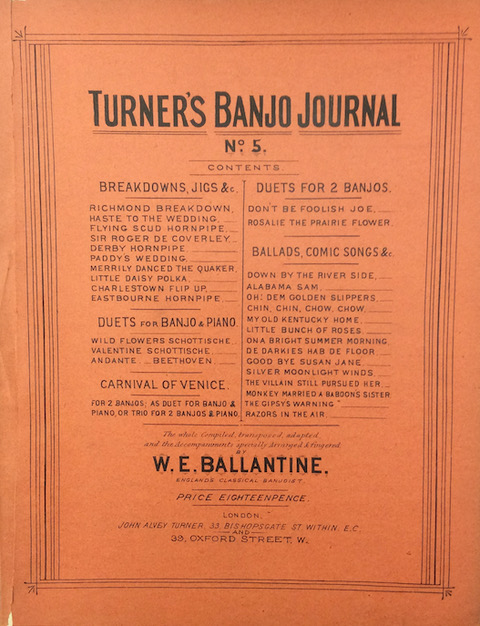
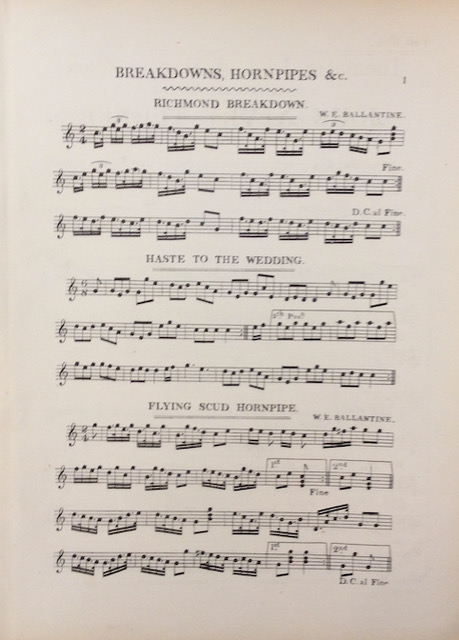
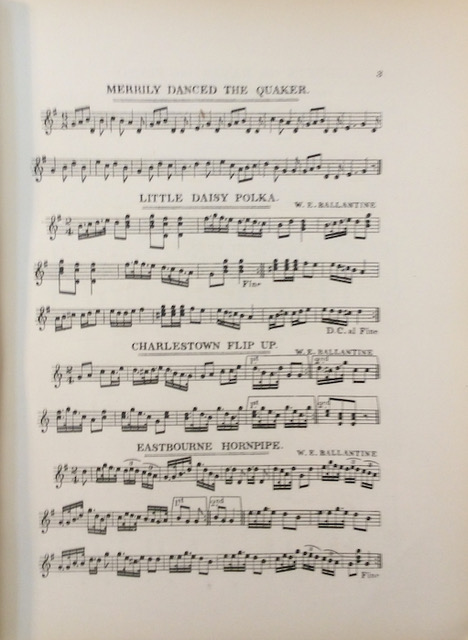
Elliott, the notation for a version of Haste to the Wedding, the well-known English jig appears in Turner's Banjo Budget No.5, page 1 arranged by W. E. Ballantine. The EEB resource blog page currently displays the cover but the contents are yet to be uploaded.
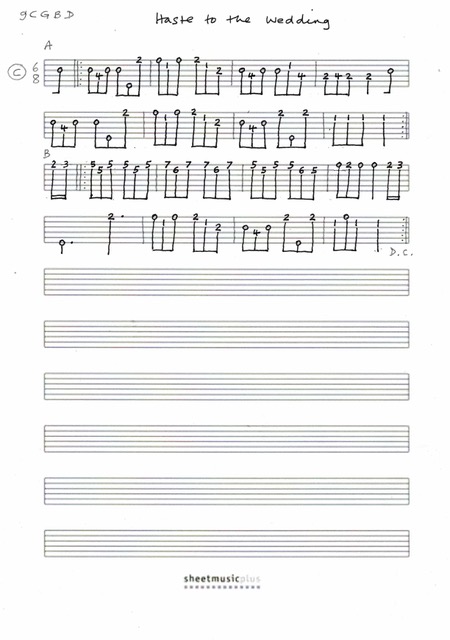
I've made a fingerstyle tab of Ballantine's version for you in the hope that this makes it easily accessible. The 5-string banjo tuning is gCGBD, the default English fingerstyle tuning unless otherwise stated. The first few bars of the B part provide a brief move to the 5th position which may extend your technique a little. I'll also tab and upload Merrily Danced the Quaker from the same publication for you. Then you'll have a 6/8 and a 2/4 tune to have fun with.
Edited by - EEB on 04/14/2026 02:13:26
If you haven't already, you should check out Martin Simpson's work - he plays excellent banjo in several different styles as well as his brilliant guitar playing and singing, across a wide range of folk, old-time and bluegrass.
Standard notation is easily accessible. In addition to the Mel Bay method being cheap and easy to find, there are nearly 100 other C notation tutors available, and all of them include what you need to know to play banjo (some better than others). Those are free for the downloading.
All it takes is a short amount of time dedicated to a course of study.
No one just knows how to read music. That is why there are instructions to teach you how, easily.
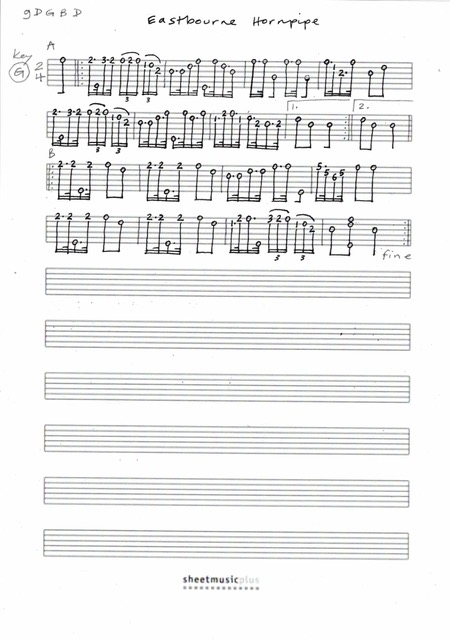
Fingerstyle tab for Eastbourne Hornpipe, an original composition by William Ballantine, also from Turner's Banjo Journal No.5. 2/4 time signature in G major, and an example of a tune where the banjo 4th string is raised to D, giving a 5-string tuning gDGBD.
Edited by - EEB on 04/14/2026 06:13:41
Hi Eliott,
Just in case you hadn't seen it, I've sent you a message.
Ian.
EEB Wow! The resources you've provided are greatly appreciated. I've spent a couple of hours playing some classic style stuff, mostly 'sunflower dance', and really want to explore this side of the instrument more. While I don't have the patience for a 'course study' right now like some have suggested, I am a classical and jazz pianist and can fluently read sheet music; of course on banjo it's different because the same note can be played in different positions, and I will no doubt need to spend some deal of time learning to read anew. I really appreciate the tab work, also the channel you provided and the linked blogspot. If you've any favourite tunes to play I'd love some recommendations. Thanks again.
quote:
Originally posted by Eliott - ElstreeEEB Wow! The resources you've provided are greatly appreciated. I've spent a couple of hours playing some classic style stuff, mostly 'sunflower dance', and really want to explore this side of the instrument more. While I don't have the patience for a 'course study' right now like some have suggested, I am a classical and jazz pianist and can fluently read sheet music; of course on banjo it's different because the same note can be played in different positions, and I will no doubt need to spend some deal of time learning to read anew. I really appreciate the tab work, also the channel you provided and the linked blogspot. If you've any favourite tunes to play I'd love some recommendations. Thanks again.
Banjo music is edited with positions and fingerings which clear this up when it is not obvious. The "obvious" part comes with experience. This is all introduced progressively in small bites with the Mel Bay Banjo Method.
Regarding a course of study... If you do it now you will be done and won't have to do it again. If you just "jump right in" you will have to unlearn bad right hand habits. At the very least, I recommend studying alternate right hand fingering and left hand positions. Random tab found online should not be trusted.
Starting by learning a single piece= you can do this. Say it takes you a one to three months to learn one piece of music. At the end of those three months you only know one piece of music. That same exact amount of time spent with a course of study and you will be able to play ALL pieces of music within your current skill level.
Joel Hooks I have downloaded the Dallas method book edited by Ellis and started working through it. Honestly I was just making excuses and being lazy when I said I had no patience for a method book. Of course I've gone through method books for other instruments, as I play a couple of others, and find that they usually progress too slowly or too quickly or fail to hold my short attention span, but this one seems pretty solid moves on from pure exercise to more musical content at a quick but understandable pace.
I agree that you don’t see much bluegrass banjo in English folk music, and I’ve long been surprised that frailing banjo has become much more integrated instead in folk circles. Possibly that’s because that’s a more laid back accompaniment style. However, it is feasible to incorporate up-picking styles, if you slow it down and simplify it somewhat, which I have been doing for a long time now. If you want to play fiddle tunes though you need to explore melodic style, which works better than Scruggs style.
Even so, I still find it easier to play jigs, reels and hornpipes on a tenor banjo or mandolin, because of the fiddle tuning, and I wonder if that’s because we tend to accent tunes slightly differently on this side of The Pond - jigs, polkas and hornpipes are a staple part of English folk music, and reels, rags and breakdowns are less common.
quote:
Originally posted by Eliott - ElstreeEEB Wow! The resources you've provided are greatly appreciated. I've spent a couple of hours playing some classic style stuff, mostly 'sunflower dance', and really want to explore this side of the instrument more. While I don't have the patience for a 'course study' right now like some have suggested, I am a classical and jazz pianist and can fluently read sheet music; of course on banjo it's different because the same note can be played in different positions, and I will no doubt need to spend some deal of time learning to read anew. I really appreciate the tab work, also the channel you provided and the linked blogspot. If you've any favourite tunes to play I'd love some recommendations. Thanks again.
You're a musician already demonstrating the curiosity and personal choice that gives you impetus and direction.
Maybe none of these techniques or repertoire suggestions will be your destination. But there is an abundant harvest of ideas and inspiration to gather along the way.
The early fingerstyle banjo repertoire (c.1850-1950) offers beauty in all its forms in plain sight; beauty in simplicity, yes - but also harmonic and expressive beauty which has been homogenised out of the modern instrument, largely by the constraints and limited expectation of 'genre'.
Rather than give you names and titles I'd encourage you to view the banjo in context. Not just the dead obvious material that was published for banjo, but the musical culture that surrounded the banjo. Because that was what those early banjoists were doing; as well as composing they were searching, finding, arranging and performing. Just because we may not have a documented primary source that confirms that a specific tune was performed on banjo on a specific date at a specific venue does not mean that a tune is 'unsuitable'. History isn't the rigidity of re-enactment and a badge of 'authenticity' - it is knowledge; an informed understanding of those previous musicians, the world that they inhabited, and their creative instincts and choices and the potential that they made audible.
Edited by - EEB on 04/15/2026 02:40:45
Page: 1 2
Terms of Use | Privacy Policy | Privacy Consent (EU/GDPR Only)
Copyright 2026 Banjo Hangout. All Rights Reserved.