




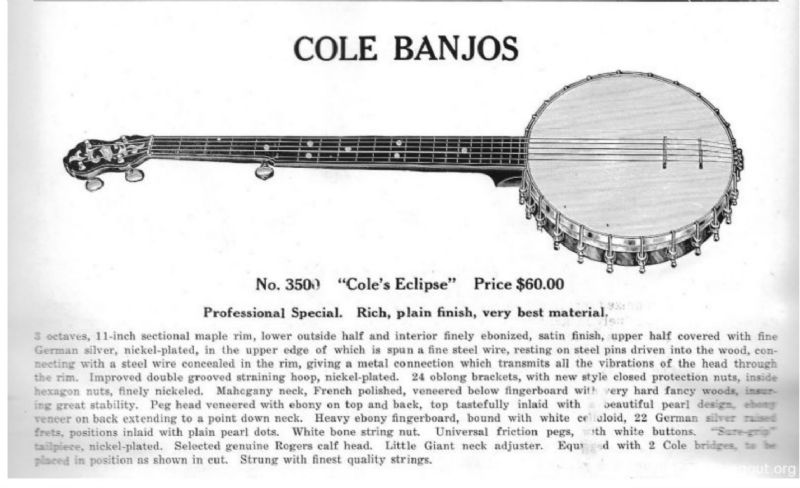
W.A. Cole apparently used 2 bridges on his Eclipse banjos but that’s all I know about them. What was the spacing on them? From advertising illustrations the first one appears to be in the standard position and the second one is set about halfway between the first and the Elite tailpiece. Was the second used to increase the angle of the strings much like you can do using a Hawktail or adjustable tailpiece? I am refurbishing a Cole Eclipse right now and may give the dual bridge setup a try assuming I can get the correct details. Here is a Cole ad showing the dual bridges.

Swirling overtones, that second bridge is going to work like a long tailpiece and stop post bridge string noise (what little there is, with gut strings with a skin head).
Maybe, they are advertising that it comes with two bridges for adjusting action or as a spare?
Edited by - pinenut on 04/21/2026 08:57:04

A head-scratcher to me .... I notice the description says, "... bridges to be placed in position as shown in cut."
quote:
Originally posted by OwenA head-scratcher to me .... I notice the description says, "... bridges to be placed in position as shown in cut."
I think they were having problems with overtones and adding a bridge was cheaper than changing to a longer tailpiece.
To me the reason is obvious. Selling you two bridges means getting more money.
I’ve seen a lot of photos of people holding banjos with the two Cole patent bridges. I also own two originals, one is much smaller than the other, which is regular sized.
My guess is that the second bridge is shorter and narrower, but I could be wrong.
I’ve tried this a number of times… meh.
There is likely a good reason it did not become a thing.
Placing a second bridge anywhere in that vicinity will decrease the break angle over the one that is driven directly by the strings. In my experience, you need at least 3 degrees to hold it in place -- unless you do something very differently -- like I did here: https://www.its.caltech.edu/~politzer/zero-break/zero-break.pdf. The zero-degree bridge in the photos actually works, but the paper's contents are wrong on two out of three major points. It got straightened out later -- as described at https://www.its.caltech.edu/~politzer/.
Lowering the break angle lowers the broad frequency range of the head's strongest sound production (e.g., https://www.its.caltech.edu/~politzer/pickers-guide/pickers_guide.pdf). That will be a dramatic consequence of the second bridge. Yes, there will be extra inharmonic partials from the very short strings between the bridges, but I'm sure they'll be weaker and higher in frequency that the ones that were there with a single bridge.
Of course, everyone is susceptible to the power of suggestion, with the visual sometimes able to override the audio. (The McGurk effect is a triumph of that phenomenon.) With banjos, for example, all pickers know that prettier sounds better.
davidppp , does this apply to classic era banjos of the OP? Very thin gut or silk strings (.016 to .018 first and 5th), half inch tall bridge, zero angle neck...
I always thought the main purpose of that double-bridge setup was to keep the (primary) bridge from sliding around on the head (and throwing the banjo out of tune).
quote:
Originally posted by Joel Hooksdavidppp , does this apply to classic era banjos of the OP? Very thin gut or silk strings (.016 to .018 first and 5th), half inch tall bridge, zero angle neck...
The very short answer is yes, absolutely.
The rest is for anyone who wants to know more of what and how.
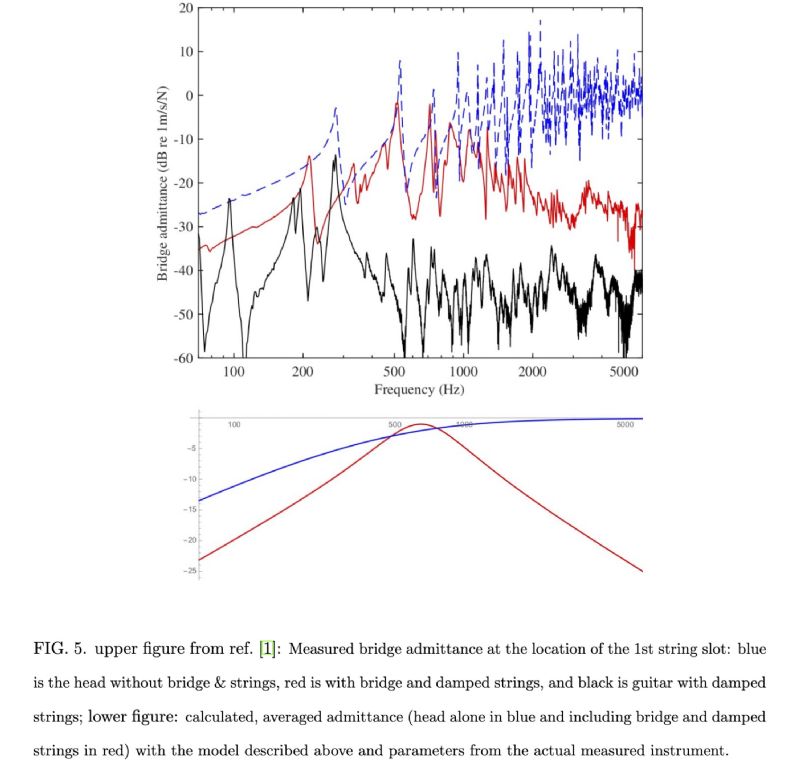
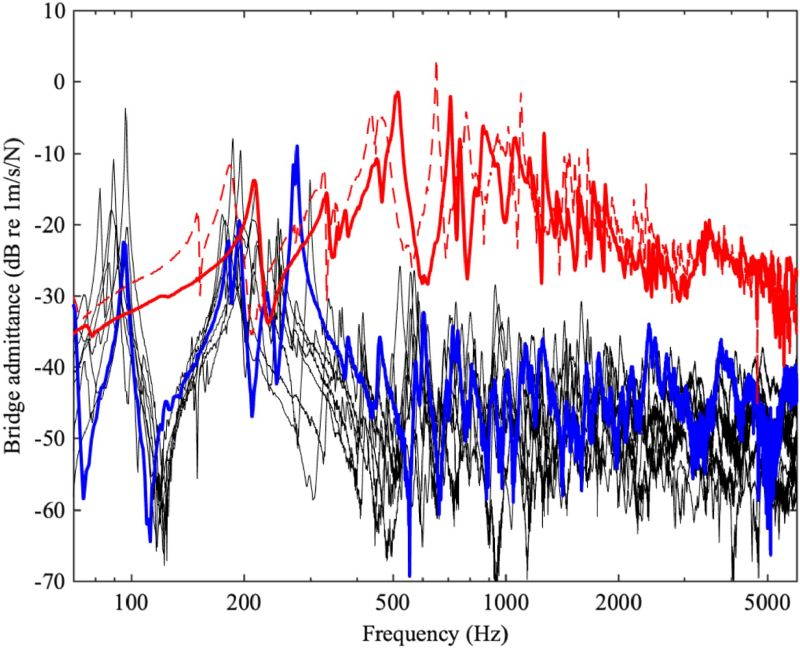
In the language of physics, the impact of break angle that I described comes from a 1st approximation, applicable to any drum-headed string instrument. As described further below, the strings don't enter into it, except to provide their tension and elasticity. Different heads are characterized by their tension, mass per unit area, and elasticity, and the bridge is described by its mass but assumed to be rigid. (Flexing of the bridge produces enhanced regions at yet higher frequencies -- with one visible in the measurements plotted below around 3500 Hz.) Details of the rest of the banjo don't enter. I figured this out with a buddy who's been doing this sort of thing with violins and guitars for decades, in work well known to luthiers and researchers in the acoustics of musical instruments. He's a retired engineering prof at Cambrdge University, with a specialty in vibration studies -- all just to say a very serious guy (unlike me, an unapologetic dabbler). It took a while to get there, but we did the theory together. He had access to the high-tech equipment that did the detailed measurements, and I did the detailed calculations appropriate to the Deering Eagle II that he measured. This note is the description of those quantitative details: https://www.its.caltech.edu/~politzer/head-stiffness/head-stiffness.pdf.
The basic experiment is to damp the strings, tap the bridge, and see how it moves in response. Through the magic of math (Fourier analysis), the tap is equivalent to an oscillating force for each frequency. The graphs are the ratio of the amplitude of motion at each frequency (times the frequency, to be exact) divided by the magnitude of the force at that frequency. The plots are log-log, which is appropriate to loudness and frequency perception because we're sensitive to both over huge ranges. The simple, universal thing to calculate is an average that smooths out the sharp ups and downs, whose fine details are instrument specific. (There is a precise way to do the averaging that connects to a simple theory. It is simple because it applies and gives the same result for any size, shape, and design of the rim.)
In FIG. 5 from the piece linked above and copied below, the red measurement is the Deering with damped strings. The blue measurement is from tapping the head with strings removed. (The black is the same type of measurement performed on a guitar.) The smooth curves below those are the calculations using only the tensions, break angle, head parameters, and bridge mass in the 1st approximation model. (We're talking Young's moduli of strings and head and bridge masses.) In the second figure, there are two resonator banjos. Their purchase prices differ by about a factor of 5. Black are seven different guitars.
It is assumed that the size of bridge motion is responsible for the amount of sound. The details there concern radiation efficiency, which is another interesting but complicated story.
The whole result has a simple explanation. The frequency of the peak in the smoothed "admittance" is the oscillation frequency of the bridge if you displace it from equilibrium and let it go, at the same time damping the strings. The equilibrium is the balance of the down force of the strings due to the break angle and a resulting up force of the head. The bridge motion generates waves, which carry energy away and damp out the bridge oscillation. So the width of the peak in frequency is a consequence of bridge's production of those waves. Of course, they're what produces the sound. All other things being equal, a steeper break angle produces a stronger return force on the bridge to its equilibrium position. Interestingly (to me at lease), the opposing break angle of the head at the feet of the bridge turns out to give a larger contribution to the return force than the more easily observed break angle effect of all the strings.
The reason for studying bridge motion rather than produced sound is because the bridge motion is a property of the instrument itself. In contrast, sound depends on where you listen or place a microphone and the relative positions of instrument and microphone in a room and the geometry of the room. Personally, I also like to do careful comparisons of recorded sounds and simply listen, but my vibration-studies buddy likes to be able to calculate things. Calculating any version of produced sound is many time harder than what we did with bridge motion.
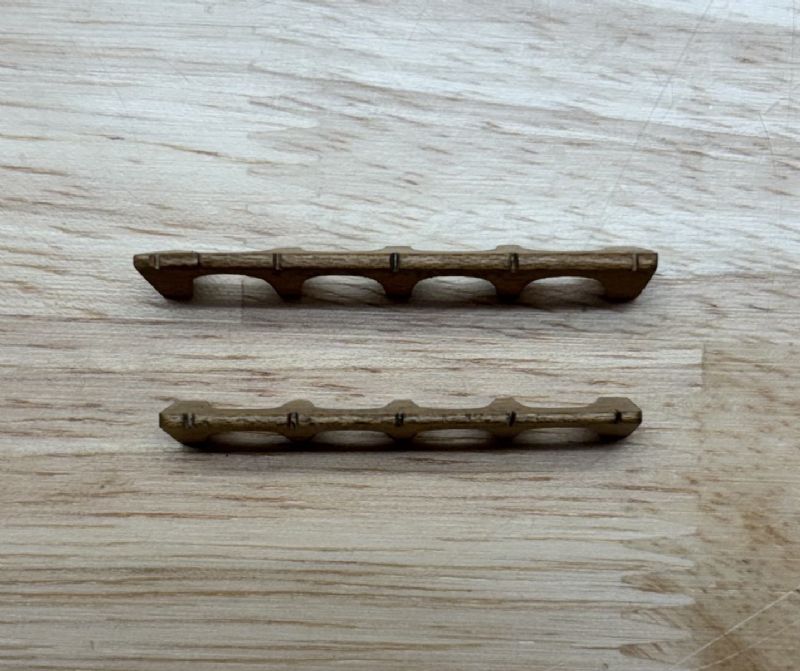
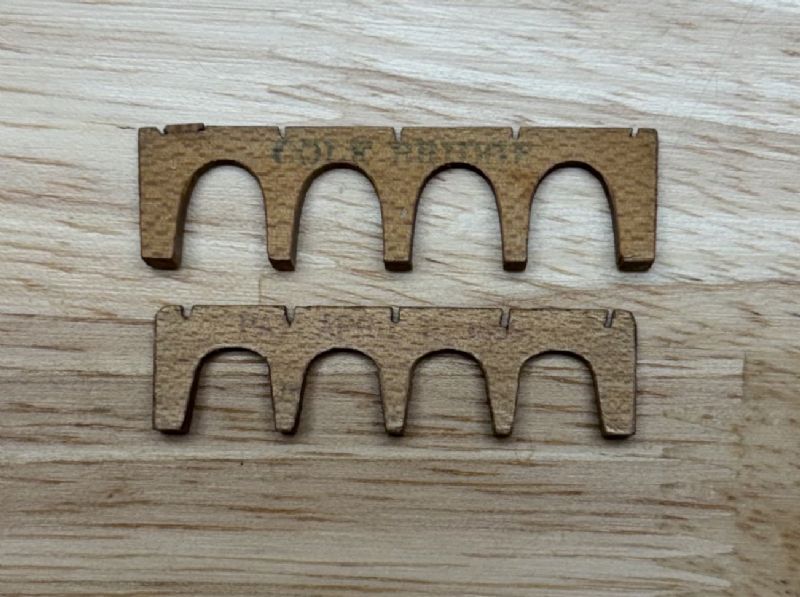
Here are the two bridges. I want to be clear, these came from two different people, at two different times and did not come together. I am presuming that they make a "set" but I do not know for sure.
The larger bridge is 1-3/4" wide at the top, 1-11/16" wide at the bottom, .475 to .48 tall (depending on where I measure). .051 to .061 thick at the top, .181 to .192 thick at the bottom (depending on which leg is measured).
Of the countless "classic era" bridges I have measured, there was not a lot of precision or consistancy (likely because it did not matter for human ears).
The smaller bridge is 1-5/8" wide at top, about 1/32" narrower at the bottom, 7/8" tall, .048 to .039 thick at the top, .144 to .152 at the bottom.
For replication, note that the cutouts are not straight sided (a detail pretty much every modern copy misses).
Also note that the string notches for 1, 3, 4, & 5 are cut at angles toward the 3rd which is straight. This was how notches were cut before wire strings. They were also deep enough to bury the strings in the bridge. This keeps them from being pulled out when playing with any sort of confidence.
One should be able to take my images, resize them using the above measurements, and make accurate copies. "COLE BRIDGE" was stamped in ink with a rubber stamp one side with the patent date on the other. The ink is black on one and blueish on the other (likely faded from black).
When mass is added to the head tone changes.
It would act as a heavier bridge and take away shrillness and let deeper tones emerge.(For one thing)
*correction to above, smaller is 7/16" tall NOT 7/8".
So Joel, do you make these or a reasonable facsimile, and when will you be back to bridge production?
quote:
Originally posted by Dry RidgeSo Joel, do you make these or a reasonable facsimile, and when will you be back to bridge production?
Interestingly I just noticed that the Morris bridge sold by Elderly are copies of the Cole bridge and are available I standard amd wide sizes. Since I already have one of them guess I could just pick up the other one and see what they sound like.
Edited by - Dry Ridge on 04/23/2026 12:49:40
quote:
Originally posted by Dry RidgeSo Joel, do you make these or a reasonable facsimile, and when will you be back to bridge production?
Nah. A) I don't really like them. B) to make them correctly would require a custom routing bit and $$$. C) I'm not sure I will ever start making bridges again as long as I have a day job. I found that it was taking a large portion of my time up. D) I'm not big on inhaling dust.
I was also dealing with about 3+ emails a week asking about putting nylon on a goodtime or beginner gold tone. I am afraid to admit that I just stopped replying to them.
Terms of Use | Privacy Policy | Privacy Consent (EU/GDPR Only)
Copyright 2026 Banjo Hangout. All Rights Reserved.