





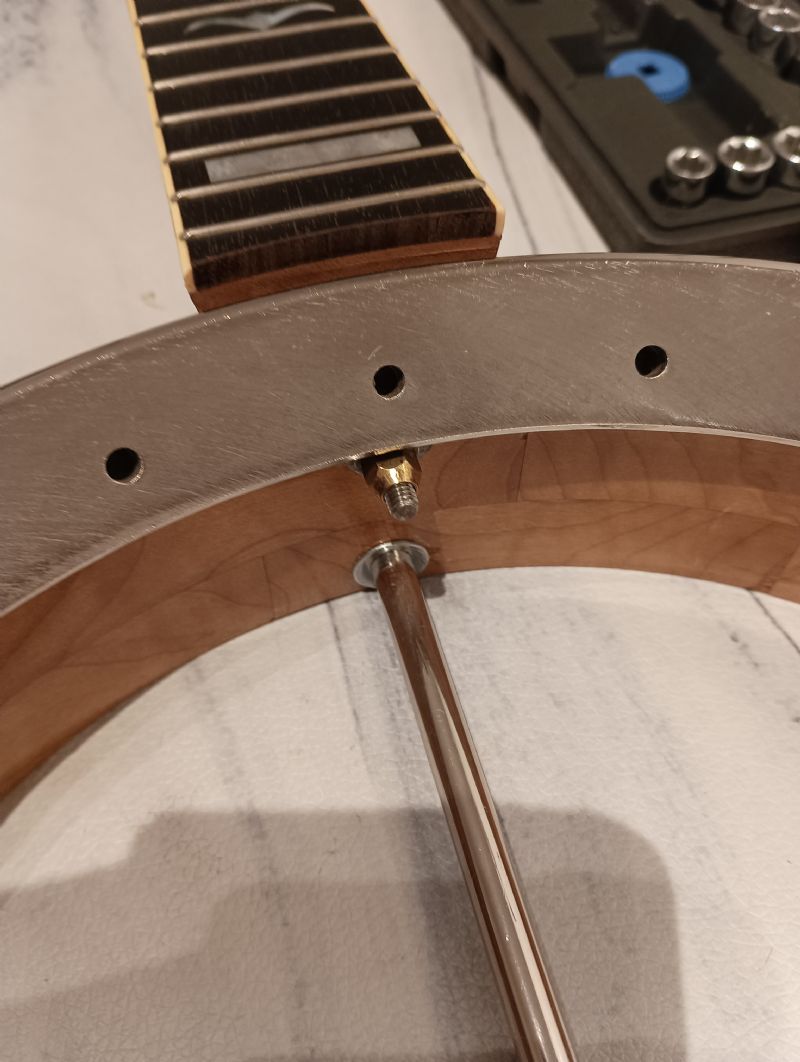
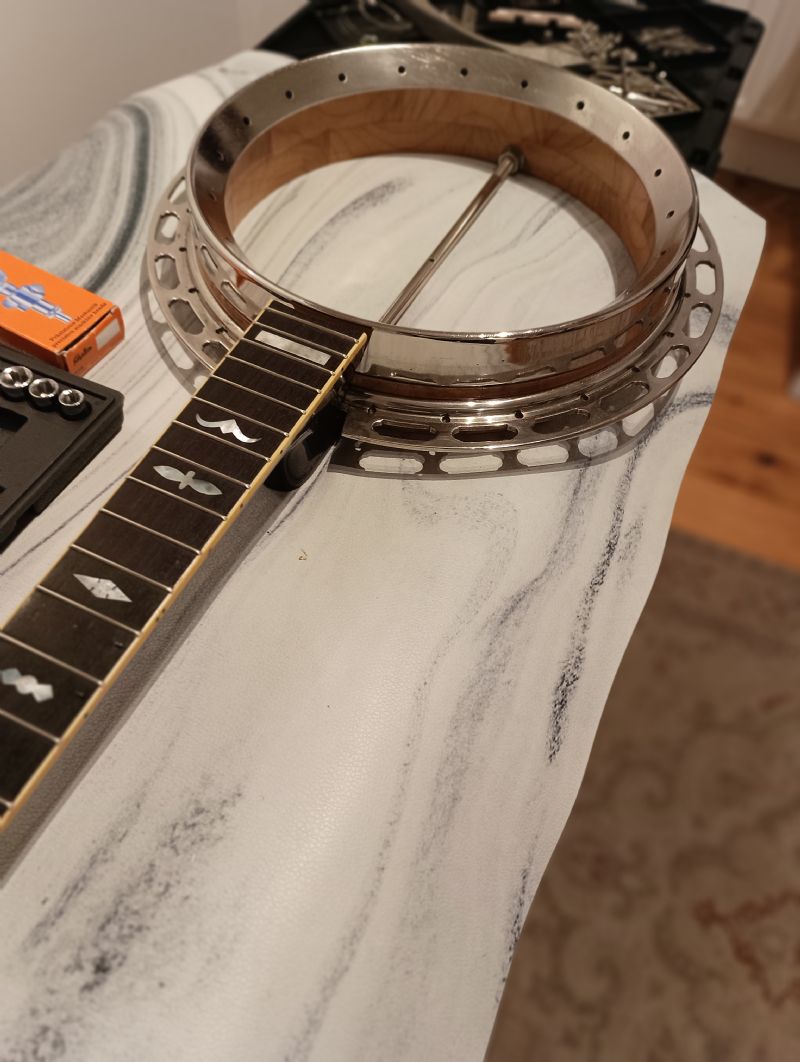
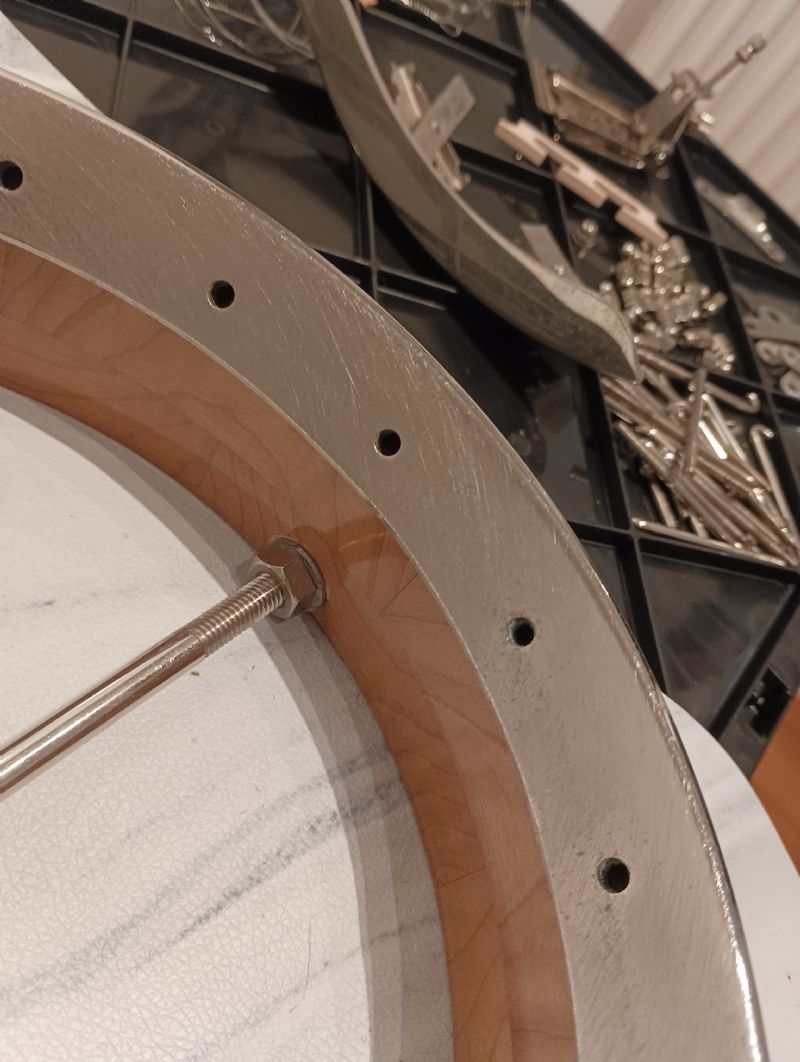
My recently acquired vintage Kasuga five string only has the 'front' coordinator rod. The neck is fixed to the rim by a brass nut.
I think the original 'rear' rod was removed when the block maple rim was fitted.
Everything is working fine... should I leave well alone or find and fit a replacement rod?
If so, how would I secure it to the rim at the tail end?
Edited by - Anthony Boadle on 04/27/2026 14:26:47

The upper rod is not "missing"; that banjo never had one. Adding the upper rod is a good thing and enhances tuning and play stability. I prefer two coordinator rods.
If your banjo has fairly thick and sturdy rim; the upper coordinator rod may not contribute enough to merit the effort.
That banjo appears to have thin block rim construction with the tone ring in a "tone bell" configuration? Adding a second coordinating rod is probably a very good idea; getting a thicker rim to support the inner lip of the tone ring is also a good idea.
Or keep the thin rim and change to a Whyte Laydie or Tubaphone tone ring... 
Edited by - pinenut on 04/27/2026 14:46:44

Thanks Kam, I assumed (incorrectly!) that the second rod was removed. I stand corrected.... maybe it's a case of 'if it ain't broke' etc!
quote:
Originally posted by Anthony BoadleThanks Kam, I assumed (incorrectly!) that the second rod was removed. I stand corrected.... maybe it's a case of 'if it ain't broke' etc!
Apologies, I didn't look at the picture close enough and posted too soon. The thin block rim looks like hardwood and is probably quite stiff, but, it's a bit on the thin side for just one coordinator rod.
I bet it sounds full/rich with a strong low end plus decent high end tinkle?
Edited by - pinenut on 04/27/2026 14:56:10
It's block maple, very solid!
It's an amazing banjo, the minute I picked it up I knew it was from a bygone age!
quote:
Originally posted by pinenutIf your banjo has fairly thick and sturdy rim; the upper coordinator rod may not contribute enough to merit the effort.
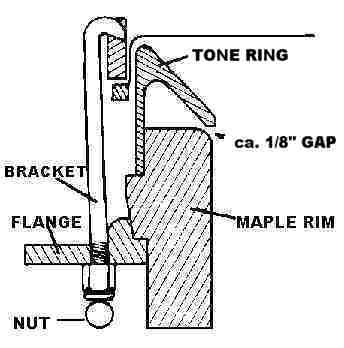
That banjo appears to have thin block rim construction with the tone ring in a "tone bell" configuration? Adding a second coordinating rod is a very good idea for improving structure, long-term-stability and tone; getting a thicker rim to support the inner lip of the tone ring is also a good idea and will change the tone.
https://www.banjowizard.com/tonebell.htm
"Do not try this modification if your banjo has an aluminum tone ring. Bailey Henry of Florida tried this with an Alvarez Denver Belle which had an aluminum tone ring. The tone ring collapsed. Aluminum has some big disadvantages in construction." ...The die-cast skirts collapse too.
Edited by - pinenut on 04/27/2026 15:39:37
Thanks, plenty of food for thought there!
quote:
Originally posted by Anthony BoadleThanks, plenty of food for thought there!
Right! Bill Palmer is a treasure. It's very generous of him to share that quantity of knowledge.
Edited by - pinenut on 04/27/2026 15:43:50
The block rim is an upgrade by a previous owner, who apparently did not feel the need to also upgrade to the second rod. Wasn't a necessity.
Sub-Mastertone Gibson banjos tended to have just one rod with an acorn nut for the other one. I believe the early bowtie inlay RB-250 also had only one rod, but I could be wrong.
quote:
Originally posted by pinenutThat banjo appears to have thin block rim construction with the tone ring in a "tone bell" configuration?
I see what you're referring to. The photo of the neck position appears to show the inside wall of the rim not staying vertical to meet the inside foot of the tone ring, but rather to bevel up into the underside of the tone ring.
I'd say that's not the small cutaway of Bill Palmer's "Tone Bell" setup but reflects the maker of the block rim copying the original fit of the Kasuga rim and tone ring. On the earlier bowtie banjos, Kasuga's rim beveled up into the underside of the rim. Some Alvarez models had a brass rod tone hoop on top of the bevel that the pot metal flathead tone ring then sat on. I've seen photos, but never one in person. The inside overhang of the tone ring over the rim copied the condition of the later '60s thin-rimmed RB-250.
I have a Kasuga rim and ring in my workshop. I'll get around to taking and posting a photo to show the slop fit.
If it works well enough as is you might as well leave it alone. You can add a top rod if you want one and if you know what you are doing. To anchor the top rod you have to drill a hole from the inside about half way through the rim. That's trickier than it sounds. The top rod braces against the inside with a nut and washer.
quote:
Originally posted by Old Hickoryquote:
Originally posted by pinenutThat banjo appears to have thin block rim construction with the tone ring in a "tone bell" configuration?
I see what you're referring to. The photo of the neck position appears to show the inside wall of the rim not staying vertical to meet the inside foot of the tone ring, but rather to bevel up into the underside of the tone ring.
I'd say that's not the small cutaway of Bill Palmer's "Tone Bell" setup but reflects the maker of the block rim copying the original fit of the Kasuga rim and tone ring. True and exactly.
On the earlier bowtie banjos, Kasuga's rim beveled up into the underside of the rim. Some Alvarez models had a brass rod tone hoop on top of the bevel that the pot metal flathead tone ring then sat on. I've seen photos, but never one in person. The inside overhang of the tone ring over the rim copied the condition of the later '60s thin-rimmed RB-250.
I have a Kasuga rim and ring in my workshop. I'll get around to taking and posting a photo to show the slop fit.
I've had one of those old thin black rims with the more roundy cutouts in the flange; they are soft, terrible things with a die-cast ring floating on it's rotten crushed out skirt. The necks and the rest of the hardware are nice enough.
That thin block rim is a good and decent thing to do with a fine set of parts. 
Edited by - pinenut on 04/27/2026 20:35:54
No need to add another rod. I have an old Kalamazoo from 1930 which has only one rod too, and the rod is even thinner than todays rods. Survived that setup the last 95 years without issues.
Yours will be fine too. The blockrim seems to be a good update.
Such interesting replies to wake up to this morning. Thanks for taking the time to advise. The previous owner has sent me the original rim, it should be here any day. I'll keep it of course.
I think it makes more sense to 'leave well enough alone' as everything seems to be fine.
On a related note, I have to say how impressed I am with the overall build quality of this Kasuga. Tone and volume are just what I hoped for. Cosmetically, the varnish and chrome plating are a joy to behold!
I appreciate that Kasuga, Tokai, Goldstar etc were all Masterclones, but I'm getting the impression that the plan during production was to produce high quality copies rather than churn out similar looking banjos as cheaply as possible.
I recently bought a Barnes and Mullins Empress as a lightweight back-up instrument.... it's an ok banjo, looks nice and is reasonably well put together. A friend then brought over a more expensive Goldtone BG150F. The two instruments seemed similar so we put them side by side. They were almost identical except for a slightly different peghead shape and other minor cosmetic differences.
We had to assume they were made in the same factory using mostly the same tooling. Tone-wise, the Goldtone was slightly louder but that's about all.
It seems the logo on banjo pegheads increasingly justifies price difference these days. And don't get me started on the satin finish 'plasticky' varnish!
Such interesting replies to wake up to this morning. Thanks for taking the time to advise. The previous owner has sent me the original rim, it should be here any day. I'll keep it of course.
I think it makes more sense to 'leave well enough alone' as everything seems to be fine.
On a related note, I have to say how impressed I am with the overall build quality of this Kasuga. Tone and volume are just what I hoped for. Cosmetically, the varnish and chrome plating are a joy to behold!
I appreciate that Kasuga, Tokai, Goldstar etc were all Masterclones, but I'm getting the impression that the plan during production was to produce high quality copies rather than churn out similar looking banjos as cheaply as possible.
I recently bought a lightweight back-up instrument.... it's an ok banjo, looks nice and is reasonably well put together. A friend then brought over his new, more expensive purchase. The two instruments seemed similar so we put them side by side. They were almost identical except for a slightly different peghead shape and other minor cosmetic differences.
We had to assume they were made in the same factory using mostly the same tooling. Tone-wise, his was slightly louder but that's about all.
It seems the logo on banjo pegheads increasingly justifies price difference these days. And don't get me started on the satin finish 'plasticky' varnish!
I owned a 1963 Gibson RB 250 and it had the "pyramid nut" only, to hold the upper lag screw/bolt.
Terms of Use | Privacy Policy | Privacy Consent (EU/GDPR Only)
Copyright 2026 Banjo Hangout. All Rights Reserved.


