





Good morning. I'm looking at getting into turning block rims on a lathe (instead of dealing with disc and spindle sanders like I have in the past). Please excuse what I imagine are dumb questions, but I'd rather not lose any fingers and all that. I'm more interested in a wood lathe because of (1) price and (2) the possibility of doing other wood-related projects. My budget isn't high and I'd love to get something used. I don't have a ton of space, either.
First, there are lots of discussions of types of lathes that get into the "lots of ways to do this" territory. If I want to do 12" rims and don't expect to want to do larger resonators, would a midi lathe with a 12.5" swing be sufficient if I get things well roughed on a bandsaw first? Technically, yeah, but in practice?
Second, for block rims and all of the inconsistencies in grain/glue that go with that, how low is a safe RPM for someone inexperienced? There appears to be a big jump between something that goes down to 500 RPM (Jet 1236 or similar that has an outboard capacity) to something that gets to 360 RPM (Delta 46-460 or similar) or so and then to a variable speed lathe that gets to 60 RPM (Jet 1221VS or thoughts on the Harbor Freight Bauer copy?). I've seen mention of doing roughing while turning by hand, am I misunderstanding that? As in, can you turn the project by hand slowly while roughing, then click up to your higher RPM later?
Third, I'd probably start with a face plate mounting setup with glue or screws, but are there are other odds and ends that you'd recommend I consider when diving in? What am I getting myself into?
Fourth, is it worth the money and precious space in a garage to get a lathe if I build a banjo or two a year? What other neat things do you all do with them? Christmas gifts? I'm clearly looking for summer projects. Thanks for any insights!

The advantage of using a metal lathe to manufacture a device such as a banjo rim is that the metal lathe has an apron and a cross slide. Those features on a metal lathe make it possible to easily achieve dimensional precision. With a wood lathe, you're using "chisel" type hand tools, and the dimensional precision you can achieve is a function of your manual dexterity with those types of hand tools.
One possible solution to the issue would be to acquire a separate, 2-axis cross slide unit that could be retrofitted to a wood lathe.
Edited by - RB3 on 05/07/2026 08:32:33

First, go to YouTube and watch videos about how to make drum shells. They are more innovative than we are and there are ways to do this that do not require a lathe.
I do use a lathe==cheap Harbor Freight with a 14" swing. I use a cole chuck with the expanding wings to hold the rim that is almost the right outer diameter. Because of tear-out concerns using lathe tools with segmented rims, I use a simple tool--I cut a curve of the desired radius of the rim into a 5 or 6 inch long 4x4 and line it with 40 to 80 grit sandpaper. I just hold it against the outside rim, stopping to check size.
I turned a few hundred block rims on a ShopSmith with a low speed of 700 RPM. Then I got a good deal on a used Nova lathe that goes down much lower using stepped pulley options. I keep it mostly on the second lowest speed, unless I am turning 16" rims, when I go to the lowest. I will have to look at what the speeds are, as I can't remember. It's nicer, but the old way was okay too. I use a faceplate and 4 screws to hold the rim to it. 1/4" aluminum plate makes the best faceplates, and I made ones for 11" and 12", while the other sizes I use less often are MDF or particle board. I don't think turning the lathe by hand will get you anything. Cutting off the excess on the bandsaw will get you to where you can spin the blank on the lathe if it's close to the max size.
Edited by - Zachary Hoyt on 05/07/2026 12:47:12
RB3 Yeah, that's along the lines of how I see people discussing it. I can't outlay the money or the space for a metal lathe (at least so far as what I see available). Just a guy in a garage... But the cross slide as an add on might be an interesting upgrade at some point. Are certain types/brands more amenable to such things? It's more of a "can I make this work for my situation or should I not bother" than "how much money and space should I dedicate to this." Which is a bummer.
Banner Blue The sanding idea is kinda brilliant and gives me a bit of confidence that I'll be able to make something work in a way that's worthwhile. I imagine that something similar would work for the inside, too, and that a similar gadget (a drum of MDF on a face plate with a covering of sandpaper) might be useful for heel curve cuts. I'm really trying to see if I can find ways to handle the remaining nasty bits without breaking the bank. It's a hobby...
Zachary Hoyt This is really helpful. My expectation is that a lot of this comes from experience at the lathe, so it's good to know what folks have made work. Some of these options are down to the 360 or 250 RPM range without getting into the 60 RPM enabled by more expensive variable speed models, so I appreciate knowing that these speeds are sufficiently slow enough to work in practice. So you made 11 and 12 inch aluminum discs with holes for screws (to make sure I understand) and then just screwed those directly into the rims? That's along the line of what I'm thinking, with doweling them off and covering them with a rim cap afterward. By the way, my wife and I went to school up in Potsdam, NY, not far from there. Perhaps we'll be back in the area at some point (she just got a new Crane School of Music sweater in the mail today, oddly enough. It's a northern NY day here, I guess).
Thanks for the help!
I learned to use a lathe turning rims on the 700 RPM ShopSmith, and it was okay, though not ideal. The speed I use now is 360 RPM, except for 16” rims which I do at 214 RPM. The goal is to get the surface speed in a certain range of feet per second, but I can’t remember what it is. Once you get used to it you can feel if the speed is too fast or slow. You are correct about how the faceplates I make work. Wood lathes come with a small faceplate which screws onto the headstock, and then the larger faceplate is bolted to it. I use four screws, and fairly robust ones. I have heard that drywall screws are brittle and can break under a shock load, so I have never used them. I drill 3/32” pilot holes for the mounting screws, so they are small enough that I don’t dowel them before putting on the rim cap. Turning chess pieces was fun as a non-banjo lathe project, though I don't recall if I ever completed the set, and bowls are fun if you have access to bigger chunks of wood.
If you’re ever up this way again I’ll be happy to show you the shop and tools if you’d like to stop by. We are kind of on the edge of the world here, so we don’t get a lot of visitors, but it’s always nice to see folks. I spent a fair amount of time in Potsdam last year because it’s where the county fire training center is, and I was getting some classes as part of the local volunteer fire department. It’s a nice town, especially the parks along the river.
Edited by - Zachary Hoyt on 05/07/2026 17:13:02
To date I've turned 1/2 dozen block rims on a wood lathe, a Carbatec variable speed. I use a steel faceplate screwed to a larger plywood faceplate that is screwed to the rim with 4 longish screws, haven't had any problems with that setup (yet). I secure the faceplate to the top edge of the rim (tone ring edge), so don't need to worry about dowelling, but just for fun have filled the screw holes with Japanese nails when finished turning. So far I have used 8 segment rings; plan to do the next 2 with 12 segment rings, to see if that reduces tearout (which for me has been worse on the inside of the rim.
All my rims have been (nominally) 11 inch so far, 12 inch one in the works. I haven't really paid much attention to actual RPMs. Start roughing slow, but not so slow that it vibrates, then speed up gradually. I've heard of a formula RPM X Diameter = 6000 - 9000, so for an 11" piece ~ 550 - 800 (but I think I start roughing a little slower).
Lately I've used the roughing gouge initially, then the spindle gouge. to accurate size, then sanding blocks. Sanding on the lathe with gradually finer grades produces a brilliant finished surface quickly. Tools need to be shave-the-back-of-your-hand sharp.
An early mistake I made was not keeping the outside of the rim square with the edge, causing issues with fitting the neck etc.
I recently had a friend with a CNC router make me 2 birch plywood rings a fraction bigger than 11" and 12" and 3/4" thick . My plan is to use these as templates to round my segment rings on the table router before I laminate them - theory being that I will then be starting the lathe work with a truer rim; we'll see if it works.
There's a pretty good You Tube series on basic wood lathe work, Woodturning 101 - here's the first video youtube.com/watch?v=XubeZKjCmeU
Good luck, hope you have as much fun with it as I have!
Yeah, the CNC route has also been an option and I've made some templates but only tried to get them bandsaw accurate. That just doesn't seem like as much fun, though... Anyone use the lathe to get the heel cut accurate or is that just asking for trouble?
I never tried using the lathe for heel cuts. The spindle sander is what works best for me, with a sled for the neck that slides around a 10" circle.
cjwit Zachary Hoyt
Well, you could probably use the cnc to make every part of a banjo, but I agree, that's no fun. I have only used it to make these ring templates, and to make a jig for cutting fret slots, which works a treat.
when you talk about heel cuts, are you referring to the neck/pot joint surface? I've been using a sled like Zach, but on the bandsaw. A friend of mine has made an ~11 inch sanding drum for his drill press that works well, also with a sled - I'm working on a copy of that.
Zach, I'd love to see a photo of the sled you mention.
John Yerxa And I'd love to see a photo of the bandsaw version... I've tried a few things for that cut and I've had some luck. The latest was sitting a router on a pivot/bearing and a stand that rises up and down. All work, but it's a tricky cut and one of the more interesting problems to solve.
John Yerxa, here are a couple of pictures. The piece that goes around the drum is clamped to the table when in use. The wooden cams provide adjustability, and the block at the end of the sled controls the neck angle. That one is set up for 3 degrees. If I want something less I add a thin block under the neck heel end. This method is very fast and if the neck is firmly held and correctly aligned it's pretty accurate. I used it for 10+ years on a tabletop spindle sander before I got the floor one 18 months ago.
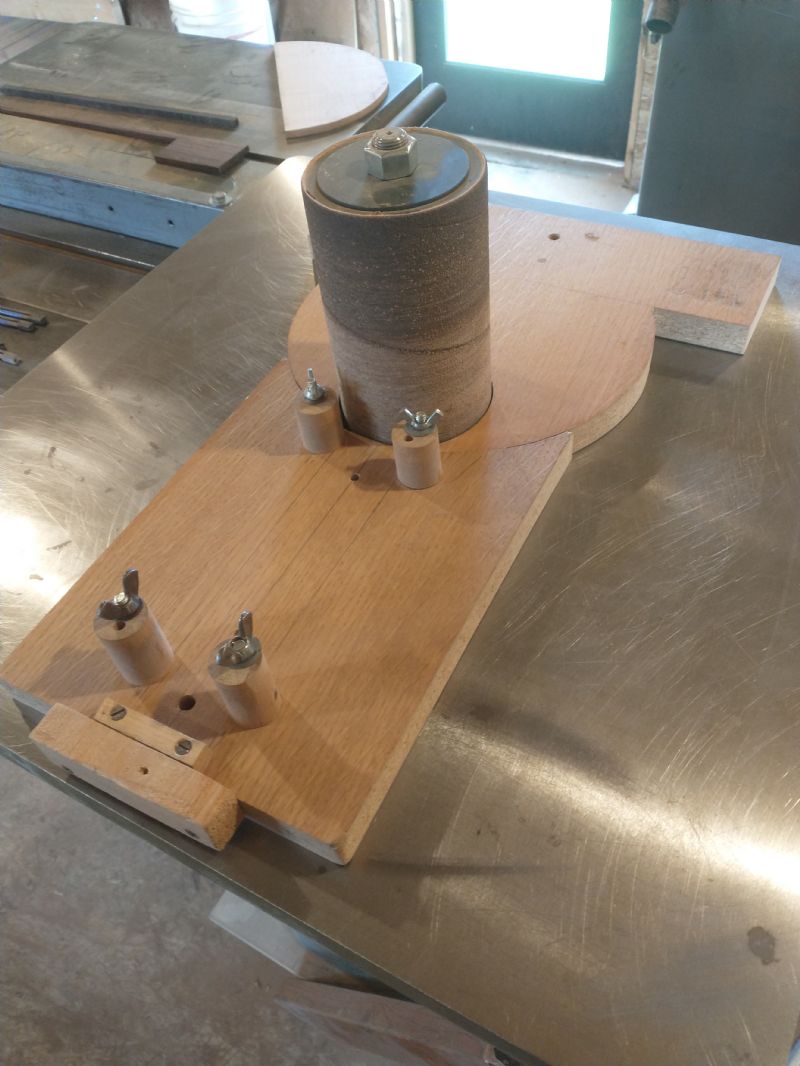
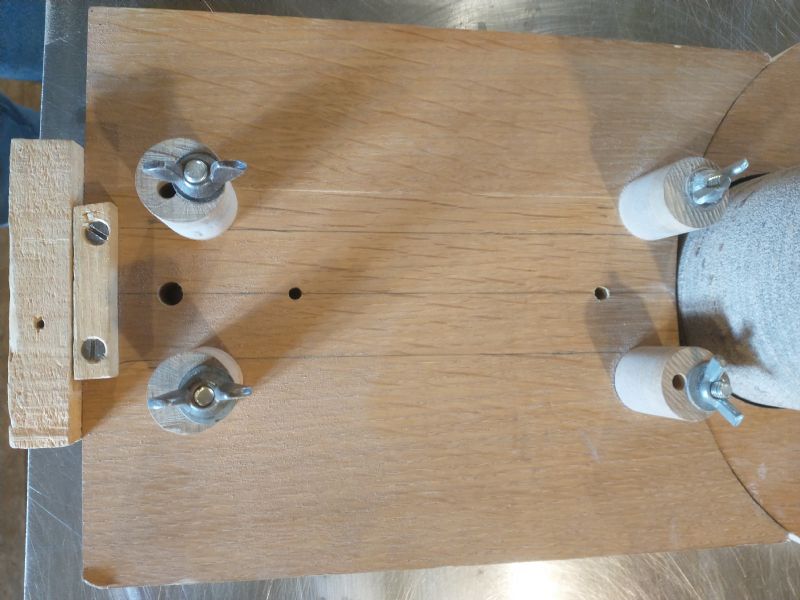
Zachary Hoyt
cjwit
Thanks Zach. My friend's drum sander works similarly, except the drum itself provides the arc, while the sled moves in.
Chris, here's a couple of photos, actually a mock up after I'd already made the cut. There is a strap screwed to the underside of the sled that holds it at 2.5 degrees. It has worked pretty well, except it's a little hard to correct the "yaw" angle of the neck.
The other difficult cut is the rebate for the tension hoop. I've made a jig to hold the neck in my vise and use the plunge router with a 1/4 " rebate bit (3rd photo). Works OK, but I had to learn to do it before I profile the neck - tends to tear out at the end. I've seen a set-up with a router mounted to a swivel base that also works well.
So many ways to scan a cat------
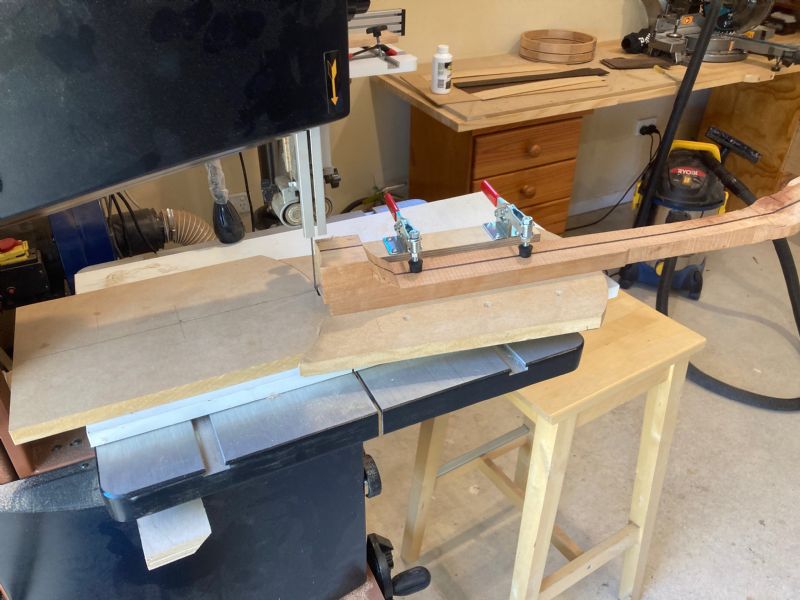
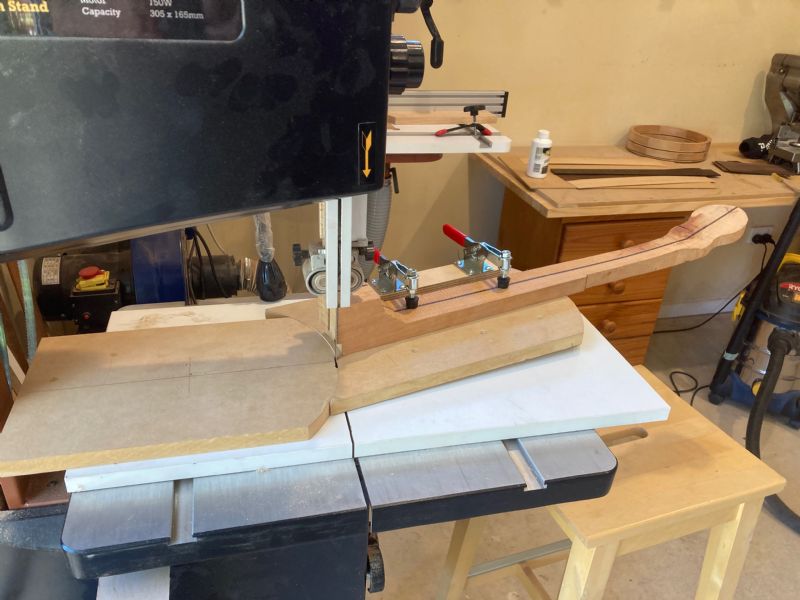
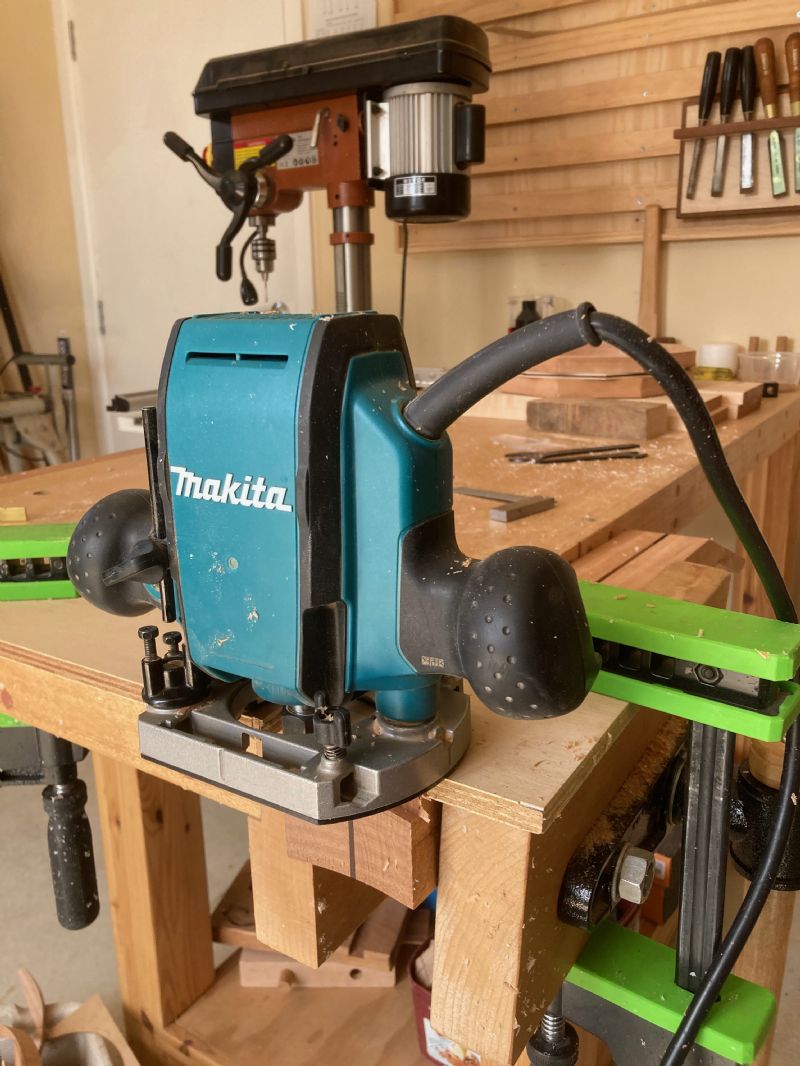
Zachary Hoyt John Yerxa Thanks for these. Yes, I set up a jig with a router on a swivel and a scissor stand for my last build. It was easier than others, but the give in the stand (you need to get pretty expensive before they don't move around) made it... a scary few moments. The nature of that rabbet, where it's in relation to the angled cut and not the fretboard, makes for some surprisingly curious geometry! But this is why we build things, right? I appreciate you sharing. I'll be continuing to experiment for these next few builds. I'm only on #22 and 23 over here. Lots to learn.
Well, you've done more than me! I spend a lot of time figuring out jigs, etc., love that part.
I just bought a motorcycle jack - like a scissors jack except with a big flat surface, and heavy. planned to use it for a horizontal drilling jig, but - hmmm--------
Oh, that's a good idea. I went the scientific "jack" route, but it's flimsy. Now, something made to lift a car could certainly handle my little Ryobi router.
Edit to add: I just looked over at some of your photos and saw the block rim with the splines. That's another cool idea. I've had luck with rolling the segments in blue tape, but it would be nice to have a touch more confidence. Plus, the result with the contrasting wood is a neat effect. I may consider stealing that, if you don't mind! I already have a bunch of other experimenting planned for these next few, though.
Edited by - cjwit on 05/09/2026 19:59:02
cjwit
Yes, I did my first one with the splines, after some exchanges with Ken Le Van on this forum. I thought they looked cool, too, but found they actually made it harder to get the segments lined up. Found that if I numbered the segments as I cut them, and arranged them in order with the same side up, I got the best result. The splines aren't neccessary for strength once you get the rings laminated.
I'm now experimenting with contrasting rings and/or segments. If you want to blow your mind, google segmented bowl images.
It's fun geeking with you in real time - you caught me on a lazy-feeling, grey Sunday afternoon.
I've never had strength issues with block rims, so that tracks for me. But they do look neat. And yeah, I've certainly fallen into the segmented bowl rabbit hole a few times. I'm thinking about messing around with some turning this summer, even if it's not for the rims themselves. Same, good to meet you!
Terms of Use | Privacy Policy | Privacy Consent (EU/GDPR Only)
Copyright 2026 Banjo Hangout. All Rights Reserved.


