





hangoutstorage.com/banjohangou...82910.jpg
Does anyone have any info about this tailpiece? Thanks in advance!

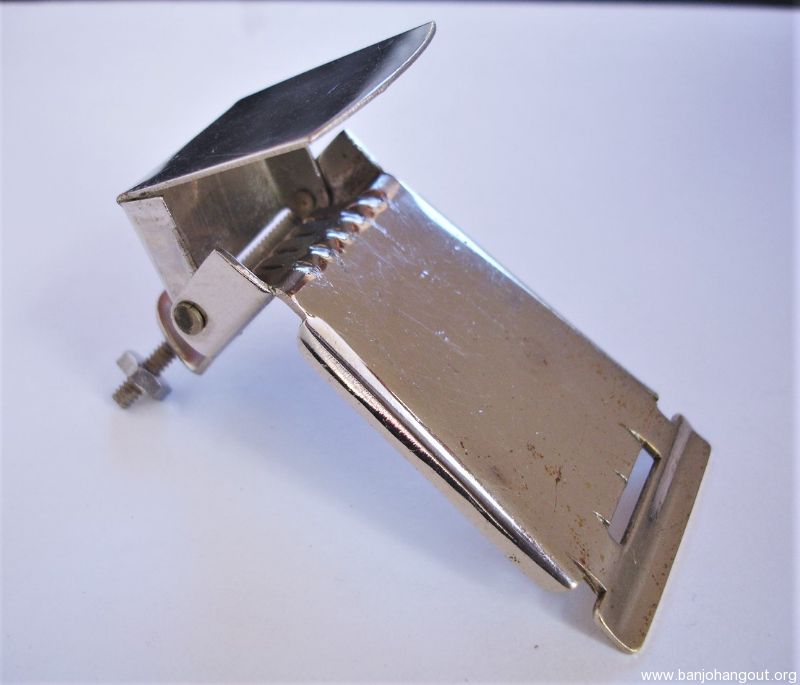

Did that come from a known prewar instrument?
It looks just like the tailpiece from my 1964 Vega Pete Seeger banjo.
Not sure if this was "a Presto", however. Might have been made by Waverly?
I reckon Mike Halloran would know...
Yeah this tailpiece showed up a lot on POST war Vegas.
Somebody mentioned this in the past week or so in a discussion of tailpieces for Pete Seegers (I think), and knew the manufacturer based on the LACK of an outline scribed into the cover.
Link: https://www.banjohangout.org/topic/408660 and scroll down to the comment and photo by Culloden.
Edited by - The Old Timer on 05/27/2026 17:53:02
quote:
Originally posted by J.AlbertDid that come from a known prewar instrument?
Yeah, it was on a 1931 Gibson RB-1 that I recently bought. I wasn't sure if Gibson used them on their banjos (somehow, I thought I had seen them on old Gibsons before) . I have no idea of the provenance of this banjo but I can tell you that the tailpiece on my banjo is a little different than the one on the Vega. Mainly, the cover is held on with two little tabs instead of the pin shown on the one on the Vega. Also, the groves where the strings sit aren't quite as pronounced on my tailpiece. It looks very "Prestoish" and very old. There is pitting on the metal and the underside has that "pewter" look like the prewar Prestos. Anyway, thanks for the info so far! If anyone has any further info, PLEASE share!
quote:
Originally posted by The Old TimerYeah this tailpiece showed up a lot on POST war Vegas.
Somebody mentioned this in the past week or so in a discussion of tailpieces for Pete Seegers (I think), and knew the manufacturer based on the LACK of an outline scribed into the cover.Link: https://www.banjohangout.org/topic/408660 and scroll down to the comment and photo by Culloden.
Thanks for posting the link, Dick. I have two Vegas from the sixties, both with that tailpiece.
What does mikehalloran has to say about this tailpiece?
this exact tailpiece was on my rb-00, it seemed original to the banjo, but you never know.
quote:
Originally posted by EmielWhat does mikehalloran has to say about this tailpiece?
This chrome plated Waverly tailpiece was used by Vega and a few German banjo makers in the early to mid 1960s. Except for the solid bar and lack of a hole for the 3rd string, this is essentially a riveted Grover Presto*.
Like the Presto before it, these are somewhat fragile—especially with the Medium string sets back in the day: Vega: .012 .015 .020w .026w .012. Gibson: .012 .014 .020w .025w .011. The one on my PS-5 Pete Seeger has a bead of silver solder laid in underneath the 90° bend as a preventative measure (I have a spare but haven't done this yet to it). Strings are much lighter nowadays but I still don't recommend adjusting one all the way down—never, ever adjust the height with tension on the strings! Likewise, if you have one in good shape, get it to someone who does jewelry repair and have it reinforced as I have described.
Anyway, when these broke, Vega sent chrome plated P-110 Waverly 'pieces (also used by Gibson, Martin and Fender) as replacements—far more rugged.
*When StewMac bought Waverly, it was learned through records and tooling that Waverly was the OEM for a lot of Grover. Unfortunately, most of that tooling and ephemera went into the dumpster. This answers the question: Why can't StewMac reproduce the old Waverly hardware? I've hinted at this before but never revealed that it was the late Frank Ford who told this to me.
In case I wasn't clear, there's nothing "pre-War" about this. Vega went to this sometime around 1961. Not sure of the date other than I've seen 1959s with riveted Grover Prestos.
Edited by - mikehalloran on 06/01/2026 12:29:18
In case I wasn't clear, there's nothing "pre-War" about this. Vega went to this sometime around 1961. Not sure of the date other than I've seen 1959s with riveted Grover Prestos.
Thanks very much for the info! But it would seem that the tailpiece on my banjo is a bit of a mystery. It essentially looks like the Vega tailpiece pictured earlier in this thread, but it does not have rivets holding on the cover. And the string grooves aren't as pronounced as the one pictured above. Mine doesn't seem to be chrome plated either, nor is it lightweight. In all respects, the patina looks like a prewar Presto. Regardless of it's origins or age, it fits very well on my old RB-1! Thanks again!
quote:
Originally posted by mikehalloranquote:
Originally posted by EmielWhat does mikehalloran has to say about this tailpiece?
This chrome plated Waverly tailpiece was used by Vega and a few German banjo makers in the early to mid 1960s. Except for the solid bar and lack of a hole for the 3rd string, this is essentially a riveted Grover Presto*.
Like the Presto before it, these are somewhat fragile—especially with the Medium string sets back in the day: Vega: .012 .015 .020w .026w .012. Gibson: .012 .014 .020w .025w .011. The one on my PS-5 Pete Seeger has a bead of silver solder laid in underneath the 90° bend as a preventative measure (I have a spare but haven't done this yet to it). Strings are much lighter nowadays but I still don't recommend adjusting one all the way down—never, ever adjust the height with tension on the strings! Likewise, if you have one in good shape, get it to someone who does jewelry repair and have it reinforced as I have described.
Anyway, when these broke, Vega sent chrome plated P-110 Waverly 'pieces (also used by Gibson, Martin and Fender) as replacements—far more rugged.
*When StewMac bought Waverly, it was learned through records and tooling that Waverly was the OEM for a lot of Grover. Unfortunately, most of that tooling and ephemera went into the dumpster. This answers the question: Why can't StewMac reproduce the old Waverly hardware? I've hinted at this before but never revealed that it was the late Frank Ford who told this to me.
In case I wasn't clear, there's nothing "pre-War" about this. Vega went to this sometime around 1961. Not sure of the date other than I've seen 1959s with riveted Grover Prestos.
Pedantic question (but small and useless banjo details are kinda my thing).
A. D. Grover was an engineer. His whole thing was designing machines and tooling for making stuff. His real money maker was designing and manufacturing coin operated vending machines.
He sold his first bridge design (with the rosin filled legs) and, more importantly, the machine he built to mass produce them cheaply so that he could start over and ended up with his Non Tip design.
So, manufacturing, and the machines/tooling to do it with, was Albert Grover's specialty.
Did Waverly originally do the manufacturing or did Albert Jr. eventually sell/transfer the manufacturing to Waverly (after Albert Sr. passed)?
Waverly also eventually made some of Elkington's stuff too (if not all of it).
Is it possible that Waverly just outlasted the others as far as manufacturing?
quote:
Originally posted by Joel Hooksquote:
Originally posted by mikehalloranquote:
Originally posted by EmielWhat does mikehalloran has to say about this tailpiece?
This chrome plated Waverly tailpiece was used by Vega and a few German banjo makers in the early to mid 1960s. Except for the solid bar and lack of a hole for the 3rd string, this is essentially a riveted Grover Presto*.
Like the Presto before it, these are somewhat fragile—especially with the Medium string sets back in the day: Vega: .012 .015 .020w .026w .012. Gibson: .012 .014 .020w .025w .011. The one on my PS-5 Pete Seeger has a bead of silver solder laid in underneath the 90° bend as a preventative measure (I have a spare but haven't done this yet to it). Strings are much lighter nowadays but I still don't recommend adjusting one all the way down—never, ever adjust the height with tension on the strings! Likewise, if you have one in good shape, get it to someone who does jewelry repair and have it reinforced as I have described.
Anyway, when these broke, Vega sent chrome plated P-110 Waverly 'pieces (also used by Gibson, Martin and Fender) as replacements—far more rugged.
*When StewMac bought Waverly, it was learned through records and tooling that Waverly was the OEM for a lot of Grover. Unfortunately, most of that tooling and ephemera went into the dumpster. This answers the question: Why can't StewMac reproduce the old Waverly hardware? I've hinted at this before but never revealed that it was the late Frank Ford who told this to me.
In case I wasn't clear, there's nothing "pre-War" about this. Vega went to this sometime around 1961. Not sure of the date other than I've seen 1959s with riveted Grover Prestos.
Pedantic question (but small and useless banjo details are kinda my thing).
A. D. Grover was an engineer. His whole thing was designing machines and tooling for making stuff. His real money maker was designing and manufacturing coin operated vending machines.
He sold his first bridge design (with the rosin filled legs) and, more importantly, the machine he built to mass produce them cheaply so that he could start over and ended up with his Non Tip design.
So, manufacturing, and the machines/tooling to do it with, was Albert Grover's specialty.
Did Waverly originally do the manufacturing or did Albert Jr. eventually sell/transfer the manufacturing to Waverly (after Albert Sr. passed)?
Waverly also eventually made some of Elkington's stuff too (if not all of it).
Is it possible that Waverly just outlasted the others as far as manufacturing?
Interesting questions. Unfortunately, StewMac threw many of the answers into a dumpster around 1981 when they bought Waverly. As many conversations as I had with the late Frank Ford over the decades, I never drilled down on how he much he knew about the events surrounding StewMac's acquisition other than he said that he was there and watched tools and paper being thrown away—everyone seemed to be surprised that so much of it was branded Grover. BTW, i had known Frank and Richard since 1976 when I found Gryphon Strings in Palo Alto while helping friends who lived a block away.
S. Nathaniel Adams has a couple sites giving a brief history of Elkington and Waverly but I don't see anything there I don't already know.
Apparently, Waverly lasted longer than Elton as a company but stores I was working with were still getting Elton parts in stock as late as 1973–4 — I still have a few tubes of hook/nut assemblies that I picked up in college ('72–'76). Elton was also the maker of those distinctive Ode tailpieces and round banjo shoes well into the Baldwin era.
Terms of Use | Privacy Policy | Privacy Consent (EU/GDPR Only)
Copyright 2026 Banjo Hangout. All Rights Reserved.


