




I have this banjo: sagamusic.com/shop/banjos/gold...me-banjo/
I love how it sounds in first five frets but action is very high up the neck. I play clawhammer with light strings. I have another banjo with much lower action up the neck and I love it. I don’t seem to prefer high action for hammer ons and such. And I must have a light touch because I rarely hit the head when I strike on my banjo that has the low action I like. (I mostly play over the head and not the scoop).
This banjo doesn’t have a truss rod. I tried adjusting the coordinator rod to reset the neck angle. I got the action where I wanted and it sounded great! But I had to crank that coordinator rod way too much. The rod was sticking out of the banjo and bending the tailpiece bolt outwards, and it was also starting to make my rim oblong. Not good long term for the banjo I think. I adjusted it back to where it was mostly.
My neck does not look bowed compared to my guitar necks, which do have some relief in them. It just looks angled if you ask me.
My bridge is 0.625”.
Action height measurements:
5th fret - 3mm
12th fret - 4mm
17th fret - 5.05mm
Should I try to shim the neck? 0.5” bridge? Both? If neck shim is recommended, I would appreciate any guidance. Is there a way to calculate what thickness of shim I need based on desired action at a certain fret, or should I just guess and check?

When shimming a neck, I have always had to rely on trial and error. One sting I suggest is to find a piece of heavy cardboard and cut a shim out of it. Put it in place and see if it works. That will tell you if it's thick enough. You may have to use several pieces. When you find the right thickness, take a thin piece of wood and cut it to fit the cardboard pattern.
Try the lower bridge first. That would be an easier fix. But, if it doesn't work, then you can try the shim.

I’ve got a cheap fix, if you’re mechanically inclined, and have the taters. I’ve been messing with Goodtimes (same configuration) for over 20 years (I’m on my 6th one), and finally figured it out. The problem with the thin rim and single co-rod, is that trying to adjust the rod, warps the whole rim. Not only that, but the string pressure continues to squeeze the rim into an egg, forever. Working against the single co-rod, the rim warps and the action keeps getting higher.
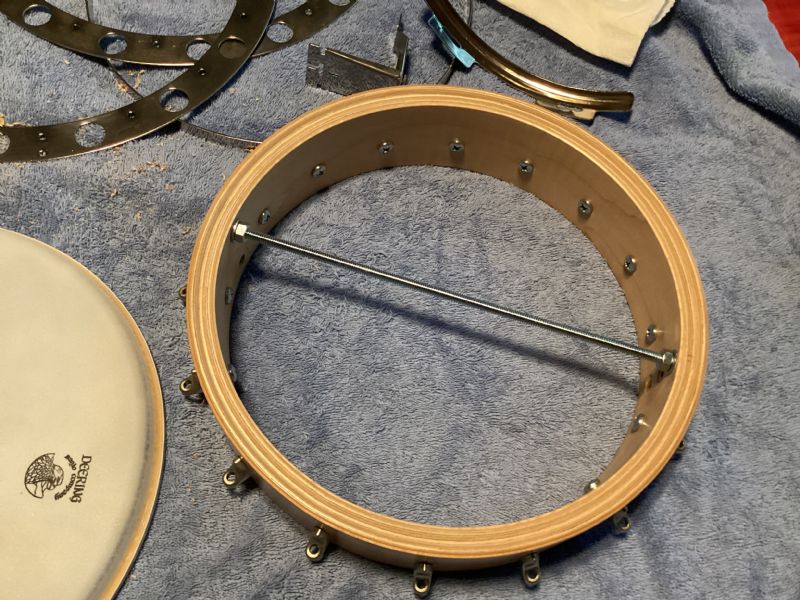
For less than $5, I went to ACE and got some 1/4” threaded rod, two nuts, and two washers. I disassembled the banjo, drilled the needed holes in the rim, just under the head, and installed the rod. I adjusted this rod to make the rim perfectly round, then reassembled the banjo. Walla. Not only will the rim stay round forever, but the lower factory rod has something to work against. Action adjustment with the lower factory rod is solid, immediate, and permanent, with no need to add shims or oblong the neck holes. And I do believe it has made my old Goodtime sound better.
Edited by - Dean T on 05/28/2026 07:19:23
Of course, the correct answer is to refit the neck at a luthier's who has a machine for that purpose.
That said, I have successfully shimmed necks and thought that the sound was just fine. I like to use brass. You can buy a brass feeler gauge set from Amazon for $22 that has plenty of brass in plenty of thicknesses. In fact you were probably needing a feeler gauge set anyway and most of the pieces will still be available in the set for that purpose. Ha
To lower the action, the shim is going to go on the fingerboard side. I'm in the faction that doesn't like any contact between the fingerboard and the tension hoop.
So you're trying to get the shim down there below the tension hoop and there's usually the upper lag screw in that location. In other words the shim is going to be between the the neck and the area where the tone ring usually has got a skirt.
Brass in the thicknesses that we're talking about can often be cut with a pair of utility scissors. If you have to use a tin snip, it may curl on the edges and you'll need to hammer on it to flatten it back out.
To avoid that lag screw, you can either make two shims (one for each side), or you can have one single shim as wide as the neck and drill a hole for the lag screw.
Lastly, I did make a shim one time by molding it. I put tape on the two surfaces and I mixed up some of that steel stick which I think is a JB Weld brand. While it was still malleable, I put a very thin amount into the Zone where I wanted the shim and I reinstalled the neck, not fully tightening it just snugging it up. That made it perfect shim except there was squeeze out so I took it back apart after it had fully cured and used a Dremel and razor blade to trim it down to exactly what I wanted. There was a unique situation on that neck where the owner did not want any wood removed so a shim was the only way. It was also complicated that the neck alignment from the third string nut slot to the center of the bottom of the pot was off, so the shim actually was thicker on one side than the other. Those two reasons accounted for this attempt to make a conformal Shim that succeeded.
I had to shim a 1960s Gibson Mastertone, to use even a 5/8" bridge.
I bought (on line) a little envelope of specified thickness brass shim stock, each piece a rectangle slightly larger than a feeler gauge. I cut the stock with tin snips to be narrow enough to fit between the upper lag screw/bolt and still fit beneath the tension hoop, and "mostly" bearing against the wood rim rather than the tone ring. I ended up with a height around 3/16" or 1/4". Full width of the neck heel as near as possible with no brass protruding. I used one drop of glue to hold them in place (with neck on the pot but VERY loose) while I re-tightened the neck to the pot.
I ended up needing two shims one atop the other to get the action as low as I wanted.
Decades ago when I first tried using a shim (instead of cranking the coord rod), I used little slices of maple wood. They worked fine too.
Dean throwing out a fine idea for many banjos above. Im gonna steal that idea Dean.
The compressed type of cardboard that, in particular, is used for producing playing cards also is well suited as material for shims.
quote:
Originally posted by BrettDean throwing out a fine idea for many banjos above. Im gonna steal that idea Dean.
Thanks Brett!
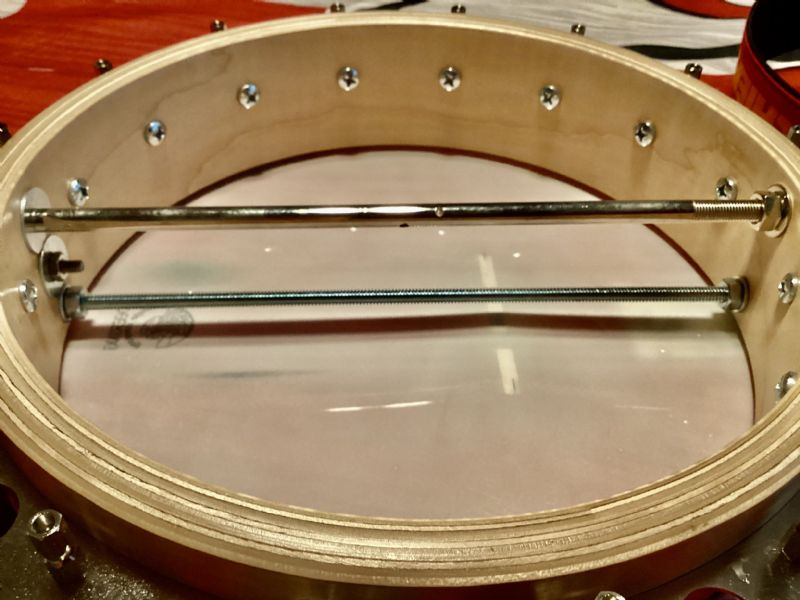
I've been fixing up goodwill banjos for many years, and have tried everything from shims, to elongating rim holes. I finally started measuring rims for out-of-round, and the lightbulb came on. The low end thin rimmed banjos are getting squeezed out of round by string pressure. And the single co-rod doesn't stop it. The action goes up, And trying to adjust it, just makes things worse and more out of round. I've tried to add the second traditional co-rod to a couple banjos, but they are 1) expensive 2) May or may not be the right size and thread, and ordering them is a hassle 3) and sitting at the middle of the rim, have less leverage and put much more stress on the lower co-rod for the same results. The added stand alone rod is much cheaper, available at any hardware store, don't have to be compadable with anything, have much more leverage, easy to install, and 100% successful. With the extra rod installed, and the upper rim measured perfectly round, you can go from high action to low action, within a half turn of the lower co-rod nut. Here's a picture of the inside of my Goodtime after assembly.
Edited by - Dean T on 05/28/2026 13:07:20
quote:
Originally posted by Dean Tquote:
Originally posted by BrettDean throwing out a fine idea for many banjos above. Im gonna steal that idea Dean.
Thanks Brett!
I've been fixing up goodwill banjos for many years, and have tried everything from shims, to elongating rim holes. I finally started measuring rims for out-of-round, and the lightbulb came on. The low end thin rimmed banjos are getting squeezed out of round by string pressure. And the single co-rod doesn't stop it. The action goes up, And trying to adjust it, just makes things worse and more out of round.I've tried to add the second traditional co-rod to a couple banjos, but they are 1) expensive 2) May or may not (never) be the right size and thread , and ordering them is a hassle (totally) 3) and sitting at the middle of the rim, have less leverage (yup) and put much more stress on the lower co-rod for the same results. It's a rabbit-hole and, aesthetically worth it.
The added stand alone rod is much cheaper, available at any hardware store, don't have to be compadable with anything, have much more leverage, easy to install, and 100% successful. With the extra rod installed, and the upper rim measured perfectly round, you can go from high action to low action, within a half turn of the lower co-rod nut. Here's a picture of the inside of my Goodtime after assembly. Dean is right. Do this immediately; get that banjo-wagon fixed and rolling. Think about the shim later when you probably won't need it.
+1
Adding the upper coordinating rod doesn't just fix the action; it stabilizes tuning on flexible rims like these, making them sound better (stability = less bad bounce) and play easier (stable notes are less confusing to the ear). I've added the 2nd rod to several banjos, it's a good thing.
Edited by - pinenut on 05/28/2026 13:40:16
Thanks everyone! I think adding a second rod is outside my wheelhouse. I’m going to try out a 1/2” bridge and if I don’t get good results, next stop may be a luthier.
If you’re uncomfortable disassembling one, it might not be a bad idea to locate a luthier. It’s hard enough to learn without ridiculous action, ungeared fifth tuner, head that isn’t tuned, etc. it’s hard to get into a functional inexpensive banjo. You can put in some work to make them more stable but theyre like a motor home. The more you take them out and use them, as they were intended, the more $hit will rattle loose and require attention.
quote:
Thanks Dean, with the extra threaded rod, Is it correct that the rim is drilled right through at the tail end to insert the rod through then at the neck end drill in approx 5mm ?
Originally posted by Dean Tquote:
Originally posted by BrettDean throwing out a fine idea for many banjos above. Im gonna steal that idea Dean.
Thanks Brett!
I've been fixing up goodwill banjos for many years, and have tried everything from shims, to elongating rim holes. I finally started measuring rims for out-of-round, and the lightbulb came on. The low end thin rimmed banjos are getting squeezed out of round by string pressure. And the single co-rod doesn't stop it. The action goes up, And trying to adjust it, just makes things worse and more out of round. I've tried to add the second traditional co-rod to a couple banjos, but they are 1) expensive 2) May or may not be the right size and thread, and ordering them is a hassle 3) and sitting at the middle of the rim, have less leverage and put much more stress on the lower co-rod for the same results. The added stand alone rod is much cheaper, available at any hardware store, don't have to be compadable with anything, have much more leverage, easy to install, and 100% successful. With the extra rod installed, and the upper rim measured perfectly round, you can go from high action to low action, within a half turn of the lower co-rod nut. Here's a picture of the inside of my Goodtime after assembly.
quote:
Originally posted by conicquote:Thanks Dean, with the extra threaded rod, Is it correct that the rim is drilled right through at the tail end to insert the rod through then at the neck end drill in approx 5mm ?
I drill all the way through both sides. I don't really see any reason not to, and just wanted to keep it simple!
quote:
Originally posted by CantSingI tried adjusting the coordinator rod to reset the neck angle. I got the action where I wanted and it sounded great! But I had to crank that coordinator rod way too much. The rod was sticking out of the banjo and bending the tailpiece bolt outwards, and it was also starting to make my rim oblong. Not good long term for the banjo I think. I adjusted it back to where it was mostly.
Action height measurements:
12th fret - 4mm
Should I try to shim the neck? ... If neck shim is recommended, I would appreciate any guidance. Is there a way to calculate what thickness of shim I need based on desired action at a certain fret, or should I just guess and check?
4mm is essentially 5/32, which is only 1/32 above 1/8, which is widely considered comfortable action at 12th fret. I consider 1/32-inch an amount of change that's safe to to do with the coordinator rod(s). BUT here, 5/32 is the action you've achieved AFTER adjusting the coordinator rod, producing visible egging of the rim. And you're getting interference with the tailpiece bolt. So I wouldn't try to achieve any further reduction with the co-rod.
If this were my banjo -- and I've dealt with the type of action change you're facing -- I'd shim the neck at the upper bolt area (which is in fact what I've done -- successfully and safely, I believe).
The way I make shims requires removing the neck from the banjo. With the neck off, I make a template of the shim from a piece of index card. I punch a hole in the card, put the top bolt through the hole, hold the card against the heel, and with a sharp pencil trace the outline of the upper bolt area of the heel. The shape should be a trapezoid with two different length parallel sides top and bottom and two upwardly/outwardly flared sides left and right. Mark the template so you know which is left and right.
Then trace this template on your shim material. My favorite is maple veneer cards sold on Etsy. These are a bit over .02-inch thick and have worked. From a project years ago, I have scraps of .02 and .01 thick black wood fiber veneer like this. For one shim, I added a layer of .01 to the maple veneer.
To my mind, shimming one of the two bolt areas of the heel achieves the same result as cutting away the other one. Except it's not permament and it's far more foregiving of mistakes.
I lightly glue the shim to the heel with a couple of spots of glue stick. Just enough to hold it in place when I re-mount the neck.
When doing this, I return the co-rod to the "neutral" condition of exerting no pressure on the rim. That way I see what result the shim has achieved. Get there by fully loosening both nuts at the tail end. Then make sure the rod is sufficiently tight at the neck end. Then tighten the tail end nuts. I do the inside nut first, finger tight as much as I can do. Then finger-tighten the outside nut. Then, holding a nail or L-shaped hex key in the hole in the co-rod to keep it from moving, I slightly tighten the inside and outside nuts with a wrench. Or I just use two wrenches: to tighten one nut while holding the other from moving. We're talking a few seconds of work here.
Terms of Use | Privacy Policy | Privacy Consent (EU/GDPR Only)
Copyright 2026 Banjo Hangout. All Rights Reserved.