




I have an inexpensive Trinity River tenor banjo I bought used. The neck is OK, but the sound was less than ideal. I decided to change out the pot assuming the heel cut was good as long as I reproduced the position of the holes in the new pot. It didn't work out and the neck angle if way off. Now I am trying to adjust the heel cut to get the correct angle. I don't want to take it to a luthier (that would run about $200 around here).
Can anyone share some DIY methods for shaping the heel?

quote:
Originally posted by rkdjonesI have an inexpensive Trinity River tenor banjo I bought used. The neck is OK, but the sound was less than ideal. I decided to change out the pot assuming the heel cut was good as long as I reproduced the position of the holes in the new pot. It didn't work out and the neck angle if way off. Now I am trying to adjust the heel cut to get the correct angle. I don't want to take it to a luthier (that would run about $200 around here).
Can anyone share some DIY methods for shaping the heel?
shim-it

I use a string (just a twine string, not a banjo string); attach it to a tuner or something on the peghead, stretch it to the center tailpiece position in the third string position, put the bridge in place, and be sure that the string is in the centered third string path from nut to tailpiece position. I it is not, cut the contact areas of the heel on whichever side adjusts it to center. At the sane time, I measure the clearance between the string and the 12th fret and accept 1/8" clearance as ideal. When my string follows the 3rd string path and clears the 12th fret by 1/8", the neck angle is invariably good when the banjo is strung up.
Cutting the heel in the area toward the fingerboard raises action height, cutting the end of the heel lowers action height, cutting the left heel area angles the neck to the left, cutting the right heel area angles the neck to the right.
As for cutting the heel, I use a small sanding drum in a flex-shaft tool. I don't know what tools you have available or what your capabilities are, so tooling and procedures are whatever works for you.
Edited by - sunburst on 05/29/2026 09:33:01
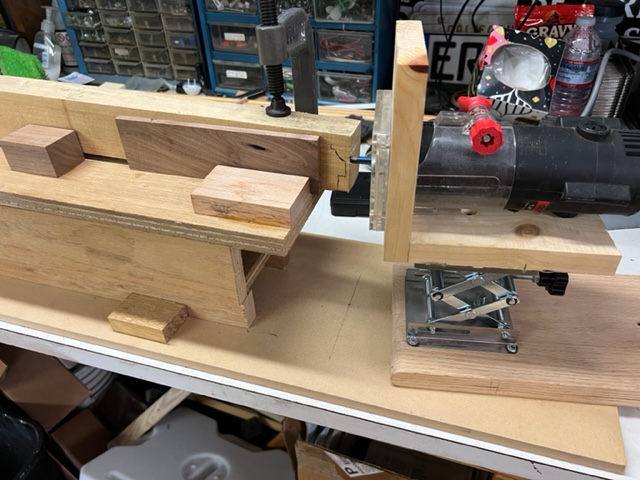
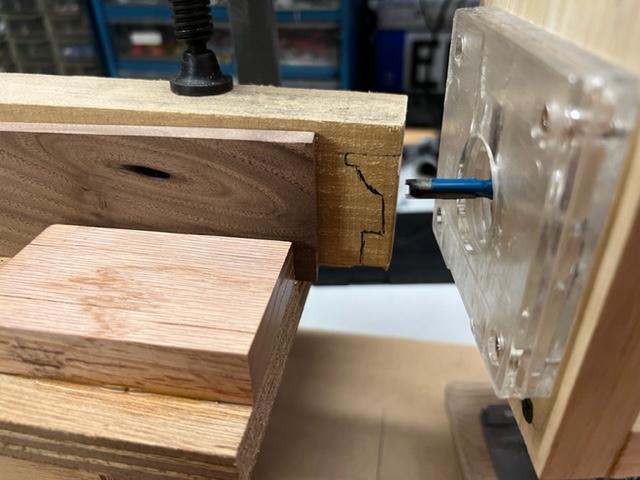
I made a little jig to cut the neck profile. I mounted a router to a small jack assembly and mounted that to a rotating board such that my radius matched my banjo rim. With some practice, I could trim the neck a small bit, adjust the height/depth and trim the next section. It worked well and it got a perfect fit. Good luck!
banjohangout.org/forum/attachm...ID=286614
quote:
Originally posted by BruceS2I made a little jig to cut the neck profile. I mounted a router to a small jack assembly and mounted that to a rotating board such that my radius matched my banjo rim. With some practice, I could trim the neck a small bit, adjust the height/depth and trim the next section. It worked well and it got a perfect fit. Good luck!
banjohangout.org/forum/attachm...ID=286614
Apart from the old mallet and chisel method by an expert (I'm ok with most woodworking, but I wouldn't try some freehand work at my pre war RB-1 neck), a method as described allowing routing to size within 0,1 mm is the only way that would yield (to me) satisfying results.
I had neck angle and fret board clearance corrected by Master luthier Norbert Pietsch from Bremen.
No way I would have tried this myself. Maybe after practicing on 10 scrap banjos first....
Terms of Use | Privacy Policy | Privacy Consent (EU/GDPR Only)
Copyright 2026 Banjo Hangout. All Rights Reserved.