





Dots or whatever markings your banjo may have.
They seem to be pure decorative to me, as I look at the side dots if I need a reference, and I can see the ends of the frets as well.
Do any of you actually use the fretboard markings when you play?

Yes. All of the time I play.

Me too. My problem is that I am stuck on the S. S. Stewart system (also used by British makers), 10 and 14. I can deal with 9th but the 15th throws me off.
On banjos with no side markers I put on the Japanese inlay sticker dots, at the very least I mark the 12th.
That said, I'm not a fan of fancy inlay and skew towards small dots or squares (on end like diamonds).
Absolutely. There is a video on YouTube with Tony and Doc playing together. I found it rather funny to see dots “position markers” on Docs guitar but none on Tony’s guitar. Yes I need/ use them all the time .
I think the poster is talking about using the side dots on the edge of the fingerboard as position marks versus using the inlays on the top side of the fingerboard as position marks, and inquiring which do you use.
I use the inlays in the banjo fingerboard, yes! All the time. I found out how much I miss them when I had a conversion neck made for a Gibson Style 6 with a blank fingerboard, a la Don Stover's Style 6 in the late 1960s. The conversion neck has checkerboard SIDE binding, with the usual fret position black dots. I find it REALLY hard to play in keys other than G when I go up the neck. The black fret position dots are "drowned out" by the dazzle of the checkerboard side binding. Every now and then I consider sending it away to have Style 6 fingerboard inlays installed, but I always lose focus and interest.
As for how Stover could play all over his blank fingerboard without a second thought, he once answered the question (and I paraphrase) "playing several sets every night 7 days a week, I got to where I could play all the song with ear muffs and a blindfold on!" However, eventually Stover did inlay his fingerboard with little flying geese.
I don't find that fingerboard inlays do anything for me on a GUITAR or mandolin however.
I use the side dots , although it’s instinctive - I don’t have to “think it”. Because he had a sliding 5th string capo I read that Bobby Thompson drilled holes in the slide bar. Rolf Sieker has a post somewhere about the “Thompson banjo”.
Chet Atkins would try out an unfamiliar classical guitar and put a piece of tape at the 7th fret.
Edited by - chuckv97 on 06/12/2026 19:28:04
I’m all side dots. I’m not into fancy inlay, in fact the simpler the better. I play standing 100% of the time, so I never see the fretboard anyways. I have an old Gumby Goodtime that I use for practice, and they didn’t come with side dots. I used a sharpie, but they wore off, so I finally bought side dot rod stock, and added them.
I am not sure WHY they put the dot/inlays at the 10th fret rather than the 9th because that B note on the 9th fret of the first string is used quite often in all the old time keys, A, Am,D, & G. In some tunes you have to hit that 9th fret lickiity split if you don't want to miss the beat. So I have taken to putting a white reinforcement circle label that is used for 3 hole binder paper at the 9th fret as a glaring side dot. I find it quite useful. banjered
I adhere to Tom’s utilization of marking/playing the 9th and not the tenth.
It worked for HC Dobson.
Edited by - mrphysics55 on 06/12/2026 20:41:33
When I play standing up, I have trouble seeing the inlays. Relying on the side dots takes some getting used to. I prefer sitting down to play mainly because I can see the inlays better and the banjo sounds better when am not standing. Standing up you’re actually behind the banjo are you’re not hearing its actual tone.
quote:
Originally posted by Alex ZI think the poster is talking about using the side dots on the edge of the fingerboard as position marks versus using the inlays on the top side of the fingerboard as position marks, and inquiring which do you use.
This. Maybe my post wasn't clear, but I use only the side dots, not the markings on the wide part of the fretboard.
The responses are all jumbled now depending on one's interpretation so I guess we'll never know.
I only put side dots on any of the banjos I make. Nobody has ever made any comment about it to me either way. I always put a dot on the tenth for five strings, tenors and plectrum banjos. The dot goes on the ninth for six strings and regular tuned (fourth) basses with basses tuned in fifths on the tenth.
I've never use the side dots, only the fretboard inlays. I play seated.
On fretless instruments, if I'm playing complex music, I use violin tapes for 5, 7, 10, 12.
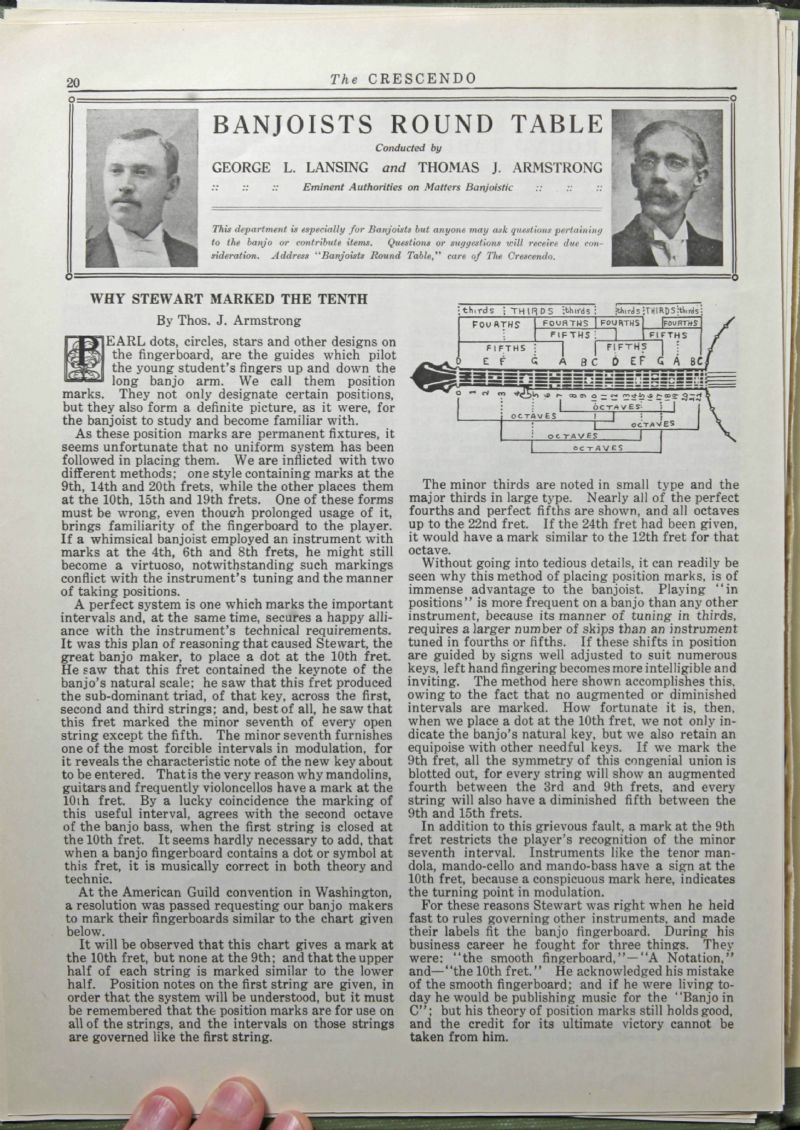
The inlays are generally simply a reference. However, there is a 19th C explanation of how they support music theory, written by Armstrong (IIRC). It's been posted here several times.
At first I never noticed the side dots. When many, many years later I finally did, I tried using them I found them hugely distracting. Sometimes I do look at my fingers to see if they're in the proper shape on the fretboard or if there might be an easier way to place them. When I'm at a jam I look at the guitar player's fingers to see what chord they're at or just at the people I'm playing with.
Instead I let my ears tell me if my fingers are at the proper fret. To me, them side dots, hmmm... But hey, maybe some baseballers ought to try them on their bats...
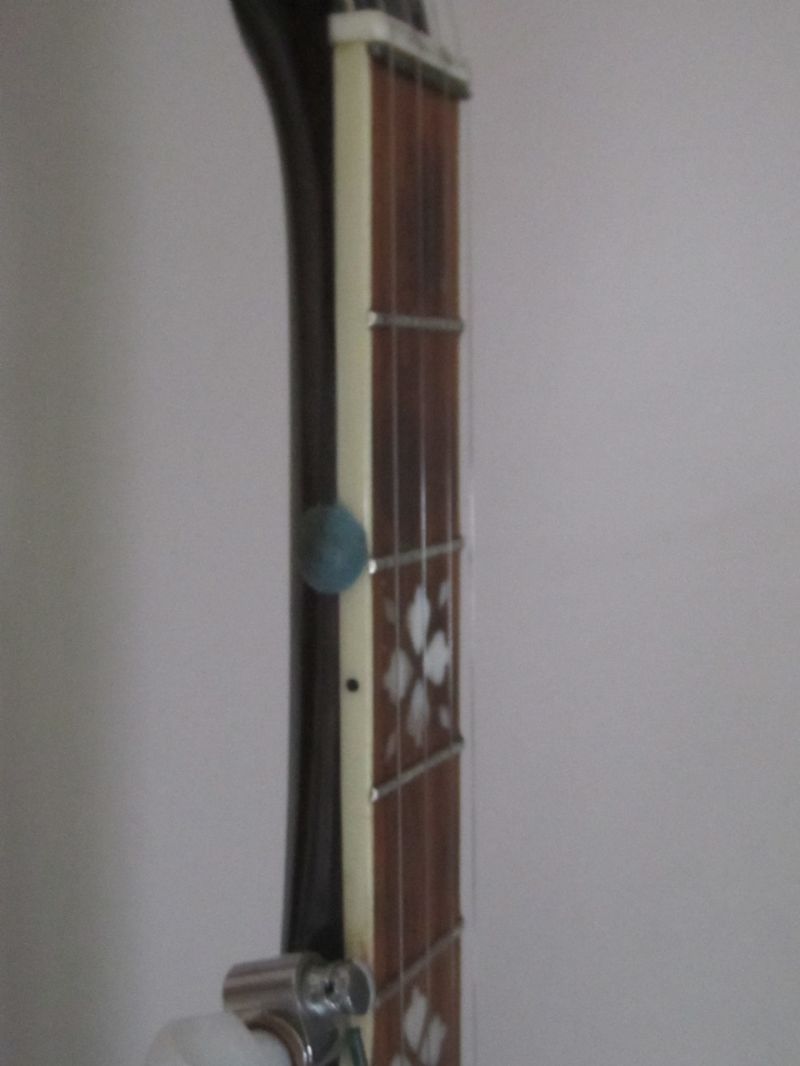
The mother of all side dots .... a bit of fun tack so I don't move my hand too far up the neck in fretting a down-the-neck "D" chord.
[Who needs "let my ears tell me" when we could just use fun tack??  ]
]
Edited by - Owen on 06/13/2026 07:52:56
Well, 20th century (June 1915) explanation.
This article spurred the Guild of Banjoist, Mandolinists and Guitarists to officially standardize banjo fingerboard markings.
Everything about the banjo as we know it is based around the "tuning" intervals (historically pitch was arbitrary) of gCGBD.
Scordatura, or "alternate tuning" had no bearing on banjo design and did not seem to formulate until the original banjo fad had run is course. But the creators of this new music style that involved "alternate tuning" skewed in a nostalgic way and often claimed it was older-- and you can't prove that it is not. After all, you were not personally there at that "older" time. And if you were and did not hear about it, you were just not in the right place because of "isolation" and so forth.
Anyway, before the official Guild edict (and even after) it was the wild west regarding fingerboard position markings. Look at some of the early Fairbanks banjos for some weirdness in positions.
The eventual 5,7,10,12,15,17 positions that were standardized are based on a pretty solid formula around the gCGBD.
Perhaps the modern old time banjo should have some sort of movable position markers for each tuning?
To the OP, I use both. I always play sitting down. I play banjos with them and without them. But sometimes I do add side dot stickers. Sometimes I don't.
quote:
Originally posted by reubenstumpDo any of you actually use the fretboard markings when you play?
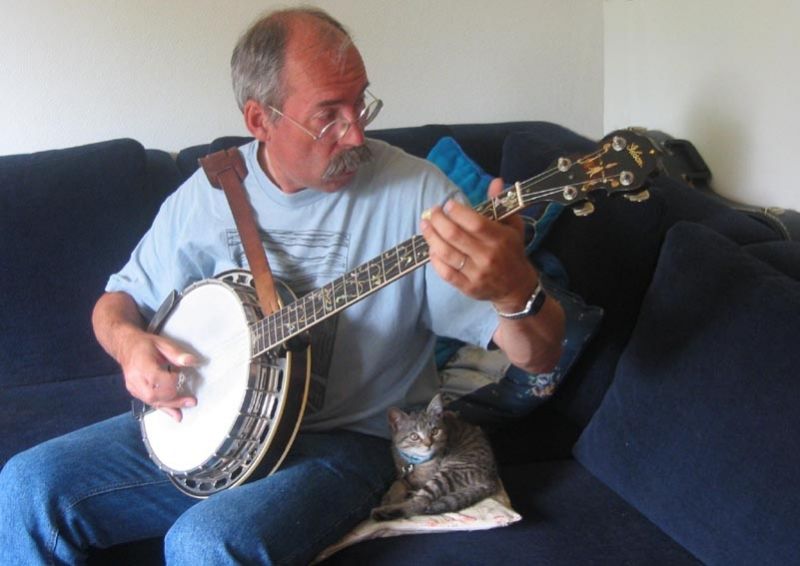
Well... what would you expect? 
Thanks Joel. I think you nailed the tenth fret dot question/mystery (for me anyway) with the historical CGBD (dropped C tuning) as the tenth fret is the note "C" which is handy in the key of C. On my jam banjo I have scotch taped a strip of white paper 1/16" by "1/2" at the 9th fret which I find handy for a quickie visit to the 9th fret in the usual old time keys. If I ever had a custom banjo made I think besides a marking at the 9th fret I'd have double dots at the 7th and 12 frets. banjered
Perhaps someone should develop (and patent) a rail set into the side of the neck that has movable position markers so that they could be switched around for different tunings?
Likewise, why not make banjos with a convertible scoop that attaches with a couple of screws? Take out two screws, remove part of the fingerboard, reveal the scoop.
I should design and build old time banjos.
quote:
Originally posted by RB-1quote:
Originally posted by reubenstumpDo any of you actually use the fretboard markings when you play?
Well... what would you expect?
Beautiful cat. I had a cat with similar markings. I miss her a lot. And she liked my playing.
quote:
Originally posted by Joel HooksPerhaps someone should develop (and patent) a rail set into the side of the neck that has movable position markers so that they could be switched around for different tunings?
Likewise, why not make banjos with a convertible scoop that attaches with a couple of screws? Take out two screws, remove part of the fingerboard, reveal the scoop.
I should design and build old time banjos.

Better (?)--how about a neck with LED or LCD position markers, microchips in the neck at each fret position, and a corresponding chip in the capo that communicates with the ones in the neck? Whenever you put the capo on, the dots automatically reconfigure to 3-5-7-10-12 etc. starting from wherever the capo is.
I pretty much just use the side dots just myself, but I do play and jam with a lot of other musicians. We all watch each other and appreciate any help we can get when we are playing together.
Terms of Use | Privacy Policy | Privacy Consent (EU/GDPR Only)
Copyright 2026 Banjo Hangout. All Rights Reserved.


