





Just bought an RB-170. I'd like to upgrade the 5th string tuner. Do you have recommendations for a tuner, and is it something an inexperienced Luthier can do?
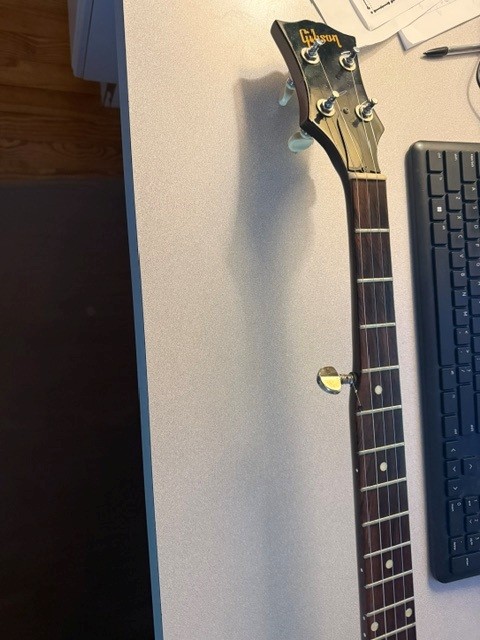
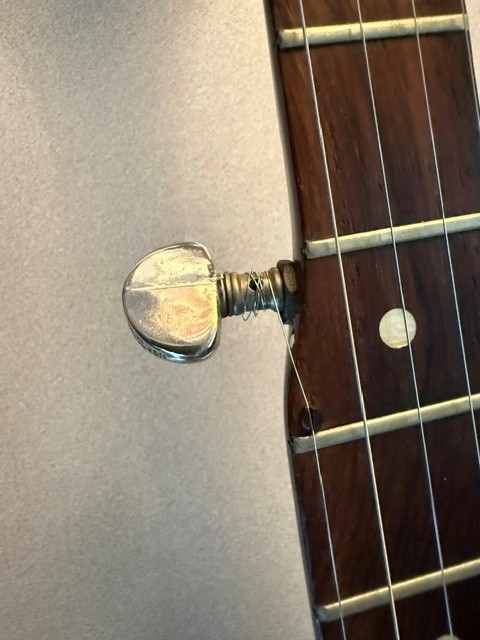

Well, you have an "issue" there, since your Grover friction tuner is screwed into a threaded hole in the side of the neck. You'll be able to remove this tuner with ease, if you look at it and figure out the details. But then putting a new geared tuner (geared tuners are NOT threaded) into the threaded hole is going to call for some "adjusting". I've never done it, but I'm sure it can be done. Others with first hand experience will advise you.
Just go slow and never use too much force! You don't want to crack or break the neck, nor pop the fingerboard loose.
And of course, you could just leave it as-is, and learn how to use a friction peg correctly. Earl Scruggs did it for a couple of decades before geared 5th pegs were developed. (The secret is in the tension applied by the little screw in the peg button or key.)
Edited by - The Old Timer on 06/14/2026 09:01:34

First: it's not my banjo.
Second: Why? Those Grover Sta-Tite 5th string tuners work great.
Third: it's not my banjo.
My favorite geared fifth string peg is the Saga. They are not terribly expensive, they work smoothly and they are sold with several styles of knobs to match other tuners. Schaller makes nice quality geared tuners if you can still find them. Gold Tone sells a geared fifth string peg which looks like the Saga. Gotoh also makes good tuners that are very affordable. Bob Smakula, who is a member here usually keeps them in stock. One geared tuner I don't recommend is the Waverly geared tuner from Stewart MacDonald. If a string breaks off inside the tuner it is a real job to remove the broken piece. If it happens while you are on stage, you might as well figure on missing the rest of the set while you change the string.
Now, since you want to change the tuner, I assumed you meant change to a geared tuner. If you want to keep a friction tuner, the Grover you have is one of the best ever made. The Grover has a tiny set screw that must be removed before the tuner can be taken out of the neck. Once that is removed, a 3/8" socket can be used to remove the base.
Whether you change to a friction tuner or a geared tuner, the hole must be reamed to a taper to fit the new peg. That is not an easy job if you don't have the proper reamer. A luthier will likely have one and can change the peg in a few minutes.
I've changed out the Grover friction tuner for a geared tuner on a couple of banjos. It is as Culloden described. I did use a 5th string peg hole reamer to do the job. I wouldn't try to do it otherwise.
I found out that replacement 5th string tuners can have different diameter shafts by brand name.
Nobody seems to mention this in parts listings.
I have owned three or four RB 170’s over the decades. Not my banjo, but I would leave that peg alone. Once you figure them out, they are fine quality pegs. Looks like your instrument is all original. Kind of nice to keep them that way as you are getting close to 60-65 years old on that one.
If you must change that peg, for what ever reason, have a real luthier who knows banjos do it. It’s a simple job, and fairly easy to do, but you only get one shot. Do it wrong, and you can potentially ruin the instrument. At the very least, if it’s done wrong, you wind up with an instrument that never stays in tune. One thing as Mark above mentioned, some folks miss the fact that peg is kept in place by a very small set screw. Miss that fact, and you can ruin the neck. Seen the end product of a “Luthier” who happened to miss that aspect.
Great banjos BTW.
Thanks for all your thoughts. I'm going to give the existing tuner a chance. It is nice to keep the banjo as close to original as possible.
Replaced this tuner in a Gibson RB 100 about 7,8 yrs ago because original kept slipping thus came out with ease. Was pleased with results. As already mentioned be sure you replace with correct diameter and tapered tuner to ensure a good fit. If in doubt take to an experienced luthier. Nice banjo! Good luck!
Terms of Use | Privacy Policy | Privacy Consent (EU/GDPR Only)
Copyright 2026 Banjo Hangout. All Rights Reserved.


