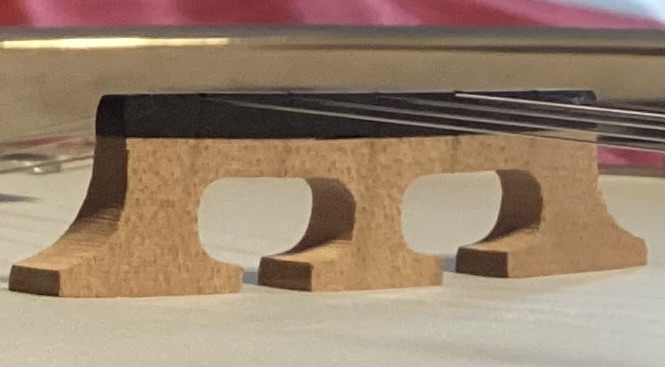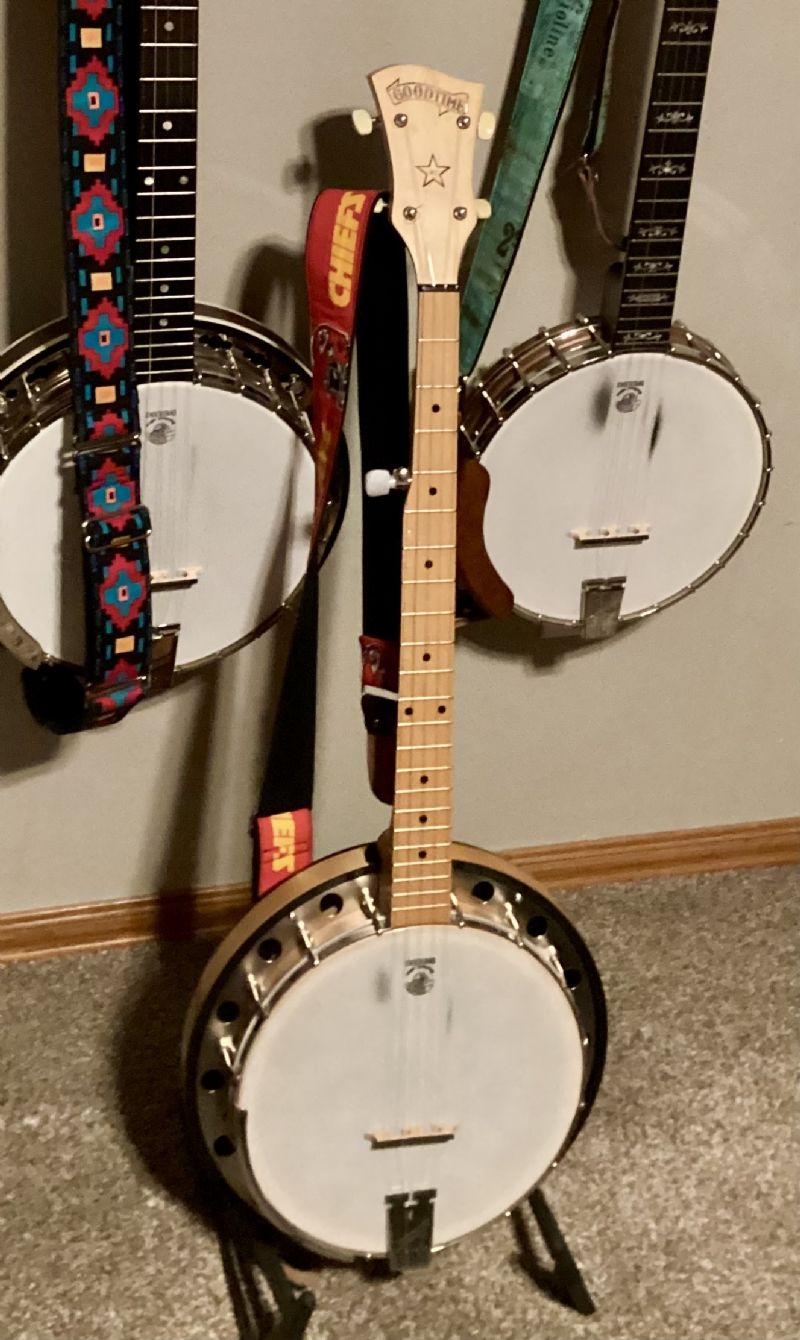





This is the original bridge (about 27 years old) that was on my Goodwill Goodtime 2. It was bad sagging. But after trying several modern, lighter bridges, that made it sound thin and tinny, I decided this bridge sounded the best. But I hate playing saggy bridges. So… I filed the outer slots deeper, sanded the top flat, and walla, a kind of homemade smile bridge. And even keeps the old Gumby all original. Plays great, sounds great. Man those old bridges were tanks… looks hand cut. Maybe the secret to making a Goodtime sound good?
Edited by - Dean T on 06/14/2026 19:05:15

I took my Calico to a luthier a few years ago to do a refrett and he told me that he also found the bridge was warped so he steamed it and straightened it. I have no idea how but it was straight.
Rick

quote:
Originally posted by rvroseI took my Calico to a luthier a few years ago to do a refrett and he told me that he also found the bridge was warped so he steamed it and straightened it. I have no idea how but it was straight.
Rick
Has it stayed level?
I've never steamed one, but have soaked them in water, before installing them, after sanding the outer legs shorter. I've tried all kinds of things, from dishing the bottom, to shortening the outer legs, to shimming the middle leg. Then Deering came out with the smile bridge, and that's what I have on my other banjos ever since. However, they are lighter, and just didn't sound good on the old Gumby. Since the old bridge was cold flowed for so many years, I figured just deepening the other string slots to match the 3rd string, was the best stratigy. That way, the wood stays stress free, and sounds fantastic. It only took a few minutes, and was the easiest solution yet.
Edited by - Dean T on 06/15/2026 09:48:27
Honestly I had never noticed it as it didn't seem bad enough to affect the action. I have since changed to a compensated bridge on that banjo. I think the head tension impacts it long term. Looser head more sag.
Rick
I use a couple of layers of iron-on maple edge banding on the center leg (~0.005"), trimmed with scissors.
If the bridge is warped or new, the legs take a few days to submit; noticeable tone improvement on cheap bridges.
Edited by - pinenut on 06/15/2026 11:18:19
I straighten upright bass bridges using a pressure cooker. Bring up to steam ,then let cool
quote:
Originally posted by rvroseI took my Calico to a luthier a few years ago to do a refrett and he told me that he also found the bridge was warped so he steamed it and straightened it. I have no idea how but it was straight.
Rick
If it's a "regular" kinda bridge then steaming it makes it highly likely for it's topping, ebony or whatever, to loosen and/or drop off.
My question about steaming, is what prevents the bridge from sagging again, when reintroduced to string pressure and head dip? I would think that the physical forces that cause the sagging need to be eliminated/neutralized… such as the Deering smile bridge, outer feet sanding, or center foot shimming. In the case of my old Goodtime bridge, I just figured that since it spent 27 or so years in the closet, under string pressure, on a slacking head, it was petrified in the sagging shape, and will never move … so slot modification made sense for a permanent fix.
quote:
Originally posted by Dean TMy question about steaming, is what prevents the bridge from sagging again, when reintroduced to string pressure and head dip?
Nothing, it will sag again.
At one time Bill Keith would wind a banjo string around the outside feet of his bridge (possibly a standard Grover).I can't remember his reasoning,but a string wound around the feet would be a way to not allow any sagging.
Of course mass would be increased,too.
quote:
Originally posted by Dean Twhat prevents the bridge from sagging again ~ or center foot shimming
A steel bar under the head will do the job just fine 
Glue a piece of popsicle stick under the middle foot, sand it so the shape matches the bride's shape and you're smiling. I've "smiled" my bridges since the 90ies and that simply works great.
quote:
Originally posted by steve davisAt one time Bill Keith would wind a banjo string around the outside feet of his bridge (possibly a standard Grover).I can't remember his reasoning,but a string wound around the feet would be a way to not allow any sagging.
Of course mass would be increased,too.
That's right. I have one of Mr. Bill's bridges with the string wrap, gifted to me by a close friend of Mr. Bill's.
The string is looped around the outer legs, and crosses over under the middle foot, which has a groove in the bottom to accommodate the crossing strings.
The result of this is that the middle leg is higher than the outer legs (opposite the smile bridge), but not shorter, and the consequence is that the middle of the bridge top is slightly arched.
I have not put this bridge on a banjo. The geometry indicates that when it is put on a banjo, the downward pressure on the outer legs will be greater than on the middle leg, the middle leg will sag such that all three legs will touch the head with the same downward pressure, and the arched top will sag to straight.
In short, it appears that Mr. Bill's design results in equal length yet unequal pressure legs that relax to equal pressure, and an arched bridge top that sags to flat. This is the opposite of sanding the outer legs shorter than the middle, which is unequal length legs that start and end with equal pressure, and a flat bridge top that stays flat.
Mr. Bill's bridge puts more upward pressure on the outer legs. Smile bridge puts more downward pressure on the middle leg. The both end up conforming to the banjo head and maintain a flat top.
I'll post a picture sometime.
Did Bill do this to match up to a radiused fingerboard rather than flat one?
I don't think so. The Great Lakes he started playing in the mid 1970s and the later Rich and Taylor had flat fingerboards.
Seems like the concept of the design was to start higher in the middle of the top of the bridge, and then when the bridge stabilizes to conform to the depression in the head, the top ends up flat.
If people use heat to straighten a neck….then it seems heat without water or soaking would last longer as long as you don’t pickle the glue like Bart implied. Refer: Smakula ironing.
Iron the bridge gently or use gravity and weights and a long time!
I haven’t seen one bridgemaker come on and show the well known methods of making bridges. It’s like a secret society of numerical control and patterns and jigs. Hand-held like music we make with our hands
Dean, you vintaged that old piece of Maple, please keep it and put new tires on that rig if you have to
Deering and Gold Tone and so many others use Maple for whole banjos, you got an old Gumby and a Sunbeam at one time, wouldn’t a Maple bridge with Ebony top vintage great with proper humidification and care and daily music lessons
I got a Veerman that made my Bamboo #001 rock out
Edited by - Helix on 06/21/2026 21:36:01
I think the worst enemy of a sagging bridge is low head tension.
When I went back to wound 3rds and straight bridges, I bought a few 11/16 bridges, installed them onto my Kays (tenor and 5 string) and let them sag. Later, I flattened the top, re-slotted and installed them onto my performing instruments.
quote:
Originally posted by HelixDean, you vintaged that old piece of Maple, please keep it and put new tires on that rig if you have to
Deering and Gold Tone and so many others use Maple for whole banjos, you got an old Gumby and a Sunbeam at one time, wouldn’t a Maple bridge with Ebony top vintage great with proper humidification and care and daily music lessons
The Sunbeam is still in the Columbia Mo area, as far as I know. If anyone sees a banjo with "Helix" on the headstock, it's my old banjo, rim built by Larry, and played out for years with an old bandmate of mine.
Larry, the old Gumby ain't going anywhere! It's the best Goodtime I've come across, and the original old bridge sounds better than anything else I have in my bridge bag.
Terms of Use | Privacy Policy | Privacy Consent (EU/GDPR Only)
Copyright 2026 Banjo Hangout. All Rights Reserved.