




Happy 4th of July, folks!
I decided on Pride of America for this week’s TOTW in keeping with the holiday. I’d also looked at Green Fields of America for a second consideration, but there seems to be a few different tunes under that title and decided this one was more definite. This tune comes from the Hamblen Collection of fiddle tunes by David R. Hamblen (specifically David in this case), son Williamson, and transcribed by grandson A. Porter Hamblen. I learned the tune initially on fiddle from the playing of the late Christian Wig off his Chadwell’s Station CD.
Original notation here: chriswig.com/hamblen/tune37.html
You can see the note written in the left margin to play as if in A minor or A modal, leaving the C and G notes natural. After learning it, I attempted to play it as if in A major as written, and then omitted the G sharps followed by both G and C sharps coming back to A minor to test it, the latter of which sounded better to me. With my renditions below, I’m playing it with C and G naturals.
Chris’ recording: https://christianwig.bandcamp.com/track/pride-of-america
A fiddle rendition by Nikos Pappas: https://nikospappas.bandcamp.com/track/pride-of-america
Band session by Hog-Eyed Man: https://youtu.be/HZJlagSJS4w?is=X1I--OmnuHO7zR64
Nice rendition by April Verch on fiddle and Joe Newberry on banjo: https://youtu.be/cwxaWNnJfJk?is=eppYrdFnGNgiZLIi
My rendition on solo fiddle among four other modal selections from the Hamblen Collection: https://youtu.be/kejAOGYpC0s?is=ePCBvv_9Ov4o5tXS
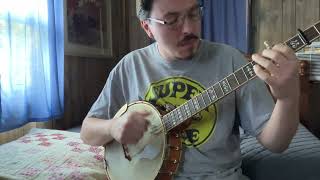
And finally my take on solo banjo: https://youtu.be/RrW0y5oMvSE?is=6lXR6i1Q0-7pfXMn
Banjo is tuned aEADE (gDGCD, capo 2). I decided to do a high break for the A part to keep the melody straight in succession of notes for variety along with a couple ways of doing a re-entrant line to obtain the low C note that the fiddle catches, and for giggles decided to also do a high strain of the B part, going up to fret 21. On a side note, I do hear a bit of Cousin Sally Brown from Marcus Martin throughout this tune. Possible relation?
Look forward to reading your comments and hearing other renditions. Have a safe and happy weekend for those here in the states! Something to be proud of!
Edited by - Noah Cline on 07/02/2026 12:17:00

Thank you and others who have recently included links for notation. I play tenor tuned GDAE, so the dots let me learn the tunes.
And I really like the modal sound of your version.

Very appropriate pick and nicely done!
I had often wondered who had written that note about playing in A Dorian rather than A Ionian (major). I had incorrectly assumed that it was Garry Harrison (see the Pride of America CD, and specifically track 7). As per usual, I was wrong. See: Wig's description (http://www.chriswig.com/hounding_hamblen.html) where he indicates that the written annotations were from Steve Green who discovered the manuscript at Berea College.
Re: Boblamoy's comment, I very much agree with giving standard notation where possible. But if I stick with my current plan for the July 31st TOTW, it will be a clawhammer tune that is played unaccompanied and which defies writing in standard notation.
quote:
Originally posted by LyleKVery appropriate pick and nicely done!
I had often wondered who had written that note about playing in A Dorian rather than A Ionian (major). I had incorrectly assumed that it was Garry Harrison (see the Pride of America CD, and specifically track 7). As per usual, I was wrong. See: Wig's description (http://www.chriswig.com/hounding_hamblen.html) where he indicates that the written annotations were from Steve Green who discovered the manuscript at Berea College.
Thanks, Lyle, and also for clarifying the author of the note -- I didn't remember who it was at the time for the presentation, but I do remember reading Chris' article some time ago.
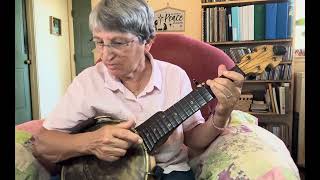
A pleasant tune discovery for this Independence Day! Your ambitious banjo work, Noah, would have my head reeling up the neck. The short scale lacks the highest notes anyway -- no 21st fret at all. I look for the simplest way to play these days, though it usually doesn't seem all that simple. After trying on cello banjo, I went back to a standard banjo and studied the notation with its three sharps (was that a mistaken key signature?). It was fairly easy to play in A modal tuning, like you suggested.
As for the tab with notation, it contains my clawhammer drone strings, Bob, which might sound strange on your tenor banjo. It also has the anticipatory note at the beginning, reflecting the Christian Wig recording. As for key signature, since it has no sharps or flats, I wonder if it's in the Aeolian mode. Some modes and scales are still mysterious.
quote:
Originally posted by JanetBAs for key signature, since it has no sharps or flats, I wonder if it's in the Aeolian mode. Some modes and scales are still mysterious.
Excellently played as always, but re: the key signature for standard notation, that's a tricky business in Tabledit. Seeing as tablatures don't have key signatures, you have to set the key signature for the standard notation. If you go to "Score" in the menu you'll see "Key signature..." as a sub-menu. The only modes that Tabledit knows about are Ionian (major) and Aeolian (minor). If you do not set the key signature, Tabledit will assume there are no sharps or flats (so C-major or A-minor depending on whether the tonic is C or A). Any notes not in the given scale are treated as accidentals (as in the one F# in your conversion of your tab). In general, the key signature and tonic will establish the proper mode, so if you take your Tabledit file for Pride of America and add one sharp (G-major/E-minor) then you will get A-Dorian given that the tonic is A, and that's the correct mode for Pride of America (given that written annotation). You can also set different key signatures for tunes that modulate (e.g., two sharps for the A part of Forked Deer (in D major) and three sharps for the B part (in A major). Otherwise, the key signature will have no sharps, all of which will shows as accidentals.
I'm attaching my tab/notation for TOTW #50 (in D-major) shown with the proper key signature and shown with no sharps or flats in the key signature (so, using accidentals).
Thanks, Lyle, that was helpful. I assume my notation will be helpful as is, based on your explanation. My understanding of modes comes from a gadget my husband created, called "The Circle of Kit's." More on that if anyone is interested.
In the meantime, here is information on A. Porter Hamblen on the Find a Grave site.
Edited by - JanetB on 07/05/2026 20:10:04
Terms of Use | Privacy Policy | Privacy Consent (EU/GDPR Only)
Copyright 2026 Banjo Hangout. All Rights Reserved.