www.myspace.com/banjoulf
Playing Since: 1958
Experience Level: Expert/Professional
Interests:
[Jamming] [Socializing] [Helping]
Occupation: Retired banjofreak
Gender: Male
Age: 85
My Instruments:
Tenor, old-time five string, minstrel, mandolin. Tenor guitar, harmonica, washboard.
Classified Rating: not rated
Rate this Member
Profile Info:
Visible to: Public
Created 4/15/2008
Last Visit 12/11/2016
Kasumy!
(That's "Hello! How are you?" in the language of the Jola of Senegambia, West Africa. The proper response is "Kasumy balle!")
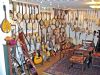
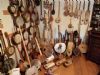
My name is Ulf Jägfors. I'm a historian and collector of banjos and West African plucked lutes which are the living ancestors of the New World banjo, such as akonting folk lute of the Jola (Senegal, Gambia, Guinea Bissau) and the koliko folk/artisan lute of the Frafra (Ghana). I'm also interested in related string instruments-- especially those of the lute family-- from West Africa and the world over. In fact my home here in Tyreso (Sweden) has become something of a private banjo museum, showcasing my collection of over 80 banjos, West African lutes, and related string instruments from around the world that I've collected on my travels over the years.
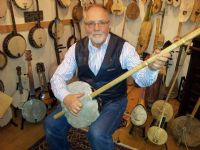
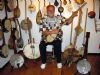
Here I am in a corner of my little banjo museum surrounded by some of the banjos and related instruments in the lute family I've collected in my travels the world over. I'm playing an entofen, a type of Jola akonting from Casamance (southern Senegal) that has an oval gourd body instead of the more typical round kind.
I've been hooked on banjos since 1960 when I first got into playing traditional jazz on the tenor banjo. A few years later, I got caught up in "The Great Folk Scare" that came over from America and swept Europe, so I swapped my tenor for a 5-string "regular" banjo. Like hundreds of other aspiring banjoists the world over, I taught myself the instrument using Pete Seeger's classic tutor, How to Play the 5-String Banjo.
For more than 40 years, I've been into American old-time country music as well as early jazz and blues. I've always been intrigued by the roots of traditional American vernacular and popular music as they extend back to both Europe and Africa. My interest in the history of these forms as well as the banjo led me to purchase a 130 year old 5-string banjo in 1990 and study 19th century styles of playing the instrument, in particular the down-picking technique known as stroke style.
(The stroke style is considered to be the oldest known style of playing the banjo. This is the technique that the blackface minstrels learned from African American slave musicians in the early 19th century and popularized along with the banjo in the 1830s and ཤs. Stroke style remained the principal style of playing the 5-string banjo until the advent of "guitar-style" up-picking in the late 1860s. Down-picking survived in the folk traditions of the African American and European American communities of the rural South where it's known by a variety of names: clawhammer, frailing, thumping, and so on.)
Curious about the banjo's African heritage, I embarked on what you might call my own personal "journey of discovery," searching out the instrument's long obscured roots in West Africa. At the time, the conventional wisdom was that the West African archetypes of the banjo were those wooden-bodied plucked lutes that were exclusive to the griots, like the Mande/Bamana ngoni, the Wolof xalam, and the Fula hoddu. However, this never made much sense to me. According to period documentation of the early banjos made and played by slaves in the Caribbean and the Americas from the 17th century on through the mid-19th century, these instruments all had gourd bodies, typically round or teardrop-shaped. Yet, the griot lutes are distinguished by having narrow, canoe shaped or figure-eight shaped, hollowed-out, wooden bodies.
(Photo by Ulf Jägfors)
Daniel Laemouahuma Jatta playing the Jola akonting folk lute. In the background is a reproduction of The Banjo Player (1856) by William Sidney Mount (1807-1868) of Setauket, New York. Note that Daniel and the banjo player are both down-picking their instruments.
At that point, my search for the elusive "missing link" that could connect the banjo to present-day West African lutes ran smack into a brick wall. Then, in 1999, I happened on a lecture in Stockholm that literally gave new life and direction to my quest. The lecturer was Daniel Laemouahuma Jatta, a member of the Jola people from Gambia currently living and working as a economist here in Sweden. Daniel was doing a presentation on his people's folk lute, the akonting. I was amazed to see that the instrument had a round gourd body and was strikely similar to period depictions of early gourd banjos. Even more amazing was how Daniel played the akonting-- he was down-picking it exactly as one down-picks a 5-string banjo!!!
In 2000, I had the privilege and honor of introducing Daniel and his pioneering work researching and documenting the akonting to the international banjo community at the 3rd Annual Banjo Collectors Gathering in Boston. Daniel, in turn, has introduced to me to his people and their wonderful culture and music. Together, we've taken several trips to Gambia as well as the Casamance region of Senegal-- the heartland of Jola culture and the birthplace of the akonting-- to film and document the rich musical traditions of the Jola as well as those of neighboring peoples such as the Manjago, Wolof, Mandinka, and Fula.
The most recent trip in July of 2006 was perhaps the most rewarding in that it was the occasion of the official opening of The Akonting Center for Senegambian Folk Music and The First International Conference on the African Origins of the Banjo. This was the first ever meeting on African soil of American and European scholars and musicians with their West African counterparts that focused specifically on extant Senegambian string instruments and their kinship with the banjo.