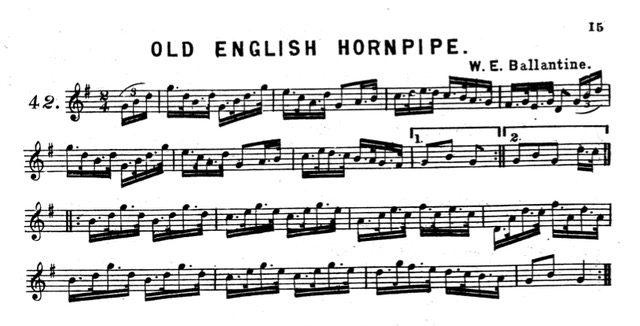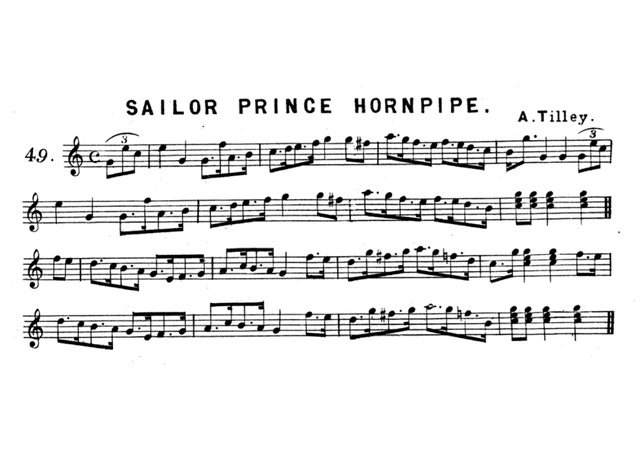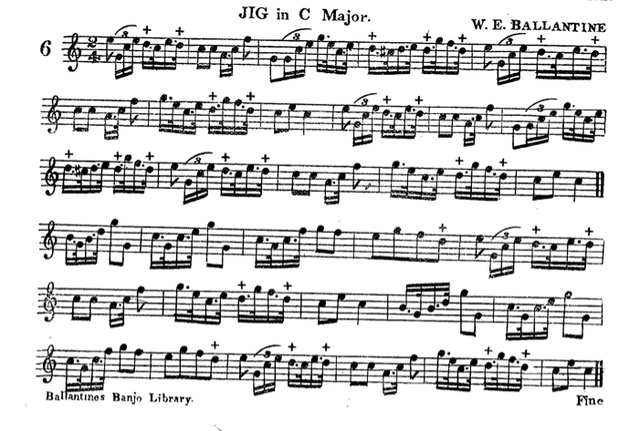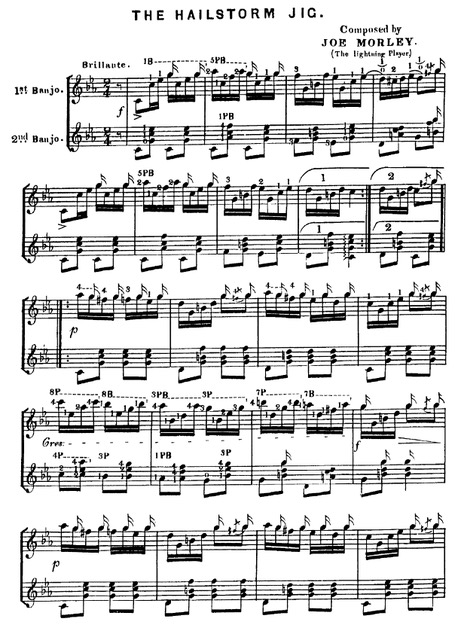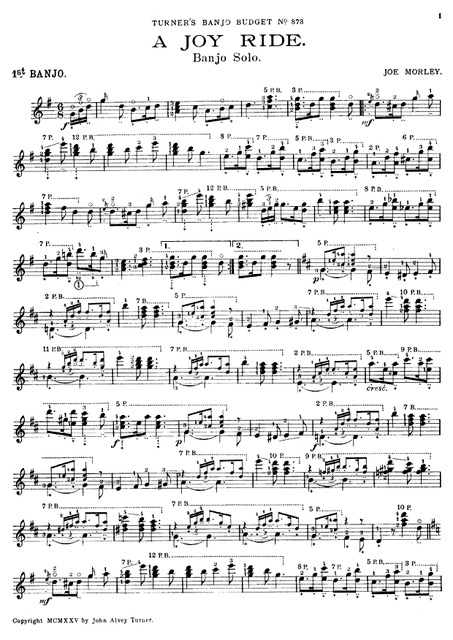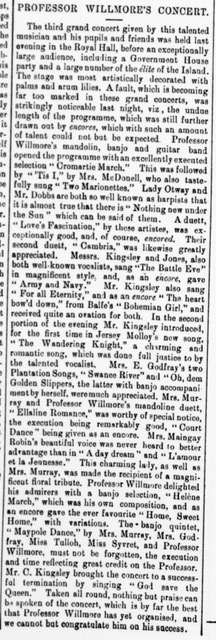





Four original tunes, two hornpipes and two jigs, composed for banjo by three 19th century English finger-style banjoists. Hailstorm Jig is in 2/4 time rather than the more common 6/8. These 'straight jigs' were first introduced by touring American musicians and became immensely popular.
No sleight of hand, no mystery, no disguising complexity. Just easily identifiable, straightforward traditional forms, no different to those in the Village Music Project collection. English musicians know they have the freedom to embellish the basic notation as they choose.
Edited by - EEB on 08/03/2026 19:09:02


And here is another Morley composition for finger-style banjo. The word ‘jig’ doesn’t feature in the title. But the form is simply a traditional English 6/8 jig like many examples in the Village Music Project collection. Morley would’ve been steeped in this sound from boyhood when he would step-dance to his father’s playing.
Edited by - EEB on 08/04/2026 01:10:30
We needn’t fall under the false impression that traditional dance forms were all the old finger-style banjoists played. These were one small part of a much wider and often highly innovative repertoire.
Many original tunes were influenced by the popular music publishing of the day. As one might expect Victorian cultural motifs also feature. One of the most curious themes derives from the Victorian preoccupation with the supernatural world, fairies imps, goblins and the grotesque. Banjo composers turned these other-worldly visions into extraordinary original compositions for finger-style banjo.
Edited by - EEB on 08/04/2026 01:24:45
This is a 1914 recording of Bert Basset playing fellow banjoist Sid Turner’s original finger-style composition ‘Goblin Gambols’. Despite the less than ideal quality of the early recording the ingenuity of the composition and its rhythmic dexterity shine through.
Sid Turner’s day job was a hairdresser. He owned and ran a barber’s shop in Gloucester where customers would often be entertained by his banjo playing. In the evenings he was a sometime semi-professional banjoist who performed in many prestigious venues and concerts around the U..K.
Edited by - EEB on 08/04/2026 01:57:34
The style has a long an interesting history.
But I want to know what is happening in 2026? Is there innovation? Are there new compositions? Are we still supposed to play the way we were instructed in some method printed in the 19th century? Because quite honestly, other banjo styles have moved on since then. So I’m wondering if it is a nostalgic celebration of past glory or is it a “living” art form?
quote:
Originally posted by Laurence DiehlThe style has a long an interesting history.
But I want to know what is happening in 2026? Is there innovation? Are there new compositions? Are we still supposed to play the way we were instructed in some method printed in the 19th century? Because quite honestly, other banjo styles have moved on since then. So I’m wondering if it is a nostalgic celebration of past glory or is it a “living” art form?
Laurence, there are certainly new finger-style compositions in the quiet grassroots tradition that is by banjo player for banjo player. We quickly learn that composition is an integral part of finger-style. Finger-style players led from the front; they were not trapped in retrospective repetition.
The curious enquiries in this and other recent threads in this section, are evidence of how this foundational banjo technique is both almost entirely overlooked but also, when shown in a less proscribed context a technique that is immediately relatable to contemporary banjo players. To my mind that is a fundamental omission and a big gap in banjo player's awareness of their own instrument. It also neglects a legacy gifted by some of the finest exponents of our instrument .
This 'invisibility' ought to, if a reason was in doubt, explain the push for a designated home space on BHO.
I really hope the mosquito is freed from it's suspension in amber and takes flight. What potential modern finger-style players choose to compose would, like any creative activity, naturally express their here-and-now experience. Because as musicians we aren't inert Jurassic mosquitoes in amber in a museum.
Edited by - EEB on 08/04/2026 13:49:38
Creativity doesn’t ask ‘what?’; creativity takes us by the hand and surprises, challenges and delights.
Ultimately we all focus our time and effort on what we love :-)
Edited by - EEB on 08/04/2026 14:08:41
that is why I was mentioning known melodies--to see possible new uses ==There is certainly much to glean --on how to embellish --- even modern lead sheets
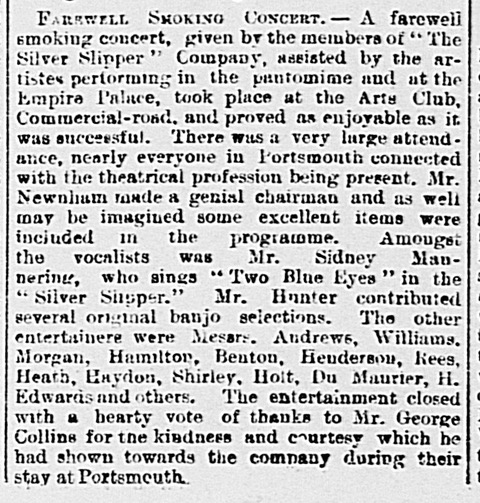
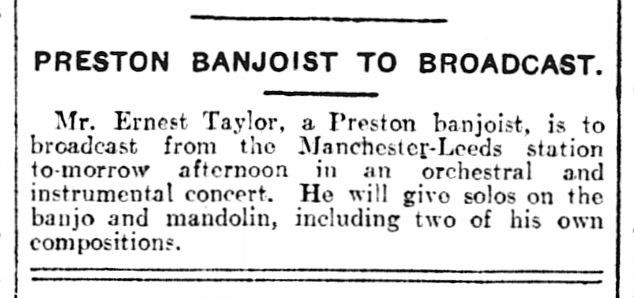
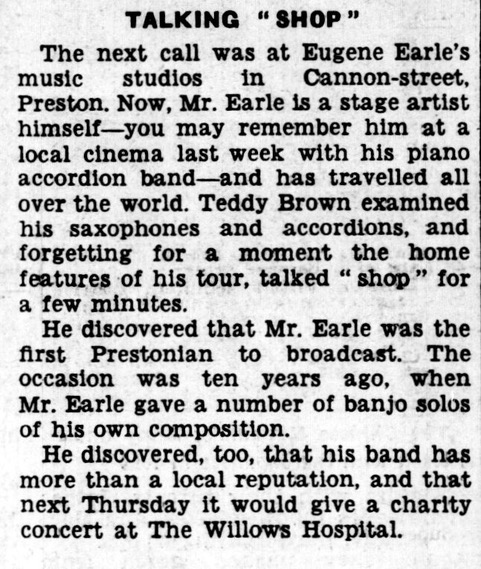
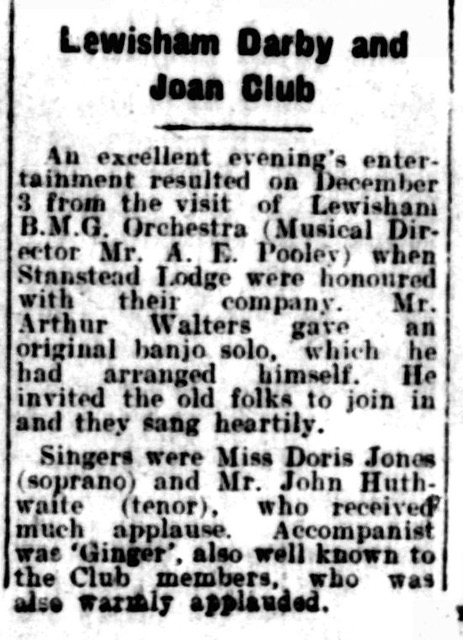
Grassroots performance of original compositions by amateur finger-style banjo players do leave a trace in primary sources. Though almost invariably the tunes themselves are lost. Original composition is a common activity among finger-style banjo players. These are just 4 typical examples ranging in date from 1894-1951.
Hi Mike, I'm not sure I totally understand the meaning behind your last post. Basically ALL banjo compositions were composed by someone.
Where is the line between "amateur" and not? Ernest Taylor had a good amount of solos published. Is "Mr. Hunter" Parke Hunter?
I've scanned a large number of self published solos. On some level even the "major publishers" were still DIY in a way. S. S. Stewart started out by selling handwritten copies of music. Albert Baur and Frank Converse did this too.
Self-evident really. Simply prompted by Laurence’s query about original composition. The uploaded references are four of many, many similar collated examples on file.
U.K. composers of commercially published banjo pieces were a mixture of people who made their living from music e.g. William Ballantine, Walter Redmond, William Nice, Richard Spencer, and finger-style players who had day jobs with no link to music.
Many of the former like Fred Chapman, Harry Angel, Denis Keely, though sharing a working class background, had more or less continuous self-employment as music teachers. Others were piano tuners, music shop owners, or music venue managers.
However, research into diverse English banjo contexts reveals the extent of non-commercial composition by local finger-style players. Individuals who not only played the available printed banjo music, but also enjoyed, and in many cases were highly motivated to perform to local audiences. their own original compositions. We see this process and engagement clearly and explicitly in a number of English finger-style players personal hand-written notebooks.
This commercial and non-commercial activity shares a common creativity but are by definition distinct.
In the context of this thread and the BHO it is illustrative of the prevalence of personal composition among finger-style players. I don’t see a comparable level of originality among all levels of players of other banjo styles; whereas originality purely for its own sake is a characteristic of finger-style.
Edited by - EEB on 08/06/2026 14:56:50
To me this thread has long since morphed into a wider scope--amateur and semi amateurs have probably existed as long as free market and music entertainment has---
a nostalgic look at yester year is fun--when time permits
I am starting to wonder what the classic guys are getting out of ornamentation-- such as a turn??--that one where you go above the note then down below it then land on it--Kevin Burke (fiddle) said it was more of a percussive use--do classic players sound this out
quote:
Originally posted by Tractor1
I am starting to wonder what the classic guys are getting out of ornamentation-- such as a turn??--that one where you go above the note then down below it then land on it--Kevin Burke (fiddle) said it was more of a percussive use--do classic players sound this out
Every player will probably have their own opinion on ornamentation.
If I was going to summarise my take on it, I'd say it offers scope for 'contrast'. Ornament can add interest and emphasis at specific places in a melody. I'll often use mordants and grace notes. Not so keen on tremolo. We all develop our own preferences.
They're a bit like the equivalent of slides on a fretless. Overdo them simply because we can, and they just become intrusive.
Another area of expressivity that finger-style utilises a lot are dynamics. Not just softness and attack, but also occasionally retarding and advancing tempo for short sections.
Is a bass-string solo ornamentation? Probably not, but it does alter the texture of a tune.
These are all techniques to use when it feels 'right' to us to use them.
Edited by - EEB on 08/06/2026 15:41:43
quote:
Originally posted by Laurence DiehlThe style has a long an interesting history. But I want to know what is happening in 2026? Is there innovation? Are there new compositions? Are we still supposed to play the way we were instructed in some method printed in the 19th century? Because quite honestly, other banjo styles have moved on since then. So I’m wondering if it is a nostalgic celebration of past glory or is it a “living” art form?
I'm going to push back a bit on this line of questioning.
1. The body of published music for the five-string banjo -- what is typically identified with "classic" banjo -- is so large but so rarely heard, it might as well be new. Whoever you perform it for will almost certainly be hearing it for the first (and perhaps only) time.
2. There is artistry and skill involved in the interpretation of composed music. At the most basic level, you have to make practical decisions about fingering. At a higher level, you are dealing with dynamics, articulation, shifts in timbre, expressive changes in tempo, and so on. Many of these finer details are not written and are therefore up to the player.
3. Does it matter? You don't go to a local old-time or bluegrass jam expecting to be blown away by musical innovation. For the most part, it's people playing the same old tunes the same old way. And people enjoy it. What makes it "living" is the community of players, not the repertoire.
to each their own and not to disagree --for whatever reason I see things different==we all are from different formative environments
both ways have merit to me== neither is top dog I enjoy many kinds of music--My music entertainment is someone making an instrument say something that I like--This will be more than likely --be something --that all of it's newness and special signatures, has not ''wore down ''into same old -same old--I don't find enough of that in the jams ,to make them worthwhile--
Times are certainly great for studying and preforming the classic style--with the abundance of material around and ability to hear audio examples to help clarify the old instruction books--there is no end to great tunes from back then --but I have always been overzealous in my appetite --so I have to hold back and spread it around-
To me arranging a great melody is just as good as- inventing a great melody and is better than inventing a mundane one
my opinion I ask no agreement
Edited by - Tractor1 on 08/07/2026 10:20:20
Questions help people reach new conclusions. I thought I would actually receive more pushback than I did.
quote:
Originally posted by Laurence DiehlQuestions help people reach new conclusions. I thought I would actually receive more pushback than I did.
I considered pushing back with something similar (but less tactical) to what Ethan wrote, but I really did not know how to write what I think.
So I will throw this out, I've heard/seen some "recent" (last 30 years to present) classic banjo compositions, and there are really only a few I have liked. And those few were composed very close in style and feel of period works-- not exactly reaching new levels (not that I fully understand what new levels means).
Atonal or 12 tone (insert puke emoji) no thank you. Sadly this seems to be the academic darling.
I don't think it is very easy to summerize the volume and scope of the existing published classic banjo music. It is seemingly endless. Seriously, it is absurd just how much music was composed and published for banjo. Thousands and thousands. One could play a new (and unheard) piece of music every day for the rest of their life and not run out!
Then there are the file boxes of manuscript I have.
Is it all good? Absolutely not. Generally, it can be derivative, of its era, and somewhat generic. But when you find that piece that stands out! That is the best.
I'm cool with all that is published. I'll encourage new music, but I have yet to hear anything that bests "period" compositions.
The one thing that I will do is make my own arrangements.
Where am i failing in my counting?
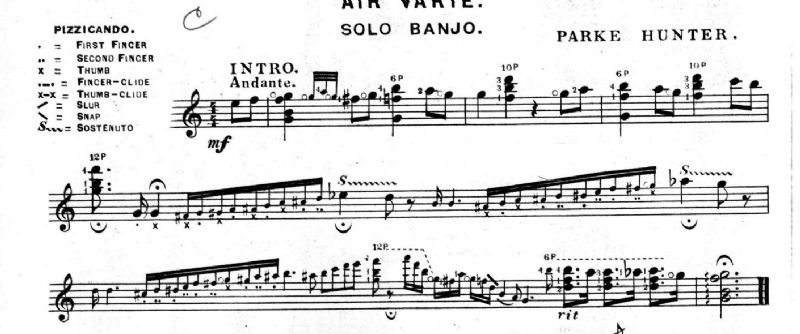
I was piddling with this and counted 21-- 16th spaces up to the first E flat --should there be a bar somewhere or do I just wing it by ear and stay with the melody's timing--I like the way it mimics a bird's flutters
Edited by - Tractor1 on 08/07/2026 12:36:37
btw I forgot to mention that was on the second staff
quote:
Originally posted by Laurence DiehlQuestions help people reach new conclusions. I thought I would actually receive more pushback than I did.
They do.
And composition can help us reach or connect more fully with a person. Expression is fundamental to music making.
quote:
Originally posted by Tractor1btw I forgot to mention that was on the second staff
That is a cadenza. It continues through the third staff. Play it how you want.
quote:
Originally posted by Tractor1btw I forgot to mention that was on the second staff
Context so that the rest of us can see it all.
https://archive.org/details/mocking-bird-with-variations-parke-hunter/
thanks Joel I never ran into that word , I never knew it had a term--be certainly was aware of them as a type of intro--I do think it is a bird fluttering perch to perch--
Edited by - Tractor1 on 08/07/2026 14:08:55
Terms of Use | Privacy Policy | Privacy Consent (EU/GDPR Only)
Copyright 2026 Banjo Hangout. All Rights Reserved.