
DVD-quality lessons (including tabs/sheet music) available for immediate viewing on any device.
Take your playing to the next level with the help of a local or online banjo teacher.
Weekly newsletter includes free lessons, favorite member content, banjo news and more.
Premier Sponsors





|
Please note this is an archived topic, so it is locked and unable to be replied to. You may, however, start a new topic and refer to this topic with a link: http://www.banjohangout.org/archive/173153/10
Page: 1 2 3 4 5 6 7 8 9 10 11 12 13 14 15 16 17 18
JoeH - Posted - 08/15/2012: 09:57:53
quote:
Originally posted by steve j.
Heres my 1st, I love this thing, 2nd is in progress,
Hey Steve,
I really like that, great sound. I'm a beginner clawhammer guy & I hate getting into the different keys. Building 2 or 3 mountain banjos & dedicating each one to a certain tuning may be the answer for me. Do you recommend the Firefox 3 book as opposed to some of the other suggestions in this thread? Do you think I could build a mountain banjo that sounds as good as yours for under $100 in materials? I read where you talked about the pricey woods you were looking at but I don't know if the more expensive woods were necessary for the sound or just appearance.
Thanks,
Joe
Steve Jeter - Posted - 08/15/2012: 10:14:27
Hey Joe :)
Man the double C tuning is way easier than you think. I was so scared of it, before I tried it. The only thing you lose {to me anyway} is the easy G chords.
If your banjo is in standard tuning, just fret string 2 {starting away from you} at the 1st fret... makes a C note ,,, tune that string to that. then de tune the heavy 4 string to match. If you already know this , cool,, I didnt for a good while, it just confused me.
I have looked at that foxfire book over and over , read & re read. and read alll these pages. getting both of the info I think would be helpful. Put the foxfire in the bathroom,,, and re read whenever your in there LOL study the pics. I like the Tedra Harmon version best.
you can get a skin for 5 bucks ,,, and I used a cafeteria size pudding container for the ring. couldnt find a big coffee can. the wood is just poplar,, cheap and easy to find. I put a 7 dollar set of tuners on it,,, cause I need to get a side peg hole reamer, before I can use wood pegs
Id say go for it, this is the most fun Ive had with banjo,,,,,,,, now if I could really understand how to put a neck angle using hand tools.
Steve
Steve Jeter - Posted - 08/15/2012: 10:16:20
oh cost ,,, I bet you could put one together for under 40 bucks maybe less
JoeH - Posted - 08/15/2012: 10:24:05
quote:
Originally posted by steve j.
oh cost ,,, I bet you could put one together for under 40 bucks maybe less
Thanks for the quick response & detailed advice Steve. I'm gonna go for it. I just ordered that book. Looking forward to this!
initialimage - Posted - 08/16/2012: 07:30:10
Hello All,
This is an awesome thread!!! A co-worker of mine and I are beginning a design that will be "loosely" based on this style of banjo. We are going to have some fun with it. I am designing two banjos that will be very similar. One will use an 8" banjo head and the other a 6" banjo head. We are going to fret ours and add a truss rod for steel strings. I think we've settled on a 25 1/2-26" scale length with 22 frets. For those of you that have built several of these banjos, where is the optimum place for the bridge on the head? Does it tend to be in the center of the head, or an inch behind the center of the head? Maybe a different length from center? Any help is appreciated as I'll use this to determine my initial dimensions. Thanks. We'll add to this thread once we get going.
Steve Jeter - Posted - 08/17/2012: 07:49:07
quote:
Originally posted by initialimage
Hello All,
This is an awesome thread!!! A co-worker of mine and I are beginning a design that will be "loosely" based on this style of banjo. We are going to have some fun with it. I am designing two banjos that will be very similar. One will use an 8" banjo head and the other a 6" banjo head. We are going to fret ours and add a truss rod for steel strings. I think we've settled on a 25 1/2-26" scale length with 22 frets. For those of you that have built several of these banjos, where is the optimum place for the bridge on the head? Does it tend to be in the center of the head, or an inch behind the center of the head? Maybe a different length from center? Any help is appreciated as I'll use this to determine my initial dimensions. Thanks. We'll add to this thread once we get going.
I have only done 1 mountain banjo,,, but a few gourds and tackheads, Yep it seems tone is best with bridge about 1 inch aft of center. I put mine in the center of my Mountain banjo ,, cause I must have measured wrong somewhere and wanted the cut away at five to be on target. this is only my unschooled opinion,,, YMMV
Steve
Ron44 - Posted - 08/21/2012: 05:47:26
I womder something has anyone ever put frets on a mountain banjo?
I play mine fretless but I am not so sure that I can live with it hard to explain why exactly.
anyone ever done it?? If so whatcha think anout it?
Ron
teebee - Posted - 08/21/2012: 06:24:53
You could use flush (fake) frets. Cut the kerfs for frets and lay in contrasting wood strips for the frets. Sand them smooth. I've also pulled the frets on a banjo so I could fill in with wood frets, sanded smooth and liked the results.
cbcarlisle - Posted - 08/21/2012: 07:38:44
...frets on a mountain banjo?
There are lots of them out there. Homer Ledford, among others, made them both ways.
Always struck me as wanting to keep training wheels on your bike.
Steve Jeter - Posted - 08/21/2012: 08:24:33
Before I tried fretless, I had read guys saying"frets just get in the way" I thought wow, really but having got a bit used to no frets , I agree. Not that I can hit it perfect everytime, but it does {to me} add to the joy , challenge whatever you want to call it.
also. I play a lot outside, and as moisture sets in my skin, I can keep playing w/ a minor finger shift w/o having to retune constantly ymmv
GrizClaw - Posted - 08/30/2012: 16:39:09
I apologize if this has been asked and answered.....but on the openbacks I've built the heel to pot angle is about 2 1/2 degrees.....Is the neck angled on a mountain banjo? Thanks, Rick
teebee - Posted - 08/30/2012: 17:45:33
Depends! On the one I built several years ago, I put in 2-3 degrees. On the last one I bought acouple months ago, there was no angle. Both play easily and sound fine.
GrizClaw - Posted - 08/30/2012: 18:57:31
quote: Thanks teebee.....I'm working on one now and wasn't sure......Rick
Originally posted by teebee
Depends! On the one I built several years ago, I put in 2-3 degrees. On the last one I bought acouple months ago, there was no angle. Both play easily and sound fine.
Steve Jeter - Posted - 09/28/2012: 06:39:37
I have read different things on traditionally correct strings,,,,,,,,,,,some say steel,,,,, some say "gut" aka nylon mono whatever,,,,,,,,,,,which is true? any time period on the change of these things. what did Mr Proffitt use?
thanks for your thoughts in advance
cbcarlisle - Posted - 09/28/2012: 10:34:01
what did Mr Proffitt use?
All the makers in the Glenn/Proffitt tradition used light steel strings, which is not surprising since that's all that was available from the '30s on. The ones from the 19th century could have had gut and you hear old-timers talking of the first banjers they made out of gourd, etc., being strung with locally-sourced materials: both critters and screen doors.
All my (dozen or so) mountain banjers originally had steel but I have, recently, replaced some with Nylgut. Love 'em all.
rudy - Posted - 09/29/2012: 07:09:53
quote:
Originally posted by cbcarlisle
what did Mr Proffitt use?
All the makers in the Glenn/Proffitt tradition used light steel strings, which is not surprising since that's all that was available from the '30s on. The ones from the 19th century could have had gut and you hear old-timers talking of the first banjers they made out of gourd, etc., being strung with locally-sourced materials: both critters and screen doors.
All my (dozen or so) mountain banjers originally had steel but I have, recently, replaced some with Nylgut. Love 'em all.
That's an interesting detail. I'm wondering if they considered string slippage a problem with the traditional violin-style friction tuners, or was it not an issue due to the lower tunings that I believe were commonly used? I run Nylguts on all my fretless stuff, so I'm a bit ignorant when it comes to steel string use for mountain.
Was there indeed a "common range" of tuning used by Proffitt and others building along his style? I'd be interested because I can add it to the comments on my website page devoted to the mountain banjo.
MountainBanjo - Posted - 09/29/2012: 12:37:47
I've almost always use steel on my mountain banjos, though I do have geared tuners. But I also use steel on my old Supertone that has violin tuners. It's a pain sometimes but not a big pain.
Steve Jeter - Posted - 10/02/2012: 08:11:29
quote:
Originally posted by rudy
quote:
Originally posted by cbcarlisle
what did Mr Proffitt use?
All the makers in the Glenn/Proffitt tradition used light steel strings, which is not surprising since that's all that was available from the '30s on. The ones from the 19th century could have had gut and you hear old-timers talking of the first banjers they made out of gourd, etc., being strung with locally-sourced materials: both critters and screen doors.
All my (dozen or so) mountain banjers originally had steel but I have, recently, replaced some with Nylgut. Love 'em all.
That's an interesting detail. I'm wondering if they considered string slippage a problem with the traditional violin-style friction tuners, or was it not an issue due to the lower tunings that I believe were commonly used? I run Nylguts on all my fretless stuff, so I'm a bit ignorant when it comes to steel string use for mountain.
Was there indeed a "common range" of tuning used by Proffitt and others building along his style? I'd be interested because I can add it to the comments on my website page devoted to the mountain banjo.
Id sure like to know this myself,,, anybody??
cbcarlisle - Posted - 10/02/2012: 08:37:06
All of mine from Leonard, Frank, and Frank, Jr., came with steel strings in roughly standard pitch. My tunings are all over the place; it depends on the individual instrument. I don't know who started the canard about steel strings slipping but Properly Fitted pegs and steel strings are used daily on violins with no problems and I don't think Frank would have used them if they didn't work. I played mine for 40 years before I recently changed some to Nylgut.
5steve - Posted - 10/08/2012: 15:12:20
Just about finished with this , First attempt at the Mt. banjo pic isn't so good . will have a head on it tonight and the first run in a few days. hopefully pic will upload
Steve Jeter - Posted - 10/09/2012: 06:49:57
Steve, she is absolutely beautiful!! I would love to see more pics, esp close up to see the details you carved in. im very impressed
5steve - Posted - 10/09/2012: 15:48:37
I'll post some more pics in a few days . I might have to get a different head for it, make a tailpiece and mount the pegs. So far I have less than $15 in it and hope to keep it that way. The wood is some douglas fir I had laying around picked the pegs up for $10 I bought the brass screws and had an old head laying around. We'll see how it sounds by the weekend maybe. I have to cut some firewood while the weather is nice. Steve
Ron44 - Posted - 10/15/2012: 06:30:00
don't forget to post a video we want to HEAR it too !
Looks very good. all I can say is WOW !!
bluehollow - Posted - 11/05/2012: 15:12:24
Good evening to all:
I am going to try to build the Stanley Hicks Mt. Banjo, have foxfire3.
Question: In order to get the 15 degree angle for the peg head, what rough thickness should I start with for the neck?
Any help would be appreciated.
Thanks.
MountainBanjo - Posted - 11/06/2012: 05:22:45
You can sketch a profile of the peghead on paper and see how much you need. I used 3.5" laminated boards on my first one, so 3.5 was the thickness of the peghead end before any cutting. My second one was made from a solid board but I don't recall it's exact thickness.
rudy - Posted - 11/08/2012: 05:19:33
quote:
Originally posted by bluehollow
Good evening to all:
I am going to try to build the Stanley Hicks Mt. Banjo, have foxfire3.
Question: In order to get the 15 degree angle for the peg head, what rough thickness should I start with for the neck?
Any help would be appreciated.
Thanks.
You can download the first pdf of my wine box / hand drum banjo plan (click HERE) and check the dimensions needed. The pdf pages print actual size and are appropriate for mountain banjo designs.
You can also download the Proffitt-style plan from the same site. There isn't much difference between the Hicks and Proffitt peg head designs.
Edited by - rudy on 11/08/2012 05:22:42
bluehollow - Posted - 11/13/2012: 13:19:52
Good evening:
I am trying to figure out the plans (foxfire 3) Hicks banjo. I am confused at how the Top, Hide, Metal Ring, Rim, Hoop Pot and Back comes togeher. I plan on using a commercial synthic hide. Is there more clear instruction somewhere showing how they come together with dimensions etc. Maybe a video etc. I don't have problems using tools.
Any info will be appreciated.
MountainBanjo - Posted - 11/14/2012: 16:23:48
It will make sense when you have the parts in front of you. You wet the skin, and press it into the pot from the back with the metal hoop, pressing toward the front. The skin stretches and tightens. The back goes on, pushing the metal hoop in flush and tightens the skin the last little bit, and there you go.
or something like that. Been a while since I've done it but its very straightforward. Make yourself a little model of the put using plywood, a tuna can and a handkerchief for "skin" if you really feel the need to visualize it.
stoneclaw - Posted - 11/29/2012: 11:25:38
yes i am having trouble understanding how the whole thing comes together as well. could someone make a video of their next build assembly possibly??
rudy - Posted - 11/29/2012: 15:08:32
quote:
Originally posted by stoneclaw
yes i am having trouble understanding how the whole thing comes together as well. could someone make a video of their next build assembly possibly??
Maybe someone will post a link. I think I remember seeing one assembled on YouTube at one time.
stoneclaw - Posted - 11/30/2012: 08:54:03
quote:
Originally posted by rudy
quote:
Originally posted by stoneclaw
yes i am having trouble understanding how the whole thing comes together as well. could someone make a video of their next build assembly possibly??
Maybe someone will post a link. I think I remember seeing one assembled on YouTube at one time.
that would be amazing
MountainBanjo - Posted - 11/30/2012: 16:06:53
quote:
Originally posted by stoneclaw
yes i am having trouble understanding how the whole thing comes together as well. could someone make a video of their next build assembly possibly??
This is traditional folk art/craft. Some specifics you just have to decide for yourself, and you'll know what those are once you get started and have some pieces in front of you. Will it be the wood choice, the color of screws, the way you decide to hide or not hide them, the thickness of the pot or the shape of the neck? Each mountain banjo will be/should be a little different, because they are made by individuals with different tools, skills, materials and wants. As folk art/craft, I encourage you to try it rather than cloning every detail revealed beforehand by video. I'm pretty sure there is a generic diagram of how they are assembled somewhere in the previous 20 pages.
As for your question about wood on the other forum, just about any hardwood will do if it is reasonably clear and straight. I've used mahogany in one neck, with an oak pot, and my other one is all yellow birch. Maple and cherry would work, as would many other local hardwoods you might have available. Some present certain problems so if you aren't sure just ask about a specific wood.
MountainBanjo - Posted - 12/01/2012: 08:55:44
Mahogany works pretty easily and makes great necks. You can't lose with a maple pot and a maple or mahogany neck and both are readily available most places. I'm sure others have their personal preferences. When I get around to making another it will either be all maple or mahogany/maple. Mahogany is better for necks than pots, IMO. I love my oak pot but wouldn't recommend it for ease of working. So to keep it simple I'd head down to the store or local sawmill and see what they have in maple/mahogany. If the grain is straight maple won't be hard to work. Walnut is good but too expensive, at least where I live. Avoid soft "hard"woods like poplar and aspen.
stoneclaw - Posted - 12/01/2012: 09:35:02
alright. I dont have a band saw so im not quite sure how im going to cut my neck out. I guess i could always use hand saws since thats what they used back in the day.
MountainBanjo - Posted - 12/01/2012: 21:01:47
You can use hand saws. I work rather primitively, though I have a $100 Pro-tech bandsaw that I use to cut the rough outline of the neck. You can do it with a handsaw without much additional trouble-it may take 12 minutes instead of 2.
MountainBanjo - Posted - 12/01/2012: 22:27:38
BTW, there are different types of "poplar" and some might be suitable for banjo making despite my comment above. My local poplar is definitely not banjo wood.
I have never worked hickory but I suspect it's a rougher on tools and might not be a good first choice because its incredibly dense and tough. I do know it has been used for banjos and I'd like to use it someday.
matechik4 - Posted - 12/02/2012: 13:38:13
I posted a thread about my newly completed mountain banjo, and Rudy suggested I add my information to this thread. This was my first instrument, but I have some experience with skin-on-frame boat building and general wood working. I used birch play for the top and bottom of the pot, pine for the middle of the pot, and poplar for the neck. I know these woods don't have the best tonal qualities, but this project was mostly a practice run. Now that I have some experience, I might try making one with some walnut that somebody just donated to me.
Here is a video of me playing sweet sunny south on the banjo.
Here is a page following my construction of the banjo.
plunknplinkntwang - Posted - 12/02/2012: 14:57:24
read somewhere that Frank Proffit sometimes used poplar and would condition it by storing it near the stove until it was dry. Not sure where to find this info now as my interest was in the man and his bio.
There's some good information about different types of wood at this website, wood-database.com/
Never made a mountain banjo nor am I a carpenter, just a avid amateur who makes big bits of wood smaller. My favorite wood for both shaping & getting a great finish easily is cherry. It bears up to everyday knocks and doesn't have open pores like of Walnut. It is softer than maple to cut, but finishes as smooth and doesn't tear out when being planed
cbcarlisle - Posted - 12/04/2012: 08:01:10
I've been collecting mountain banjers since my first Proffitt 50 years ago and have never seen or heard of one in poplar. That doesn't mean he (like many other old-timers) wouldn't have used whatever was at hand for his earliest endeavors: gourds, tin cans, etc.
plunknplinkntwang - Posted - 12/04/2012: 09:14:25
I can't argue with that, 50 years trumps 5 minutes in my book  Don't want to hijack the thread but heres how one can sound
 Groundhog - Stanley Hicks |
MountainBanjo - Posted - 12/04/2012: 12:07:59
I think I've heard of poplar MBs too, which is why I qualified my earlier poplar comment. But one mans poplar is another mans Balm of Gilead, or as they call it around here, "Bombagillian", so you never know what you're talking about with common names.
MountainBanjo - Posted - 12/23/2012: 19:32:41
I started my third mountain banjo tonight. Well sort of. I took that 10 foot piece of 3/4" birdseye mapkle that I picked up a long time ago and sliced it into three neck sized pieces, ready to laminate. I have no plans for step 2.
It may be months before I get to the next step, but the first one is the hardest and I wanted to get it out of the way. I don't have any wood for the pot, although there's probably enough maple left over for either the front or back. I'm kinda thinking of a hickory pot though. They have some very pretty reddish hickory boards on sale CHEAP at Menard's for the next couple weeks. On the other hand I remember what a bear it was to make my oak pot....it was about the last thing my jig saw did before it expired. We'll see. I do love the way the oak sounds and I think hickory would be just as good. OTOH I'm curious how all maple would sound too. So many choices, so little money.
MountainBanjo - Posted - 12/26/2012: 07:19:04
thinking ahead to my next build, I'm considering incorporating some non-traditional elements. In Rudy's BanjoPlanMB1.pdf, he shows a simple neck adjustment mechanism using just a barrel nut and a 1/4-20 bolt. Has anyone used one of these? It looks extremely simple, like it just requires one hole each for bolt and nut, but I'm pretty bad at reading diagrams. Is it as simple as it looks and as effective as it appears? With no drill press and an intense aversion to building jigs, how can I be certain my bolt lines up perfectly with my nut?
ObsidianSpike - Posted - 12/31/2012: 12:19:12
Has anyone used a synthetic head for their MB? If so, can you point me to what size/type you used? I planned at first to use a 6" Fiberskyn but I'm having trouble finding that, if one exists.
StPeteNick - Posted - 12/31/2012: 20:04:35
ObsidianSpike,
You can get 6” Fiberskyn heads here:
musiciansfriend.com/drums-perc...000000104
They look better than in that photo.
I got one for a mountain banjo I started, but I will probably use a tambourine (with the metal parts clipped out) or frame drum for the head on the first pass.
Something like this:
remo.com/portal/products/6/25/...nomy.html
Nick
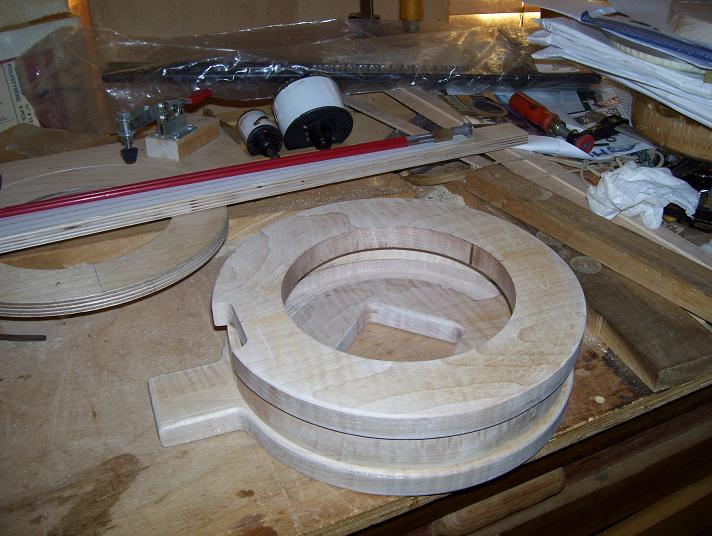 Mountain Banjo |
ObsidianSpike - Posted - 12/31/2012: 20:12:46
Thanks Nick! I might consider something like that tambourine as well.
Terms of Use | Privacy Policy | Privacy Consent (EU/GDPR Only)
Copyright 2026 Banjo Hangout. All Rights Reserved.


