
DVD-quality lessons (including tabs/sheet music) available for immediate viewing on any device.
Take your playing to the next level with the help of a local or online banjo teacher.
Weekly newsletter includes free lessons, favorite member content, banjo news and more.
Premier Sponsors





|
Please note this is an archived topic, so it is locked and unable to be replied to. You may, however, start a new topic and refer to this topic with a link: http://www.banjohangout.org/archive/173153/2
Page: 1 2 3 4 5 6 7 8 9 10 11 12 13 14 15 16 17 18
MountainBanjo - Posted - 03/19/2010: 23:02:02
Solo, you will need to have someone shape the pegs and ream the holes for you too since I assume you dont have those tools. I like metal tuners and will probably use them on the new one too.
My neck is not chunky. So far no problems with lightweight steel GHS strings. (PF-150) I have it tuned down 1/2 step for better sound, but I have tuned it all the way up. My neck is laminated mahogany, which may be stronger/stiffer than a 1 piece.
Solo - Posted - 03/20/2010: 07:33:51
Bisbonian .... 1 degree sounds like the way to go. I'm starting to see how building these things can become addictive, and open to experimentation.
Btw, those black walnut banjos of yours are incredible. How did you cut and plane the walnut from your mother's yard? It must have been one massive tree and I'm imagining that you had it milled.
MountainBanjo, thanks for this thread. About peg holes, I did purchase a set of two tapered reamers made by Cal-Hawk, for about $8. This will work fine for the peghead, but I'm thinking of also adding the 5th string reamer from Stew Mac. About cheap guitar tuners, Stew Mac has a set of five for $10.88, and they work great. I replaced the the dying tuners on a Rover RB-30 with these open geared things. I have a half dozen neglected sets of GHS lights kicking around which will be perfect, normally preferring heavier stings. Also, I'll bet that you're right about laminating the neck. A straight neck is central to the success of this banjo, and I'm thinkiing this might be the way to go.
raybob - Posted - 03/20/2010: 08:37:53
Rudy, That banjo in the picture is lovely. Do you ever make those fretless (or is the one you're finishing going to be fretless) ?
Bisbonian - Posted - 03/20/2010: 09:36:52
Thanks, Solo. The tree fell down over 20 years ago. She was living in a Northern California logging town, and had a local mill cut it up for her. She has moved a few times, since, and the walnut had become mantel pieces here and flooring there, and she slowly used it up. My brother started turning bowls out of some of it, and she made some spoons, and I thought I had better grab some before it was all gone. I got enough to make a neck for a tackhead, and all of my mountain banjo, and have enough left over to build her an autoharp. (Soon as I get done with all the banjos I have going!)
This is one I am working on today, from "hardware store walnut":
The front and back of the rim are made from a 1x6, laminated together matching the grain up as much as possible to make it look like one piece (at first glance, anyway.)
Jim D - Posted - 03/20/2010: 16:04:41
quote:
Originally posted by MountainBanjo
I just noticed something. On my first banjo the pot is flush with the outer edges of the front and back all the way around, and the neck meets it there at the base of the tabs. But Plate 173 shows the pot being smaller in diameter than the top/back, so the neck actually inserts between the top and back, as well as their tabs. They dont give a measurement for the insertion length, but it probably doesn't matter much. I am mostly wondering if you other builders are doing it that way, with the pot smaller than top/back and the neck inserted between them.
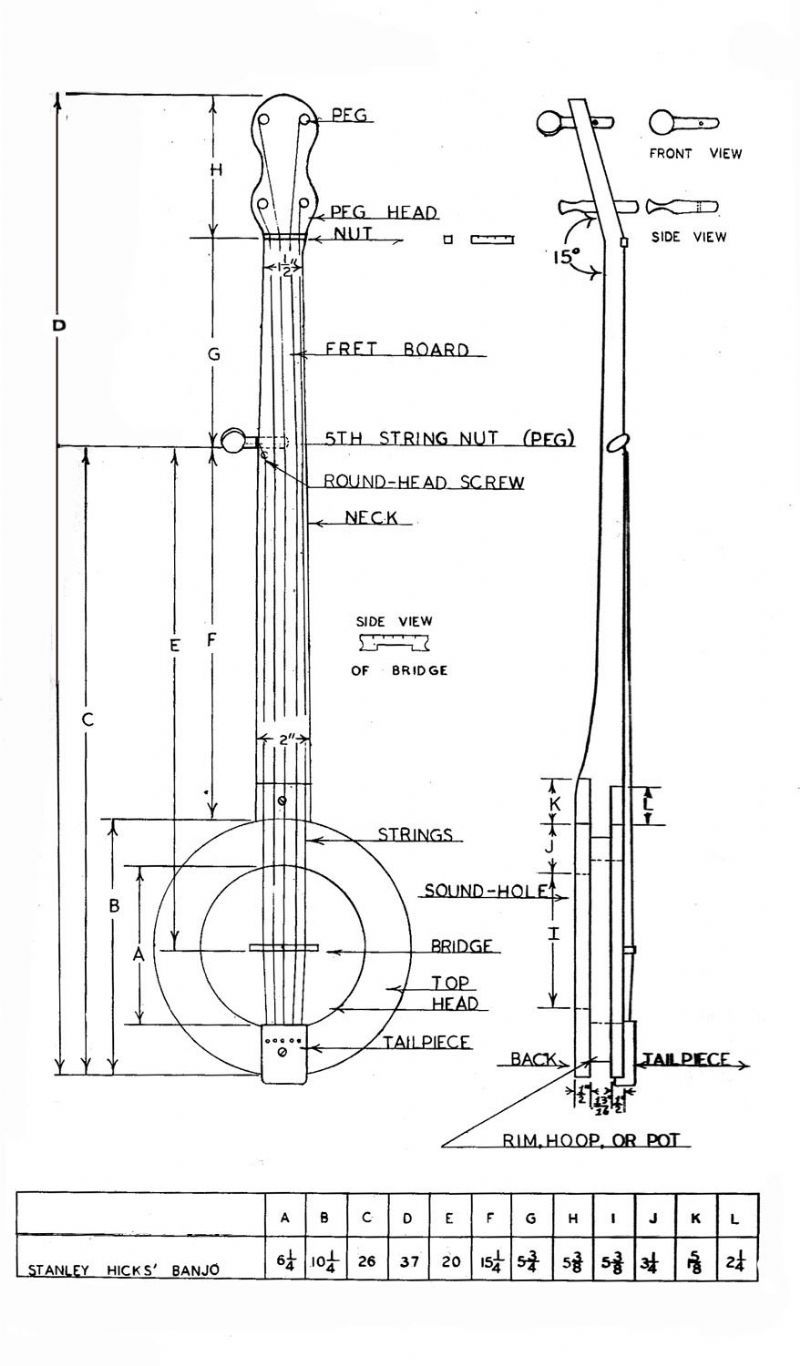 Stanley Hicks style from Foxfire 3 |
rudy - Posted - 03/20/2010: 17:44:16
Thanks all for the complements on my website info and plans.
Raybob,
The "Mountain Nouveau" banjos are fretless. They have flush maple "frets" inlaid in the finger board to serve as guides for intonation. I play a lot of fretless notes at the upper registers, so it's nice to have the flush frets there. Flush frets aren't needed for the lower notes, but I think they add to the looks of the fretless. The "Mountain Nouveau" is sort of like a mountain banjo pushed to new heights!
The latest one is very similar to the photo, but has a 10" fibreskin head and fifth string peg at the 6th fret to facilitate 4th string slides.
More info on the original instrument can be found at this archived discussion:
banjohangout.org/archive/134371
Edited by - rudy on 03/20/2010 18:28:12
Jim D - Posted - 03/20/2010: 18:13:16
quote:Hmmm. I knew I shouldn't have erased the plate numbers... OK, how about this. I simply measured my Hicks banjo. The centerpiece of the pot is only 1/2" less in diameter than the top and bottom plates.
Originally posted by MountainBanjo
That's plate 173.
Edited by - Jim D on 03/20/2010 18:30:33
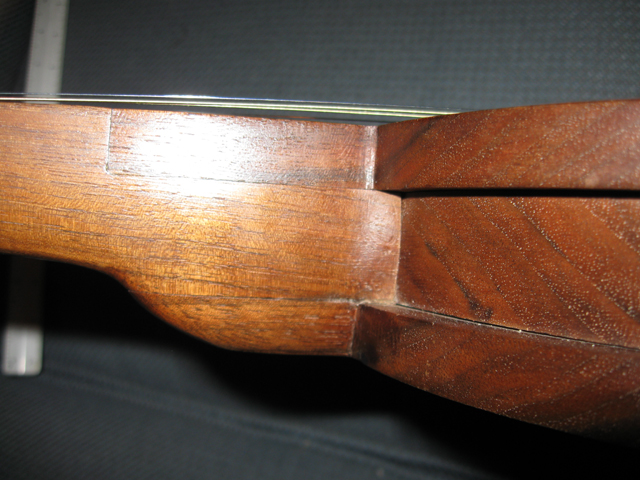 STH - Neck-rim junction |
raharris - Posted - 03/20/2010: 18:48:05
Hey mountainbanjo, looking forward to hearing you play your creation!
Seems to me I see you over at the Mandolin Cafe as well, yes?
Cheers,
Bisbonian - Posted - 03/20/2010: 20:07:54
Jim D, and MountainBanjo, I have seen them done both ways...with all three rings flush, and with the center ring indented. I've even seen flush examples made by Frank Proffitt and Stanley Hicks. I like the look of the indented center ring, though...looks a little more "rustic", or something.
raybob - Posted - 03/20/2010: 21:04:04
Rudy, That's very cool. Does one of the tunes on your music page feature the 'Mountain Nouveau' ? Do you ever tune it to 'A' or 'double D' ? I'll watch for it to come up in the classifieds.
Edited by - raybob on 03/20/2010 21:16:30
rteale - Posted - 03/20/2010: 22:07:11
quote:
Originally posted by MountainBanjo
the old and the rough cut new...
MountainBanjo - Posted - 03/20/2010: 22:53:53
quote:
Originally posted by Jim Dquote:Hmmm. I knew I shouldn't have erased the plate numbers... OK, how about this. I simply measured my Hicks banjo. The centerpiece of the pot is only 1/2" less in diameter than the top and bottom plates.
Originally posted by MountainBanjo
That's plate 173.
rudy - Posted - 03/21/2010: 05:16:05
Raybob,
Most of the fretless tunes on my Hangout music page are done on the Mountain Nouveau. The exception would be "1866" that was done to demonstrate my newest fretless with a 12" conventionally bracketed pot.
D tuning would normally be too high when using friction fit violin pegs. I normally tune lower to "E" tuning (eAEAB), although "G" tuning is also acceptable. Part of the charm of the fretless nylon strung mountain banjo is the lower tunings that sound so awesome with these banjos.
"Leroy's Extra Three" and other tunes such as Angeline the Baker are presented in two separate forms, one with only the banjo and a second with guitar/bass accompanyment.
hangoutstorage.com/banjohangou...22008.mp3
Edited by - rudy on 03/21/2010 05:18:50
MountainBanjo - Posted - 03/21/2010: 06:59:37
quote:
Originally posted by un5trung
Hey mountainbanjo, looking forward to hearing you play your creation!
Seems to me I see you over at the Mandolin Cafe as well, yes?
Cheers,
 Just build one.
quote:
Originally posted by rteale
What a very interesting thread this is. Lookin at MountainBanjo's pictures. From here you cut a large hole in the front and middle bits and a smaller hole in the back bit, is that right? How is the skin held in place? Do you create a small drum and drop it in. Perhaps I should get my glasses and check those plans.
Ray
Bisbonian - Posted - 03/21/2010: 08:59:10
Seven inches should work, but that's about the limit. You need room on the inside to attach the head, and enough thickness to the center ring/pot to be able to attach it to the top and bottom. The genius of rudy's design is that it allows for a bigger head, and incorporates some novel head-tightening features, and gives you a modernized banjo without external brackets digging into your knee, or blocking the view of that wood. I really need to sit down and build one. Soon as I get done with the next four mountains on my plate!
teebee - Posted - 03/21/2010: 10:57:11
I've made only 4 mountain style banjos and the first used a possum hide. It was too saggy. The others, I used plastic heads and bent wood to take the place of the tin can or tin sheeting. I was afraid the tin would cut the plastic head. The smallest uses a 6" Remo practice pad head and has an 8" wide pot. The one pictured uses an 8+" plastic head and has a 12" pot. The size was determined by what kind of practice heads were available at the music store that day. I like guitar tuners, so used them instead of tapered pegs. The first one I made was from a kit from MN. Maybe it was a Hero, can't remember. tybarlow.com
rudy - Posted - 03/21/2010: 18:03:13
Bis,
If you like the Mountain Banjo Nouveau design, I would add that if you decide to make one you might think about incorporating a small drum shell such as a Keller for the inner tensioning portion. It would reduce the labor of making one considerably. I've thought about making up a few like that. I kept the design as originally drafted so folks can make one without the need to purchase many items that they can make themselves. So many instruments to make, just not enough hours in the day!
teebee,
"Possum hide too saggy?" I would have thought "too greasy!” Actually, I love possums. Only North American marsupial with opposable thumbs, I believe.
The guitar tuners are a good idea. Not conventional as far a s mountain banjo goes, but innovation and functionality gets points with me.
On a side note, my kids were Urbana High grads! We lived very close to the high school for many years.
It would seem from this length of this thread that mountain banjo designs hold a lot of interest for many people. Aside from my more modernized designs, part of the attraction of these is their very primal nature. There's nothing quite like experiencing making music on an instrument that in its basic form is little more than stretched strings over a tensioned membrane. About as close to the diddly bow as you can get, and it doesn't get much simpler than that.
Mountainbanjo, keep up the good work of bringing this up occasionally!
Crowman - Posted - 03/21/2010: 18:17:36
Wow what great information and just what I was looking for. I ordered the Foxfire 3 book myself after reading this thread, and I have poplar and walnut available at the local Home Depot and Lowes. I am going to start building one ASAP, and walnut is my first choice but being my first scratch built I may go with poplar. I have been looking for something light, cheap that I could make myself and try to learn clawhammer on it. I am new to old time music and clawhammer type playing but this seems like the way to go. I was thinking could you order a small 8" Remo head and built the top to have an internal ring to hold it down? Don't know if this makes sense, but I have never worked with skins and they seem like they have a learning curve. I do appreciate the information and would very much like to communicate with someone who is building one and maybe we could learn from each other. My BG banjo is killing my back and this seems like the answer and maybe one day I could build a few to sell locally?? Please email if your interested in building one and we can share notes. I will be purchasing some wood this week and hopefully get started. I only have hand tools so its going to be tough, but my shop needs a band saw for sure, and this may be the reason to get one.
Thanks
Ronnie
Sultans of Claw - Posted - 03/21/2010: 18:41:52
quote:
Originally posted by Crowman
I have . . . walnut available at the local Home Depot and Lowes.
Sultans of Claw - Posted - 03/21/2010: 18:42:15
quote:
Originally posted by Crowman
I have . . . walnut available at the local Home Depot and Lowes.
teebee - Posted - 03/21/2010: 19:01:17
Crowman, the 8" Remo head sits on a wood ring. It's some basswood about 3/32" thick from the model/hobby section at Ace Hardware. The light colored plywood ring around the head is screwed down to hold the head and stretch it. It is pretty tight and has stayed that way for ages. The neck tang is sandwitched between the tabs on the top and bottom plywood. Just like the parts in MountainBanjo's pictures. Then a thin brass shim was placed under the tang to adjust the angle of the neck and it has been pretty stable. I did have to cut the bridge down a little to reduce the action. The brass came from Ace and may be a sign plate, like one of the directional arrows. In one picture at tybarlow.com you can see fret markers on the brass made with a pencil eraser mounted in a drill.
Wood, my experience is that walnut is easier to work with with sharp tools than is poplar. It takes a nice finish too. Poplar is sort of ho hum in my book. Probably cheaper, that's its virtue.
And my Urbana home was about 4 houses west of Race St on Indiana. That was at graduation in 1945. My banjo experience up to that time was seeing them played in the traveling Toby shows out in St. Joe during the summer in the late 1930's. I got a plectrum in the 60's and never figured out what to do with it. Things haven't changed that much.
The tailpiece.....On one banjo, I drove five nails into the edge of the top rim, used loop end steel strings slipped over the head. They were round brass eschutchion pins. The one pictured here, I drilled five holes in the rim and used ball end strings. The smallest one, I bent the end of a NoKnot tailpiece flat and ran a screw into the end of the pot. Then you get to fuss with how to get a good hitch onto those posts.
Edited by - teebee on 03/21/2010 20:05:42
MountainBanjo - Posted - 03/21/2010: 21:22:50
I was poking around earlier and came across this site that sells very reasonably priced mountain banjos and kits. I dont know anything about em though. I still think the best deal is building one yourself but for those who cant or wont:
stoneyend.com/dulcimers.html
Crow, I have only made one with skin but it wasn't difficult. Mine has stayed pretty tight. It will of course change sound with the weather but thats not always a bad thing. Its a banjo thing.
I think I may use deer skin on my current build, to keep it local.
Booger McGee - Posted - 03/22/2010: 08:55:43
quote:
Originally posted by Sultans of Clawquote:
Originally posted by Crowman
I have . . . walnut available at the local Home Depot and Lowes.
Really? That's amazing, good luck, I've never seen walnut at either one.
MountainBanjo - Posted - 03/22/2010: 09:28:28
My pot/top/back are made from laminated oak shelving. I know some people have made necks from oak but it may be harder to work. I would think most lumber stores have maple too, but I suppose it varies from place to place. Since walnut is a popular one people should know walnut dust can cause allergies in some people, more so than a lot other woods. Cant remember if I already said that above...so I'll say it again!
Bisbonian - Posted - 03/22/2010: 10:20:39
Our local Home Despot has red oak, and poplar. But a locally owned (yeah!) builder's supply place has very nice walnut, oak, maple (with the occasional curly piece), purpleheart, jatoba, poplar, mahogany, and a few others. At roughly HD prices. Dang!
I had a really strong reaction to lacewood a couple of years ago...I didn't know about the walnut, but it might explain the persistent sinus drainage I've got lately. I've been using a dust mask, and rig up a shop vac as dust collector, but maybe it's time for more effective measures.
Crowman - Posted - 03/22/2010: 11:37:30
Well neither of my local stores have maple, but I really like how oak looks finished. I did not know that about oak dust, thanks for the info. I have a coffee can that's 6 inch and I was thinking that would be perfect for a skin head? Who do you recommend for purchasing the small skins from. This is great information and I am looking forward to getting started. Thanks
Ronnie
Solo - Posted - 03/22/2010: 12:07:19
Oak presents a couple problems for this project. First, typical northern red oak is harder and more difficult to work than many other woods. It's certainly harder than walnut, cherry and poplar, and very similar to the hard maples. Second, it has a very open grain which makes it more difficult to apply a nice, smooth finish. It should be filled first, if you like the look. If you're going to be working primarily with hand tools, and doing a lot of sanding, then this is also a consideration.
About tanned skin heads, just google calf and goat skins for banjos. I've ordered them from Elderly Instruments in the past.
Bisbonian - Posted - 03/22/2010: 12:09:13
I've always wanted to try a coffee can. All I can find are the plastic ones. But if I had a metal one, I would cut out the lid part of the can, and use the thick edge to support the skin. You ought to be able to get two "tone rings" out of one coffee can. 6" is perfect. As for skins, I've just been using full sized ones from Elderly...can only get one head out of it, but I save the leftovers for...something. The link on the last page says they will have 10" (perfect for this!) available soon. Don't know how long ago they said that.
Crowman - Posted - 03/22/2010: 12:32:59
Yes, I thought the metal coffee cans would be great and thought I could probably get 2 out of one can. I just happen to have a couple metal ones and since they are there I am going to use them. I will check out the skins tonight when I get home. Now I got to figure out how to make my own tuners from walnut scraps? Thanks for help.
Ronnie
MountainBanjo - Posted - 03/22/2010: 13:06:15
Crowman its walnut that causes allergies, although any wood dust can depending on the person its more common in walnut than most others. I've been having sinus issues since cutting my yellow birch last week. Its always good to wear a mask, and I rarely do. Solo is right-I think I mentioned in one of my earlier posts that the oak was kind of a bear to work with, but it does sound great. I'd use it again if nothing was available but it wouldn't be my first or second choice.
If you live in or near a rural wooded area check with small local sawmills. They could have something real nice for a good price.
I used elderly goatskin. I just bought a roll of flashing and a snipper at Menards so I can make any size head I want. I'm choosing 7" because I have bowls with that diameter I can trace the pot/top holes with.
gjb - Posted - 03/22/2010: 14:38:23
I built a banjo neck out of red oak, almost entirely using hand tools. It was harder to work with than some other woods, but I'm happy with how it turned out. I used oak for the fretless fingerboard on it as well, and really like it. I'm building a mountain banjo out of poplar and cherry right now, though, and both of those woods are much easier to work with than red oak.
The mountain banjo I'm building at the moment uses an 8" Remo pre-tuned hand drum for the head. It just drops in, so it could be replaced if necessary. I build another banjo (not a mountain banjo) that uses one of these hand drums for the pot and have been happy with the sound.
Edited by - gjb on 03/22/2010 14:45:57
Crowman - Posted - 03/22/2010: 18:33:57
yes I was meaning to say walnut dust before but was thinking oak as that is the only other wood choice I have at local lumber stores. We are eat up with oak in NC, and your right its hard to work with. I am building a parts banjo now out of walnut and I really like the way the Tru-Oil finish is looking on it, and thats what I meant to say and that it was concerning me after I had been sanding for several days on the walnut without a mask. Anyway, poplar may be a better choice after all :) Just seems like its hard to get a good looking finish on it, although I havent used it before just seen other folks work. I have saw folks paint it before, and I would rather not paint it if I build it. Any thoughts on staining it before putting Tru-Oil on it. The Tru-Oil is very easy to work with for someone like me who has no wood working experience. Also, do you laminate the neck or use one 1" board for the neck? I plan to take the drawings from this thread to office max to get them printed in full scale and I am sure it will help. The Foxfire book will help also when it arrives. I just don't have a parts list ready to go to Lowes, so I need to get that done before the trip. Oak may be an option as I have seen on here but I dread working with it, as I have worked it before, and it aint fun. Sorry for the confusion on oak and walnut, but hopefully this cleared it up.
Ronnie
Crowman - Posted - 03/22/2010: 18:38:02
Mountainbanjo what do you mean by flashing? Do you mean the metal flashing like is used on roofs? I have a roll of that already, but did not think of using metal for the head? It is very thin and flexible though come to think about it?
Ronnie
MountainBanjo - Posted - 03/22/2010: 20:31:47
I am just going to use the flashing for the metal tube the skin sits stretches over, instead of stovepipe. I can make a 7inch head with it. I wouldnt use metal for the head, but some of these old mountain banjos used no skin either, just a solid wood top. But skin is better I'm sure.
Edited by - MountainBanjo on 03/25/2010 06:32:56
Crowman - Posted - 03/23/2010: 04:43:26
That sounds good mountain and the flashing will be easier to work with than stove pipe. I did not think I had ever saw a metal banjo head before. Now I have to make a choice on wood, what does the group think would be the best for my first banjo build Red Oak, Poplar or Walnut? Help me out, I'm a newbie as you can see?
Ronnie
rudy - Posted - 03/23/2010: 05:46:54
Crowman,
I'd vote for walnut from your list of choices. It would require filling of the wood pores before finishing, though. I dislike oak for instrument work of any kind due to it's tendancy to splinter. Poplar is too soft to use IMHO. It might make a good wood to "learn" on. My preferance would be maple as it's easy to work and finish.
teebee,
My kids lived half-time with their mom at 206 Indiana. That's got to be darn close to where you lived! Small world.
gjb,
quote:
I build another banjo (not a mountain banjo) that uses one of these hand drums for the pot and have been happy with the sound.
Edited by - rudy on 03/23/2010 05:57:06
gjb - Posted - 03/23/2010: 07:38:32
I can take some pictures later today and post them, but I don't have any on hand.
This is the line of drums I've used (remo.com/portal/products/6/20/...kyn3.html). The downside to using just these Remo drums for the pot is they aren't made of wood; they are "Acousticon" cardboard with a veneer. This makes them pretty light, so the balance of the banjo is a little off. The fact that my neck was make of oak probably didn't help. The larger drums in this series have a thumb notch and holes for attaching a rope tuning system, this starts with the 12" drum. That said, the sound is good and the drums are very stable. The drums have Fiberskyn heads, though they might be a little thicker than a Fiberskyn banjo head. The price is great, though. Remo does make some more expensive frame drums with tensioning hooks (remo.com/portal/products/6/20/...d_kt.html). They also make a line with Renaissance heads (remo.com/portal/products/6/20/...ance.html) instead of Fiberskyn, but those are hard to find.
I've recently bought a different variety of frame drum to try to make into a banjo (interstatemusic.com/webapp/wcs...Id=175435) that has a real skin head. Unlike a lot of cheap hand drums and tambourines, the head is both glued and tacked on and has an actual maple rim. The rim is only 1.75" deep, and it does have a 3/4" thumb hole, but my plan is just to have the dowel stick extend through the hole so I can tie the tailpiece to it. The largest size for these is 10" though, which is a bit smaller than you were looking for. The skin head is really nice though, and this would be an easy way to make a tackhead.
Jim D - Posted - 03/23/2010: 14:54:41
Just a note... I'm a wood carver. The dust of MANY forms of wood are allergenic and some may be carcinogens. I am allergic to oak dust but have no problem with walnut, although I know those that do.
A fair amount of safety can by attained with a GOOD dust mask (not the $1.50 paper things) or, even better, a dust collection system.
Rule number one is "Avoid breathing the dust, no matter what the wood!"
Jim D - Posted - 03/23/2010: 14:57:17
I spent the last few days at Colonial Williamsburg. At the Abby Aldrich Rockefeller Folk Art Museum they had a small exhibit of "folk" instruments.
Here's a NC Mountain banjo from around 1900... from the same area that produced Stanley Hicks, and Frank Profitt.
The label says:
Banjo - Maker unidentified
Probably Watuga County NC
1890 – 1910
Maple Neck, Gut strings
Rim and Body – maple front, poplar sides
Jim D - Posted - 03/23/2010: 15:00:02
Here's a photo that shows the back side of the Mountain Banjo to your left.
The banjo in the foreground is a nice one, also.
Its label says:
Banjo – Eugene Chapman
Southern Appalachians, ca 1863
Walnut neck, beech rim with brass
Tensioning hooks, band, and brackets
Crowman - Posted - 03/23/2010: 15:59:45
Jim D those pictures are very nice and show up well. really helped a lot. I learn more every day I check in on here. Thanks for the info on the wood dust, as I need to do better especially in my small shop. I would really like to learn to wood carve so I can add that to the banjo building, but I think thats over my head for sure?
gjb thanks for the info on the hand drums, I had already ordered one of the Remos with the Fiberskyn head in 8" when I saw your post. Looks like a good cheap way to try this out. The other one with the real skin head even looks nicer, and I will order one of those also. I think I am going to try to build one in poplar first, just to see if I can do it. The Hicks banjo drawing really helped me with the list of the materials. Next I might try walnut or maple, but I would really like to see if I can actually build one from scratch first.
Thanks
Ronnie
teebee - Posted - 03/23/2010: 17:55:22
Rudy, we were at 207, this might get you to a Google map, maps.google.com/maps?hl=en&tab=wl
I was sanding floors after high school graduation. I remember being sick a lot then, probably from the oak floor wood dust.
Crowman - Posted - 03/23/2010: 18:35:33
Rudy, your construction guide is great, and your work is outstanding. You have some great ideas, and the tube for the 5 th string is a great idea, and I for one hate the tuner sticking out and your idea gets rid of it. I wish I could learn to do work like yours, I spent a lot of time on your sites and I appreciate the time you spent to show folks how to do this.
rudy - Posted - 03/23/2010: 20:14:44
Crowman,
Thanks, I always aim to please!
teebee,
Yup, right across the street. I'll have to check which house next time I'm over that way. Either 207 or the one next door was where Adrian Belew (King Crimson, etc.) lived when he was in Urbana for several years.
gjb,
Thanks for the quick response! I'll check out the links ASAP. I thought I'd go with the 12" as it's a realistic 2-3/4" deep. Most of the others are too shallow to be useful.
rteale - Posted - 03/23/2010: 23:36:53
Found this on the net relating to Foxfire 3
scribd.com/doc/8961322/Foxfire-Three
If this is breaking somebody's copyright then please ignore.
Ray
teebee - Posted - 03/24/2010: 05:37:40
Thanks rteale, finally got some use out of that wheel on my mouse. That's interesting. It's certainly not the way Waring builds a mountain banjo and I don't think it's quite like what we've discussed here. Is there another Foxfire reference to mountain banjos somewhere?
The answer to my question is, just read further in the book. There are several different banjo patterns shown and discussed. Sorry!!!!!!
Edited by - teebee on 03/24/2010 05:47:49
Viper - Posted - 03/24/2010: 08:13:15
quote:
Originally posted by rteale
Found this on the net relating to Foxfire 3
scribd.com/doc/8961322/Foxfire-Three
If this is breaking somebody's copyright then please ignore.
Ray
Ernest M - Posted - 03/24/2010: 16:02:39
Someone posted a link to this video in another thread:
median.emerson.edu/media/video_misc/520/
Check out the banjos on the wall, especially that octagonal one on the wall to the upper left.
The player is Taj Mahal rocking out.
EM
Terms of Use | Privacy Policy | Privacy Consent (EU/GDPR Only)
Copyright 2026 Banjo Hangout. All Rights Reserved.


