
DVD-quality lessons (including tabs/sheet music) available for immediate viewing on any device.
Take your playing to the next level with the help of a local or online banjo teacher.
Weekly newsletter includes free lessons, favorite member content, banjo news and more.
Premier Sponsors





|
Please note this is an archived topic, so it is locked and unable to be replied to. You may, however, start a new topic and refer to this topic with a link: http://www.banjohangout.org/archive/173153/5
Page: 1 2 3 4 5 6 7 8 9 10 11 12 13 14 15 16 17 18
MountainBanjo - Posted - 05/02/2010: 10:51:28
Thinking of maybe trying something like Rudy's design for my next one, or something else for a larger head and pot. I havent scrutinized the plans closely but is there a way to adapt it to using a skin head? A banjer just isnt a banjer if there isnt a dead animal in it somewhere...
Solo - Posted - 05/02/2010: 12:55:48
quote:
Originally posted by MountainBanjo
Thinking of maybe trying something like Rudy's design for my next one, or something else for a larger head and pot. I havent scrutinized the plans closely but is there a way to adapt it to using a skin head? A banjer just isnt a banjer if there isnt a dead animal in it somewhere...

devoall - Posted - 05/02/2010: 13:13:00
Good Job solo. Keep posting those pictures! it's an inspiration to all of us.
Craig - Posted - 05/02/2010: 17:22:29
I've made two mountain banjos, both out of curly maple. It looks very traditional but I decided to use modern technology. I've used a plastic 6" bongo drum head instead of skin, and a PVC pipe fitting inside instead of stove pipe. All the round parts are made with a router. The middle section is routed to hold the aluminum around the bottom of the head. Finally, all the tuners are geared so tuning is much easier and never slips. You can see it in the pictures section of our web site and I use it to play John Henry on our most recent CD...there is a sound clip. Check it out here:
thepleasantfamily.com
Craig - Posted - 05/02/2010: 17:49:31
I have to confess I'm not reading all the comments in order. In fact I read the first page and then went to the last page. So now I'm reading about tailpieces on page 8. I made a wooden tailpiece. It's curved to the diameter of the pot and it has 5 holes across the top and 5 small round head brass screws below the holes to hold the string loops. The part below the top is V-shaped with two screws into the top and one screw in the bottom. It has the added advantage of serving as the place I tie my rawhide strap. I put a guitar end-peg into the heel to hold the other end of the strap.
Bisbonian - Posted - 05/02/2010: 19:30:50
Two of my banjos have the simplest of tailpieces: five small holes drilled through the top plate. The strings are knotted, and fed up from the underside of the lip that sticks out past the middle ring, through the top plate. The holes angle toward the skin head, so they meet a couple of the criteria mentioned above...close to the head, and a little more downpressure on the bridge. Not an elegant tailpiece, but it does the job, is almost unnoticable, and as simple as can be.
Edited by - Bisbonian on 05/02/2010 19:31:50
Solo - Posted - 05/02/2010: 22:37:43
quote:
Originally posted by Bisbonian
Two of my banjos have the simplest of tailpieces: five small holes drilled through the top plate. The strings are knotted, and fed up from the underside of the lip that sticks out past the middle ring, through the top plate. The holes angle toward the skin head, so they meet a couple of the criteria mentioned above...close to the head, and a little more downpressure on the bridge. Not an elegant tailpiece, but it does the job, is almost unnoticable, and as simple as can be.
Bisbonian - Posted - 05/04/2010: 10:03:41
Thanks, Solo...that's exactly how I built the tone ring. There are pictures of it in progress earlier on this thread. The sound is noticeably louder than with the metal ring, which surprises me a bit. I'm playing with too many variables at once, though...it also has a thinner bridge than I normally make, and the bridge is topped with a strip of purpleheart.
The really big surprise (to me) is the much greater variation in tone, and volume, in moving playing position up the neck. Most of the mountain banjos I have played don't change much as you move up the neck, but this one is VERY noticeable. The tone is almost nasal toward the bridge, and gets much warmer as I move toward the pot/neck joint. Quite a bit louder, too.
Oddly enough, I think the shape of the anchor soundhole is affecting the tone, and volume. First, the banjo is significantly louder from the back. And if I pluck a string and listen, from the back, I can hear different overtones coming out of the hole than I hear from the front. It's like those two large peninsulas of wood between the points and the crossbar on the anchor act as a partial resonator, reflecting the sound back up to reverberate off the head again. Helix has talked about building some sort of fresnel lens into the back of a rim...and I may have hit on a crude form of the same idea.
The purpleheart strip on the back of the neck is actually a 1/4" thick strip laminated between the two walnut sides of the neck. Then there is a 3/16" "fretboard", also of walnut, on top of the neck, and the same for a peghead overlay...so at first glance it looks like the purpleheart might be inlaid.
Bisbonian - Posted - 05/04/2010: 10:10:40
"The Pleasant Family... not a real family; not really that pleasant!"
Love the website, Craig :)
Craig - Posted - 05/04/2010: 16:23:19
Thanks to teebee and Bisbonian from The Pleasant Family! (You can also find us on YouTube.)
Bisbonian, one of my two fretless banjos has a head that doesn't quite fit right. I believe your aluminum pot design will work to solve the problem, at least I want to try it. Am I correct that you butt the ends of the hoop and rivot a piece on the inside? I've curled it around a form and I took it off to cut it. I notice the last couple of inches don't curve as well as the rest.
RG - Posted - 05/04/2010: 18:18:42
Just got through reading this thread and it's great, some real talent and ingenuity out there, but I must say that my favorite post is the picture of Rudy's dog...priceless...dogs life indeed!!
Edited by - RG on 05/04/2010 18:19:06
StPeteNick - Posted - 05/04/2010: 20:19:42
Hey Craig,
I was the guy drooling over your mountain banjo a few weeks ago at the old time music competition at Sertoma (it was the first real mountain banjo I have ever seen.) Glad to see you dropped in on this thread.
Bisbonian,
great work on the 'anchor' banjo.
This is a great thread ....can't wait to start building my own mountain banjo...
Nick
Edited by - StPeteNick on 05/04/2010 20:21:28
Solo - Posted - 05/04/2010: 21:31:18
quote:
Originally posted by Bisbonian
Thanks, Solo...that's exactly how I built the tone ring. There are pictures of it in progress earlier on this thread. The sound is noticeably louder than with the metal ring, which surprises me a bit. I'm playing with too many variables at once, though...it also has a thinner bridge than I normally make, and the bridge is topped with a strip of purpleheart.
The really big surprise (to me) is the much greater variation in tone, and volume, in moving playing position up the neck. Most of the mountain banjos I have played don't change much as you move up the neck, but this one is VERY noticeable. The tone is almost nasal toward the bridge, and gets much warmer as I move toward the pot/neck joint. Quite a bit louder, too.
Oddly enough, I think the shape of the anchor soundhole is affecting the tone, and volume. First, the banjo is significantly louder from the back. And if I pluck a string and listen, from the back, I can hear different overtones coming out of the hole than I hear from the front. It's like those two large peninsulas of wood between the points and the crossbar on the anchor act as a partial resonator, reflecting the sound back up to reverberate off the head again. Helix has talked about building some sort of fresnel lens into the back of a rim...and I may have hit on a crude form of the same idea.
The purpleheart strip on the back of the neck is actually a 1/4" thick strip laminated between the two walnut sides of the neck. Then there is a 3/16" "fretboard", also of walnut, on top of the neck, and the same for a peghead overlay...so at first glance it looks like the purpleheart might be inlaid.

devoall - Posted - 05/06/2010: 00:00:56
quote:
Originally posted by Soloquote:
Originally posted by Bisbonian
Thanks, Solo...that's exactly how I built the tone ring. There are pictures of it in progress earlier on this thread. The sound is noticeably louder than with the metal ring, which surprises me a bit. I'm playing with too many variables at once, though...it also has a thinner bridge than I normally make, and the bridge is topped with a strip of purpleheart.
The really big surprise (to me) is the much greater variation in tone, and volume, in moving playing position up the neck. Most of the mountain banjos I have played don't change much as you move up the neck, but this one is VERY noticeable. The tone is almost nasal toward the bridge, and gets much warmer as I move toward the pot/neck joint. Quite a bit louder, too.
Oddly enough, I think the shape of the anchor soundhole is affecting the tone, and volume. First, the banjo is significantly louder from the back. And if I pluck a string and listen, from the back, I can hear different overtones coming out of the hole than I hear from the front. It's like those two large peninsulas of wood between the points and the crossbar on the anchor act as a partial resonator, reflecting the sound back up to reverberate off the head again. Helix has talked about building some sort of fresnel lens into the back of a rim...and I may have hit on a crude form of the same idea.
The purpleheart strip on the back of the neck is actually a 1/4" thick strip laminated between the two walnut sides of the neck. Then there is a 3/16" "fretboard", also of walnut, on top of the neck, and the same for a peghead overlay...so at first glance it looks like the purpleheart might be inlaid.
Fascinating about the sound qualities of the purple heart. I just finished reading about it's physical qualities, having a moderate to severe blunting effect on tools. Hahaha! Must be durable, in addition to it's other abilities.
I'm going to have to consider the Helix theory about fresnel lens type sound projection, being a sailor and very thankful for the efficient qualities of lighthouses. Multi-angular reflective surfaces should have a great impact on sound. Here's one of the best first order lighthouse fresnels I've seen:
You had me fooled with your neck laminations. I was thinking router inlay. It goes to show how beneficial it is being able to craft perfectly flat surfaces in the shop. I really like Rudy's idea of the Wagner Safe-T planer, thoroughly attracted to the notion of planing and safety. I used to have a radial arm saw with a thoroughly evil planing attachment. It had the occasional ability to grab the wood being planed, flinging it at light-speed somewhere. My last experience with this thing got me squarely in the abdomen. I was nearly halved, like in the Dewey Cox Story. Great flick, and I was walking hard for quite a while after this exciting adventure in carpentry. My planer got tossed and it's now time to join the Wagner crew.
youtube.com/watch?v=CqwlLLm87xU
Flat surfaces, round holes, graceful curves, perfect rings ..... it's a wonderful thing. Great banjo.
Craig - Posted - 05/06/2010: 15:31:07
I successfully made an aluminum inside ring. The old ring was a but smaller and left little wrinkles all around the outside of the 6" head (not a Remo). It's much better now...both tighter and closer to the edge of the hole in the top. The tighter head improves both the sound, both tone and loudness.
Thanks for the tip!
Craig
Bisbonian - Posted - 05/07/2010: 22:44:38
Awesome...good to hear it, Craig. The Golden Age of Banjos just got a little better :)
tonet - Posted - 05/08/2010: 09:25:30
What kind of strings (steel, nylon, gut) used Foxfire mountain banjo makers?
Edited by - tonet on 05/08/2010 09:26:19
Craig - Posted - 05/08/2010: 13:45:34
I use Elixer strings, because I don't change them very often and they (4th string is teflon coated) don't tarnish.
rudy - Posted - 05/08/2010: 14:53:12
tonet,
I see you hail from the mountains of Spain! Welcome to the wide world of mountain banjo.
The Foxfire books document the processes of mountain banjo construction used by several different makers. Many of these folks used materials that they had available to them or that could be obtained locally with little or no cost involved. I'm sure more than a few feral cats sacrificed their lives for a set of new strings. Many of the very early mountain banjo designs utilized gut strings, so it's a very natural progression to use the currently popular Nylguts made by your close neighbors, Aquila of Italy. The farm cats of the world thank them for their fine products. I would think they should be readily available to you.
Some makers are using classical guitar strings. Others are using steel strings, but the increased tension usually requires some sort of mechanical tuner. Friction pegs usually are used with lower tension nylon strings such as the Nylgut. Nylon fishing line is also a popular alternative material.
Hopefully that answers some of your questions.
On an un-related note, I was going to post the 200th comment in this topic but it got away from me somehow. If it keeps going, I'll try for post number 300! It's great to see there is enough interest in "The Amazing Mountain Banjo" to keep it going this long. The mountain design is really quite adaptable for a wide variety of skill levels from the "tensioned fishing line on a stick" concept all the way to the current crop of very nice designs done by many of the folks who have posted here. One of my favorite folks, Jon Whitney (our own Jonnycake White) comes to mind. Check out his home page photos for some nice jos. He posted to this topic back on page 8, I believe. I love to see folks pushing the envelope of tradition.
I've got a whole new top tension design that I'm currently working on, so the story continues and the design evolves!
Edited by - rudy on 05/08/2010 15:21:57
Bisbonian - Posted - 05/08/2010: 18:37:22
I read somewhere about one of the mountain banjo makers (Proffitt, Hicks, somebody else...) pulling steel strings from the front door screen. At least the cats were happy :)
tonet - Posted - 05/09/2010: 06:47:12
Rudy and Bisbonian, thank you very much for your answers. I have a soprano ukelele with nylguts and I love its sound. Surely I will use these strings in the future for my banjo.
Bisbonian, do you use nylguts in this video? The sound of your banjo is lovely.
youtube.com/watch?v=P5N5R9fdOP...e=channel
This topic is changing my mind about banjos and music. I bought a Xina made openback banjo one year ago to play clawhammer. Some months ago I was interested in american made fretted openbacks banjos to update my crappy one. But I found this topic and I am really amazed in everything related with mountain banjos. I bought Foxfire 3 book and one day I have the intention to build my own mountain banjo. I admire a lot all banjo makers.
But first I want to buy one to check its sound, playbility, weight and learn how to play with a fret-free instrument. Could you tell me the current mountain banjo makers, please?
Edited by - tonet on 05/09/2010 06:55:13
Bisbonian - Posted - 05/09/2010: 08:20:36
Yes, tonet, I have Nylguts on practically everything. I like the sound, and especially the feel. They take about 2-3 days to settle in and stay in tune, but once they do, they are very stable. I use the "classics" for most banjos, and I have a set of "minstrels" on a gourd banjo, tuned much lower. I know there are a few other favorite nylon strings here on the BHO, but I haven't tried many of them. I have played a Brooks fretless with Chris Sands (black) nylon strings on it, and they were very nice as well. Perhaps a little stiffer than the "classics", but a little smoother to the feel. Some people (myself included) like the "toothiness" of the nylguts...a little more friction to the feel of the way your nail strikes it.
Solo - Posted - 05/10/2010: 14:18:29
quote:
Originally posted by devoall
Hey Solo, check out the pics of my Helix on my hangout page. you can see the ridges that Larry turns into his rims to approximate his version of the fresnel. It's pretty cool. I think it sounds pretty good as well.
Crowman - Posted - 05/10/2010: 17:38:55
Well guys I still check in once in awhile to see the thread, but have not be able to start my banjo yet as I am still taking care of my Dad as he is very sick. I hope that by reading this thread and learning from all of you that when I do get to build my first it will be a nice one as I have learned alot already. Been a rough road for Pop but he is hanging in there. See ya later.
Ronnie
ronwalker49 - Posted - 05/10/2010: 18:03:48
Hi Crowman.....Still remembering your Dad when talking to God....All my best wishes..
Solo - Posted - 05/10/2010: 20:12:27
Crowman, lost my Dad in '84 and it still feels like I've lost my best friend. Hope you Dad has an easier road ahead.
Good to see you back Ron. Hope you're recovering well, and getting back into music.
ronwalker49 - Posted - 05/10/2010: 21:25:08
Thanks Solo....Starting to feel like a human again....Have been fooling around out in my shop a little.....Have been working on fiddles, they are small and I can sit at the bench and work on them mostly hand work and I have a bunch of them....I just put together a 1/2 sized that sounds surprisingly good....
Played a little music today with my buddy Eugene (the Dobro picker) and my wife Donna (guitar) had a pretty good time but got tired fast....Things are startin to look up....
rustman - Posted - 05/11/2010: 04:15:55
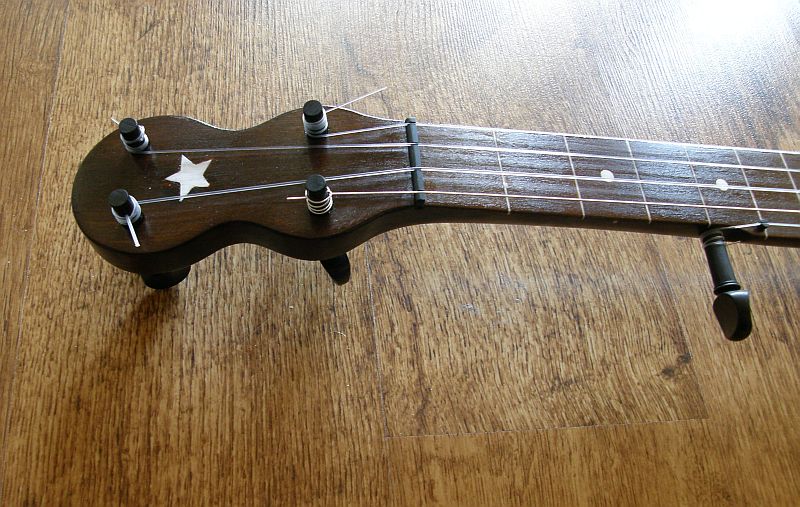
I'm writing this to let you all know that my mountain banjo is well on the way. Few days ago I ordered a peg hole reamer to get the holes right at the first try. Actually all I need is the inside ring and finishing after I make the peg holes. I made the flush frets, dot marks on the fretboard and small dots at the side of the fretboard. I even made the star inlay on the headstock. Pics will follow.
devoall - Posted - 05/11/2010: 16:06:33
Hey folks.
What size neck stock are you guys using for your neck blank?
One piece or two.
Thanks.
Im starting to look for wood and would like to know what dimensions to look for.
MountainBanjo - Posted - 05/11/2010: 18:43:27
I used three laminated 1x4s on my first one. The stock I used for my 2nd one was from a local sawmill and was nearly 1" thick so I only needed 2. In both cases I had to laminate ears onto the peghead.
Craig - Posted - 05/11/2010: 20:07:58
I used a one piece neck. The peg head was a simple design the fit the width of the wood.
rinemb - Posted - 05/25/2010: 07:58:48
Bisbonian, please contact me [pm] so we can descuss, need an email addr. Thanks, Brad
Bisbonian - Posted - 05/26/2010: 18:57:59
Progress on a couple more banjos. This one is all walnut:
I decided to give up on trying to do the neck joint with machines and jigs, and just do it by hand. It was much more satisfying to me to do it with a file, and I came out with a better fitting joint in the end, too.
And here is the next one in line. I'm building it out of jatoba. HARD, heavy, splintery...I don't recommend it...but the tone from knocking the pieces is fantastic, so it ought to sound great. I'll let you know:
rustman - Posted - 05/28/2010: 07:21:56
Hello Everybody!
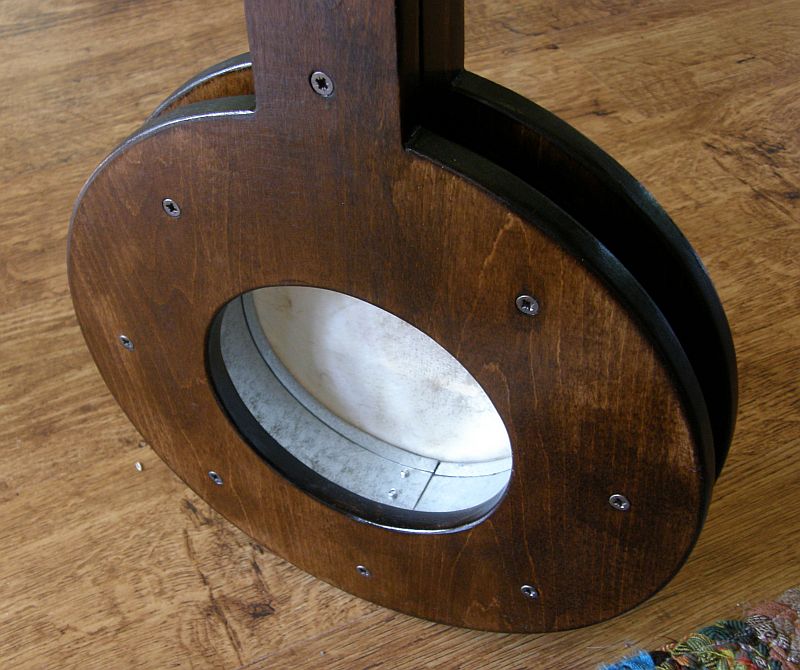
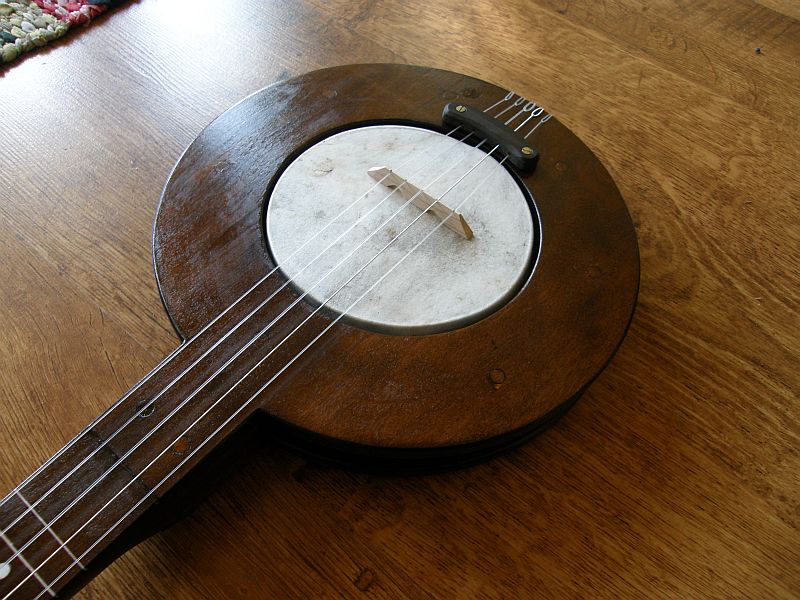
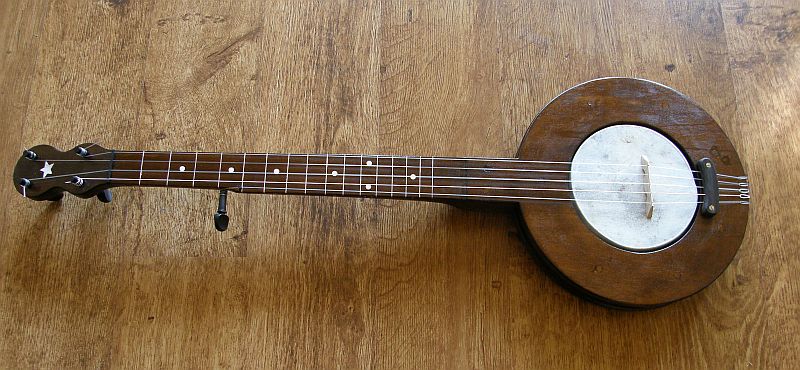
Here it is! My first Mountain banjo. Maple body with ebony tuning pegs and flush frets. This thing sounds great  Easy to play and with no actual frets it's easier to play than normal banjo because you don't have to worry about hitting the right fret, heh! Some pics here. And the summer has arrived in Finland!
Cheers!
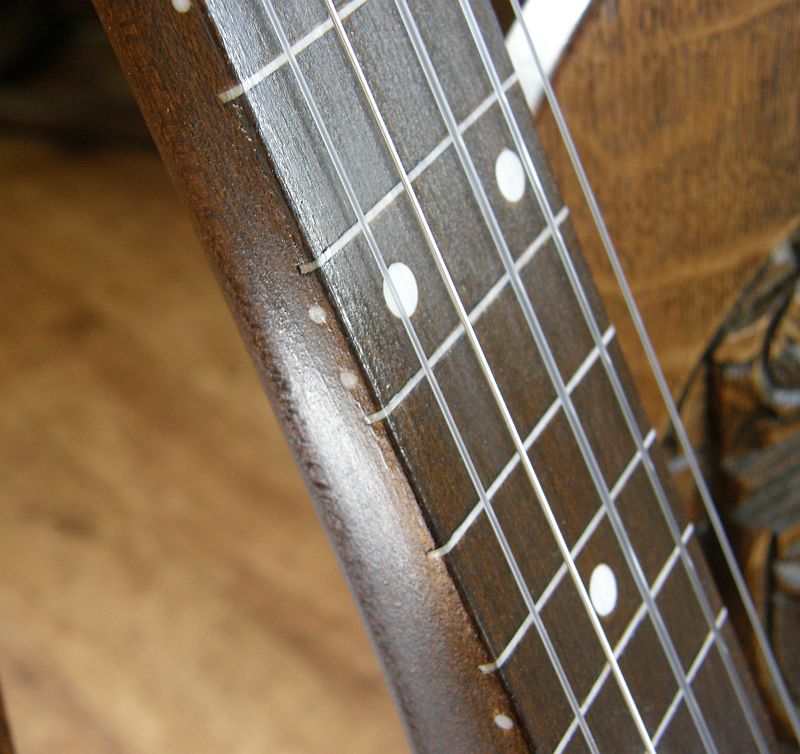 | 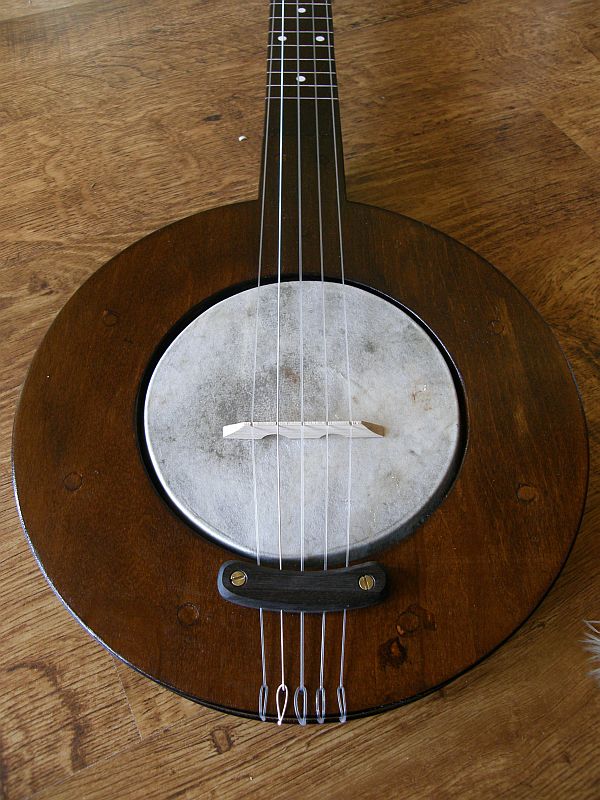 | 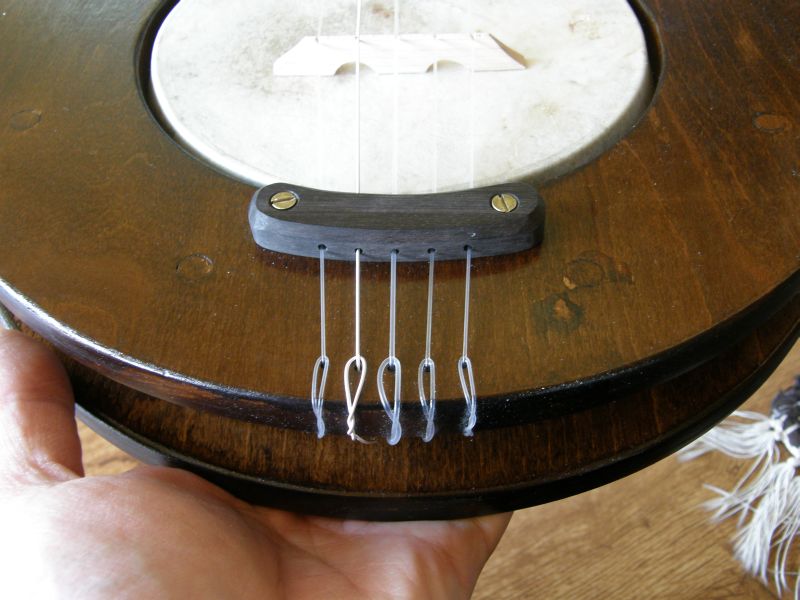 | 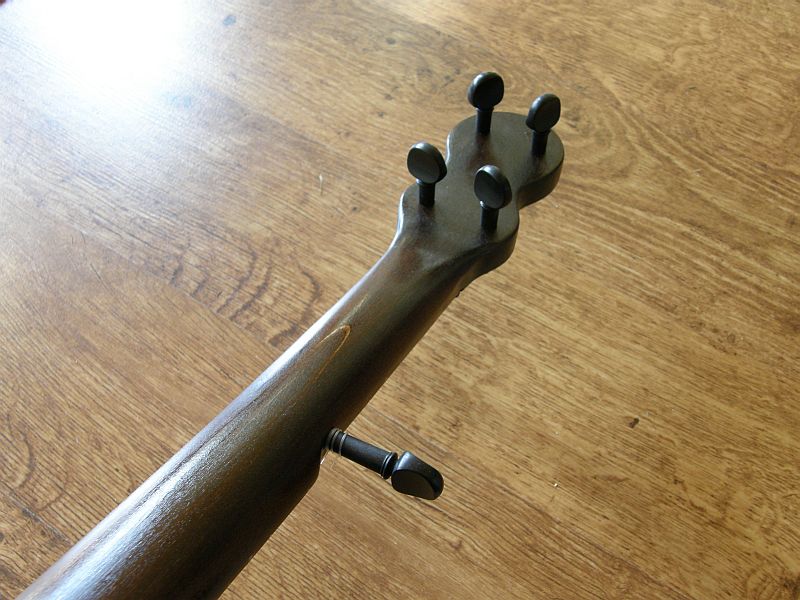 |
 |  |  |  |
ronwalker49 - Posted - 05/28/2010: 08:13:52
Rustman- that looks like a great first effort to me.....Congratulations on a fine looking banjo....
tonet - Posted - 05/29/2010: 23:52:47
Hello Rustman
Your banjo is gorgerous. Could you upload a soundfile played with this beauty?
Regards
Edited by - tonet on 05/29/2010 23:59:13
rustman - Posted - 05/30/2010: 02:55:17
Thanks!
It sure is fun to play and the sound is nice. I have basic classical guitar strings on it, but I'm planning to order nylguts for it. I've been playing banjo for only about two months, so my skills are somewhat humble. I'll try to record a sample in the near future. Staying in tune is a challenge with this fretless instrument.
MountainBanjo - Posted - 06/02/2010: 06:22:27
nice job Rustman, your first looks nicer than my second.
rustman - Posted - 06/02/2010: 09:32:02
Thanks ronwalker49 and MountainBanjo!
Tonet, you asked for a sound file. Well, here it is. No eq, no compression, no effects. Recorded mono with modded Oktava MK-319 microphone.
Cheers!
I might add that the banjo is tuned to fCFAC.
Edited by - rustman on 06/02/2010 09:36:35
 Jesse James |
Alan Hill - Posted - 06/02/2010: 22:01:40
As a novice player from Australia this thread has been most enjoyable and an education and I must thankyou all what great banjos and friendlyness well done lads !
drummer101 - Posted - 06/12/2010: 10:34:43
I have been working on a mountain banjo for the last week, mashed together with whatever wood and things I found around my dads workshop and sheds. I think it's coming along well theres just one thing im slightly worried about and that is the neck. It seems to be quite a soft wood and I have already managed to dent it numerous times while working on it. I was wondering if there is anything I can treat the wood with to make it even a little harder on the outside.
MountainBanjo - Posted - 06/12/2010: 13:56:49
if it is "quite soft" then you will be better off finding another piece of wood for the neck. I'd be more than slightly worried, because it will lead to a poor sounding, poor fitting banjo that might discourage you from building another. You could use this one as practice for cutting and shaping maybe, and get your woodworking technique down. But if its truly a soft wood like pine or spruce or fir (and those are the woods someone is most likely to have just hanging around), it will not make a good neck either structurally or tonally. You might be able to get away with using it for the pot, but I think I would use plywood for the pot before spruce-pine-fir.
You dont have to spend a lot to get good neck wood, most lumber or home improvement stores should sell mahogany or maple or something fairly cheap. I see you are in Ireland so it may be different there, but you probably have some easy to get cheap local hard wood. You want hardwood.
Edited by - MountainBanjo on 06/12/2010 13:58:45
rustman - Posted - 06/13/2010: 10:13:05
Hello you all!
I just added a song on my myspace songs.
myspace.com/mattimikkonen
Choose "Iron Bench" a sort of ghost story featuring my mountain banjo in sawmill F tuning. Also, the mandolin banjo I fixed can be heard on the left.
Feel free to listen to the other songs as well 
Check out for
myspace.com/thebeautifulpeoplemusic
We have an album ready and we are looking for a record label.
drummer101 - Posted - 06/15/2010: 08:22:18
Thanks for the reply MountainBanjo. This was only supposed to be a first attempt at building so I will continue on and see how it turns out with this neck. Hopefully it will be playable at least. I doubt I will be put off making another... unless it explodes on me or something. Should have some pictures of the finished product in 3 or 4 days.
Two questions though.
How long do you soak the goat skin before it can be installed? I read in one place two hours and in another over night.
I got a set of the Aquila All Nylgut Light Tension strings and im wondering what tuning these should really be in? I'm assuming since it says light tension that they don't go up to standard G for example.
rudy - Posted - 06/15/2010: 18:51:55
drummer,
The Aquilla Classical set, which I believe is what you have, will tune to G with no problem on a standard scale banjo. It depends on what scale length you've built to. The tuning is related more to what pegs you are using, as standard violin pegs in a tapered hole will have a hard time maintaining the tension required in G tuning. That's one reason folks opt for shorter scales and lower tunings.
drummer101 - Posted - 06/18/2010: 07:52:31
Well heres my first attempt. Took nine days to make and i'm quite happy with it for what it is. Had to glue the nut in place so once thats done I will tune up and see if I can play anything on fretless, then perhaps there will be a video.
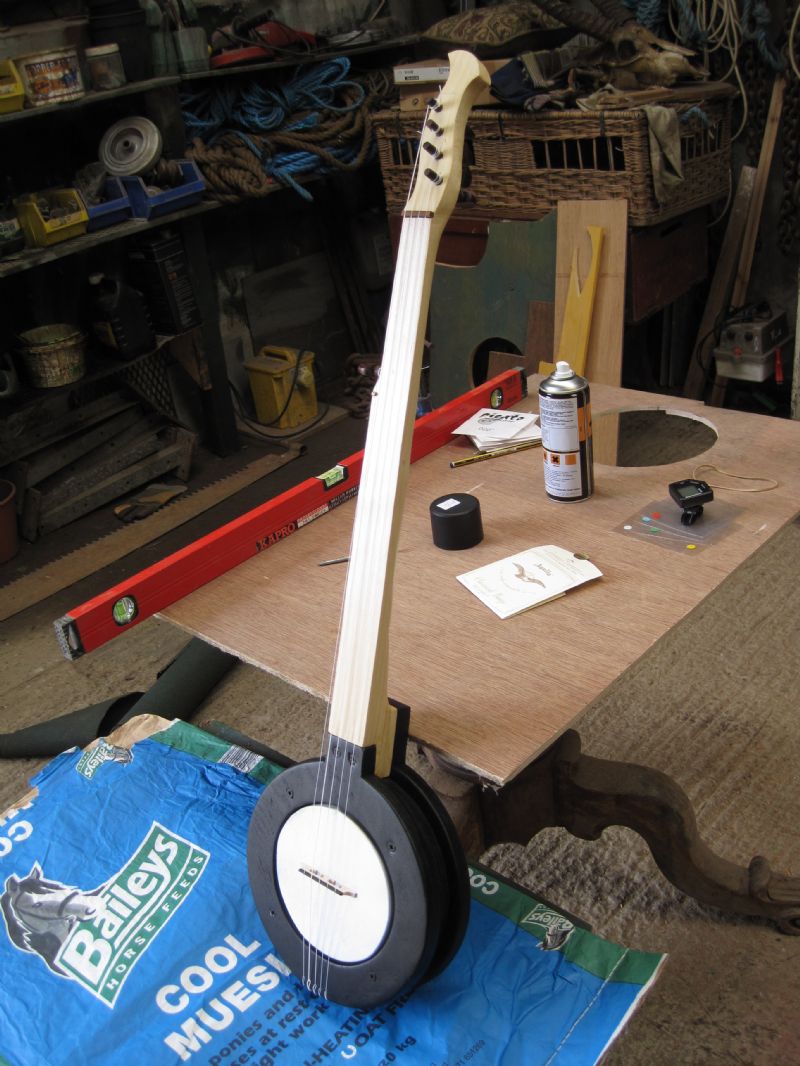 Mountain Banjo | 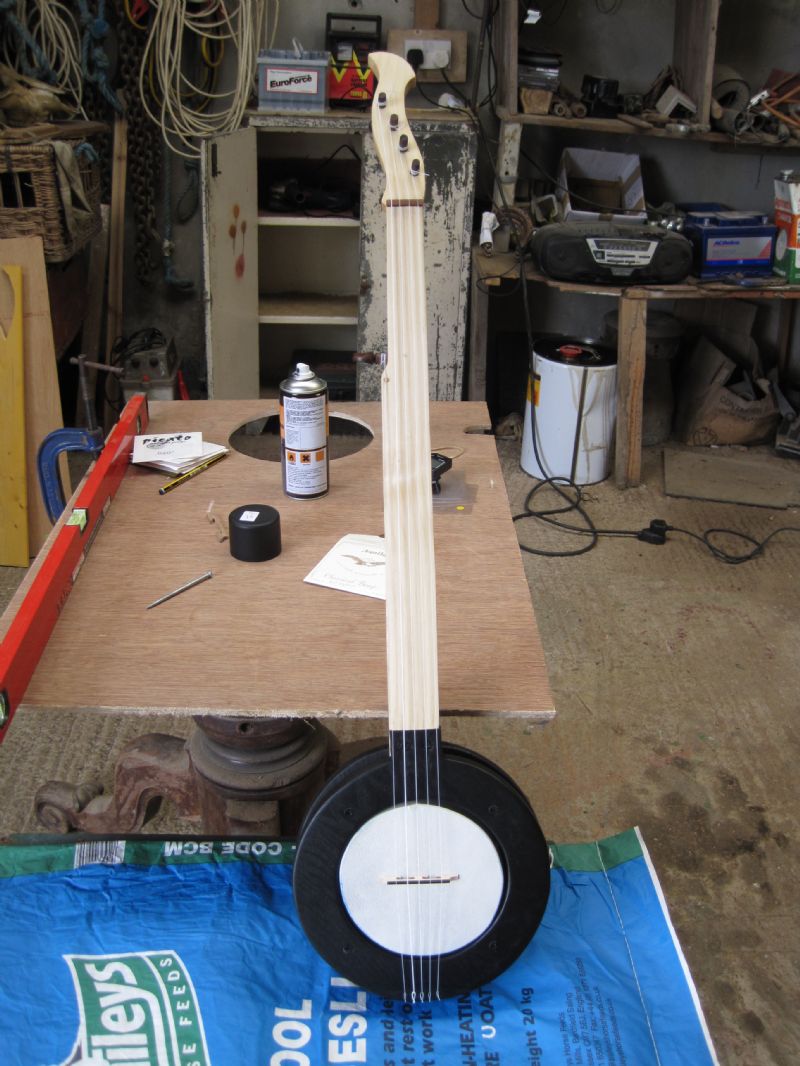 Mountain Banjo 1 |
rustman - Posted - 06/18/2010: 08:33:58
Looks great! I like the contrasting wood colours. I'd put the bridge a little more towards the "tailpiece". Without frets it is easy for you to experiment with the bridge position. Waiting to hear some sounds 
OT Banjo - Posted - 06/19/2010: 19:59:00
Really nice! There are a lot of nice instruments on this thread.
rudy - Posted - 06/20/2010: 20:00:46
Thread followers:
I just received a batch of 9" Renaissance high crown heads in the post. These will be used for a new top tension mountain banjo design that I’ll be starting as time permits. It may be awhile, as I’m doing several lap steels that have to get done before I can start one. My guess is that they are going to be really nice, I’ve got Pegheds 4:1 mechanical tuner sets that I’m going to incorporate into the first one.
I’ve got several banjos that are used for different purposes, but I have to admit for pure visceral enjoyment I often pick my mountain banjo up first. We aficionados of mountains are a select group, and I really feel a special connection when I sit down with one of mine.
Terms of Use | Privacy Policy | Privacy Consent (EU/GDPR Only)
Copyright 2026 Banjo Hangout. All Rights Reserved.


