
DVD-quality lessons (including tabs/sheet music) available for immediate viewing on any device.
Take your playing to the next level with the help of a local or online banjo teacher.
Weekly newsletter includes free lessons, favorite member content, banjo news and more.
Premier Sponsors





|
Please note this is an archived topic, so it is locked and unable to be replied to. You may, however, start a new topic and refer to this topic with a link: http://www.banjohangout.org/archive/173153/8
Page: 1 2 3 4 5 6 7 8 9 10 11 12 13 14 15 16 17 18
cbcarlisle - Posted - 05/06/2011: 07:47:47
Remember the old saying, "When Life gives you kitchen tables, make banjos!"
Sultans of Claw - Posted - 05/11/2011: 02:56:56
I realize that black isn't at all traditional for the head, but tradition aside, any reason one of these wouldn't work?
band-orchestra.musiciansfriend...ku=491293
Edited by - Sultans of Claw on 05/11/2011 02:58:30
rudy - Posted - 05/11/2011: 11:32:10
any reason one of these wouldn't work?
Yes, most heads made for drums have a very low crown height which usually will not work for most banjo tensioning systems.
crmdgn - Posted - 05/11/2011: 12:30:01
So if you build a mountain banjo you're pretty much committed to a skin head, right? Or does someone make a 6'' synthetic head? (I'm assuming you can't adapt an 11'' synthetic head to a 6'' mountain banjo hoop, but maybe I'm wrong about that.)
Mark Johnson - Posted - 05/11/2011: 12:33:01
Remo lists all kinds of drum heads available in 6":
remo.com/portal/products/tools...nder.html
But as Rudy points out, the diameter isn't the only issue. I have no idea if the crown height of any of those would work here...
crmdgn - Posted - 05/11/2011: 13:21:52
That's the thing: I've seen the 6'' drum heads but don't know whether they'll work in a banjo.
Craig - Posted - 05/11/2011: 19:29:55
A plastic 6" bongo drum head works fine. I've done it twice with two different brands. As I stated above, i cut all the circles with a router and a circle jig. The middle piece is routed in two steps to create a "seat" (first), meaning cut a larger circle the diameter of the hoop and then a second hole all the way through the size of the head. The depth of the larger diameter shelf is determined by the of the height of the head. Then the inner aluminum ring stretches the head to tighten it when pushed up by the bottom.
I special ordered a 6" Remo head for my second banjo. I asked for the closest thing to a Renaissance head they had. It two months to get an answer from Remo as to what to order and then to actually get it.
Sultans of Claw - Posted - 05/12/2011: 04:56:57
Yeah, the way I envisioned approaching it was to rout a lip on the underside of the top piece (depth of crown) that would trap the head band as the middle ring tensioned the head.
rudy - Posted - 05/12/2011: 05:25:56
quote:
Originally posted by Sultans of Claw
Yeah, the way I envisioned approaching it was to rout a lip on the underside of the top piece (depth of crown) that would trap the head band as the middle ring tensioned the head.
Craig's system will work fine. The bongo heads have a higher crown than the standard Remo drum heads, so that allows you to "inset" the head into the top portion so the face will be flush without routing so deep that there isn't enough wood left to act as a substantial ledge to resist the force exerted from tensioning the head.
Be sure to draw a cross-section of whatever design you intend to use so you know how it will all work. Note that the "middle ring" is part of the rim and does not bear on the head to tension it. Most of the mountain designs trap the tensioning hoop between the head and the rear face of the pot to exert tensioning force to the head.
Sultans of Claw - Posted - 05/12/2011: 07:25:20
quote:
Originally posted by rudy
Be sure to draw a cross-section of whatever design you intend to use so you know how it will all work. Note that the "middle ring" is part of the rim and does not bear on the head to tension it. Most of the mountain designs trap the tensioning hoop between the head and the rear face of the pot to exert tensioning force to the head.
My bad. Thanks, Rudy, that's really what I meant. Bad description on my part. I'll probably end up going with a skin head on the first one, but I like the prospect of some tuning stability in fluctuating humidty.
Ephraim - Posted - 05/13/2011: 04:47:13
Anyone here have a mountain banjo made by R. K. Smith who sells on ebay?
If so, how is it?
Craig - Posted - 05/14/2011: 07:44:45
Rudy, thanks for clarifying what I had to say. My mind wasn't working very well the other night. I was in a motel on my way from Fl to Western NY.
I didn't look it up but I think you were the source for the aluminum inner hoop. I retrofitted both of my banjos with one of those.
The first head I bought from a local music store for 5 bucks. It doesn't fit as nicely as the Remo. I wish I could say for sure which Remo I bought for the second one, but it looks great, fits well, and sounds good.
Here's another tip. A simple way to further tighten the head if it's too loose is to run a heavy wire around the lip. I use at least four squeeze clamps to assemble everything and that gets the head tight.
crmdgn - Posted - 06/27/2011: 06:25:23
I am currently going crazy trying to make a nut out of scrap wood. Either the nut breaks as I'm shaping it, or there's a curve in it that I can't sand away. I have failed three times in the last twenty-four hours to make a nut for this banjo. So clearly I'm doing something wrong. Does anyone have any tips or suggestions for nut shaping?
MountainBanjo - Posted - 06/27/2011: 16:18:16
What kind of wood are you using? You'll need a very hard wood for it to be any good anyway, something like ebony preferably. Got a violin peg? Native hardwood like oak or hickory might work, but softwoods sure wont work. You'll want perfectly straight grain, preferably parallel to the length of the nut (I would think). Better yet just head down to the butcher and rip one off on the old bonesaw...er...bandsaw!
johnv - Posted - 06/27/2011: 22:11:44
Did you ever think of using bone? I steal er borrow excess bones from my two dogs for all kinds of craft work such as scrimshaw ect and have seen some good bones for banjo nuts Cheers
rudy - Posted - 06/28/2011: 05:24:27
Don't forget to check the builder's section for tips and advice on topics that are not specific to mountain banjo construction. There have been recent topics on making nuts, processing your own raw bone, as well as working with bone. I posted a topic recently on trimming the cap overhang on a new mountain banjo pot I'm working on. The design might be of particular interest to mountainjo makers, it's located HERE.
Here's a quick photo of the new mountain banjo pot in progress:
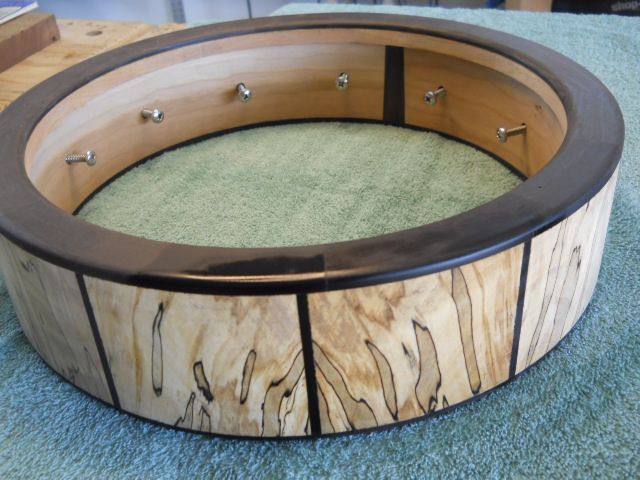
crmdgn, I most often use ebony scraps to make nuts. My finger boards are raw ebony blanks and yield extra length when trimmed. Make sure the wood you are using has its grain oriented correctly so it does not break easily. Almost any hardwood scrap should work fine. Start your nut by forming the flat dimensions first, then work any curves you need to add. Slotting is the last step before final sanding and polishing of the nut. You can also find small scraps of very dark Corian or other synthetic countertop material that it more difficult to work but makes a great nut.
Lastly, tell us about your avatar photo!
Edited by - rudy on 06/28/2011 05:32:32
rudy - Posted - 06/28/2011: 06:38:39
I happened across a post (click HERE..) on a European Old Time music site relating to a mountain banjo produced by John Pearse (of the well-known John Pease strings and accessories fame). The rear of the peg head plainly shows John's "Breezy Ridge" brand name and (????) Valley, Pa. as the location. Anybody have any knowledge of how many mountain banjos were produced by Breezy Ridge?
Edited by - rudy on 06/28/2011 06:40:31
Craig - Posted - 06/28/2011: 06:45:28
Rudy,
Your pots are increasingly sophisticated and so beautiful that to me they are no longer "mountain" banjos. I consider mountain banjos to be the somewhat crude Profitt style, characterized by a small (6") head pushed up by a back against an inner ring, plus a fretless neck. I can accept some variation but how much and when in the direction of commercial banjos leads me to this question:
How do you define a mountain banjo?
rudy - Posted - 06/28/2011: 09:06:38
quote:
Originally posted by Craig
Rudy,
Your pots are increasingly sophisticated and so beautiful that to me they are no longer "mountain" banjos. I consider mountain banjos to be the somewhat crude Profitt style, characterized by a small (6") head pushed up by a back against an inner ring, plus a fretless neck. I can accept some variation but how much and when in the direction of commercial banjos leads me to this question:
How do you define a mountain banjo?
Craig, That indeed is a GREAT question, and it's one that I actually wrestle with a bit myself. I was literally thinking about the need to have an actual definition of the term as I posted this rim design. My designs are certainly is in the grey areas of what to call them.
I think you've certainly hit upon some of the key qualifications of what defines a mountain banjo.
My mountain designs DO have the head pushed up by an inner ring, although the head is markedly larger for better low end.
My necks are fretless, although I'm doing flush frets, but they are more position marker than fret. Frets by definition are actually raised bars designed to stop the vibrating string length to produce a specific note interval. Some of the historic mountain banjo makers certainly weren't above using frets, but you wouldn't want to exclude some of the original makers for occasional fret use.
As far a crude goes, I've seen some beautiful examples of "back hills" banjos that show obvious attention to craftsmanship and even a certain amount of "bling" beyond the strictly utilitarian form. If there's any doubt, a trip through the Museum Of Appalachia (HERE..) will certainly verify their sense of originality.
I like to think of my banjos as rooted in the basic design elements and "home-brew" mentality of the originals, but pushing the envelope forward to refine the designs to be even more functional than the originals. Not much that I use is beyond the small home shop's abilities, although Pegheds planetary tuners and 9", 10", and 11" Renaissance heads aren't reproducible by me. I do think that many of the old makers would have loved to have some of the materials that are within our grasp today to work with. I'm thinking they would have heavily agreed to the "use what you have to work with" concept. It's just that we have so much more to choose from today.
Again, Thanks immensely for posting the question, and I'd like to see more input and opinions as to what the defining characteristics are that make a "Mountain Banjo".
Edited by - rudy on 06/28/2011 09:20:14
Craig - Posted - 06/28/2011: 10:02:13
There is nothing you said I can disagree with. My very traditional looking mountain banjo has a 6" Renaissance type head and planetary pegs as well. I guess my general definition of mountain style is that it's folk art (whatever that is). It involves a certain simplicity in concept, design and execution.
crmdgn - Posted - 06/28/2011: 14:24:01
Whoa. Lots to reply to. OK:
1. MountainBanjo, I'm using scraps of cherry, which is what the whole contraption is made of.
2. Johnv, I did think of using bone, but thought (wrongly?) that a wooden nut would be more mountainy. Actually, does anyone know about that? I've read the Foxfire book but don't remember seeing anything specific about nut construction. But I could be misremembering.
3. Rudy, the avatar image is by a guy named Brian Froud, who did some book illustrations and so forth back in the 1970s. I grabbed it from a Google search. I like it, and wish I could take credit for it...
Thanks for the tip on grain orientation. I'll keep at it.
rjr1948 - Posted - 07/01/2011: 01:03:18
crmdgn...if you go back a couple pages to page 13 I posted some pics of the banjo I was working on...I use remo and evans 6" tom bat heads...you can make anything fit. the clear head i used on the one is an evans tom..it was a frosted double head and I removed the frosting.
rudy - Posted - 07/02/2011: 06:10:45
quote:
Originally posted by crmdgn
Whoa. Lots to reply to. OK:
1. MountainBanjo, I'm using scraps of cherry, which is what the whole contraption is made of.
2. Johnv, I did think of using bone, but thought (wrongly?) that a wooden nut would be more mountainy. Actually, does anyone know about that? I've read the Foxfire book but don't remember seeing anything specific about nut construction. But I could be misremembering.
3. Rudy, the avatar image is by a guy named Brian Froud, who did some book illustrations and so forth back in the 1970s. I grabbed it from a Google search. I like it, and wish I could take credit for it...
Thanks for the tip on grain orientation. I'll keep at it.
Re:#2, I'd be fairly confident in saying that wood is the most logical choice if you want to stick to the basic concept of the "mountain banjo", as many were built from a very utilitarian point of view. Simplicity and ease of construction would opt for a "quick and dirty" nut and not spending the additional time it would require to produce a bone nut. If you're not going for the "simple" vibe, bone is perfectly acceptable.
Thanks for the avatar info!
MountainBanjo - Posted - 07/09/2011: 21:12:40
Well did ya get that bridge done yet? We're waiting for pictures. If you are still having trouble and dont want to make one from scratch you can buy a bone nut blank for $3
crmdgn - Posted - 07/11/2011: 05:25:30
Barely touched it. This project has endured every delay imaginable. Soon, I hope.
crmdgn - Posted - 07/19/2011: 14:33:51
I'm starting to wonder whether this project is under a curse.
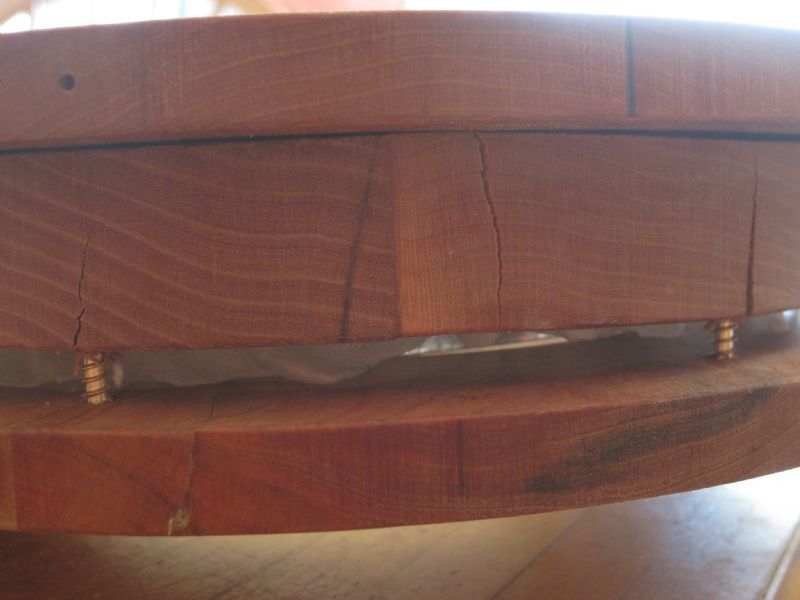
After every imaginable delay (see above, and stay tuned for an epic tale about the nightmare of building this banjo), it was finally time to assemble the banjo I've been working on. As I was working, I heard wood crack. It turned out that the center hoop (between the top and bottom plates) had cracked open. I kept working, figuring that one crack wasn't the end of the world. When it got up to three cracks, a little while later, I realized I have a big problem.
Has anyone else had this happen? Why would it? I did drill pilot holes for the screws. I momentarily wondered whether the tension of the tone ring and the skin could have caused it somehow, but the first crack occurred when I was screwing the top plate to the hoop -- i.e., before the tone ring and skin were in play. I was careful to tighten the screws evenly and go slowly. I was using the screws specified in the plan.
Relatedly, is it worth gluing and clamping the hoop, and trying again, or do I need to make a new hoop from scratch?
Any thoughts on causes & remedies much appreciated.
MountainBanjo - Posted - 07/19/2011: 14:50:33
That's very odd. Is it and the surfaces it mates with absolutely flat? What kind of wood and how thick is it? I cant see why that would happen unless it had wild grain or some weakness. Pics would help a diagnosis. I would not bother gluing it back together unless you figure out why it happened. Make a new one, and do something different with it. ;-)
crmdgn - Posted - 07/19/2011: 15:02:41
OK, here's a photo. The banjo is right side up, so the half-attached plate is the bottom. The center crack was the first to appear, as I was attaching the top plate; the two on the sides appeared as I was attaching the bottom plate. The wood is cherry: 1'' high by 1/2'' thick. I'm happy to take more photos if there's something else you need to see.
 |
crmdgn - Posted - 07/19/2011: 15:07:16
PS. This is the lower edge of the banjo if you're looking at it straight on (you can see a pilot hole for the tailpiece in the upper left corner), so all these cracks are at about five o'clock.
MountainBanjo - Posted - 07/19/2011: 15:39:32
is that 3rd crack--the one running from top to bottom in the pic-also at a screw that we cant see, coming from above?
MountainBanjo - Posted - 07/19/2011: 15:44:22
If so, drilling the holes out a bit more-but not too much- might save the center piece, along with some glue. Looks like they are just splitting it open. You can test the screwholes with the piece removed from the banjo. I'd also wait for a second opinion before doing anything, but thats what I would try if it were me. Be extra careful and listen when you rectify the center problem and do the final tightening for sure, to make sure the top/back don't split too.
crmdgn - Posted - 07/19/2011: 15:47:23
Yes, the third crack is also at a screw. I'll see whether anyone else weighs in. Thanks.
crmdgn - Posted - 07/19/2011: 15:50:27
I have to say I don't remember about the pilot holes: I made that hoop two months ago.
Craig - Posted - 07/19/2011: 18:32:13
You could try gluing the middle ring. If you it doesn't work and you end up making a new one that's no different than making a new one now. But I suggest one important change in what you're doing. Make the holes in the middle ring as big as the screws (or slightly bigger), then use longer screws and screw into the bottom from the top, and into the top from the bottom. Make pilot holes, but don't expect the middle ring to take all the screws without a complaint!
Also, clamp the "sandwich" together before adding the screws. Don't expect the screws to actually tighten the head, just to hold it once you have tightened it with clamps.
MountainBanjo - Posted - 07/19/2011: 18:58:59
I agree, based on the probably cause of the problem, that you can save that piece and glue it. Just gotta make sure the problem is taken care of first.
staronjeff - Posted - 07/19/2011: 20:45:53
well mountainbanjo point me over here.
i'm working on starting to build mountain banjo's(was going to buy one but my girl wouldn't let me, she said you can build that, so here you go), this is my first. it's a little ruff around the edges being #1. most of the flaws will be worked out on the next one when i get a band saw at the end of the month,(mostly cutting). i did most of this with a coping saw and a old crappy jig saw i got for free.
it's kinda based on the hick's except the pot is just two pieces instead of the three, the the neck was just groved once, instead of twice and the top half of the pot was roated to fit the neck.
it plays great, has a 3/4 bridge, a goat skin head and cookie tin as a resonator and friction tuners reamed to fit(man was that a pain in the but).
anyway i love thease banjo's, there is something so special about them, just raw and wonderful, i'm glad to finally have one made from my own two hands.
i can't wait to build another(this time maybe with a brass overlay on the fret board)
i'm suprised there not a group for this after 16 pages of forum any thanks
johnv - Posted - 07/20/2011: 09:53:45
It may be a little rough around the edges BUT I like it, I think it looks like a mountain banjo should look. And yes there should be a side forum just for mountain banjos, construction ect. Cheers
teebee - Posted - 07/20/2011: 11:57:47
That is one beatiful banjo. I like that off center head and the shaping/carving on the neck. A bandsaw can be used to cut inside and outside circles if the pot is made of layers glued up.
On the one shown here, I cut through the top and bottom rings at the 6 o'clock position so I could cut the inner waste away with my band saw. I was going to get a router, but I'm leary of using one and sold mine before this project got started. The inner two layers were cut so that the joints lapped instead of aligned. The wood os 1/2" birch plywood.The neck is 2 x 3 poplar.
That is one pretty piece you built.
staronjeff - Posted - 07/20/2011: 13:53:24
quote:
Originally posted by teebee
That is one beatiful banjo. I like that off center head and the shaping/carving on the neck. A bandsaw can be used to cut inside and outside circles if the pot is made of layers glued up.
On the one shown here, I cut through the top and bottom rings at the 6 o'clock position so I could cut the inner waste away with my band saw. I was going to get a router, but I'm leary of using one and sold mine before this project got started. The inner two layers were cut so that the joints lapped instead of aligned. The wood os 1/2" birch plywood.The neck is 2 x 3 poplar.
That is one pretty piece you built.
i really like the size of the pot on that, what did you use for the mettle ring
fuzzyacg - Posted - 07/20/2011: 14:33:39
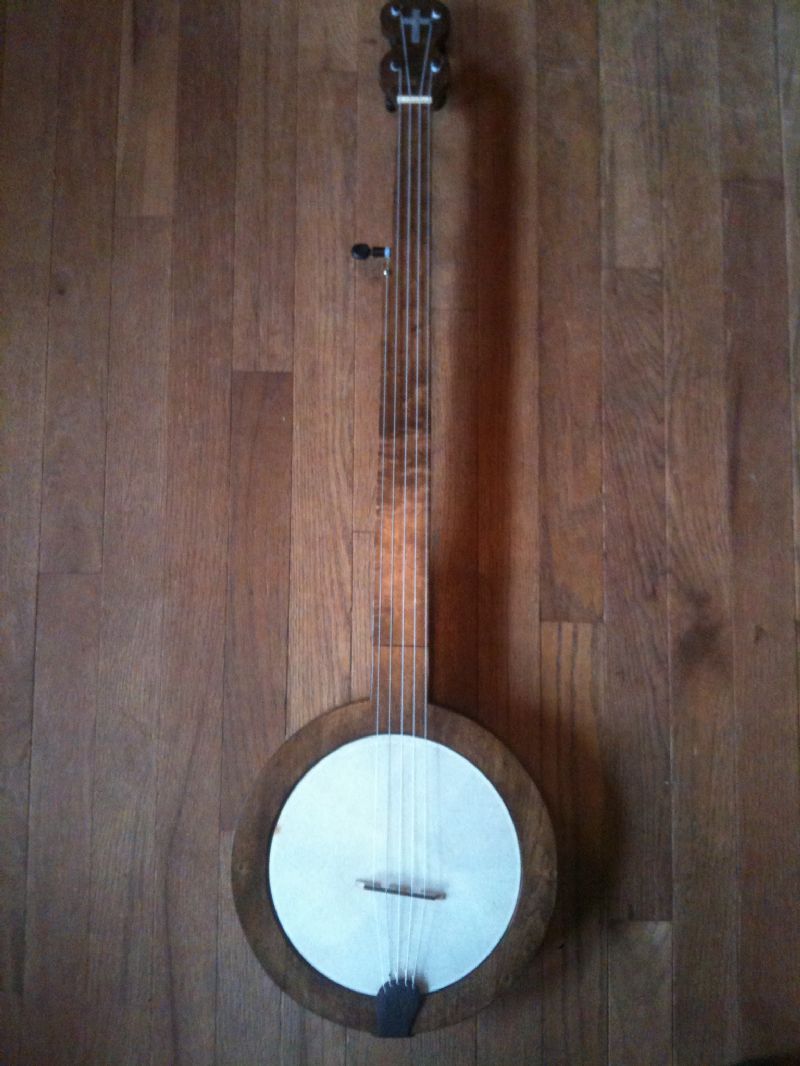
Figured I'd add my mountain banjo here as well. I made mine loosely out of the foxfire 3 book. I made my head a little larger however. Its an 11" O.D. with an 8.5" skin head. I made my pot out of rolled aluminum sheet, 16ga. I riveted it together . The hole in the back is only 3" so its kinda like an internal resonator. I made it out of maple drop leafs from my kitchen table (wife wasn't to happy). I may have to record kitchen girl on it. I keep it tuned with nylguts to fCFAC. (G but one whole step lower) I used violin pegs for the peghead and a peghed mechanical for the 5h string. Leather tailpiece and a bone nut. It plays really nice, I cut the neck to 2 degrees and used a 1/2" bridge.
 |
teebee - Posted - 07/20/2011: 15:40:20
The hoop isn't metal at all. It's a thin sheet of 1/8" wood from the Ace Hardware hobby supply. soaked in hot water, slipped into a copper clad pan of boiling water allowed to cool and then formed into a 7 3/8" circle and butt jointed together, no patch . It's 1 3/8" tall. The head is an 8" practice drum head, I think. I guess I should call it my Ace mountain banjo. It's pretty crude compared to some others here, but it sounds fair.
staronjeff - Posted - 07/20/2011: 21:08:36
thought i'd put the sound up here,
the first is the mic up close the other are away
crmdgn - Posted - 07/21/2011: 10:14:44
Well, that hoop just came all to pieces when I took the banjo apart---there was another crack I missed the first time, back by the neck, and there were chips of wood falling off the broken surfaces, &c. So I might try gluing it, but I suspect I'm just going to have to make another one. Sadly, it'll be a month before I can do so. Long story.
MarkRough - Posted - 07/31/2011: 11:43:05
I just finished building one of the Stoney End mountain banjo kits. I think I'm ready to start from scratch now. There are some pictures of it on my profile page: banjohangout.org/myhangout/pho...albumid=0.
justdiggity - Posted - 08/01/2011: 11:44:42
Hi everyone - I've been lurking on this thread for a while - managed to read through all 16 pages of posts! What a tremendous source of information and ideas you all have been! I'm wondering if I can get your comments on a mountain banjo project I'm going to be tackling later this summer.
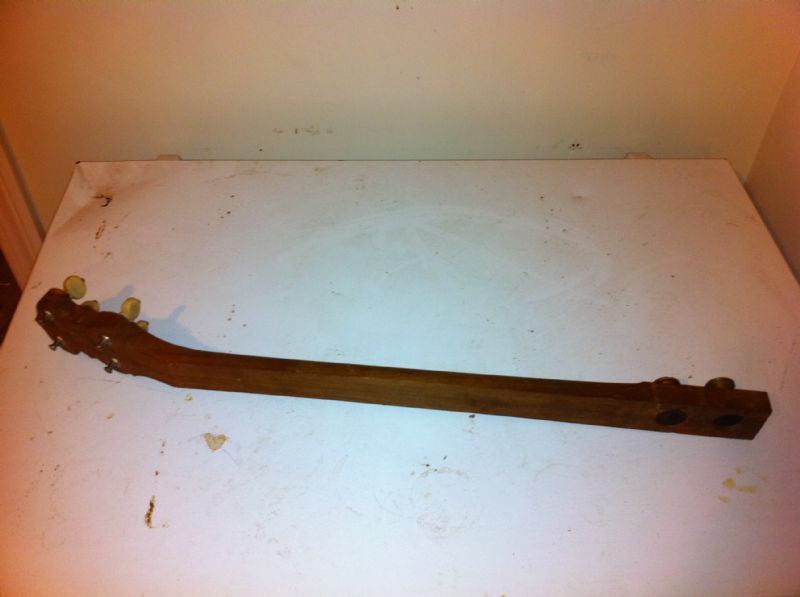
I want to build a 4-string plectrum mountain banjo for my daughter, who is 10 years old. She's a very good violin player (proud Dad, I know!), so I plan on tuning it GDAE. I don't want to confuse her with crazy banjo tunings. In GDAE tuning, she can play violin (fiddle) tunes, mandolin, and the banjo I build for her. So before I found this thread, I looked on eBay and happened to find a 4-string banjo neck for short money. See pictures below. Now in retrospect, and after a bit more research, I realize that I probably could have built my own neck rather than buying one, but that's beside the point! I already bought it, and I want to figure out how to use it. So I have a few questions for you Mountain Banjo Gurus:
1) See those funny little brass screws/nuts? What's up with that? I could envision how they would hold the neck to the bottom plate, but then what? The neck gets glued to a top plate that would be continuous with the fingerboard (which apparently I'll have to make)?
2) Any problem with the idea of tuning this GDAE? I'm actually thinking of using steel strings and not nylon, because I think she'll probably be using a flat pick. As a guitarist, I know flat picks and nylon strings don't really sound or play that great together. Can I achieve GDAE tuning at this neck scale with steel strings, without breaking strings or deflecting the neck?
Any thoughts or advice is very much appreciated! This project is a bit of a warm-up for me... once this one is complete, I'm going to build a 5-string for myself, along the lines of Rudy's design, but first things first, I want to build this one for her first.
Thanks!
 Neck1 | 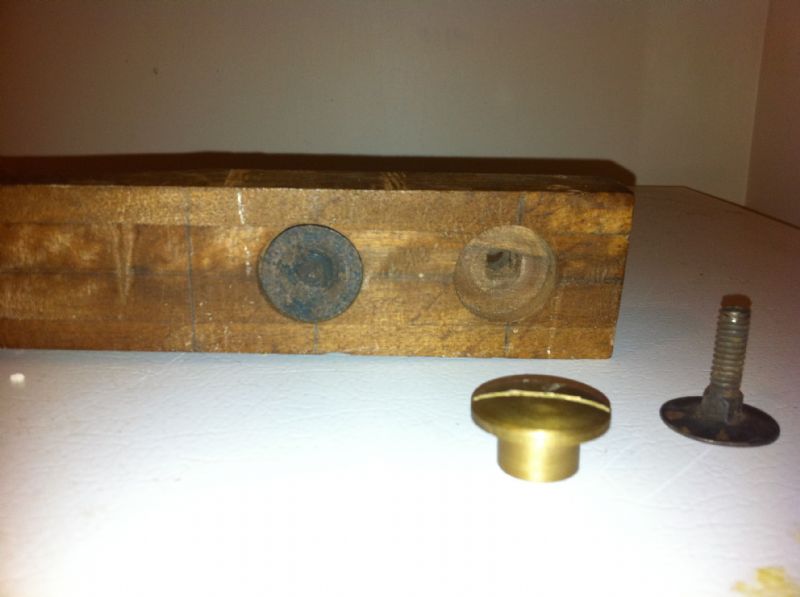 Neck2 | 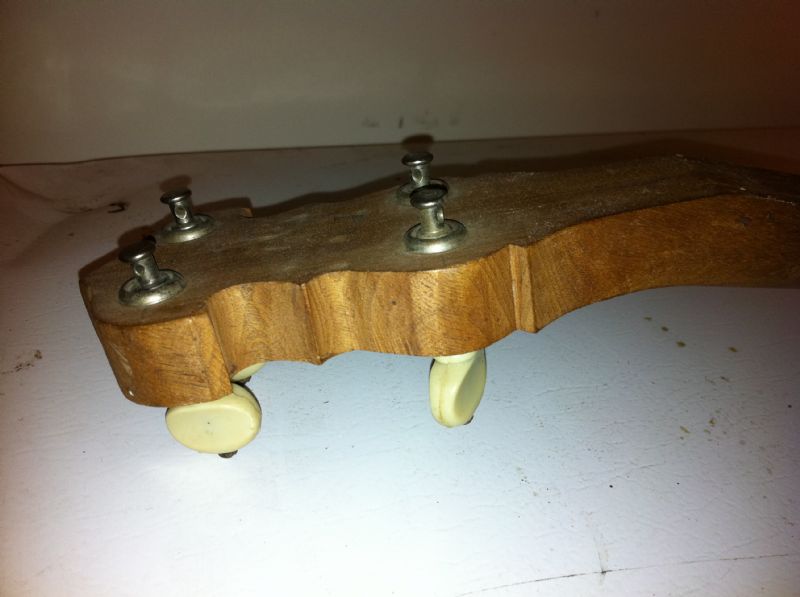 Neck3 |
MountainBanjo - Posted - 08/01/2011: 19:06:38
I'm not sure how you are going to use that neck for a traditional mountain banjo where the top plate is usually flush with the neck. It doesn't look like you have enough thickness for that. I know you don't want to hear it but I'd just make your own neck, it would make your life easier and your banjo probably better. Someone else may have an idea for MacGivering it, but you're daughter will have a Frankenbanjo.
I don't know about GDAE, but I suspect that will tax your neck. I know you don't want to hear this either but I would just use cgbd and tune it down a step. Your daughter is 10 so she's probably smarter than all of us combined and can figure it out. And GDAE may work tuned down a ways too, never tried it.
Terms of Use | Privacy Policy | Privacy Consent (EU/GDPR Only)
Copyright 2026 Banjo Hangout. All Rights Reserved.


